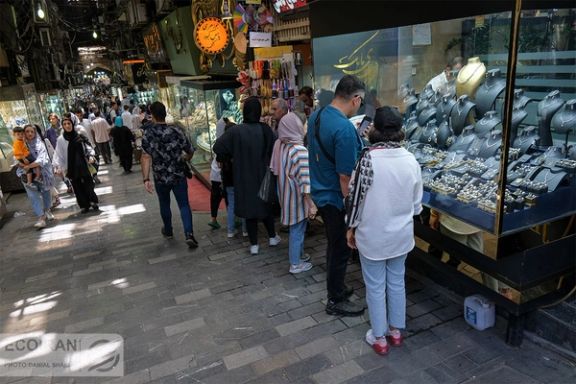
As Iran's economic situation continues to deteriorate and the rial loses value, citizens have increasingly turned to purchasing gold, foreign currency, and moving capital out of the country.
Over the past year, the Iranian rial has lost 20% of its value, and in the past three years under President Ebrahim Raisi, it has plummeted by 60%.
The crisis in the stock and real estate markets has discouraged people from investing in these sectors, leading to the withdrawal of over 1,600 trillion rials ($2.6 billion, based on the current USD rate in open markets) from the stock market over the past three years.
In just the first week of August, approximately 20 trillion rials ($33 million) were withdrawn from the Iranian stock market. The real estate market is also in a severe recession, exacerbated by Iran's chronic electricity shortages in the summer and significant gas deficits in the winter. These energy shortages have particularly impacted the construction sector, with power cuts in cement factories causing cement prices to double and halting construction and housing projects nationwide.
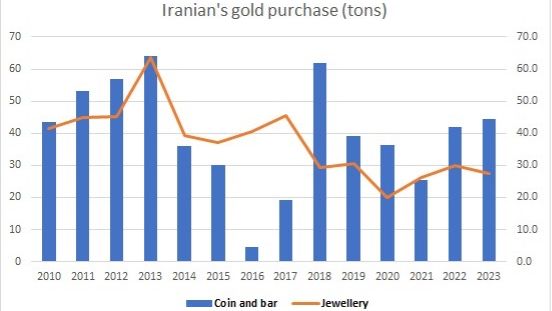
With the worsening economic conditions, particularly in the industrial and construction sectors, citizens are increasingly investing in gold, foreign currencies, or moving their capital abroad to preserve their assets. According to the World Gold Council, Iranian citizens’ purchases of gold coins and bars have surged from 25.5 tons in 2011 to nearly 42 tons in 2022, and 44.4 tons last year. In the first half of this year alone, they have purchased more than 22 tons of gold coins and bars.
On the other hand, data from the Central Bank shows that capital flight from the country has been on an upward trend since the imposition of US sanctions against Iran in 2018, rising from $350 million in 2018 to $15 billion last year. In the first nine months of the last fiscal year (March 2023–January 2024), capital flight reached $20.1 billion, a historical record.
No official reports have been published on Iranians' foreign currency holdings, but it appears that government restrictions on the supply of hard currencies like the euro and US dollar have not deterred people from converting their rial assets into foreign currencies. Despite a government ban on holding more than 10,000 euros or dollars, many citizens feel compelled to convert their rial savings into foreign currencies to protect their wealth.
Lotfollah Siahkali, a member of the Parliament’s Industries Commission, stated last year that Iranian citizens held $60 billion in foreign currency reserves, while the Central Bank's governor cited a much lower figure of $16 billion. This discrepancy suggests that even the government may not have an accurate understanding of the amount of foreign currency held by the public in Iran’s chaotic financial system.
Regardless of the exact figure, the presence of even $16 billion in foreign currency stored in people's homes poses a significant challenge for the Iranian economy, which is already grappling with a liquidity shortage in the industrial and construction sectors. This amount is equivalent to half of Iran’s oil export revenues from last year. If the $60 billion estimate is accurate, it would represent approximately 16% of Iran’s GDP.
The core issue is that Iranians lack trust in the Islamic Republic and its flawed economic policies, making it unlikely that people will reintegrate their foreign currency assets into the country’s economy. It's important to note that these figures represent the savings of a small segment of Iran’s affluent population. According to official statistics, more than half of the population lives below the poverty line, struggling to afford basic necessities.
Meanwhile, the government faces a massive budget deficit each year and is forced to borrow from the Central Bank and other financial institutions, exacerbating liquidity issues and further devaluing the rial. Central Bank data shows that from 2021 to 2023, government debt to the country’s banks has more than doubled, exceeding 13,000 trillion rials ($22 billion). Additionally, the Iranian government owes $100 billion to the National Development Fund. As a result, liquidity has also doubled, and the rial has lost 60% of its value.
Remarks by media commentators and key Iranian lawmakers indicate that parliamentary opposition is focused primarily on four of the ministers proposed by Iran’s new president Masoud Pezeshkian.
Two reformists on the president’s list; Mohammad Reza Zafarghandi as Miniser of Health and Ahmad Maydari as Minister of Labor, as well as female nominee Farzaneh Sadegh as Minister of Housing and Urban Planning, are likely to face the strongest opposition in the Iranian Parliament (Majlies).
There is also Alireza Kazemi for the Ministry of Education, who is a hardliner but without the minimal credentials needed for the post.
Ahmad Fatemi, a member of the Majles Social Affairs Committee, stated that lawmakers hold a negative viewtoward Ahmad Maydari and Zafarghandi. He also noted significant opposition to Ms. Sadegh’s nomination but he insisted that the opposition is based on technical matters rather than gender issues. Others have a different opinion and believe hardliners would oppose almost any female candidate.
He added that there is also some opposition to Mohsen Paknejad as oil minister due to his possible links to former centrist oil minister Bijan Zanganeh, but Paknejad has assured the lawmakers that he is not associated with Zanganeh.
Commentator Jahanbakhsh Mohebbinia criticized the qualifications of several proposed ministers, stating that they fall short of the standards expected for cabinet positions and can only be generously described as experts. He accused some nominees of being opportunists who secured their spots through lobbying by Pezeshkian's political rivals, suggesting that their inclusion on Pezeshkian's list raises suspicions.
Journalist Zaynab Ghobishavi noted that, aside from three ministers with reformist backgrounds, the remaining candidates for ministerial posts largely belong to factions best described as Pezeshkian's rivals. Iran International TV's prominent news bulletin, First Title, identified Maydari, Zafarghandi, and Gholamreza Nouri Ghezelche (nominated for the Ministry of Agriculture) as the only "reformists" on Pezeshkian's list.
Although Intelligence Minister nominee Esmail Khatib and Interior Minister nominee Eskandar Momeni are facing the most serious criticism from the press and public, Mohebbinia stated that both are unlikely to encounter any issues in securing a vote of confidence from the Majles.
Massoud Zehabioun, a member of the task force to propose candidates to the president has said that despite parliamentary opposition to Ms. Sadegh's nomination as roads minister, she is in a better position in terms of her educational credentials and work experience than the two previous road ministers. She has studied Urban Planning and has a long experience in working as a Deputy Minister of Roads and Urban Planning.
If Sadegh secures the Majles' vote of confidence, she will become the second woman to hold a ministerial position in the Islamic Republic. The first was Marziyeh Vahid Dastgerdi, who served as Health Minister in President Ahmadinejad's cabinet.
Zehabioun emphasized that Sadegh's nomination should be evaluated based on her expertise rather than any bias against female officials. Meanwhile, Sobhan Nazari, a transportation activist, praised Ms. Sadegh's career progression, attributing it to her expertise and sound decision-making.
Teachers Trade Union activist Ali Poursoleiman has characterized Alireza Kazemi criticized Alireza Kazemi, labeling him as "a dogmatic, inefficient, and unsuccessful manager." He urged Pezeshkian to reconsider Kazemi's nomination to protect his own public reputation. Poursoleiman also recommended that Pezeshkian appoint a woman as Minister of Education to demonstrate his commitment to gender equality.
Iranian journalist Leila Farhadi wrote that the inclusion of Kazemi on Pezeshkian's list was both controversial and surprising to observers. She added that Kazemi's plans for the ministry's future appear to be merely a rehash of documents previously presented to the Majles by former ministers.
Amid widespread criticism from the media and public regarding the composition of his cabinet, President Masoud Pezeshkian has urged the nation to withhold judgment and evaluate the cabinet based on its future performance.
Sunni leader Molana Abdolhamid said that the list of Pezeshkian’s ministers has disappointed the people. Abdolhamid also wrote that not including religious and ethnic groups in the cabinet leads to disappointment and prevents national accord.
Earlier, many journalists and social media activists criticized Pezeshkian’s choices and expressed the belief that this cabinet is likely to be short-lived.
The centrist Entekhab website has quoted President Pezeshkian as saying that he and his aides have made every effort to select the most suitable candidates from the available pool.
However, critics have already expressed concerns about the appointment of Intelligence Minister Esmail Khatib, a leftover from the previous administration and other military officials appointed to ministerial posts.
Senior Iran International analyst Morad Veisi saidthat the choice of ministers has proved three things: First, that the majority of people who refused to vote in the election and believed that voting will not change anything were right. Second, even the reformists who encouraged others to vote have now realized that voting has not changed anything in Iran. And third, it proved that the main problem in Iran is the system and the fact that Supreme Leader Ali Khamenei controls everything.
Veisi argues that potential voters have come to realize that even changing presidents won't bring any significant change as long as Khamenei holds power. The selection of candidates in Pezeshkian's cabinet, according to Veisi, proves that the election has brought no real change.
For instance, the appointment of IRGC General Eskandar Momeni as Interior Minister suggests that the government's stance on suppressing protests and enforcing the compulsory hijab will remain unchanged. Veisi notes that Momeni's role, which includes heading the National Security Council and overseeing provincial security, will continue to be dominated by IRGC influence, just as it was under the previous administration, where key security positions were also held by IRGC generals.
Momeni's background as Iran's deputy police chief and a senior commander of the Special Forces, responsible for quelling dissent, further indicates a continuation of hardline tactics. Additionally, Veisi highlights that Momeni previously commanded the Morality Police, the main force enforcing the hijab mandate, signaling that the repressive measures against women who defy this law are unlikely to change.
"This comes after Pezeshkian had pledged during his campaign to relax the compulsory hijab rules and ease restrictions on Iranians' access to the Internet, particularly social media. Meanwhile, as debates and criticisms about the new cabinet continue, the previous cabinet remains in place. On Monday, incumbent Culture Minister Mohammad Mehdi Esmaili announced that his ministry has finalized a document to regulate movie supervision. In essence, Esmaili's statement suggests a further tightening of censorship in Iran, allowing the outgoing government to implement these measures without the new administration being held accountable."
These two examples justify the concern that is being expressed by many Iranians, particularly on social media about their fears of further repression on social activism and freedom of expression in Iran. Instead of addressing the concerns, Pezeshkian wants Iranians to wait for another four years and then judge the cabinet based on their performance, mindless of the fact that nearly all of the proposed cabinet members have already a track record of inefficiency as ministers, deputy ministers and state officials. A few have also a record of having been implicated in financial corruptioncases and this leaves little hope in the future for many Iranians.
Among Iran's new president's 19 proposed cabinet ministers, Sattar Hashemi stands out, seemingly aligning with Pezeshkian’s promise of young, expert faces.
Attention is centered on the Minister of Information and Communications Technology (ICT) nominee as a possible beacon of hope amid Iran's ever increasing internet crackdowns in recent years.
But who is Sattar Hashemi?
Hashemi, 48, is an associate professor in the Electrical and Computer Engineering School at Shiraz University but previously served as the Deputy for Technology and Innovation under Mohammad-Javad Azari-Jahromi, from 2019 to 2021.
What exactly did Pezeshkian promise, and why?
During his presidential campaign, Masoud Pezeshkian repeatedly emphasized his commitment to ending internet bans, declaring: "I will make every effort to reform the ineffective filtering system...We must free the internet." He promised, "I will stand against filtering."
There was a certain appeal to this for some voters because over the past two decades, Iran has enacted widespread censorship measures, blocking access to tens of thousands of websites.
With the advent of social media, platforms such as Facebook, Twitter, and YouTube have also faced stringent restrictions. Traditional media, literature, and films are similarly subject to heavy censorship, scrutinized for their adherence to Islamic principles and political content.
Iranians often resort to VPNs to gain unrestricted access to the Internet to circumvent these restrictions and bypass filters. In more open societies, VPNs are primarily used to protect user anonymity.
Millions of Iranians have been left poverty-stricken due to internet crackdowns all but obliterating their small businesses which rely on social media, especially affecting women in rural areas.
But the task is so daunting that even within Ebrahim Raisi's hardline administration, there are acknowledgments of presidential power's limitations, particularly concerning internet censorship in Iran.
The outgoing Minister of ICT, Issa Zarepour, conceded that the government lacks the authority to unilaterally lift internet restrictions imposed by the country's small, elite circle of decision-makers around the Supreme Leader. He even criticized presidential candidates who had pledged to do so.
"Those advocating for the removal of internet filtering should recognize that such decisions are often determined in meetings where government consensus does not necessarily align with the majority opinion," Zarepour remarked, alluding to the significant influence wielded by security and intelligence agencies in controlling the flow of information.
Will Hashemi be able to fulfill the promises made by Pezeshkian during his campaign?
Unlike Pezeshkian, Hashemi has not directly addressed the removal of internet filtering in Iran nor made any promises to do so. His proposed action plan simply includes measures to “reform its current implementation.”
However, on Tuesday, an MP quoted Hashemi, stating that he would act according to the system's general policies regarding internet filtering in Iran. In other words, he is unlikely to undertake the necessary efforts to explore potential changes to lift internet restrictions.
During his tenure in the ICT, Hashemi championed what appeared to be a straightforward initiative: the production of Iranian-made smartphones, touted as a means to reduce dependency on imports, create jobs, and bolster Iran's information and communications technology industry.
The Islamic Republic has invested lavishly in this endeavor for years, taking cues from China's model. This has included offering production incentives to over 100 companies last year and allocating a hefty budget for manufacturers, all accompanied by grandiose promises.
Yet, developing a domestic smartphone industry is intertwined with the Islamic Republic's broader agenda of advancing its long-term "national internet" project. The goal is to produce phones equipped with a native operating system designed to limit VPN installation while enhancing surveillance capabilities.
The industry so far has delivered little tangible benefit for the Iranian populace. Instead, it has led to squandering the nation’s budget, funneling significant financial resources into the hands of crony companies and trusted affiliates. Meanwhile, ordinary citizens bear the brunt of daily costs just to access the internet.
Alireza Kolahi Samadi, Chairman of the Industry Commission of the Chamber of Commerce, recently said of plans to have a home-grown mobile phone industry: "It’s the joke of the century that 11 licenses have been granted for mobile [phone] production. One of these units was given 360 million euros in foreign currency."
He further noted that many producers vanish after receiving financial assistance—funds ostensibly intended for creating a national mobile phone with local infrastructure, which has so far resulted in a colossal failure.
Mohammad Reza Faraji, head of the Tehran Computer Technology Union, corroborated this by stating that, as of now, no Iranian-made mobile phones are available on the market.
A time of discontent among reformists
The debate is especially noticeable in a period marked by intense dissatisfaction among pro-reform factions. The discontent reached such a peak that even Mohammad Javad Zarif, instrumental in securing President Masoud Pezeshkian's election, resigned shortly after the new president presented his cabinet list to parliament on Sunday.
Zarif expressed his regret over his inability to implement the committees' expert recommendations to identify the most suitable candidates and his failure to fulfill promises of including women, youth, and ethnic groups in the cabinet.
He disclosed that among the 19 ministers introduced, only three were the primary choices recommended by the steering committee responsible for candidate selection.
With an average age of 60, the cabinet starkly contrasts with Pezeshkian’s earlier pledge that 60% of the ministers would be under 50.
The nation watches closely to see if this youthful appointee will break with tradition or fall in line with the status quo, especially given the daunting challenge of lifting internet restrictions—a task so formidable that even hardliners have admitted it may be impossible.
Iran’s Supreme Leader Khamenei condemned "enemy psychological warfare" aimed at forcing the country to reconsider retaliation against Israel in the wake of the killing of the Hamas political leader in Tehran.
Speaking on Wednesday, Khamenei underscored that any non-tactical retreat—be it military, political, or economic—invites "divine wrath," as per the Holy Quran.
Ismail Haniyeh, the political chief of Iran-backed Hamas, was killed in Tehran last month while attending the inauguration ceremony of the new president. He had boasted of his freedom of movement as he strolled around Tehran just hours before his assassination.
Iran has subsequently been biding its time as it weighs retaliation. "Governments that yield to the demands of today's dominant powers, regardless of the size or strength of the nations they represent, could defy these pressures if they draw on the strength of their people and accurately assess their adversaries' true, unembellished capabilities," Khamenei said.
He further criticized the longstanding habit of “exaggerating” enemy capabilities to instill fear, pointing to what he described as US, British, and Israeli efforts since the 1979 Islamic revolution in Iran.
Meanwhile, Iran has been leveraging its own psychological tactics, building suspense by threatening retaliation over Haniyeh's killing, yet refraining from immediate action.
Some believe that the Islamic government is apprehensive about escalation but uses the threat of an attack on Israel to get concessions from the United States, which has committed itself to preventing a wider conflict. On Thursday, President Joe Biden indicated that a Gaza ceasefire can prevent Iran's potential retaliation, while Hamas can use a cessation in hostilities to regroup and avoid a complete defeat.
As Western powers caution Iran against retaliation, urging restraint to prevent escalating regional tensions and to facilitate the release of over 100 hostages held by Iran-backed Hamas amid the ongoing conflict in Gaza, Iranian authorities have dismissed the warnings as "illogical and excessive."
Tehran has asserted its right to retaliate for the killing of the Hamas political chief in Tehran without seeking external permission.
Nasser Kanaani, the spokesperson for Iran's Ministry of Foreign Affairs, criticized Western nations for their "apathy," claiming it has allowed Israel to commit "a myriad of international crimes, including genocide and war crimes," in the Gaza war, all while remaining "unpunished."
Meanwhile, Iran-backed Hamas is threatening to boycott the latest ceasefire talks as the possibility of an Iranian retaliation looms.
Iran's new president, Masoud Pezeshkian, also has reaffirmed Iran's right to retaliate, publicly aligning with the Supreme Leader's stance, though it is alleged that he privately expressed concerns about the impact of escalation and urged Khamenei to reconsider.
Iran's President acknowledged that war is undesirable but affirmed the right to "punitive responses against an aggressor," according to IRNA.
Meanwhile, Israel's Army Radio reported that Israel warned the US and European nations that any direct aggression from Tehran would trigger an Israeli strike on Iranian territory, emphasizing their intent to retaliate, even without Israeli casualties.
Iran's foreign minister-designate has dismissed the 2015 JCPOA nuclear deal as irreparable, advocating instead for a strategy that blends military force with diplomacy, according to an Iranian MP.
Abbas Araghchi, who has openly aligned himself with IRGC values, firmly rooted in anti-Western and anti-Israel stances, is currently defending his proposed action plan in parliament, where he seeks approval as the nominated minister.
Speaking after Araghchi's parliamentary session, MP Mohsen Fathi quoted him as stating, "The JCPOA is beyond revival. In the new government, our focus is not on restoring the nuclear deal but on lifting the sanctions. We are dedicated to a strategy integrating diplomatic efforts with military strength."
It is not clear how Tehran wants to have the sanctions lifted without a nuclear agreement, unless Araghchi was referring to using diplomatic-military pressure on the United States.
In 2015, Iran and global powers signed the Joint Comprehensive Plan of Action (JCPOA) to limit Iran's nuclear activities for sanctions relief. In 2018, then-president Donald Trump withdrew, claiming it failed to address Iran's missile program. Since then, efforts to revive the JCPOA have involved indirect talks, with European diplomats mediating between US and Iranian officials.
Araghchi's remarks mirrored those of the outgoing Acting Foreign Minister Ali Bagheri-Kani who asserted in July that the primary objective of the JCPOA was lifting sanctions.
“We must concurrently pursue both the neutralization and the lifting of sanctions, drawing upon our experiences to refine our approach in future endeavors,” Bagheri-Kani said, suggesting the circumvention of sanctions as has been seen with Iran's illicit oil sales.
The JCPOA is set to expire in 2025 but Araghchi's assertion that the JCPOA is beyond salvage will come as no surprise at home or abroad. The Biden administration declined to resume nuclear talks with Iran under Masoud Pezeshkain's new leadership, citing Tehran's policy of supporting terrorism as a significant obstacle.
Fathi also quotes Araghchi as saying Iran’s foreign policy should be firmly oriented towards “securing the nation’s economic interests.”
“He asserted that economic diplomacy's core mandate is to facilitate global economic engagement by creating opportunities, setting strategic directions, and eliminating barriers to the country’s economic activities on the international stage,” Fathi said on Wednesday.
Tehran's increasingly assertive foreign policy, which appears to be yielding results, may be attributed to the perception of a more lenient stance by the Biden administration. Critics argue that this softer approach has allowed Iran's oil exports to surge, despite the ongoing sanctions.
Iran's oil exports have seen a considerable increase, from 400,000 barrels per day post-2019 US sanctions to over 1.5 million barrels per day currently.
Data from the analytics firm Kpler reveals a 30 percent increase in Iran's oil sales during the last quarter, propelling its fossil fuel exports to their highest level in five years.
However, as tensions rise over Iran's threats against Israel for the killing of Hamas political Leader Ismail Haniyeh in Tehran, the US State Department is now considering stricter measures to curb Iran's oil exports, reflecting concerns about the broader implications of this financial flow.
In remarks to Politico, a US State Department spokesperson said on Tuesday, "As Iran continues to escalate regional tensions, we will collaborate with our partners to intensify pressure on Iran and curtail their oil exports."
The latest report from the US Office of the Director of National Intelligence accuses Iran of becoming ever bolder in boasting about its nuclear weapons as the chances of a return to the JCPOA nuclear deal look to be fading away.
"There has been a notable increase this year in Iranian public statements about nuclear weapons, suggesting the topic is becoming less taboo,” the report stated.
In May, Iranian MP Ahmad Bakhshayesh Ardestani said openly that Iran might already possess a nuclear weapon. It followed closely on the heels of remarks by Kamal Kharrazi, senior foreign policy advisor to Supreme Leader Ali Khamenei, who had said that Tehran will change its nuclear doctrine if its archenemy Israel were to attack its atomic facilities.
As Iran exceeds 60 percent enrichment, the UN's nuclear chief, Rafael Grossi, said earlier this year that Iran could build a nuclear weapon in weeks, not months.