A single dot under Khamenei's tweet gets Iranian blogger long jail term
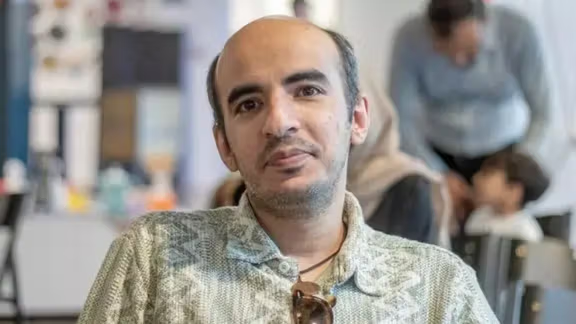
Iranian blogger and proofread Hossein Shanbehzadeh
Iran's Judiciary on Saturday handed a total of 12 years in prison to Iranian blogger Hossein Shanbehzadeh who was arrested in June after posting a single dot in response to a tweet by Supreme Leader Ali Khamenei.
Shanbehzadeh posted the dot in May in a seemingly innocuous move but was arrested a few weeks later, after his reply garnered significantly more likes than Khamenei's original tweet, drawing widespread attention. His temporary detention order was extended in July for another month.
On August 31, his lawyer announced he has been sentenced to a total of 12 years in prison for spurious chargesthat are usually leveled by the Islamic Republic's Judiciary against activists to keep them jailed for long terms and intimidate others.
Shanbehzadeh, known for his candid critiques and social media presence, has been sentenced to five years in jail for "pro-Israel propaganda activity," four years for "insulting Islamic sanctities," two years for "spreading falsehoods" on social media, and one year for "anti-regime propaganda activity," his lawyer Amir Raisian told Shargh newspaper on Saturday.
Although sentenced to a total of 12 years, he is required to serve the longest term, which is five years, Raisian explained.
According to the lawyer, the Judiciary has not provided any evidence to prove that the defendant committed "pro-Israel propaganda activity". Raisian says the charge has been leveled against him based on his "private chats".
For his other charges, Raisian said the court cited his support for other political prisoners, portraying the country's situation negatively, using the hashtag "No to Execution," supporting the removal of mandatory hijab, creating a negative media atmosphere against Iran's elections, and expressing joy at the death of Iran's former president, Ebrahim Raisi, as evidence.
The lawyer says he will consider appealing the sentence after discussing it with his client in prison.
Shortly after his arrest in May, Shanbehzadeh's X account was deactivated, likely to prevent its misuse by security agencies, but his name trended on Persian-language X for hours as users highlighted his influence and fearless commentary.
Shanbehzadeh had previously been imprisoned in connection with the 2019 protests on charges of "insulting the sanctities and the leader of the Islamic Republic." His arrest this time led to accusations by IRGC-linked media, with reports claiming he was a "fugitive Mossad agent" with ties to Israeli intelligence and a history of insulting religious figures. The Ardabil prosecutor's office further alleged that Shanbehzadeh had been in contact with high-ranking Mossad officers and was arrested when trying to flee the country through northwestern borders.
In response to these accusations, Shanbehzadeh's family refuted the claims as "unjustifiable," emphasizing that he has always used his real identity on social media. They also pointed out that the charges were leveled just 24 hours after his arrest, without him having access to a lawyer.
The arrest has drawn outrage from social media users, many of whom link it directly to the viral comment Shanbehzadeh made under Khamenei's tweet. Chess grandmaster and Putin critic Garry Kasparov even responded to the news with a single dot on his X account.
Shanbehzadeh's case has raised alarms about Iran's history of using espionage charges against its critics, drawing comparisons to other high-profile cases, such as that of Maziar Ebrahimi, a businessman falsely accused of spying for Israel.
In recent weeks, Iran has been consumed by concerns over a potential gasoline price hike. This anxiety stems not only from economic fears but also from the deep-seated distrust many Iranians have toward their government.
At the center of this storm is the newly installed Pezeshkian administration, which has sent mixed signals about its intentions, further exacerbating the public's concern.
Abdolnaser Hemmati, the Minister of Economy, has tried to calm the waters, stating in a televised interview that no shocking economic measures should be taken, as society cannot bear the brunt of a gasoline price hike or other economic shocks. He emphasized that “any decision to raise gasoline prices must take into account its inevitable inflationary effects.”
But how long can the government spend billions of dollars, selling the cheapest gasoline at around 2 cents a liter or less than 10 cents a gallon, especially when it must import some of it to make up for the shortfall in domestic production.
Yet, Hemmati's words stand in contrast to those of the head of government, Massoud Pezeshkian. In a meeting just days earlier, the new president made it clear that he sees no logic in continuing to subsidize gasoline. “There is no logic in buying gasoline at the open market dollar rate and selling it at a subsidized price,” he said, questioning whether the current policy could continue. His comments only deepened the sense of uncertainty and fear that a price increase might be imminent.
These contradictory remarks have left Iranians wondering what to expect. On one hand, Mohammadreza Aref, First Vice President, reassured the public that the government would not make “any hasty decisions” regarding a gasoline price increase. On the other, Pezeshkian's previous statements, including those made during his election campaign, indicate a belief that the current subsidy system is untenable. In a conversation with Ali Khamenei's website, Pezeshkian argued that Iran’s energy imbalance, where gasoline is purchased for billions of dollars and sold at a fraction of its cost, cannot continue indefinitely.
Violent protests shook Iran in November 2019, when the government suddenly tripled gasoline prices.
Pezeshkian’s inconsistent messaging, particularly during the election debates, has only added to the confusion. While he initially supported removing subsidies and raising prices to 250,000 rials (about 42 cents) per liter, he later backtracked, saying that his remarks were taken out of context and that, in governance, such decisions must be left to experts. However, these contradictions have done little to quell public fear, especially given Iran’s recent history.
The specter of past fuel protests looms large. Under Mahmoud Ahmadinejad, the quadrupling of fuel prices led to widespread unrest, with angry citizens setting fire to gas stations in Tehran. Similarly, Hassan Rouhani’s decision to triple gasoline prices sparked protests across the country, resulting in the deaths of nearly 1,500 people as the government suppressed dissent.
Currently, rationed gasoline is sold at 15,000 rials (2.5 cents) per liter, while non-rationed gasoline is sold at 30,000 rials (5 cents) per liter. For many, who earn less than 200 dollars per month a large increase could push an already struggling population to the brink.
Some believe that the Pezeshkian administration’s indecision is not just a political misstep; but it is a recipe for disaster. The country’s economic situation is dire, and people’s livelihoods are hanging by a thread. Rouydad24 news website in Tehran wrote on Saturday that “Any sudden price hike could lead to irreparable damage.”
As economic expert Mehdi Robati noted in a recent tweet, “Analyses based on the increase in gasoline prices and seeing this issue from a one-dimensional perspective are a banana peel under the feet of the Islamic Republic and will not bring any benefit to the country.”
Moreover, public trust in the government is at an all-time low. Many Iranians believe that if there were no fire, there would be no smoke—meaning if the government truly had no plans to raise gasoline prices, there would be no reason to discuss it. Instead, as reported by Rouydad 24, it appears that some advisors are attempting to prepare the public: shock them with the prospect of a significant price hike, only to then offer a gradual increase as a “compromise.”
This strategy is unlikely to succeed. The anger is palpable, with people expressing their discontent on social media. One viral video shows a farmer lambasting Pezeshkian’s comments, saying, “It’s not logical for you to increase gasoline prices and make us villagers and farmers poorer and more desperate by the day.”
Observers say the contradictions within the Pezeshkian administration are more than just political blunders—they are fuel for a fire that, if ignited, could engulf the nation in unrest once again.
Iran's domestic economic issues, marked by fragmented growth and the dominance of powerful "mafias," are deterring investment, according to Sirous Talari, a board member of the Iranian & Foreign Joint Venture Investments Association (IFJIA).
"The economic mafia in this country swallows all resources, infiltrating every industry," Talari told the state-affiliated ILNA news agency, emphasizing that these internal challenges, alongside international sanctions, are significant barriers to private sector investment.
Talari also pointed out that while some Afghan nationals are making relatively small investments between $200,000 and $15 million, "they are doing so primarily to secure residence permits in Iran." He added, "Beyond these cases, we have not seen significant demand for larger or more substantial foreign investments in Iran.”
Up to 80 percent of Iran's economy is controlled by the state, in conjunction with the religious establishment. This has bred nepotism, inefficiencies and corruption at all levels. At the same time US economic sanctions have handicapped oil exports and international banking relations, drastically reducing the government's revenues from foreign trade.
In recent years, the Financial Action Task Force (FATF), an international financial watchdog, has blacklisted Iran for failing to meet transparency standards and prevent money laundering and terrorism financing.
However, in May, Mohammad Khazaei, Secretary-General of the Iranian Committee of the International Chamber of Commerce (ICC), acknowledged that while issues like FATF are important, they are not the only obstacles to foreign investment in Iran.
During Iran’s presidential debates in June, President Masoud Pezeshkian argued that Iran's international isolation must end and that foreign investment is essential for economic improvement.
Pezeshkian emphasized that Iran needed $200 billion in foreign investment to pull its battered economy out of a crisis that has worsened in the past six years.
However, according to Talari, Pezeshkian's administration may face significant challenges in achieving these goals, noting that they "cannot be implemented in the short term."
The relationship between Iran and Russia is built on mutual benefits, and the strategic partnership formed in 2022 after Russia's invasion of Ukraine is now influencing Tehran and Moscow's foreign policies in their respective conflicts with Kyiv and Israel.
In this week's episode of Eye for Iran, Greg Brew, a senior analyst on Iran and Energy with the Eurasia Group, speaks to the connection between the two conflicts spanning two continents yet intricately intertwined.
Iran, a country that has had a bitter past with Russia and even experienced occupation at the hands of its powerful neighbor, has involved itself in the Ukraine war by becoming a military enabler for Russia and providing diplomatic support.
With the Russian invasion of Ukraine in February 2022, the Kremlin saw Tehran's support as a necessity and the Islamic Republic saw long-term strategic payoffs.
With Russia's isolation from the West and the US and NATO's support for Ukraine, Iran seemed like the likely rogue, anti- US nation to turn to.
"Russia's war in Ukraine and Russia's increasing isolation from the international community, the weight of Western sanctions, US support for Ukraine, and Russia's need for weapons, increased arms for its war in Ukraine has offered Iran a way to increase its leverage, get a closer relationship with Moscow largely through by serving as Russia's sort of new source of armaments," said Brew.
"There of course have been multiple reports of Iran selling drones to Russia assisting Russia in establishing a drone factory. There have been recent reports of Iran potentially selling ballistic missiles to Russia, although these remain somewhat unconfirmed," he added.
How Ukraine-Russia is related to Israel-Iran
But what does this all have to do with the spiraling, unprecedented conflict being seen in the Mideast at present?
In 2022, Pentagon Press Secretary Air Force Brigadier General Pat Ryder said there were Iranian military personnel on the ground in Crimea assisting Russia.
On Monday Andriy Kostin, Ukraine's Prosecutor General, announced that a case has been opened against an IRGC brigadier general, Abbas Mousavi Sharifi Mollasaraei, on suspicion of aiding Russia in war and war crimes against Ukrainian. Iran's Foreign Ministry spokesperson dismissed the claims.
Moscow also receives hundreds of Iranian-made drones that has been used in its war against Ukraine and there are also reports that Iran is sending ballistic missiles to Russia as well.
Iran, which has a clear deficit in its air force and air defense systems is eyeing Russia’s S-400 advanced air defense system, which would offer an upgrade to the S-300 system Iran currently possesses. Iran also has Russian Sukhoi Su-35 fighter jets on its wish list. Its air force has been relying on aging American fighter jets bought before the 1979 Islamic Revolution.
There were also reports in August that Russia had transferred Iskander short-range ballistic missile systems and Murmansk-BN electronic warfare systems to Iran, but Iran International has not been able to verify that.
Nevertheless, it is evident that as Iran gains a stronger partnership with Russia and more procurement, the threat only increases to Israel and the United States interests in the Middle East.
Deterrence is part of the strategy, said Brew, who believes Iran's budding relationship with Russia would help it to have more leverage against its foe, Israel.
"From the point of view of Iran, this does affect its confrontation with Israel and the ongoing Middle East crisis that began on October 7th with the Hamas attack against Israel. Iran is conscious that it faces a conventional mismatch, if you like, in terms of military capabilities. Israel and the United States have much more powerful conventional militaries than Iran, so Iran is always looking for sources of additional deterrence, additional support. And one potential source of support is Russia, " said Brew.
"That's how these two conflicts are connected. That's how they form part of Iran's broader foreign policy."
Iran's role in Hamas' Oct 7 attack on Israel in some ways provided a distraction of the atrocities being committed by Russia in Ukraine.
The Islamic Republic's unprecedented and first-ever direct attack on Israel in April involved hundreds of ballistic missiles, cruise missiles and about 170 drones, lasting for about 5 hours according to Israel's Defense Forces (IDF).
Ukranian President Volodymyr Zelensky condemned Iran for that, stating that his country is familiar with "the horror of similar attacks." Ukrainians have suffered from Iran-made Shahed-136 drones, the same model reportedly used on Israel that night.
Ukraine’s sudden counterattack in Russia’s Kursk region has increased pressure on the Kremlin and President Vladimir Putin, but Russia is still making gains in Ukraine, and there appears to be no end to the war much like there appears to be no end to the conflict in the Middle East and the war against Hamas in Gaza.
While the Iran-Russia partnership is not a full alliance, it hangs on a balance of fragility, with neither of their interests always aligning and a troubled history between the two nations.
Just what will unfold in 2025 will in large part depend on what happens in the war in Ukraine and the Mideast, said Brew.
To find out more, and to see how the Houthis and Gulf States fit into the equation, watch the full episode of Eye for Iran featuring Greg Brew on YouTube, or you can listen on Spotify, Apple, Castbox orAmazon.
Behind the manicured veneers of Iran's capital, Tehran, the hidden toil of the unseen workforce remains invisible, the country's Afghan children.
The workers, some as young as 13, are being exploited by municipal contractors who prioritize cost-cutting over human dignity, said a report by Khabaronline website.
In neighborhoods across Tehran, the presence of Afghan children laboring in municipal services is a reminder of the city’s reliance on cheap, undocumented labor.
These children, who have fled conflict and instability in their home country, find themselves in a harsh new reality. Employed to clean streets, collect waste, and perform other menial tasks, they are paid a fraction of what Iranian workers earn and often receive their wages sporadically.
Lacking basic identification documents like bank cards, the children are voiceless. They cannot lodge complaints about unpaid wages or unsafe working conditions. Their plight is compounded by their invisibility in official statistics and reports, making them an easy target for exploitation.
A group of Afghan kids, gathered around a public water fountain in Iran
Tehran City Council member Nasser Amani warned: “The oversight of municipal contractors is insufficient. I have seen firsthand that contractors employ very young foreign nationals, including children as young as 13 or 14 years old,” Amani stated.
Mohammad Amin Tavakkolizadeh, Tehran Municipality’s Deputy for Social Affairs, announced last year that a new plan would be implemented to remove children from municipal labor. However, this commitment has yet to be realized. Despite assurances, Afghan children continue to work under conditions that defy both legal and ethical standards.
“The promises made about eliminating child labor have not been fulfilled,” Amani said. “Municipal regulations are being flouted, and the children are still being exploited by contractors who are not held accountable.”
Iran's Labor Law prohibits the employment of children under the age of 15. Those aged 15 to 18, classified as "young workers," must undergo regular medical examinations conducted by the Ministry of Labor to be eligible to participate in the workforce.
The plight of Afghan children in Tehran is part of a broader pattern of exploitation involving foreign labor. The children work under dangerous conditions and receive inadequate compensation, often delayed for months. Their situation stands in contrast to Iranian workers, who are frequently deterred from such roles due to insufficient wages and job insecurity.
Amani pointed out: “The lack of regular and adequate payments, along with the absence of proper insurance, has led to a situation where Iranian workers are unwilling to take up such jobs. This reliance on cheap, undocumented labor perpetuates the cycle of exploitation.”
Afghan labor children in Iran, gathered around a cart filled with items, possibly for sale or collection
“Municipal officials currently say that urban service workers are paid between 120 to 130 million rials (about $200) per month, but we have checked and found that this is not the case. Some urban service workers and especially children receive between 40 to 60 million rials (70 to $100), or at most 70 million rials (115$),” added Amani.
The situation comes at a time when estimates suggest up to 10,000 Afghans enter Iran daily. This influx has pushed the Afghan population in the country to around 10 million, constituting more than 10% of Iran's total population.
The growing presence of Afghans has sparked a backlash from Iranians, many voicing concerns about the economic and social impact of accommodating such a large number of migrants, particularly as Iran grapples with its own economic crisis, declining public services, and rising unemployment.
Following the death of Mohammad Mir-Mousavi, an Iranian citizen who died from beatings while in police custody in the northern city of Lahijan, authorities dismissed the city's police chief.
Yet, many Iranians protest that the removal serves as little more than a smokescreen for a system that continues to unleash violence upon its citizens with impunity.
A newly released video underscores this ongoing violence, showing police officers violently shoving a person into the trunk of a police vehicle.
In a video released by BBC Persian, three officers are seen forcefully cramming an individual into a police vehicle’s trunk in Shahr-e Rey on August 26, assaulting him for several minutes as passerby begin to congregate and watch the incident.
In a Friday night statement, the police command attributed the dismissal of Lahijan's police chief to "insufficient supervision over personnel conduct and behavior." Shargh newspaper reported on Saturday that apparently the victim also had a gunshot wound on his, as some citizens reported hearing a weapons being fired when he was being taken into a police station.
Despite the authorities' efforts to manage the fallout from Mir-Mousavi’s death by promising a forensic report to determine the exact cause, new evidence of police violence continues to surface, dispelling any doubts about the persistence of oppressive tactics.
With the new video showing another instance of police violence, the government’s attempts to explain away Mir-Mousavi’s death with excuses like "excitement caused by friction" between him and the officers, or the inability to "control anger and emotions" by some personnel, ring hollow.
On August 24, Mir-Mousavi was arrested by officers from a special unit in northern Iran following a local altercation. He was then taken to a police station in the Lahijan district, where he was tortured, leading to his death.
On Wednesday, a video emerged, showing the lifeless body of Mir-Mousavi. The footage, captured during the ritual washing of his body, exposed severe signs of torture, including deep wounds on his back and waist.
In a Saturday report on the death of Mir-Mousavi in police custody in Lahijan, the Shargh daily, quoting local witnesses, wrote: "They tied Mohammad to a chair or a post and beat him with cables, iron rods, and batons. Then, a gunshot was heard from inside the station, and in the video from the mortuary, a bullet wound on his back is clearly visible."
The Islamic Republic’s violence did not end with Mir-Mousavi’s death. According to the Hengaw Human Rights Organization, he was the seventh person to die under torture while in the custody of Iranian security forces since the beginning of 2024 alone.
On Friday, the seventh-day memorial service for Mir-Mousavi was held under heavy security pressure. That same night, unconfirmed reports emerged of another death in custody—Komeil Abolhasani, a 32-year-old father of a young daughter, who was allegedly killed under mysterious circumstances in a detention center in Tonekabon. Abolhasani’s case is not verified yet and police has had no reaction regarding it.
As Iran nears the second anniversary of Mahsa Amini’s death in morality police custody for not adhering to hijab in mid-September 2022, the parallels between these cases are impossible to ignore. Javad Rouhi, a protester arrested during the Woman, Life, Freedom demonstrations, also died under suspicious circumstances last year, with the government attributing his death to a "drug interaction." Such explanations have been used time and again to obscure the true cause of death for those who dared to oppose the system.
The deaths of Mir-Mousavi, Rouhi, and countless others reveal a pattern of violence that persists unabated. Many believe the Islamic Republic’s actions, such as the dismissal of a police chief, cannot mask the deep-seated issues within its ranks while the government institutions are shielded from accountability and lack of a will for reforms.