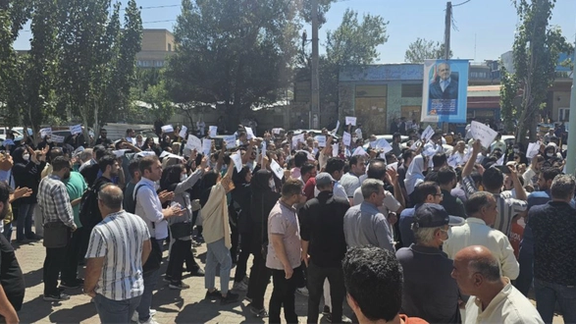
Nurses protest in Tabriz, northwestern Iran for unpaid wages, as part of a month-long strike in many cities in August.
Iran's domestic economic issues, marked by fragmented growth and the dominance of powerful "mafias," are deterring investment, according to Sirous Talari, a board member of the Iranian & Foreign Joint Venture Investments Association (IFJIA).
"The economic mafia in this country swallows all resources, infiltrating every industry," Talari told the state-affiliated ILNA news agency, emphasizing that these internal challenges, alongside international sanctions, are significant barriers to private sector investment.
Talari also pointed out that while some Afghan nationals are making relatively small investments between $200,000 and $15 million, "they are doing so primarily to secure residence permits in Iran." He added, "Beyond these cases, we have not seen significant demand for larger or more substantial foreign investments in Iran.”
Up to 80 percent of Iran's economy is controlled by the state, in conjunction with the religious establishment. This has bred nepotism, inefficiencies and corruption at all levels. At the same time US economic sanctions have handicapped oil exports and international banking relations, drastically reducing the government's revenues from foreign trade.
In recent years, the Financial Action Task Force (FATF), an international financial watchdog, has blacklisted Iran for failing to meet transparency standards and prevent money laundering and terrorism financing.
However, in May, Mohammad Khazaei, Secretary-General of the Iranian Committee of the International Chamber of Commerce (ICC), acknowledged that while issues like FATF are important, they are not the only obstacles to foreign investment in Iran.
During Iran’s presidential debates in June, President Masoud Pezeshkian argued that Iran's international isolation must end and that foreign investment is essential for economic improvement.
Pezeshkian emphasized that Iran needed $200 billion in foreign investment to pull its battered economy out of a crisis that has worsened in the past six years.
However, according to Talari, Pezeshkian's administration may face significant challenges in achieving these goals, noting that they "cannot be implemented in the short term."
The relationship between Iran and Russia is built on mutual benefits, and the strategic partnership formed in 2022 after Russia's invasion of Ukraine is now influencing Tehran and Moscow's foreign policies in their respective conflicts with Kyiv and Israel.
In this week's episode of Eye for Iran, Greg Brew, a senior analyst on Iran and Energy with the Eurasia Group, speaks to the connection between the two conflicts spanning two continents yet intricately intertwined.
Iran, a country that has had a bitter past with Russia and even experienced occupation at the hands of its powerful neighbor, has involved itself in the Ukraine war by becoming a military enabler for Russia and providing diplomatic support.
With the Russian invasion of Ukraine in February 2022, the Kremlin saw Tehran's support as a necessity and the Islamic Republic saw long-term strategic payoffs.
With Russia's isolation from the West and the US and NATO's support for Ukraine, Iran seemed like the likely rogue, anti- US nation to turn to.
"Russia's war in Ukraine and Russia's increasing isolation from the international community, the weight of Western sanctions, US support for Ukraine, and Russia's need for weapons, increased arms for its war in Ukraine has offered Iran a way to increase its leverage, get a closer relationship with Moscow largely through by serving as Russia's sort of new source of armaments," said Brew.
"There of course have been multiple reports of Iran selling drones to Russia assisting Russia in establishing a drone factory. There have been recent reports of Iran potentially selling ballistic missiles to Russia, although these remain somewhat unconfirmed," he added.
How Ukraine-Russia is related to Israel-Iran
But what does this all have to do with the spiraling, unprecedented conflict being seen in the Mideast at present?
In 2022, Pentagon Press Secretary Air Force Brigadier General Pat Ryder said there were Iranian military personnel on the ground in Crimea assisting Russia.
On Monday Andriy Kostin, Ukraine's Prosecutor General, announced that a case has been opened against an IRGC brigadier general, Abbas Mousavi Sharifi Mollasaraei, on suspicion of aiding Russia in war and war crimes against Ukrainian. Iran's Foreign Ministry spokesperson dismissed the claims.
Moscow also receives hundreds of Iranian-made drones that has been used in its war against Ukraine and there are also reports that Iran is sending ballistic missiles to Russia as well.
Iran, which has a clear deficit in its air force and air defense systems is eyeing Russia’s S-400 advanced air defense system, which would offer an upgrade to the S-300 system Iran currently possesses. Iran also has Russian Sukhoi Su-35 fighter jets on its wish list. Its air force has been relying on aging American fighter jets bought before the 1979 Islamic Revolution.
There were also reports in August that Russia had transferred Iskander short-range ballistic missile systems and Murmansk-BN electronic warfare systems to Iran, but Iran International has not been able to verify that.
Nevertheless, it is evident that as Iran gains a stronger partnership with Russia and more procurement, the threat only increases to Israel and the United States interests in the Middle East.
Deterrence is part of the strategy, said Brew, who believes Iran's budding relationship with Russia would help it to have more leverage against its foe, Israel.
"From the point of view of Iran, this does affect its confrontation with Israel and the ongoing Middle East crisis that began on October 7th with the Hamas attack against Israel. Iran is conscious that it faces a conventional mismatch, if you like, in terms of military capabilities. Israel and the United States have much more powerful conventional militaries than Iran, so Iran is always looking for sources of additional deterrence, additional support. And one potential source of support is Russia, " said Brew.
"That's how these two conflicts are connected. That's how they form part of Iran's broader foreign policy."
Iran's role in Hamas' Oct 7 attack on Israel in some ways provided a distraction of the atrocities being committed by Russia in Ukraine.
The Islamic Republic's unprecedented and first-ever direct attack on Israel in April involved hundreds of ballistic missiles, cruise missiles and about 170 drones, lasting for about 5 hours according to Israel's Defense Forces (IDF).
Ukranian President Volodymyr Zelensky condemned Iran for that, stating that his country is familiar with "the horror of similar attacks." Ukrainians have suffered from Iran-made Shahed-136 drones, the same model reportedly used on Israel that night.
Ukraine’s sudden counterattack in Russia’s Kursk region has increased pressure on the Kremlin and President Vladimir Putin, but Russia is still making gains in Ukraine, and there appears to be no end to the war much like there appears to be no end to the conflict in the Middle East and the war against Hamas in Gaza.
While the Iran-Russia partnership is not a full alliance, it hangs on a balance of fragility, with neither of their interests always aligning and a troubled history between the two nations.
Just what will unfold in 2025 will in large part depend on what happens in the war in Ukraine and the Mideast, said Brew.
To find out more, and to see how the Houthis and Gulf States fit into the equation, watch the full episode of Eye for Iran featuring Greg Brew on YouTube, or you can listen on Spotify, Apple, Castbox orAmazon.
Behind the manicured veneers of Iran's capital, Tehran, the hidden toil of the unseen workforce remains invisible, the country's Afghan children.
The workers, some as young as 13, are being exploited by municipal contractors who prioritize cost-cutting over human dignity, said a report by Khabaronline website.
In neighborhoods across Tehran, the presence of Afghan children laboring in municipal services is a reminder of the city’s reliance on cheap, undocumented labor.
These children, who have fled conflict and instability in their home country, find themselves in a harsh new reality. Employed to clean streets, collect waste, and perform other menial tasks, they are paid a fraction of what Iranian workers earn and often receive their wages sporadically.
Lacking basic identification documents like bank cards, the children are voiceless. They cannot lodge complaints about unpaid wages or unsafe working conditions. Their plight is compounded by their invisibility in official statistics and reports, making them an easy target for exploitation.
A group of Afghan kids, gathered around a public water fountain in Iran
Tehran City Council member Nasser Amani warned: “The oversight of municipal contractors is insufficient. I have seen firsthand that contractors employ very young foreign nationals, including children as young as 13 or 14 years old,” Amani stated.
Mohammad Amin Tavakkolizadeh, Tehran Municipality’s Deputy for Social Affairs, announced last year that a new plan would be implemented to remove children from municipal labor. However, this commitment has yet to be realized. Despite assurances, Afghan children continue to work under conditions that defy both legal and ethical standards.
“The promises made about eliminating child labor have not been fulfilled,” Amani said. “Municipal regulations are being flouted, and the children are still being exploited by contractors who are not held accountable.”
Iran's Labor Law prohibits the employment of children under the age of 15. Those aged 15 to 18, classified as "young workers," must undergo regular medical examinations conducted by the Ministry of Labor to be eligible to participate in the workforce.
The plight of Afghan children in Tehran is part of a broader pattern of exploitation involving foreign labor. The children work under dangerous conditions and receive inadequate compensation, often delayed for months. Their situation stands in contrast to Iranian workers, who are frequently deterred from such roles due to insufficient wages and job insecurity.
Amani pointed out: “The lack of regular and adequate payments, along with the absence of proper insurance, has led to a situation where Iranian workers are unwilling to take up such jobs. This reliance on cheap, undocumented labor perpetuates the cycle of exploitation.”
Afghan labor children in Iran, gathered around a cart filled with items, possibly for sale or collection
“Municipal officials currently say that urban service workers are paid between 120 to 130 million rials (about $200) per month, but we have checked and found that this is not the case. Some urban service workers and especially children receive between 40 to 60 million rials (70 to $100), or at most 70 million rials (115$),” added Amani.
The situation comes at a time when estimates suggest up to 10,000 Afghans enter Iran daily. This influx has pushed the Afghan population in the country to around 10 million, constituting more than 10% of Iran's total population.
The growing presence of Afghans has sparked a backlash from Iranians, many voicing concerns about the economic and social impact of accommodating such a large number of migrants, particularly as Iran grapples with its own economic crisis, declining public services, and rising unemployment.
Following the death of Mohammad Mir-Mousavi, an Iranian citizen who died from beatings while in police custody in the northern city of Lahijan, authorities dismissed the city's police chief.
Yet, many Iranians protest that the removal serves as little more than a smokescreen for a system that continues to unleash violence upon its citizens with impunity.
A newly released video underscores this ongoing violence, showing police officers violently shoving a person into the trunk of a police vehicle.
In a video released by BBC Persian, three officers are seen forcefully cramming an individual into a police vehicle’s trunk in Shahr-e Rey on August 26, assaulting him for several minutes as passerby begin to congregate and watch the incident.
In a Friday night statement, the police command attributed the dismissal of Lahijan's police chief to "insufficient supervision over personnel conduct and behavior." Shargh newspaper reported on Saturday that apparently the victim also had a gunshot wound on his, as some citizens reported hearing a weapons being fired when he was being taken into a police station.
Despite the authorities' efforts to manage the fallout from Mir-Mousavi’s death by promising a forensic report to determine the exact cause, new evidence of police violence continues to surface, dispelling any doubts about the persistence of oppressive tactics.
With the new video showing another instance of police violence, the government’s attempts to explain away Mir-Mousavi’s death with excuses like "excitement caused by friction" between him and the officers, or the inability to "control anger and emotions" by some personnel, ring hollow.
On August 24, Mir-Mousavi was arrested by officers from a special unit in northern Iran following a local altercation. He was then taken to a police station in the Lahijan district, where he was tortured, leading to his death.
On Wednesday, a video emerged, showing the lifeless body of Mir-Mousavi. The footage, captured during the ritual washing of his body, exposed severe signs of torture, including deep wounds on his back and waist.
In a Saturday report on the death of Mir-Mousavi in police custody in Lahijan, the Shargh daily, quoting local witnesses, wrote: "They tied Mohammad to a chair or a post and beat him with cables, iron rods, and batons. Then, a gunshot was heard from inside the station, and in the video from the mortuary, a bullet wound on his back is clearly visible."
The Islamic Republic’s violence did not end with Mir-Mousavi’s death. According to the Hengaw Human Rights Organization, he was the seventh person to die under torture while in the custody of Iranian security forces since the beginning of 2024 alone.
On Friday, the seventh-day memorial service for Mir-Mousavi was held under heavy security pressure. That same night, unconfirmed reports emerged of another death in custody—Komeil Abolhasani, a 32-year-old father of a young daughter, who was allegedly killed under mysterious circumstances in a detention center in Tonekabon. Abolhasani’s case is not verified yet and police has had no reaction regarding it.
As Iran nears the second anniversary of Mahsa Amini’s death in morality police custody for not adhering to hijab in mid-September 2022, the parallels between these cases are impossible to ignore. Javad Rouhi, a protester arrested during the Woman, Life, Freedom demonstrations, also died under suspicious circumstances last year, with the government attributing his death to a "drug interaction." Such explanations have been used time and again to obscure the true cause of death for those who dared to oppose the system.
The deaths of Mir-Mousavi, Rouhi, and countless others reveal a pattern of violence that persists unabated. Many believe the Islamic Republic’s actions, such as the dismissal of a police chief, cannot mask the deep-seated issues within its ranks while the government institutions are shielded from accountability and lack of a will for reforms.
The Tehran prosecutor's office has announced legal action against Iranian filmmaker Rakhshan Bani-Etemad and her daughter, actress Baran Kowsari for appearing in public without the mandatory hijab.
According to reports from state media, the charges stem from a film critique session where Bani-Etemad, a renowned filmmaker, and her daughter attended without adhering to the mandatory hijab. The judiciary has not officially named the women, but details released by the prosecutor's office leave little doubt about their identities.
This case is the latest in a series of actions by the Iranian government aimed at silencing women who dare to challenge the country’s Islamic dress code. Since the nationwide protests in 2022, spurred by widespread demands for women's rights and personal freedoms, a growing number of Iranian actresses have removed their hijab in public, risking punishment. The government’s response has been predictably harsh, with numerous women facing legal action, arrests, and harassment.
Journalist Masoud Kazemi, commenting on the filing of the case against the two cultural icons, pointedly remarked on X, "Yes, it makes a difference who the president is." His words highlight the reality that the policies and crackdowns have persisted unabated after President Masoud Pezeshkian took office.
During his campaign, Pezeshkian pledged to voters that he would put an end to hijab patrols and the violence inflicted on women for not complying with compulsory hijab regulations.
Shaqayeq Norouzi, an actress and women’s rights activist based in Barcelona, told Iran International that the Iranian government's actions reveal their fear of women’s defiance.
Rakhshan Bani-Etemad (second from the left), the Iranian filmmaker, and her daughter, actress Baran Kowsari (first on the right), pose alongside colleagues at a film review session in Tehran
"While nearly a hundred actresses are banned from working, another well-known artist, fully aware of the risks to her safety, takes a bold stand. Such actions are incredibly effective in sustaining hope within the collective psyche of Iranian society, particularly among women. This is precisely why the government responds so quickly and harshly," she said.
The Islamic Republic's campaign against women who resist its repressive laws has seen a surge in recent months. In a similar case, Afsaneh Bayegan, a veteran actress, was recently sentenced to a fine and banned from social media and international travel. The judiciary accused her of "publishing indecent images," a charge often used to enforce moral codes.
The situation took an even darker turn when reports emerged of government forces shooting a young woman named Arezou Badri, over her refusal to comply with hijab laws. The judiciary claimed the incident was unrelated to the hijab, but the context of escalating violence against women tells a different story.
Internationally, the Islamic Republic's actions continue to draw condemnation. On August 25, the United States government expressed deep concern over the incident involving Arezou Badri, emphasizing that Iran's leadership has failed to learn from the death of Mahsa Amini, who died in custody after being detained by the morality police for defying hijab.
While the conservative-dominated Parliament's approval of his cabinet may have buoyed Masoud Pezeshkian, his administration now faces numerous serious challenges that require urgent attention.
These challenges span a broad spectrum, including foreign policy and pressing economic issues such as the budget deficit, corruption, inflation, housing shortages and unaffordability, and high fuel subsidies draining the treasury.
During an event on Tuesday to introduce the new oil minister, Mohsen Paknejad, Pezeshkian criticized the allocation of massive fuel subsidies. This remark was widely interpreted as a signal that fuel prices may increase, despite the minister's earlier assurances that no such plans were in place. So far, no clarification has been provided.
The crippling strike of thousands of nurses that has spread to several cities now is another major and urgent issue to be addressed. The minister of health, Mohammad-Reza Zafarghandi, has promised to resolve the problem of the long overdue payments, but nurses’ demands go much beyond the payment of owed salaries.
Meeting the expectations of large groups of reluctant voters, who voted for Pezeshkian because he vowed to address Iran's multiple crises, is another serious challenge. These voters expected see more rational governance, justice, economic improvement and to have more women in the cabinet and at least some ministers from among Sunnis and ethnic minorities.
Since the cabinet's approval, three more women have been appointed to government positions in the past few days. These appointments include a Special Assistant to Vice President Mohammad-Reza Aref, a Deputy Head of the Department of Environment, and a government spokesperson.
The appointment of Fatemeh Mohajerani as government spokesperson is a first in the history of the Islamic Republic. The appointment announced Wednesday was welcomed by many social media users who called Mohajerani a “brave woman” for a fiery speech she delivered at one of Pezeshkian’s campaign gatherings.
In her speech she not only mentioned a young protester killed by security forces during the Woman, Life, Freedom protests by name but also referred to him as a “martyr”. As a mother, she said in her speech, she would not “allow the blood of the youth to color the streets.”
However, some dissidents and critics see her as an opportunist who used the names of government victims to squeeze herself into Pezeshkian's team, while it is unclear if she is a real reformer.
The appointment of a Sunni deputy, also a first in the history of the Islamic Republic, is another step Pezeshkian has taken in the past few days to appease the critics. Abdolkarim Hosseinzadeh who has been appointed as rural and deprived area’s development deputy is a reformist politician and former lawmaker from the Kurdish cities of Naghadeh and Oshnavieh.
Appointment of one Sunni deputy is unlikely to do much to appease the Sunnis who make up between five to ten percent of the Iranian population, most of whom also belong to ethnic minority groups such as Kurds, Baluchis, and Turkmen.
Many reformists remain unconvinced by Pezeshkian’s assurances that the ministers he selected, with Supreme Leader Ali Khamenei’s approval, will prove their efficiency given time.
The return of Mohammad-Javad Zarif to the cabinet as Pezeshkian’s “Strategic Deputy” is one of the steps Pezeshkian has taken to placate disappointed supporters in the 'reform' camp.
The government also seems to be taking measures to ease tensions in Iranian universities for the upcoming academic year. As an initial move, Ali Sharifi-Zarchi, a prominent lecturer at Sharif Industrial University who was dismissed for supporting student protesters during the Woman, Life, Freedom movement, has been reinstated to his academic position.
This move could significantly enhance Pezeshkian’s standing in academia if followed by the reinstatement of other dissident professors who were dismissed or forced into early retirement in recent years, as well as students who were suspended or expelled for their political activism or defiance of hijab rules.
The issue of hijab enforcement is one of the big challenges that Pezeshkian’s government is facing. Brigadier General Eskandar Momeni's appointment as interior minister disappointed many, who hold him responsible for crackdowns on anti-government protests and defending hijab enforcement. Momeni has not commented on the issue of social freedoms so far.