Iran's president begins three-day visit to neighboring Iraq
Iranian President Masoud Pezeshkian (left) and Iraqi Prime Minister Mohammed Shia' Al Sudani in Baghdad on September 11, 2024
President Masoud Pezeshkian, in his first foreign trip two months after taking office as President of the Islamic Republic of Iran, began an official three-day visit to Iraq, a key country for both Tehran and Washington.
According to Tehran’s envoy in Baghdad, Mohammad Kazem Al-Sadegh, President Pezeshkian was invited by Iraqi Prime Minister Mohammed Shia' Al Sudani. In addition to visiting the capital, Baghdad, Pezeshkian will also travel to the Shiite city of Basra and the Kurdish region of Erbil during his official visit.
He met al-Sudani at the airport, where they reviewed a guard of honour. The visit would include the signing of a number of agreements and discussion of the Gaza war and the situation in the Middle East.
"We are planning to sign several agreements," Iran's state media quoted Pezeshkian as saying before his departure.
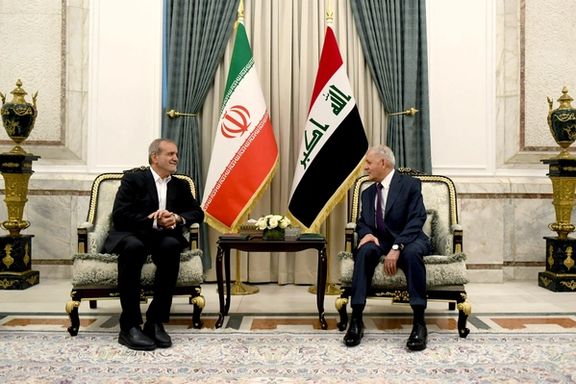
Pezeshkian also held a meeting with Iraqi President Abdul Latif Rashid.
Iranian Foreign Minister Abbas Araqchi said on Wednesday that around 15 MoUs would be signed, Iranian state media reported. "We have several cooperation areas, including political, regional ... and security issues," Araqchi said.
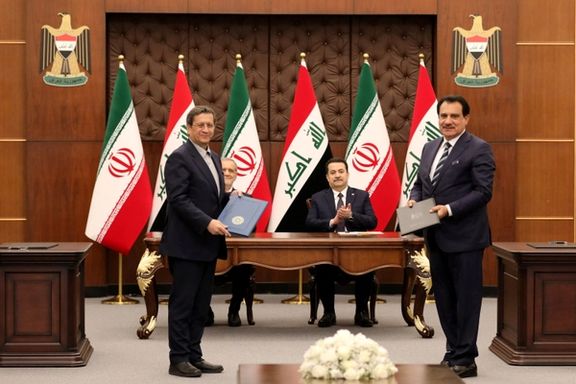
Iranian President Masoud Pezeshkian and Iraqi Prime Minister Mohammed Shia al-Sudani react as Chairman of the Baghdad Chamber of Commerce, Firas Rasool exchanges a Memorandum of Understanding with the Iranian Minister of Trade during the signing ceremony of Memoranda of Understanding between Iraq and Iran at the government palace in Baghdad, Iraq, 11 September 2024.
The relationship between the Islamic Republic and Iraq is complex, with Tehran wielding significant influence over its Arab neighbor through the Shiite religious, political, and paramilitary groups it supports. However, tensions arise due to the presence of Iranian Kurdish armed groups sheltering in Iraq's Kurdistan region, complicating the dynamic between the two nations.
In March 2023, Iran and Iraq signed a security agreement under which Tehran gave Iraq a deadline of September 19, 2023, to disarm Iranian Kurdish parties based in the Kurdistan region and close their military camps.
Iraqi President Abdul Latif Rashid meets with Iranian President Masoud Pezeshkian in Baghdad, Iraq September 11, 2024.
Last week, just before Pezeshkian’s scheduled visit, three Iranian Kurdish armed groups were relocated to a "less accessible" camp in Iraqi Kurdistan after months of pressure from Tehran on both the Kurdistan Regional Government and Iraq’s central government.
A rare partner of both the United States and Iran, Iraq hosts 2,500 US troops and has Iran-backed militias linked to its security forces. Since 2019, these groups have periodically targeted US military bases in Iraq, occasionally soliciting military responses from the United States. The attacks escalated after the October 7 Hamas attack on Israel and mostly stopped in February after retaliatory US air strikes on the Iran-backed groups.
"We are planning to sign several agreements," Iran's state media quoted Pezeshkian as saying ahead of the visit. "We will meet senior Iraqi officials in Baghdad."
The United States and Iraq have reached an understanding on plans for the withdrawal of US-led coalition forces from Iraq, say sources familiar with the matter.
Iran has carried out artillery and missile attacks on targets in Iraq Kurdistan in the past, saying it is used as a staging ground for Iranian separatist groups as well as agents of its arch-foe Israel.
"We have several co-operation areas, including political, regional ... and security issues," Iran's Foreign Minister Abbas Araghchi said ahead of the president's trip, according to state media.
Iran’s expectations from the Iraqi government, however, go further than simply relocating Kurdish groups they have demanded the extradition of dozens of separatist leaders and the complete disarming of all militias.
Iran exports electricity to Iraq, with US permission despite American sanctions, however recouping the proceeds in hard currency has been an issue for Tehran, because Washington has not waived banking sanctions on Iran. Last year, the Biden administration allowed Iraq to pay $11 billion in accumulated debts to Iran, but only indirectly.
The Iranian authorities have been accused of wrongfully arresting, threatening and harassing family members of dozens of those killed, executed, or imprisoned during the nationwide protests since 2022.
In its latest report, Human Rights Watch said “two years after the outbreak of the 2022 Woman, Life, Freedom protests, Iranian authorities continue to silence and punish family members demanding accountability for violations against their loved ones.”
Among them is Mashallah Karami, father of protester Mohammad, who was executed in January 2023. He has since been sentenced to 8 years and 10 months in prison on fake charges of “participation in money laundering” and “obtaining property through illegitimate means.” Now, he faces a fine and the confiscation of his assets as part of his sentence.
“Iranian authorities are brutalizing people twice over; executing or killing a family member and then arresting their loved ones for demanding accountability,” said Nahid Naghshbandi, acting Iran researcher at Human Rights Watch.
“The Iran judiciary should urgently free unlawfully detained family members and ensure fair trials and a transparent judicial process for anyone accused of a crime.”
Minors have also fallen victim to the crackdown. According to Baluch human rights group Halvash, Faramarz Abil Barahoui, the 15-year-old brother of Esmaeel Abil Barahoui, a victim of the Bloody Friday crackdown on protesters in Zahedan in 2022, has been sentenced to eight months in prison. Halvash reported last year that he was arrested after he visited his brother's grave.
The Kurdistan Human Rights Network also reported that on September 3, security agents raided the home of the family of Zanyar Aboubakri, who was shot and killed during the Woman, Life, Freedom protests in Mahabad in October 2022, arresting his 16-year-old brother, Ramyer.
It is part of a nationwide crackdown on dissent. “Iranian authorities have a long track record of pressuring families whose loved ones were killed by security forces or executed by Iranian courts”, HRW said, including threatening and pressuring families of victims from the 2019 protests, as well as families of those killed on Flight PS752, a Ukrainian Airlines flight shot down by the Islamic Revolutionary Guard in 2020, to deter them from pursuing accountability.
The report comes while Amnesty International released information regarding the imminent execution of human rights defender Sharifeh Mohammadi. She was sentenced to death in June in relation to her peaceful human rights activities.
A campaigner for women’s and workers’ rights as well as the abolition of the death penalty, she was a member of a legal workers’ committee in Iran until 2011, when independent trade unions were banned. "Her trial was grossly unfair, and her allegations of torture and other ill-treatment were never investigated,” the rights group said.
Amnesty also noted that “in the aftermath of the Woman Life Freedom uprising, Iranian authorities have intensified their use of the death penalty to install fear among the population and tighten their grip on power …. [including] the use of the death penalty against women on politically motivated charges”.
Last year alone, Iran executed more than 850 people. Iran Human Rights reported that Iranian authorities executed 249 people in the first six months of 2024, though under the secrecy of Iran’s government, it is believed the numbers could be higher.
The US and its allies - France, Germany, and Britain - said Tuesday they were targeting Iran’s flagship airline, Iran Air, in the West’s latest round of sanctions, following Tuesday’s confirmation that Tehran has supplied Russia with short-range ballistic missiles.
Iran has been deeply involved in Russia’s war effort in Ukraine since mid-2022, providing drones, spare parts, and training. However, the provision of missiles is viewed by Western powers as a significant escalation, warranting a strong response.
“The Department of State is concurrently designating three entities, including Iran Air, and identifying five vessels as blocked property involved in the proliferation of Iranian weapons systems to Russia,” the US Treasury announced on Tuesday, shortly after the three European powers said they would cancel all air service agreements with Iran.
“Our international partners are announcing measures that will not allow Iran Air from operating in their territories in the future and are pursuing further designations of Iran- and Russia-based individuals, entities, and vessels involved in the transfer of Iranian lethal aid to Russia,” the US Treasury added.
The E3 sanctions against Iran’s civil aviation industry are particularly significant, as Iran Air reportedly operates an average of 24 weekly flights each way to at least nine European cities, including Paris, London, Frankfurt, and Rome, according to information obtained by Aviacionline via Cirium.
Iran Air is accused by the US Treasury of having transported goods "on behalf of Iran’s Islamic Revolutionary Guard Corps (IRGC) and Ministry of Defense and Armed Forces Logistics (MODAFL)."
Iran's Foreign Ministry spokesman on Tuesday strongly condemned the "unusual" statement by the E3 regarding the cancellation of bilateral air service agreements with Iran and sanctions against Iran Air, saying it will be met with a reciprocal response from Iran. Nasser Kanaani once again denied the West's claim about Iran selling ballistic missiles to Russia, calling it baseless and false.
E3's response to Iran's missile shipments
Earlier Tuesday, France, Britain and Germany said they "will pursue the designations of significant entities and individuals involved with Iran’s ballistic missile program and the transfer of ballistic missiles and other weapons to Russia."
Britain separately announced a new wave of sanctions on Iran and Russia, adding seven designations under its Iran sanctions regime and three under its Russia regime. Some of those sanctioned include firms and entities with ties to the drone industries in Russia and Iran including Iran's Anzali Free Zone Organization as well as Baharestan Kish, Chekad Sanat Faraz and Saad Sazeh Faraz Sharif companies. Two of the companies, Britain said, are involved in producing parts for the drones supplied to Russia.
Ukraine's Foreign Ministry spokesman said on Tuesday the country could cut its ties with Tehran if Russia uses Iranian missiles in war. "I will not say now exactly what is meant by devastating consequences, so as not to weaken our diplomatic position. But I can say that all options, including the one you mentioned (cutting diplomatic relations with Iran), are on the table. If this transfer indeed happened, and if the fact of usage gets recorded - and believe me, it will become public once it has happened - then, there will be consequences," Heorhiy Tykhyi said.
Headache for Iran's new administration
US Secretary of State Antony Blinken confirmed in a press conference earlier in the day that "Russia has now received shipments with these ballistic missiles, and will likely use them within weeks in Ukraine, against Ukraine."
"Iran’s new president and foreign minister repeatedly said that they want to restore engagement with Europe, they want to receive sanctions relief. Destabilizing actions like these achieve exactly the opposite," Blinken noted.
Iran’s executive branch of power has very little say in foreign policy and defense. Strategic decisions, such as a full support for the Russian war effort in Ukraine, are made by Supreme Leader Ali Khamenei in consultation with his close aides and the top brass of the Revolutionary Guard.
The consequences of such decisions, however, will be borne almost entirely by ordinary Iranians and the administrations, which have to manage the day-to-day affairs of the state.
Iran, through its proxies, has encircled Israel in a multi-front war that is slowly expanding as more violent and new fronts emerge. A former IDF spokesperson is now calling on the Israeli government to take the fight directly to the root cause: Iran.
Former IDF combat commander in Lebanon and Gaza, Lt.- Col (ret) Jonathan Conricus, told Iran International in an interview that Israel needs to hold the Islamic Republic responsible.
"Israel has an interest and should be taking the war to Iran. I think the Israeli strategy should be very clear that the Islamic Republic of Iran is responsible for directly funding and arming terrorist organizations that are killing Israelis," said Conricus.
The next time that one of Iran-backed proxies strike Israel, Conricus would like to see Israel retaliate directly against the Islamic Republic. That would include options like Iran's facilities, military, strategic infrastructure, and the government.
“All of the targets are kosher and, on the table, and they will be attacked by Israel because Iran has been aggressive against Israel for so long."
He made it clear that Iranian people are not Israel's enemy and that civilians should not be targeted.
For years, Israel's strategy has been one to retaliate against Iranian proxies without directly involving Iran. Israel is believed to have disrupted Iran’s nuclear ambitions by going after various facilities and scientists. It likely has strong intelligence on Tehran’s nuclear weapons program, which has increased its total stockpile of highly enriched nuclear fuel and is reportedly close to becoming a nuclear power.
In an interview with Iran International, the former IDF spokesperson said Israel's current strategy of dealing with Iran's proxies while trying to undermine its nuclear ambitions is not working, but Iran's plan has proven to work.
"I'm sad to admit it," said Conricus, "But the Iranian strategy of encircling Israel with terrorist organizations and fighting a war of attrition is working for Iran, and they are not paying the price for their aggression."
Conricus, who is a senior fellow at the Foundation for Defense of Democracies (FDD), would like Israel to change the equation and formulate a comprehensive national strategy that has economic, political, and military components, which would undermine Iran's ruling system. He wants Israel to take a leadership role in that fight.
"The people are not our enemy, but the Islamic Republic regime, the Revolutionary Guard, the Basij, the secret police and the evil, oppressive regime of Iran..weaken them. And when an opportunity comes also to help brave Iranians fight against the regime.”
Iran planting the seeds for a new front?
Israeli's Foreign Minister Israel Katz posted to X on Monday "The Iranian terror octopus is working to establish an eastern terror front against Israel and moderate states in the region. We must cut off the octopus's tentacles."
Katz was referring to the escalation in the West Bank, also known Judea and Samaria in Israel, where violence has increased, and recent videos posted to social media show armed militants with ISIS and Hamas flags.
Shaiel Ben-Ephraim, a journalist and analyst who covers Israeli news and politics, posted to X on Monday a photo that was reportedly taken in Jenin where terrorist organizations allegedly run the refugee camps.
He posted that the image was from a funeral in the city. He wrote that "Sources in the army said, "We will find those in these pictures and get to them eventually." But more operations are just a band-aid. The answer is to bring governance back to Jenin, Tulkarem, and other cities where the PA has lost its grip. Otherwise, the rest of the cities of the West Bank will all look like this eventually.
Conricus, who served in the IDF for 24 years, said there’s been a slow and steady escalation of terrorism in the region. Jihadi sentiments existed before the Israel-Hamas conflict, but the key difference now is the increased availability of weapons. These weapons, allegedly originating from Iran, are funneled through Iraq and Syria and smuggled via Jordan, a US ally.
The former IDF spokesperson said the Palestinian Authority can't control it, and that in the last three weeks, five Palestinian suicide bombers were dispatched, with two of them detonating prematurely, while the other cases were thwarted.
“The Palestinian Authority, if you listen to their communications in Arabic and in English, they speak about the Iranians. They say that they're seeing Iranian influence in Judea and Samaria,” said Conricus.
Three Israeli civilians were killed in a shooting at the Allenby Crossing on the border between the West Bank and Jordan, Israeli authorities said Sunday.
The gunman, from Jordan, carried out the attack in a commercial cargo area under Israeli control where Jordanian trucks offload cargo entering the West Bank, officials said.
The IDF is also investigating after a young Turkish American woman, Aysenur Eygi, was shot and killed in the West Bank on Friday, according to US and Palestinian officials, while she was taking part in a protest near Nablus.
Behnam Ben Taleblu, a senior fellow at the Foundation for Defense of Democracies (FDD), said the West Bank and Jordan have the “Iranian target on their backs."
Iran is reportedly working to destabilize the Kingdom and capitalize on the sympathies many in the West Bank have towards civilians in Gaza, and to arm them to create more fronts in the "ring of fire" against Israel.
It’s all part of Tehran strategy of a slow “death by a thousand cuts” approach towards Isarel according to Taleblu.
Israeli PM: the situation in the north must change
Over to the north, the likelihood of an all-out war between Israel and Hezbollah has intensified, with Israeli Prime Minister Benjamin Netanyahu instructing the Israeli military on Sunday to prepare to “change the situation in the North.”
National Unity party leader Benny Gantz, who left Netanyahu’s government in June, warned that the conflict may be imminent, saying it is already unfolding “too late.”
US Central Command chief Michael Kurilla arrived in Israel on Sunday for meetings with senior Israeli security officials in a visit focused on threats from Hezbollah and Iran.
Since October 7, Hezbollah has launched daily attacks against Northern Israel – employing rockets, anti-tank missiles, and explosive UAVs at both military and civilian targets.
Hezbollah has reportedly as many as 150,000 missiles and rockets pointed at Israel.
Seventy thousand Northern Israelis, living within a 5-kilometer radius of the Lebanon border, evacuated after October 7 and remain displaced within their own country. While Hezbollah initially targeted these "ghost town" areas, the Iran-backed group is now increasingly focusing on non-evacuated zones, escalating the conflict in more populated regions.
Israel Channel 12, citing Israeli security sources, said that the war with Hezbollah is “approaching."
Taleblu, who specializes in Iranian security, told Iran International it’s too early to tell whether Lebanon will get dragged into a larger scale war with Israel.
“Israel is facing something of a multi-front war brought to you by the Islamic Republic. But ultimately, based on how the response to the escalation goes, if the Islamic Republic doubles down, if it brings in more weapons transfers, more technology, or if it tries to respond again, it certainly does have the potential to spiral,” he said.
For many Northerners, they're already facing a war, but Hezbollah's strategy, said Conricus is to “keep this situation of instability, where Israel is split between dealing with Hamas in Gaza and Hezbollah in Lebanon.”
The number of rockets has increased and so too has the range. And it’s all about a balancing act.
“They [Hezbollah] have to escalate incrementally, but they must be careful not to escalate too much,” said Conricus, who emphasized that too much escalation would trigger an Israeli response that would not be to Hezbollah's benefit.
Another front: Syria
Israel launched strikes on military sites in Syria on Sunday, reportedly killing at least 25 people, injuring dozens, according to Syrian state media.
The ariel strikes took place in Western Syria at 4 different locations, which are believed to be bases for Iranian forces and militia, housing what’s known as the Scientific Studies and Research Center (CERS), allegedly producing weapons.
Israel claims the CERS manufactures precise surface-to-surface missiles. Israel’s Alma, an institute focused on threats to northern Israel, has revealed in a detailed report that the CERS manufactures chemical, biological, and potentially nuclear weapons”.
Conricus said it’s believed there may have been an attempt by Iran to deliver the weapons to Hezbollah, but that Israel intercepted those weapons before they could be sent.
The Islamic Republic responded by blaming Israel, with the country's foreign ministry spokesperson Nasser Kanani saying at a news conference in Tehran Monday "we strongly condemn this criminal attack by the Zionist regime on Syrian soil."
Since the Israel-Hamas war broke out, Israel regularly targets military sites in Syria linked to Iran, but the intensity of Sunday's strike and death toll was significant.
The former IDF commander said those facilities have been struck in the past and he sees only one path forward as a solution:
“We can defeat Hamas and then defeat Hezbollah but if we don't deal with the root cause of instability and terrorism in the Middle East. We won't solve our problems long term. It's high time for Israel to change its strategy against the Islamic Republic of Iran."
Iran's Minister of Interior has called for Afghan migrants residing in Iran to "go to their own country and work there to rebuild it" amid rising numbers of immigrants from neighboring Afghanistan.
Eskandar Momeni's comments, delivered during a television appearance on Monday, have drawn criticism for perceived contradiction with Iran's own policies, particularly as the country continues to issue thousands of visas to Afghans daily.
During the program, Momeni justified the remarks by stating that "Iran cannot handle this volume of migration." His comments, however, have been met with skepticism from observers who argue that Iran's actions contradict its rhetoric. While Iranian officials, including Momeni, repeatedly say that Afghan migrants should return home, their actions, such as the continued issuance of visas, suggest otherwise.
Many believe the government is trying to appease public demands to reduce the presence of millions of Afghan migrants, blamed for increasing social and financial burdens, while quietly maintaining policies that keep the borders open.
The Iranian government has invested three billion euros to construct a border wall, yet reports indicate that Afghan migrants who are deported often return, some even jumping over the wall to re-enter Iran.
Afghan refugees at a border crossing waiting to enter Iran
In his television address, Momeni clarified that the "priority is for those who enter illegally and unlawfully," and emphasized the need for migrants to "respect the mechanisms of the host country." He went further, blaming Afghan migrants for the rise in unemployment in Iran, stating that "a lot of job opportunities are being taken away."
Critics argue that while the government wants to portray itself as tough on immigration, it continues to benefit from the presence of Afghan migrants in other ways. Some have accused Tehran of using Afghan migrants to bolster its regional influence, with reports suggesting that Iran has previously recruited Afghan fighters for its military operations in Syria.
The surge of Afghan migrants into Iran since the Taliban’s takeover of Afghanistan in 2021, estimated to have grown from 2.5 million to as high as 10 million, has only deepened public frustration, as Iran grapples with its own economic crisis and strained social services.
Meanwhile, human rights organizations have Iran’s treatment of Afghan migrants. In August, Shargh daily reported the arrest of several Afghan teenagers between the ages of 10 and 17, despite their having proper documentation. One notable incident involved a violent confrontation between law enforcement and a young Afghan immigrant named "Seyed Mahdi" in Damavand County, which sparked outrage.
The arrest was followed by a video that surfaced online, showing a police officer kneeling on Mahdi’s neck, a scene that immediately drew comparisons to the death of George Floyd in the US, to which Iranian officials reacted widely including Supreme Leader Ali Khameni who slammed it.
The treatment of Afghan migrants in Iran has been increasingly scrutinized by international organizations.
Amnesty International has raised concerns about the "routine arbitrary detention" of Afghan nationals in Iran, alongside reports of torture and other forms of ill-treatment.
The rights group Hengaw has also issued warnings about the growing tide of government and societal racism toward Afghan migrants, describing the situation as "catastrophic."
For many, the contradiction in Iran’s policy, open borders on one hand, and demands for migrants to leave on the other, reflects a deeper struggle within the government to balance its geopolitical interests with rising domestic pressures.
British Foreign Secretary David Lammy and US Secretary of State Antony Blinken, who will jointly visit Kyiv this week, said on Tuesday they are united on the need to tackle Iran's influence in the Middle East and Ukraine.
"(We are) completely aligned on the need to tackle Iran's malign activity in the region and beyond," Lammy told reporters beside Blinken, who is visiting Britain.
"We're seeing a disturbing pattern of greater Iranian support for the Kremlin's illegal group, and we discussed today our shared commitment to holding Tehran to account for their undermining of global stability."
Blinken said Iran's decision to supply Russia with ballistic missiles threatened European security and he announced further sanctions on Tehran.
"Russia has now received shipments with these ballistic missiles, and will likely use them within weeks in Ukraine, against Ukraine," Blinken said, citing intelligence that he said has been shared with US allies and partners around the world.
The supply of Iranian missiles enables Russia to use more of its arsenal for targets that are further from the front line in Ukraine, Blinken said.
"This development and the growing cooperation between Russia and Iran threatens European security and demonstrates how Iran's destabilizing influence reaches far beyond the Middle East."
Lammy said he and Blinken would travel to Kyiv this week, the first joint visit of this kind for more than a decade.
The British foreign minister described the supply of ballistic missiles from Iran to Russia on Tuesday as a "significant escalation".
"This is a troubling action that we're seeing from Iran. It is definitely a significant escalation and we are coordinating," he said.
Lammy said he would not comment on "operational issues" when asked whether Britain would give the green light to Ukraine to use the Storm Shadow long-range missiles to strike targets inside Russia.