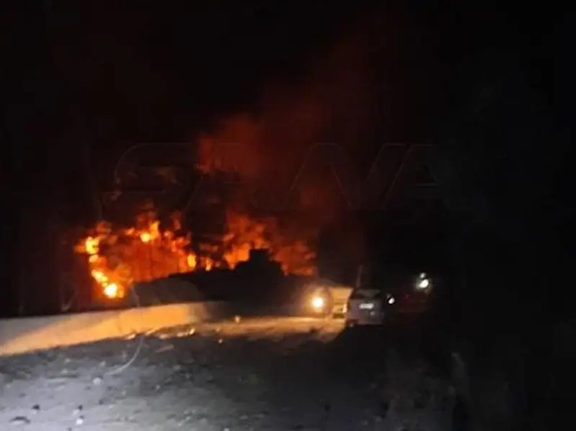
Israel hits Syrian facility allegedly used by Iran for chemical arms production
An explosion in Masyaf as a result of an Israeli airstrike
Israeli airstrikes on Sunday hit facilities in the Scientific Research Studies Center (CERS) in Syria’s Masyaf, which are said to be used by Iran and its proxies to produce chemical weapons, killing 14 people, Syria media reported.
Israel's defense minister revealed in 2022 that the facilities at the Scientific Research Studies Center in Masyaf were being used by Iran to produce advanced missiles and weapons for its proxies. Benny Gantz made the remarks following an Israeli airstrike on the sites at the time, but the strikes do not seem to have removed the threat, as the facilities were once again targeted on September 8, 2024.
Late Sunday night, a series of Israeli airstrikes hit multiple locations across central Syria, resulting in the deaths of at least five individuals and injuring 19 more, according to Syrian state media. The strikes caused fires and damaged infrastructure in the area, with firefighting teams battling to control the flames into the early hours of Monday.
Two regional intelligence sources told Reuters a major military research center for chemical arms production located near Masyaf was hit several times. It is believed to house a team of Iranian military experts involved in weapons production.
Syria’s official news agency, SANA, reported that the country's air defense systems responded to what they called an "aggression" targeting several points in the central region, specifically in Hama province. One of the strikes damaged a highway in the province, further complicating the situation on the ground.
Faysal Haydar, the director of Masyaf National Hospital in western Hama province, confirmed the number of casualties, which SANA says were all civilians.
The Syrian Observatory for Human Rights (SOHR), a UK-based war monitoring group, also confirmed the strikes and reported that one of the targeted sites was part of the CERS in Masyaf, a location known to house Iranian militias and weapons experts. These forces have reportedly been stationed in Syria to assist in developing military capabilities for the Assad regime, the report said.
“Under the vision of Soleimani, Iran transformed CERS in Syria's Masyaf into production facilities for mid and long-range, precise missiles and weapons, provided to Hezbollah and Iranian proxies. These sites host significant threats to the region and to Israel," Benny Gantz said in September 2022.
Israel’s Alma, an institute focused on threats to northern Israel, has revealed in a detailed report that “Iran’s major focus is to develop and manufacture precision missiles and rockets, cruise missiles, and unmanned aerial vehicles (UAVs) on Syrian soil”.
Israel’s Alma, an institute focused on threats to northern Israel, has revealed in a detailed report that “Iran’s major focus is to develop and manufacture precision missiles and rockets, cruise missiles, and unmanned aerial vehicles (UAVs) on Syrian soil”. Operations are centered around the CERS Center, which is the heart of Syria's military industry. Established in 1971, the institute has transformed into a collaborative platform involving Syria, Iran, and Hezbollah since the beginning of the civil war, according to Alma's statement.
Over the years, Syria’s CERS Center has been shown to be accountable for the research, development, and military production of advanced weapons such as surface-to-surface missiles such as the M-600 / Fateh-110 missile, which is “at the heart of the joint Iranian-Syrian and Hezbollah precision project", Alma reported. More alarmingly, it states that “the CERS Center is responsible for developing and manufacturing chemical, biological, and potentially nuclear weapons”.
Also on Sunday, local media reported strikes near Damascus and the coastal city of Tartous, though details on the extent of the damage or casualties in that area were limited at the time.
The incident marks yet another escalation in the ongoing conflict in Syria, with Israeli airstrikes becoming a frequent occurrence, particularly targeting sites linked to Iranian forces operating in the country. While Israel rarely confirms such operations, it has repeatedly stated that it will not tolerate Iran’s military presence in Syria, which it views as a direct threat to its national security.
An Iranian lawmaker has confirmed media reports about Tehran's delivery of ballistic missiles to Russia, but downplayed threats from Ukraine and its Western allies to impose "heavy" costs on Iran.
Ahmad Bakhshayesh Ardestani, a member of the Parliament's National Security and Foreign Policy Committee, acknowledged Iran’s military assistance to Russia amid the ongoing war in Ukraine, less than 24 hours after Iran's UN mission denied a report by The Wall Street Journal about the delivery of short-range ballistic missiles to Russia.
"We have to barter for our needs, including importing soybeans and wheat. Part of the barter involves sending missiles, and another part involves sending military drones to Russia," Ardestani told Didban Iran on Saturday.
When asked whether sending ballistic missiles to Russia might lead to further sanctions or trigger the so-called "snapback" mechanism against Iran, the lawmaker replied, "It can't get any worse than it already is. We give missiles to Hezbollah, Hamas, and Hashd al-Shaabi, so why not to Russia?"
"We sell weapons and receive dollars. We circumvent sanctions through our partnership with Russia. We import soybeans, corn, and other goods from Russia. Europeans sell arms to Ukraine. NATO has entered Ukraine, so why shouldn’t we support our ally by sending missiles and drones to Russia?" Ardestani said.
Later on Sunday, Nasser Kanaani, spokesperson for Iran's Foreign Ministry, addressed the reports of ballistic missile shipments to Russia, stating, "The Islamic Republic has never been part of the Russia-Ukraine conflict." He further added, "Military cooperation between the Islamic Republic and Russia dates back well before the start of the Ukraine war." In effect, Kanaani did not specifically deny the report but repeated Iran's standard response that can be interpreted as a denial.
The Biden administration has informed its allies that Iran delivered short-range ballistic missiles to Russia, providing Moscow with a significant new military tool amid its ongoing war against Ukraine, a Friday report by the Wall Street Journal said citing US and European officials.
"The missiles have finally been delivered," a US official said. The shipment reportedly includes several hundred short-range ballistic missiles, capable of reaching up to 500 miles. These missiles could help bolster Russia’s intensified missile attacks on Ukrainian cities and infrastructure, which have recently led to the deaths of dozens of civilians.
"We have been warning of the deepening security partnership between Russia and Iran since the outset of Russia's full-scale invasion of Ukraine and are alarmed by these reports," said White House National Security Council spokesperson Sean Savett. "Any transfer of Iranian ballistic missiles to Russia would represent a dramatic escalation in Iran's support for Russia's war of aggression against Ukraine."
Ardestani’s comments come amid repeated official denials from Iran regarding the shipment of missiles, drones, and other military equipment to Russia.
Just hours after the Wall Street Journal’s report was published, Iran’s United Nations delegation issued a statement denying any missile or weapon transfers to Russia. The statement asserted, "The Islamic Republic has not provided weapons to any party involved in the conflict in Ukraine and has urged other countries to stop doing so."
In reaction to the reported military shipments, European countries are considering banning Iran’s national airline, Iran Air, from flying to European airports. The new sanctions package is expected to target companies and individuals involved in the missile transfers, including transportation companies linked to these operations.
"If civilians in Ukraine die from these missiles (Tehran delivered to Russia), then Iran will pay a double price for that. The response will be severe," a Ukrainian defense source told The Times, but did not elaborate on the nature of that response.
Russia's access to Iranian ballistic missiles could devastate civilian populations, markinga turning point in the conflict, Farzin Nadimi, a Senior Fellow with the Washington Institute, told Iran International.
He said some of these missiles will have enough range to hit Western Ukraine and strike important targets like railway stations. "It's going to have a really bad effect on civilians."
Hossein Salami, Commander-in-Chief of Iran’s Islamic Revolutionary Guard Corps (IRGC), claimed responsibility for a series of attacks on 12 ships in the past that he called “Israeli”.
His statement, made during a visit by President Masoud Pezeshkian to the IRGC’s Khatam al-Anbia Construction Headquarters, came in the wake of weeks of tensions following the killing of Hamas's political chief, Ismail Haniyeh, in Tehran.
Salami justified the attacks by claiming they were in retaliation for strikes on 14 Iranian oil tankers in the Red Sea and the Mediterranean—accusations he placed on Israel, albeit with no evidence.
Since 2019, the IRGC has attacked or boarded numerous commercial vessels in the Persian Gulf region, often claiming that they were Israeli ships.
Salami’s remarks, laden with Tehran's usual conspiratorial tone, stated that Israel's attacks were designed to stymie Iran’s oil exports. However, what Salami left out is that when he refers to “Israeli ships,” these were commercial vessels, not military targets, perhaps partially owned by individuals of Israeli descent. This kind of rhetoric usually accompanies Tehran’s attempts to defend and justify its behavior on the international stage.
Israeli officials have so far remained silent on these claims. Salami’s statements follow a pattern of Iran seizing foreign vessels under dubious pretenses. This includes the seizure of oil tankers, such as the British-flagged Stena Impero in 2019 and, most recently, the Marshall Islands-flagged St. Nikolas in the Gulf of Oman.
Iran’s approach to maritime security seems to hinge on hostage diplomacy. The 2019 seizure of the Grace 1 by British authorities, on suspicion of breaching sanctions by transporting oil to Syria, was met with a retaliatory move by the IRGC, which seized the Stena Impero.
In January, Tehran seized the Marshall Islands-flagged oil tanker St. Nikolas and also expanded its maritime provocations, attacking the M/V Pacific Gold tanker, registered in Liberia with a drone in the Indian Ocean.
A photo, purportedly showing the seizure of MSC Aries,belonging to London-based Zodiac Maritime shipping company, owned by Israeli billionaire Eyal Ofer.
IRGC’s chief commander attempted to justify such actions by referencing sanctions, military threats, or even former US President Donald Trump, whom Salami described as being "no less of a threat than COVID-19."
Iranian officials appear to be concerned about Trump's possible return to the presidency, expecting a tougher policy by Washington than what has transpired during the Biden administration.
Vice Adm. Brad Cooper of the US 5th Fleet earlier made it clear that Iran’s actions “violate international law and pose a threat to maritime security and stability.” Yet, despite these warnings, Tehran seems determined to continue its behavior, using the high seas as yet another battlefield in its ongoing quest for regional dominance.
Iran has completed its long-awaited shipment of ballistic missiles to Russia, defying Western warnings not to supply arms to Moscow, The Wall Street Journal reported Friday, citing US and European officials.
The Biden administration has informed its allies that Iran delivered short-range ballistic missiles to Russia, providing Moscow with a significant new military tool amid its ongoing war against Ukraine, the WSJ report said.
This move comes despite Western warnings urging Iran not to supply arms to Russia, and marks a major escalation in Iran’s military support for Russia.
"The missiles have finally been delivered," a US official said. The shipment reportedly includes several hundred short-range ballistic missiles, capable of reaching up to 500 miles. These missiles could help bolster Russia’s intensified missile attacks on Ukrainian cities and infrastructure, which have recently led to the deaths of dozens of civilians.
"We have been warning of the deepening security partnership between Russia and Iran since the outset of Russia's full-scale invasion of Ukraine and are alarmed by these reports," said White House National Security Council spokesperson Sean Savett. "Any transfer of Iranian ballistic missiles to Russia would represent a dramatic escalation in Iran's support for Russia's war of aggression against Ukraine."
Iran had already been providing drones to Russia, which have been used extensively in Ukraine. Additionally, Russia has sourced ammunition and missiles from North Korea for its military campaign.
Such a deepening partnership could further isolate Iran from the West and worsen an economy already in crisis mode, as ballistic missile transfers to Russia would likely be met with additional sanctions on Iran by Western powers, as promised by Ukraine's western allies.
In response to the missile deliveries, European and US officials are preparing to implement new sanctions against Iran, according to the WSJ report.
European leaders had previously warned that they would impose coordinated sanctions if Iran proceeded with the missile transfers.
According to Western officials, sanctions could include banning Iran's flag carrier, Iran Air, from European airports, and targeting companies and individuals involved in the missile shipments, The Wall Street Journal reported.
Russia's access to Iranian ballistic missiles could devastate civilian populations, marking a turning point in the conflict, Farzin Nadimi, a Senior Fellow with the Washington Institute, told Iran International.
He said some of these missiles will have enough range to hit Western Ukraine and strike important targets like railway stations. "It's going to have a really bad effect on civilians."
The United States and Iraq have reached a preliminary agreement for the full withdrawal of US-led coalition forces from Iraq by the end of 2026, Reuters reported on Friday, amid continued attacks by Iran-backed militants against American troops.
The plan envisions hundreds of troops leaving by September 2025, with a full withdrawal by the end of 2026, the Reuters report said citing multiple sources familiar with the matter. The deal requires a final go-ahead from both capitals, but the details have been broadly agreed.
"We have an agreement, it’s now just a question of when to announce it," a senior US official confirmed. The final announcement has been delayed due to regional tensions related to Israel's war in Gaza.
Discussions between Baghdad and Washington, which began in January, focused on transitioning to a new advisory relationship, allowing some US troops to remain in Iraq for security cooperation after the drawdown.
Farhad Alaaldin, foreign affairs adviser to the Iraqi prime minister, noted that technical talks had concluded, paving the way for "a new level" of bilateral relations.
The agreement comes amid ongoing attacks by Iran-backed Iraqi armed groups on US forces, which have resulted in casualties and retaliatory strikes.
Last month, several attacks on US bases in Iraq and Syria injured multiple Americans. Seven US personnel were injured when two rockets hit Ain al-Asad Airbase in Iraq on August 5. Several US and coalition personnel also suffered "minor" injuries in an August 9 drone attack on Kharab al-Jir base in Syria's al-Hasaka.
The current US presence includes around 2,500 troops in Iraq and 900 in Syria, originally deployed to fight the Islamic State. The drawdown will initially see forces leaving key bases in Anbar and Baghdad by 2025, with the last remaining troops stationed in Erbil until the end of 2026.
This withdrawal would mark a significant shift in Washington's military posture, though US officials acknowledge that their presence in Iraq serves not only to counter the Islamic State but also to monitor Iranian influence in the region.
The phased exit is seen as politically beneficial for Iraqi Prime Minister Mohammed Shia al-Sudani, as it aligns with Iraq's balancing act between the US and Iran while addressing ongoing instability. However, it might also signal a victory for Iran and its proxies in the Arab country which have long been pushing for the full withdrawal of US and coalition forces from both Iraq and Syria.
Three Iranian Kurdish armed groups have been relocated to a "less accessible" camp in Iraqi Kurdistan after months of pressure from Tehran on both the Kurdistan Regional Government and Iraq’s central government.
Iran has long accused the semi-autonomous Kurdish government in northern Iraq of harboring groups, all under the Komala name, which Tehran labels as terrorist organizations. The Iranian Revolutionary Guard Corps (IRGC) has frequently launched attacks on their bases, claiming these groups pose a threat to the security of the Islamic Republic.
In March 2023, the governments of Iran and Iraq signed a ‘border security’ agreement that was, in essence, a plan to curb the activities of Iran’s Kurdish opposition groups in Iraq. The agreement led to partial evacuation of Komala bases in September 2023. The move now seems to have been completed, with the three Kurdish parties, with military wings, leaving their camps in the Zirgwez region near Sulaymaniyah and settling in camps in Suwardash near Dukan.
The new location is in fact closer to the border with Iran but less accessible, according to Komala sources who talked to Iran International on condition of anonymity. “The ability to transport and maintain weapons, especially the semi-heavy and heavy weapons of the Peshmerga forces, has effectively been taken from them,” one member said.
A map of the Iraqi Kurdistan with old and new Komala camps
He added that by forcing a move of the Komala inside another country’s territory, Iran's government has sent a “clear message” that it can do “whatever it wants” and neither the Iraqi central government nor the Kurdish Regional Government of Iraq can stop it.
The groups say they oppose the clerical regime in Iran, but many Iranians also view them as separatists, who harbor designs on Iran's Kurdish populated areas in the west.
Iran’s government, through its IRGC Quds Force, enjoys considerable sway over authorities in Iraq, both in Baghdad and Erbil, the Kurdish regional capital. On occasions, however, the relationship has bittered over IRGC attacks on Kurdish groups.
Tehran Erbil security cooperation
Nechirvan Barzani, the President of Iraq's Kurdistan Region, made an unexpected visit to Iran in May, where he met with top leaders, sparking strong criticism from opponents of the Iranian regime.
During his visit, Barzani engaged with key figures of the government, including Supreme Leader Ali Khamenei, heads of executive and legislative bodies, the commander-in-chief of the IRGC, the foreign minister, and the secretary of the Supreme National Security Council.
The timing and nature of Barzani's visit, coming months after the IRGC's missile attack on the Kurdistan Region, raised questions about its motives. The high-profile meetings suggest that the discussions likely focused on mutual security concerns.
In January, the Iraqi government recalled its ambassador from Tehran after an IRGC missile attack on Erbil killed four civilians and injured six others. The attack caused a popular outrage in Iraqi Kurdistan and thousands took to the streets denouncing the IRGC's ‘free hand’ in their region.
The IRGC claimed the target had been an Israeli “spy headquarter” in the Kurdistan region of Iraq, but the Kurdish prime minister Masrour Barzani categorically denied the claims and called the attack a “crime against the Kurdish people.”