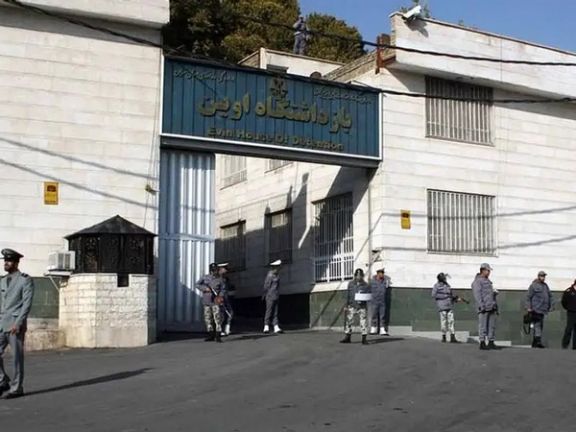
Twenty-two female political and ideological prisoners in Tehran’s Evin Prison have released an open letter demanding an immediate halt to the sexual harassment of inmates during body searches.
"We, a group of female political and ideological prisoners in Evin prison, are demanding accountability for the unconventional body searches and sexual harassment of several inmates during these inspections. If the authorities do not respond, we will resort to protest actions," their letter published on political prisoner Gholrokh Iiraee’s X account on Sunday said.
Recent reports have shed light on incidents of sexual assault and abuse within Iran’s prison system.
"These body inspections have become an excuse to sexually harass prisoners," said journalist and human rights activist, Reza Akvanian, commenting on the situation in an interview with Iran International.
While technology exists to conduct non-invasive scans, Akvanian said, Iranian prisons continue to allow invasive procedures that can result in sexual harassment. Akvanian doubted the Islamic Republic’s judiciary's willingness to address these violations, citing past neglect and the stepped-up sentences faced by activists who report such abuses.
Nobel Peace Prize laureate, Narges Mohammadi, imprisoned in Evin and one of the signatories of the letter, faced new charges earlier this yearafter exposing incidents of sexual harassment against detained women.
A March 2024 report from the UN’s Independent Fact-Finding Mission (FFM) on Iran confirmed instances of sexual violence, including gang rape and forced nudity inflicted upon those detained during Iran’s nationwide Women, Life, Freedom protests following Mahsa Amini's death in police custody in 2022.
“To extract confessions, punish and humiliate detained women, girls, men and boys, security officers subjected them to sexual and gender-based violence, including rape, gang rape, rape with an object, and forced nudity, as well as beatings, flogging and burning, the use of electric shocks, suspension, and stress positions, in acts amounting to torture,” the FMM said in their report.
Last year Human Rights Watch and Amnesty Internationalreleased reports detailing sexual assault by agents of the IRGC, Basij, Ministry of Intelligence, and various police departments against women, men, and children during the protests following Amini's death.
The top commander of Iran's military operations abroad has not been seen in days and several stilted official allusions to him on Monday further fueled speculation about his whereabouts and the possibility of his death at Israeli hands.
The leader of the Islamic Revolutionary Guard Corps' elite Quds Force Esmail Qaani did not appear alongside other top commanders Friday prayers led by Supreme Leader Ali Khamenei on Friday.
Iranian media reports on Saturday alleged that Qaani might have been in Beirut following the death of Hezbollah leader Hassan Nasrallah and continued Israeli air strikes on positions of the Iran-backed group.
Some Iran watchers suspect he might have been killed or injured in Israeli air strikes.
"Many are asking about General Qaani. He is well and actively engaged in his duties." Iraj Masjedi, the deputy coordinator of the Quds Force said on Monday.
"Some are suggesting a statement be issued. Why a statement? There is no need for such an action," he said.
Adding to the mystery, an October 1 post on Qaani's X account - "God is great" - appearing to celebrate Iran's large missile attack on Israel that day was subsequently deleted.
At a Tehran conference on youth issues where Qaani was due to speak on Monday, an organizers said he “sent his regards” and apologized for not being able to attend the meeting due to his involvement in matters elsewhere.
Informed sources have told Iran International that even Qaani's family remained unaware of his whereabouts.
A targeted air strike on Beirut last week which aimed to assassinate Hashem Safieddine, a senior Hezbollah leader and potential successor to Hassan Nasrallah, has raised speculation about Qaani’s possible presence.
Qaani had traveled to Lebanon to meet with Hezbollah officials in an effort to strengthen the group, the New York Times, citing three unnamed Iranian officials, reported. Reuters also reported on Sunday that according to Iranian officials Qaani has not been heard from since Friday.
Senior Hezbollah official Mahmoud Qmati told Reuters: "I have no information, we are also searching for the truth of this matter."
Israel was not aware of Qaani's presence when it struck Beirut, the Times of Israel reported citing military sources.
"If Qaani was actually with Safieddine during the strike, the IDF was not aware of this and that he was not the intended target," military sources told the Israeli daily.
Iranian exiled prince Reza Pahlavi issued a statement on the anniversary of the October 7 attack on Israel in an effort to reassure Iran’s neighbors that a revolution in Iran that topples its Islamic rulers would not add to the turmoil in the region.
“I say to you, our friends across the Middle East…this regime that has held us hostage for nearly half a century must go,” he said in a video statement on X. “I know you might fear change might bring chaos. But fear not, we will not allow a power vacuum to follow the collapse of the regime.”
Pahlavi has been calling for the fall of the current Iranian authorities for many years, appealing to western governments mainly. His recent message is addressed to regional powers, however, and has been published not just in English but also Hebrew and Arabic.
It appears to be an attempt to counter the Islamic Republic’s claim to be leading the fight against Israel and the US on behalf of the people of Muslims in the Middle East and beyond.
“(The Islamic Republic) has fueled sectarian conflicts in Syria, Iraq, Lebanon… It uses the Palestinians as human shields,” Pahlavi said. “The tyrant in Tehran couches his warmongering in Iranian nationalism. But he does not speak for our nation.”
The statement came as Israel weighs its options to retaliate against Iran's missile attack of 1 October. A day earlier, the exiled prince had expressed optimism that once the Islamic Republic is removed, there could be peaceful relations between Iran and Israel.
Interview with Fox News
“The end of this regime will mean an end to all these problems,” Pahlavi told in an interview with Fox News on Sunday.
Monday marked a year since Hamas forces stormed southern Israel, killing several hundred civilians and taking over 250 hostages. Since then, Israel has carried out extensive operations in Gaza, killing more than 40,000 Palestinians, according to the enclave's health officials.
Iran's leaders have praised Hamas for the attack, asserting that the country had no role in its planning or execution. Nonetheless, the Islamic Republic's unreserved support for armed groups who fight against Israel has put it on a collision course with Israel.
“If they provoke more escalation... it will create an incredible economic shock to the nation that will not be advantageous even to the regime itself,” Pahlavi said.
A top Iranian police commander at the center of repressing women's rights protests which shook the country in 2022 has described the force he commanded as unfairly maligned in stopping what he called a foreign plot.
"The Supreme Leader emphasized that even if [the death of Mahsa Amini] had not occurred, enemies would have found another excuse for unrest, and FARAJA was recognized as ‘the oppressed yet powerful’ in these events," General Hossein Ashtari told state-controlled Tasnim media outlet, referring to the police force he once commanded.
Ashtari's remarks refer to comments by Iran's Supreme Leader, the country's top decision-maker, the same year and appeared aimed at associating widely-criticized police actions with his will.
"A distressing incident had occurred, but FARAJA was not at fault in this matter, and the enemy exploited the incident for its own purposes," he added again citing Khamenei.
FARAJA, an acronym for the Law Enforcement Command of the Islamic Republic of Iran, oversees domestic security and border control in close coordination with the Islamic Revolutionary Guard Corps (IRGC).
Criticized by rights groups for its aggressive tactics, FARAJA helped suppress 2022 protests following the death of a young woman, Mahsa Amini, after she had been detained by morality police over her Islamic head covering.
Its use of live ammunition, tear gas, and mass arrests against demonstrators was met with Western governments and international sanctions.
Ashtari himself faces sanctions from the United States, EU, UK and Canada for his role in the crackdown.
Speaking to the IRGC-aligned outlet, Ashtari said FARAJA’s response to the protests was essential to stabilize the nation and weather external threats.
"Our goal was to prevent social protests from escalating into security crises, and even if they did, to return them to the social realm through wisdom and sound management," Ashtari said.
Human rights organizations have documented FARAJA’s involvement in beatings, arbitrary detentions, and crackdowns on civilians, including women and young people, reinforcing its image among many Iranians as a tool for stifling dissent.
The 2022 demonstrations quickly grew, demanding the overthrow of the ruling clerical state and were held under the slogan of "Woman, Life, Freedom."
When security forces including FARAJA cracked down on the protests, it lead to at least 500 deaths and over 20,000 arrests, putting a global spotlight and criticism on the Iranian state’s treatment of dissidents.
"FARAJA acted with prudence and showed its strength to those seeking to create chaos, while supporting ordinary citizens in their daily lives," Ashtari told Tasnim.
As Tehran faces continued fallout and ongoing civil resistance from its populace, it now also awaits Israel’s likely counterattack to its missile barrage on the Jewish state last week.
Tehran sees the attack as a show of force after the targeted killing of Hezbollah leader Hassan Nasrallah and a senior IRGC commander in Lebanon by Israeli forces last month.
Following Israel's October 4, 2024, strike on Beirut, which targeted Hashem Safiuddin, a potential successor to Hezbollah leader Hassan Nasrallah, speculation has also arisen regarding the status of Ismail Qa’ani, the chief commander of the Quds Force.
Although his deputy stated on Monday that Ismail Qa’ani is safe, the IRGC's public relations department has remained silent, releasing no official updates. Also, Tasnim News affiliated with the IRGC stated on Monday that Qa’ani sent a letter on the occasion of Hamas’s October 7 attack. However, according to Iran International sources, even his family was unaware of his status as of Sunday.
There are reports suggesting that Qa’ani traveled to Lebanon and was likely with Hashem Safiuddin when Israel launched its strike. Hezbollah has also stayed quiet on the outcome of this bombing, following a similar pattern as with Hassan Nasrallah, where the group only confirmed his safety 24 hours after an earlier Israeli bombardment.
Two Iranian officials told Reuters that Qa’ani traveled to Lebanon after Hassan Nasrallah was killed and has not been heard from since the recent Israeli attacks on southern Beirut. In response to a question about the status of Ismail Qa’ani, Mahmoud Qomati, a member of the political council of Lebanon's Hezbollah said: "I have no information."
Bragging vs. silence
The Islamic Republic is quick to publicize events it deems successful, often broadcasting them live. For instance, Friday prayers and war room directives to attack Israel are shown on state media, with foreign coverage re-aired on Farsi outlets. However, when incidents result in failure or embarrassment, the propaganda machine remains silent. A clear example is the conflicting reports following the crash of former President Ebrahim Raisi's helicopter, which remained unclear for 24 hours. Similarly, after the IRGC downed Ukrainian flight PS752, it took three days for officials to admit responsibility, despite their initial denials.
This model of no-information or disinformation has had a history in other totalitarian regimes. The Soviet government closed all channels of information about the Chornobyl nuclear reactor explosion for days in 1986. The Soviet government issued top-secret orders to classify all data related to the accident, especially information about the health of the affected population.
What does this behavior tell us about the propaganda apparatus of totalitarian and authoritarian regimes and even authoritarian parties in democratic systems?
People have no right to know
In authoritarian and totalitarian regimes, those in power often view government and public information as their exclusive property, treating the act of sharing information with citizens as a discretionary privilege rather than a fundamental duty. These systems routinely deny citizens the right to access details about government actions and decisions. For example, Ali Khamenei and the IRGC oversee vast economic enterprises, yet they consistently withhold financial statements, refusing to disclose their annual income and expenditures to the public.
In the Islamic Republic, people do not have the right to know what the officials do in their jobs. The Iranians have been curious why Ismail Qa’ani has been absent from the public arena, including the high-profile Friday prayer on October 4, led by Khamenei. The Revolutionary Guards did not provide any information about his whereabouts if he was with Sheikh Safiuddin during the attack on the Hezbollah building.
Internet disruption and low-quality connection in Iran, which constantly occurs in the conditions of a popular uprising, is to cut off the communication of political activists. In non-protest conditions, it is to prevent information-sharing on social networks, which today about 60 million smartphone owners use to get information. On October 6th, there was an Internet disruptionby major providers in the country.
Why the government’s non-information policy?
The Islamic Republic does not consider information a tool to gain public trust. Four reasons can be mentioned for the Islamist government’s misinformation and disinformation policy:
1. Fear of public reactions: The government is wary of public celebrations or displays of enthusiasm following certain news events. Opponents have often reacted in stark contrast to the regime's sentiments—mourning when the government celebrates, as in the aftermath of 9/11, and celebrating when the government mourns, such as during rumors of Nasrallah's death. To control public sentiment, the government delays releasing information until emotions subside. For instance, news of Raisi's helicopter crash was announced early in the morning possibly to minimize potential celebrations. It was even falsely reported that his motorcade continued to Tabriz after an emergency landing to downplay the incident.
2. Fear of rebellion: The government fears that any display of weakness could spark rebellion, knowing that millions of Iranians are ready to rise up against the government. Major events, like Mahsa Amini’s murder, or any significant blow to the government, could act as a trigger. To avoid this, the authorities suppress information that might fuel dissent.
3. Spreading rumors to pollute public discourse: By withholding information, authorities create a vacuum filled with rumors, causing confusion and distrust. This tactic is aimed at undermining the credibility of foreign Persian-language media and social networks. Over the past 45 years, public officials have not only ignored the spread of rumors but have at times actively fueled them. Some government-affiliated or pseudo-independent outlets even have dedicated "rumor" columns.
4. Overloading the media space: The Islamic Republic uses its vast network of state-controlled outlets to flood the news sphere with contradictory messages. This deliberate saturation leaves the public bewildered and uncertain, making it easier for the government to evade accountability. The conflicting narratives serve to confuse rather than inform, reducing the possibility of coherent opposition.
Iranian officials not only continued to threaten Israel on Monday but also glorified the October 7 Hamas attack as the anniversary passed without the anticipated Israeli retaliation.
Vice President Mohammad Reza Aref, in an interview with ISNA, said the threats against Iran after last week's missile barrage were "a joke" as Israel bided its time to respond.
Iranian military leaders spoke defiantly as the country prepared for certain retaliation. Abdolrahim Mousavi, Commander-in-Chief of Iran’s Army, stated that Lebanese Hezbollah, Iran's largest proxy, had inflicted “severe” blows on Israel, and further violence would lead to “harsher” Iranian responses. "If the Zionists commit a crime in response to the reply we gave them, they will undoubtedly receive a stronger and more destructive response," Mousavi said.
They did not acknowledge that Iran's response to the killing of Iran-backed Hamas leader Ismail Haniyeh was only carried out two months later, and on the back of the killing of Hezbollah leader, Hassan Nasrallah.
Meanwhile, Israel's Kan 11 reported that the United States had offered Israel a “compensation package” if it refrained from attacking specific Iranian targets. This package reportedly included comprehensive diplomatic protection and a weapons package, according to American officials involved in the negotiations.
As Israel mourned the one-year-anniversary of the October 7 atrocities, in which 251 people were taken hostage to Gaza and 1,100 mostly civilians were killed, the official X account of Supreme Leader Ali Khamenei in Hebrew stated, "The Al-Aqsa Storm operation", another name for the October 7 attack, "set the Zionist regime back by 70 years."
With the country in mourning, many Israelis felt the timing of a retaliation would be inappropriate on the day when ceremonies around the country focused on those lost and the people still held in captivity.
In an interview with Fox News on Sunday, Israeli Defense Minister Yoav Gallant stated that “everything is on the table” and that Israel would respond to the unprecedented Iranian attack "in the manner of our choosing, and at the time and place of our choosing."
Expectations of an Israeli strike grew on Sunday night as Iran locked down flight paths on the eve of the one-year anniversary of the Hamas attack, but Iran’s Civil Aviation Organization lifted flight restrictions late Sunday night.
Iran's First Vice President said that "no threat [of retaliation] can make us retreat from our plans and actions; we will continue our path firmly", as Iran's proxies around Israel continue to send missiles to the Jewish state.
Adding to the rhetoric, Iran’s National Security Commission also reviewed the country's preparedness for possible Israeli retaliation. Ebrahim Rezaei, the commission's spokesperson, noted that key Iranian military and security institutions, including the IRGC and the Ministry of Defense, presented reports on their readiness to face threats.
As tensions continue to mount, both sides seem poised for a potential confrontation amid a bitter psychological war. While Iran maintains its threats and displays of defiance, Israel's promised response remains to be seen, leaving the region on edge, awaiting the next move.