Germany's intelligence services are investigating alleged espionage activities involving 700 people linked to the Iranian state-run Al-Mustafa Institute in Berlin, according to the Bild newspaper.
The report coincides with diplomatic tensions between Berlin and Tehran, following the execution of German-Iranian citizen Jamshid Shahrmad on October 28.
Bild previously reported that the Berlin-based Al-Mustafa Institute is a key focus of German authorities as they investigate whether it serves as a recruitment platform for Tehran.
In its latest report, partially titled "Mullahs are Spying in Germany," Bild claims that German investigators are examining three secret lists of names. These reportedly include a list of 63 individuals holding German passports, a student directory from the international Al-Mustafa University containing 551 people connected to Germany, and a list of 78 trainees from Germany. The newspaper did not disclose the source behind this report, stating only that it relied on information in its possession.
The German domestic intelligence agency did not immediately respond to a request for comment from Iran International.
When asked for comment, a spokeswoman for Germany's domestic intelligence agency (BfV), Isabelle Kalbitzer, told Iran International she could not provide further details on the matter. She added that inquiries regarding potential actions, such as a ban on the Berlin-based Institute, should be directed to the Federal Ministry of the Interior.
Since the 1979 Islamic Revolution, Iran's clerical establishment has used religious organizations to bolster its influence in the West, with the Al-Mustafa International University playing a key role through its branches in numerous countries, including Germany.
The Al-Mustafa Institute in Berlin, founded in 2016, requests donations via PayPal on its website to "directly support projects that aim to make well-founded Islamic knowledge more accessible in German-speaking regions."
In 2020, the US sanctioned the Iran-based university, noting that the Quds Force—the overseas operations arm of the Islamic Revolutionary Guard Corps (IRGC)—utilized the university's foreign branches for "intelligence collection and operations," including recruiting for pro-Iranian militias. The US Treasury said the University was also being sanctioned for having materially assisted, sponsored, or provided financial, material, or technological support for, or goods or services to or in support of the Quds Force. The Quds Force is known to be a significant financial backer of terrorist organizations, including Hamas and Hezbollah.
In 2023, the dean of Iran's Al-Mustafa University publicly said that some officials of the new Taliban rule in Afghanistan have studied at the institution.
When asked to comment on the claims in Bild’s report, Julia Linner, a spokeswoman for Germany’s foreign intelligence service (BND), told Iran International, “As a matter of principle, the [BND] never publicly comments on matters that concern potential intelligence information or activities. This does not amount to a statement on the accuracy of the facts. The [BND] reports to the Federal Government and the competent secret committees of the German parliament on relevant topics.”
In response to Bild’s report, conservative members of the opposition parties in Germany’s parliament have called for action, saying Interior Minister Nancy Faeser should shut down the Al-Mustafa Institute.
Christian Social Union MP Alexander Dobrindt said, “Iranian Islamist institutes on German soil should be closed immediately.” He emphasized that the threat from Iran is “obvious” and added, “The interior minister must no longer ignore this.” Dobrindt urged Faeser to “immediately ban these facilities.”
Christian Democratic Union MP Christoph de Vries, an expert on intelligence services, said that Faeser must explain “why she hasn’t closed the Mustafa Institute in Berlin long ago, while the organization has been on the sanctions lists in the USA and Canada for years.”
Iranian-German dissidents have also urged the federal government to close the Al-Mustafa Institute.
Wahied Wahdat-Hagh, a political scientist and expert on the Islamic Republic, told Iran International that the Al-Mustafa Institute “is apparently not a religious university, but an Iranian-Islamist propaganda center that is run by the Quds Force unit of the Revolutionary Guards. There are said to be around seventy centers worldwide and the task of these centers is to attract international forces for terrorist activities in Europe and to recruit worldwide.”
“This means that the Islamic Revolutionary Guard's networks will be expanded worldwide in such centers. Apart from this, spies were trained, recruited and led by the Quds Force unit in this center. Such spies obviously have the task of spying on Iranian exiles and opposition members or other objects that may be important for the totalitarian Islamist dictatorship and possibly defining them as terrorist targets,” he added.
Wahdat-Hagh, who supports the closure of the Institute in Berlin, also noted that “it is closely involved and works together with the banned Islamic Center Hamburg and more importantly with the University of Religions and Denominations, which also has a close cooperation with German universities.”
In July, Germany shut down the Imam Ali Mosque, operated by the Islamic Center Hamburg (IZH), for propagating extremism.
Activist Mina Ahadi, who lives in Cologne, told Iran International the “Mustafa Institute is part of the Iranian regime” and she and others have protested against its existence.
She added the Mustafa Institute “seeks to win over people from Lebanon and Afghanistan and turn them into terrorists.” She said some of these recruits have been sent to fight in Syria on behalf of the pro-Iran government Assad regime.
According to Wahdat-Hagh, “Such centers in Iran and around the world also ideologically train Islamist forces in order to join pro-Iranian terrorist groups such as Fatemiyoun, an Afghan paramilitary unit led by the Quds Forces that have experience in Syria, or the Pakistanipro-Iranian Zainebiyoun, or even the Houthis. They are propaganda centers for the export of the Islamic revolution, that is, for the export of terrorism.”
Ahadi, who has been targeted due to her opposition to the Iranian state, says she believes there are far more than the reported 700 spies working for the Mustafa Institute
Iran International sent requests for comment to the Al-Mustafa Institute, but they were not returned.
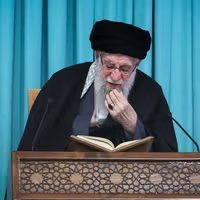
Iran is capable of producing nuclear weapons and an existential threat could cause a rethink of the Supreme Leader's injunction against them, one of his top foreign policy advisors told Lebanese news outlet Al Mayadeen.
"If the Islamic Republic of Iran faces an existential threat, we would have no choice but to adjust our military doctrine," Former foreign minister Kamal Kharrazi said in an interview with the pro-Tehran channel.
"We already have the technical capabilities to produce weapons; only a religious decree forbidding nuclear weapons prevents us from doing so," he added, referring to a religious decree by the country's ultimate decision maker Ali Khamenei.
Kharrazi heads the Strategic Council on Foreign Relations and has hinted before that Iran could ditch its stated opposition to acquiring nuclear weapons but was offering his first public remarks since Israeli air strikes on Iran on Oct. 26.
Members of the body he leads are by handpicked by Khamenei and its reports and advisories have often presaged major policy shifts by the ruling system.
Iran has maintained that it will not pursue nuclear arms because the 2010 fatwa banned all weapons of mass destruction including nuclear bombs. The decree could potentially be interpreted by Iranian decision-makers as an advisory opinion lacking legal status, however.
Israel launched air strikes on military targets in Iran over the weekend in response to a missile barrage Tehran fired on the Jewish state on Oct. 1.
The attack hit missile facilities and air defense capabilities, killing four Iranian soldiers and a civilian.
Kharrazi told Al Mayadaeen that Iran would seek to expand the reach of weapons. "There’s a possibility that Iran may increase its missile range," he said.
Upping Iran's official rhetoric, all three top leaders of Iran's Islamic Revolutionary Guard Corps on Thursday said a damaging counterstrike to Israel by Tehran was assured.
Former three-term parliament speaker Ali Larijani says that infiltration in Iran has become a serious concern, as recent months have seen Israel assassinate top leaders of Hamas and Hezbollah and severely degrade their military capabilities.
"The issue of infiltration in Iran has become serious in recent years. In my opinion, there has been some neglect over the years. Although the country’s security sectors have dealt blows to these activities, they haven’t been able to prevent all of them. In any case, it’s an important matter that they are currently pursuing with various precautionary measures,” Larijani said in a lengthy interview with Khabar Online website in Tehran.
He cited the assassinations of nuclear scientists in Iran over the past fourteen years as potential examples of Israeli infiltration, along with the targeted killing of Hamas leader Ismail Haniyeh in Tehran and Hezbollah leader Hassan Nasrallah in Beirut.
Larijani and his two brothers were influential figures within Iran’s ruling establishment until 2020, when Supreme Leader Ali Khamenei sidelined them from key political positions. His media appearance at a juncture when confrontation with Israel is intense, could signal his desire to become more visible on the political arena.
Larijani also blamed the United States for the October 26 Israeli air strikes on Iran, which reportedly crippled its air defense capabilities. This now allows Israel to conduct additional strikes, if necessary, with reduced risk to its air assets. Facing a difficult situation, Iran is now threatening retaliation.
"In the situation we find ourselves in, we must first acknowledge that this confrontation was initiated by the Americans and Israelis. The Americans are the active players, while the Israelis act as their tools. In this recent aggression against Iran, it has become evident that the Americans provided both the intelligence and the equipment to the Israelis," the former parliament speaker said. Other Iranian officials have also blamed the since the October 26 air strike.
Larijani also defended Iran’s policy of having proxy forces beyond its borders, saying it is justified on the grounds of defending national interests, an argument often voiced by Iranian officials. "Defending your national security beyond your own borders is not a weakness; it’s a strength. Of course, it comes with consequences. You must accept the costs involved, but you also reap the benefits in return."
In fact, the supposed benefits of proxy wars are increasingly coming into question, as Israel weakens Hamas and Hezbollah, forcing the Islamic Republic into a defensive stance within its own borders.
Asked about the impact of targeted killings by Israel that has eliminated dozens of top and middle ranking Hezbollah, Hamas and IRGC officers and operatives, Larijani conceded that it is a serious issue.
"It certainly has an impact, but a distinction must be made between two levels. In the short term, it’s a loss—no doubt about it. In the case of certain individuals, it’s also a long-term loss." Larijani spoke about Qasem Soleimani’s targeted killing by the US in January 2020, characterizing it as a major loss.
"Like Haj Qasem, like Mr. Nasrallah himself. The martyrdom of these individuals is a long-term loss, meaning they cannot be easily replaced. However, what’s important is recognizing the difference between short-term and long-term losses,” he said. The loss of younger cadres in Gaza or Lebanon is also damaging, but Israel and the West do not realize that these are just young fighters who will be replaced, Larijani argued.
A report by the United Nation's new special rapporteur on Iran’s human rights highlighted the country's fraught record and called for increased transparency and accountability from the government.
The report, presented by Mai Sato, marks the first submission since she assumed the role in August 2024. It outlines issues such as the use of the death penalty, suppression of civil liberties, and gender-based discrimination, while proposing constructive engagement from Iran with international human rights bodies.
In her report, Sato identifies three primary areas of concern: transparency, the right to life, and gender equality. She emphasizes that Iran continues to experience “deficits in the administration of justice such as the independence of the judiciary and the lack of accountability and impunity for human rights violations; practices that amount to torture, cruel, or degrading treatment of detainees”.
Citing a lack of access to accurate data and limited responses to international inquiries, Sato advocates for a gender-sensitive and intersectional approach to address these embedded issues.
According to the report, Iran maintains one of the highest execution rates globally, with at least 93 executions in August 2024 alone. Sato notes, “The International Covenant on Civil and Political Rights, to which Iran is a party, restricts the application of the death penalty to ‘most serious crimes,’ understood as intentional killing”.
She argues that Iran’s judicial process often falls short, citing cases where dissidents face the death penalty on broadly defined charges like “spreading corruption on earth”.
Amnesty International reports that Iran executed 853 people in 2023, marking the highest number in the last eight years—a 48% increase from 2022 and a 172% rise from 2021.
A blindfolded man stands on a platform moments before his public execution in Iran
This surge in executions reflects a broader strategy by Iran’s Islamic government to instill fear and stifle dissent. Since the 2022 nationwide protests sparked by Mahsa Amini’s death in morality-police custody, the regime has weaponized the death penalty to crush opposition and tighten its authoritarian control.
Gender discrimination and Woman, Life, Freedom movement
The report features a worsening human rights climate for women in Iran, particularly with the government’s enforcement of hijab laws. Sato writes, “while the wearing of hijab can be encouraged as a reflection of the right to freedom of religion or belief, it should not be made compulsory by law with penalties for those who do not comply.”
Iran's Guardian Council has approved the contentious Hijab and Chastity Bill, now awaiting a vote in Parliament, as the country confronts the looming threat of an Israeli attack that could challenge national unity.
Introduced by President Ebrahim Raisi's government in July 2023, the Hijab and Chastity Bill imposes strict penalties for non-compliance with mandatory hijab laws. First-time offenders would be fined 30 million rials (about $50), with the amount automatically deducted from their bank accounts. Repeat violations could incur fines of up to 240 million rials ($400), a significant financial strain in a country where average monthly salaries range from $200 to $250.
Iran’s stance, as noted in its response, argues that “The rule of hijab and Islamic covering in Islam is intended to ensure the safety of women and to enable their broader participation in society.” The government describes the hijab as a measure “to ensure the safety of women and to enable their broader participation in society”. Sato counters that “women who do not wish to wear a hijab have the right to participate in the community,” and deserve “their safety and autonomy preserved whether a hijab is worn or not”.
International cooperation and civil society engagement
While recognizing some incremental reforms in Iran’s penal laws, Sato says that civil society groups “are engaged in working on the human rights situation in the Islamic Republic of Iran, both inside and outside the country”. She stresses the need for increased collaboration, expressing that “incremental steps towards the implementation of human rights can be identified, and assessed in a holistic manner”.
In conclusion, the report urges Iran to ratify key human rights treaties, including the Convention on the Elimination of All Forms of Discrimination against Women and the Convention Against Torture, as part of a renewed commitment to international human rights standards.
Iran's government has lifted a two-year ban on iPhone registration to permit legal imports, yet the decision to maintain high tariffs has raised doubts about its motives.
Critics say the current 96 percent tariff, which President Ebrahim Raisi's government imposed in 2022 on all handsets worth 600 Euros or more, can earn Masoud Pezeshkian’s government tens of millions of dollars so the decision to lift the ban was only made to help reduce the budget deficit.
If the government decides not to lower the high tariffs, it will make more money from the sale of every iPhone than Apple which makes the phones, they say. One comment on social media said when you buy an expensive mobile phone, you also buy one for the government.
The Minister of Telecommunications Sattar Hashemi announced the decision to lift the ban on registration of new models of iPhones (14 and above) in an X post Wednesday.
Ebrahim Raisi’s government banned the registration of iPhones 14 and above in 2022 and began cracking down on retailers that sold these models. The decision immediately pushed up the price of iPhone 13 on which mobile operators were still allowed to activate SIM cards.
Iranian media say huge numbers rushed to Divar, an online marketplace similar to eBay, immediately after the minister’s announcement Wednesday to sell their iPhone 13s. This model had been more expensive than the banned higher models in the past two years and its price can hugely drop if newer models become available.
Hardliners are opposed to iPhone imports mainly because Iran's Supreme Leader Ali Khamenei slammed Hassan Rouhani's government in August 2020 for allocating foreign currency to import “a certain luxury American mobile phone”.
Some also allege that using iPhones means providing Iranians' private information and data to an American company (Apple) and eventually the American government. This could have been one reason why Khamenei suggested banning iPhone imports. However, smuggles high-price models always trickled in.
The Pezeshkian government’s decision to lift the import ban initially created a wave of optimism in the Iranian mobile phone market, sparking quite a stir on Persian-language social media among iPhone enthusiasts and among around a million who own iPhones 14 and above who have been unable to register their phones and buy SIM cards in the past two years.
Many saw the lifting of the ban on iPhone imports as an achievement for Pezeshkian's government and a prelude to the lifting of internet filtering, one of Pezeshkian’s top campaign promises. He has so far failed to make the promise true due to the huge resistance of other state bodies involved in the matter.
“Lifting the ban on iPhone [imports] is an important and promising step toward removal of bigger restrictions. People's trust in the government's [abidance by its] promises to fix filtering will increase with this move,” the moderate conservative Asr-e Iran news website wrote immediately after the minister announced that the ban had been lifted.
The optimism, however, gave way to disappointment a few hours later when a government announcement revealed that the Raisi government's 96 percent import tariff on mobile phones worth 600 Euro and more would still apply.
Government Spokeswoman Fatemeh Mohajerani soon reacted to the criticisms on X to calm the market. She stated that a mistake had occurred about the tariffs and that a decision was to be made and announced in the coming days.
Registration of all imported mobile phones on a government portal was made compulsory in 2019 by the government of Hassan Rouhani which said the plan was adopted to stop the sales of contraband handsets.
This meant that the International Mobile Equipment Identity (IMEI) of all imported devices, or those brought into the country by their owners from abroad, had to be registered to allow sim card activation by mobile operators.
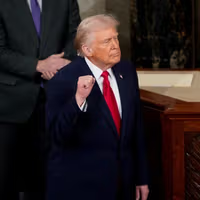
Days before the US presidential elections, foreign policy experts and commentators in Tehran are expressing varied opinions on how a win by Donald Trump or Kamala Harris could impact Iran.
These commentators are individuals permitted by Iran’s Islamic establishment to voice opinions in the media, particularly on sensitive issues like foreign policy. For months, many in government-controlled media have voiced concerns about the possibility of a second Trump term, given his hardline stance toward the Islamic Republic during his first tenure.
Foreign policy analyst and former lawmaker Shahryar Heidari told Tehran's conservative Nameh News website that Donald Trump’s election would likely escalate tensions in the Middle East.
Heidari suggested that, in contrast, Kamala Harris would approach the West Asian region with more caution. However, he emphasized that US policy in the region is largely consistent, regardless of who is elected; what may shift, he explained, are the tactics used to implement that policy.
Heidari added that “both Trump and Harris fully support Israel, though Trump’s rhetoric is more hardline.” He concluded that it ultimately makes little difference for Iran whether Trump or Harris is elected. However, a Trump victory would likely have a more significant psychological impact on Iranian officials, despite his seemingly milder stance in recent weeks. His unpredictability, nonetheless, could lead to escalating tensions in the region.
Tehran-based expert and commentator, Ali Bigdeli
International relations analyst Ali Bigdeli contended that nothing is certain in politics, so it cannot be said with confidence that Trump’s election would lead to a war between Iran and the US. He described Trump as a businessman for whom the US economy remains the top priority.
Currently, the situation of US economy is not that great, he argued, and the country is having problems about inflation and immigration. The voters believe the Republicans are more likely to be focused on domestic political issues.
Generally, Bigdeli opined, Iran may favor Harris as the next US president, as Tehran has historically had better relations with Democrats. Many Iranian politicians view Trump as a challenging leader; he was the one who withdrew from the nuclear agreement with Iran, resulting in significant issues for Tehran due to the sanctions he imposed.
Bigdeli also said that Iran is not going to like any of the two candidates anyway. Iranian officials tend to view any US government as "enemy." Nonetheless, Iran is not likely to favor Trump over Harris as he has closer ties with Israel.
Iran's former ambassador to London, Jalal Sadatian, told reporters that neither Trump nor Harris is likely to seek war with Iran. He noted that while Israel has consistently pushed for a US-Iran conflict, the United States has so far refused to engage in such a war.
Political analyst Jalal Sadatian in Tehran
Sadatian also remarked that polls indicating a lead for one candidate aren’t always reliable, as not everything in a US election depends solely on the popular vote. He added that, given Trump’s past dealings with Iran, there is a general expectation in Iran that a Trump victory would lead to challenging times for the country.
He added that Israeli Prime Minister Benyamin Netanyahu prefers Trump as he was the only US President who supported Israel's decision to move its capital to Jerusalem. However, Sadatian also pointed out that the whole political establishment in the United States is Israel's strategic ally and it does not matter which party wins the election.
“While presidents from both parties have initiated wars, one could argue that Democrats are typically ‘doves’ and Republicans ‘hawks,’” Sadatian remarked. He added that, despite the United States' longstanding support for Israel, politicians understand that any war with Iran would harm US interests in the region.
Another foreign policy analyst, Ghasem Mohebali, commented, “Trump is closer to Israeli radicals, but this doesn’t necessarily mean he supports the idea of war with Iran. Even if Trump wins the election, negotiations with Iran can’t be ruled out, although the situation is very different from 2015.”
Mohebali emphasized that the United States is reluctant to enter a war with Iran, as it would harm US interests. Conversely, he noted, Russia and China—who stand to benefit from such a conflict—might directly support Iran to strategically weaken the United States.