Khamenei vows 'crushing response' against US and Israel
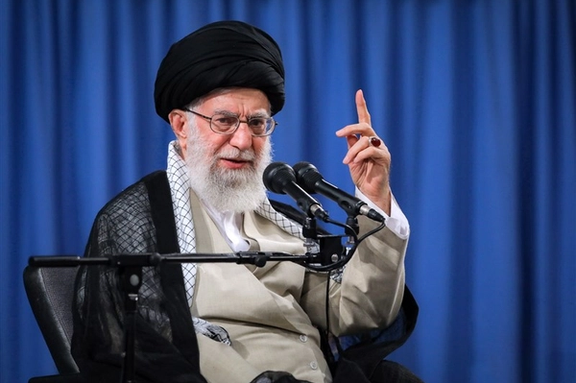
Iran's Supreme Leader Ali Khamenei
Iran’s Supreme Leader Ali Khamenei said on Saturday that the Islamic Republic of Iran is committed to preparing for confrontation with the United States and Israel through military and political measures.
“We are fully committed to preparing the Iranian nation in every necessary way to confront arrogance,” Khamenei said on Saturday, referring to the US and Israel. “Whether in terms of military readiness, weaponry, or political efforts, thank God, officials are actively engaged in these efforts.”
Iranian government-controlled media carried a uniform news item with the headline, "The United States and the Zionist regime will certainly receive a crushing response."
Since 1979, Iran's Islamic government has used the term "global arrogance" to describe the United States, conveying a meaning similar to imperialism.
Khamenei’s comments came during a speech to students on the anniversary of the 1979 attack on the US embassy in Tehran, a date remembered for the seizing of US diplomats and citizens and holding them hostage for 444 days.
Israel launched airstrikes on Iranian military targets on October 26 in response to missile attacks from Iran on October 1. Israeli airstrikes targeted missile facilities and air defense systems, resulting in the deaths of at least four Iranian soldiers and one civilian. Iranian officials have vowed to retaliate against Israel in the next few days.
“This is not merely about revenge; it is a logical movement, a confrontation aligned with religion, ethics, Sharia, and international laws. The Iranian people and the country’s officials will not show any hesitation or leniency in this regard. Be assured of this,” added Khamenei.
His words were echoed by former Iranian Foreign Minister Kamal Kharrazi and Khamanei’s advisor, who, in a recent interview, suggested that Iran’s military doctrine could shift if faced with an existential threat.
Kharrazi, now head of Iran’s Strategic Council on Foreign Relations, said, “We already have the technical capabilities to produce weapons; only a religious decree forbidding nuclear weapons prevents us from doing so,” referring to a ruling by Khamenei against nuclear arms.
IRGC Spokesperson Mohammad Naeini also on Saturday threatened that a firm response will be delivered to Israel’s attack.
"A decisive and firm response will be given to the new act of aggression by the enemy," he said.
"Israel's miscalculation is thinking that Iran fears direct confrontation and will leave military attacks unanswered," he added.
Israel's October 26 air strikes inflicted significant damage on Iran's air defenses and missile production facilities, the Wall Street Journal reported on Saturday, quoting American and Israeli officials. This has left the country vulnerable should it decide to launch a retaliatory attack against Israel in the coming days.
This time, Israel can operate with impunity, sending aircraft deeper into Iranian airspace and targeting nuclear facilities, additional military sites, or economic assets. An expert told the Wall Street Journal that Iran’s focus now is more on defending itself than on retaliating against Israel.
Ahmad Alamolhoda, the firebrand Friday imam of Mashhad, marked the anniversary of Iran’s 1979 hostage crisis by boasting that Iran pioneered global anti-American sentiment, referencing the 444-day captivity of American hostages.
"We have exported the anti-Americanism movement so effectively that, beyond influencing Islamic societies, the resistance to imperialism and animosity toward the United States have evolved into global phenomena, even resonating within America itself," Alamolhoda, Supreme Leader Ali Khamenei's representative in the city of Mashhad, said during his Friday sermon.
Iranian officials have often taken pride and praised anti-Israel and anti-US protest in Western countries since the Hamas invasion of Israel in October 2023. Over the past four decades, the Islamic government has spent enormous resources to create and support groups throughout the Middle East to fight against Israel and Western influence.
The Iran hostage crisis, unfolding from 1979 to 1981, saw militants seize 66 American citizens at the US embassy in Tehran, holding 52 of them captive for 444 days. Taking place in the turbulent wake of Iran's Islamic Revolution and the collapse of the Pahlavi monarchy, the crisis left a lasting scar on US-Iranian relations, profoundly straining diplomatic ties for years to follow.
Highlighting the initial criticism of the act, even from supporters of the Islamic Revolution within Iran, Alamolhoda said, “At the time, many circles viewed this move as a profound error, claiming that we had invited misfortune upon ourselves.”
He continued, “Yet today, we are acknowledged as a formidable regional power, having not only consolidated our internal strength but also cultivated a vast network of resistance across Islamic societies.”
One of the officials criticizing the action is the controversial former President Mahmoud Ahmadinejad. In a June interview, he questioned, "For how much longer do we desire to remain in conflict with the US?" He lamented, "Following the revolution, there was potential to resolve matters with the US, but certain individuals occupied the embassy, complicating matters."
Also, former lawmaker and outspoken politician Ali Motahari said in 2021 that it was "an unnecessary move instigated with the provocations of leftist groups to serve the interests of the Embassy of the Soviet Union and the Tudeh Communist Party."
A cyber group linked to the Islamic Revolutionary Guard Corps (IRGC) is actively attempting to influence the upcoming US presidential election by targeting hotly-contested states key to the outcome, researchers told Iran International.
The findings by cybersecurity researcher Nariman Gharib and whistleblower group Lab Dookhtegan show the IRGC’s cyber unit Emennet Pasargad is carrying out a campaign to “disrupt and incite tension in the elections, particularly in swing states,” according to their joint report.
Since 2024, the group - also known as "Shahid Shoushtari" - has been actively gathering intelligence on swing states. It has reportedly sent direct messages to US Senate candidates in one of these pivotal states with the intent of disrupting the electoral process.
“This is not the first time this particular Iranian cyber group is targeting a US Presidential Election,” Gharib told Iran International on Friday.
The United States previously sanctioned Emennet Pasargad which prohibits US entities from conducting business with the group, accusing it of disinformation spread online, including interference in the 2020 presidential election
The State Department's Rewards for Justice program also offers up to $10 million for information on its activities.
Last month, the US Treasury sanctioned seven agents working for the Islamic Republic, for efforts to influence the US presidential elections in 2020 and 2024.
An IRGC member named Masoud Jalili along with six members belonging to the Emennet Pasargad cyber group -Ali Mahdavian, Fatemeh Sadeghi, Elaheh Yazdi, Seyyed Mehdi Rahimi Haji Abadi, Rahmatollah Askarizadeh, and Mohammad Hossein Abdolrahimi - were included on Washington's sanctions list.
According to Gharib, Emennet Pasargad’s new campaign focuses on "disrupting the voter registration process, contaminating voting systems, spreading rumors, creating chaos, and ultimately damaging the infrastructure of US elections."
The latest Microsoft Threat Analysis Center (MTAC) research related to the US elections released in October said Iran is gearing up for additional influence operations.
“Iranian groups tasked with targeting the US elections may make an effort—as they have in the past—to run influence operations both shortly before and soon after the election by leveraging cyber intrusions from weeks to months prior,” the report said.
In her first reaction to her father’s sudden execution in Iran this week, Gazelle Sharmahd was mute but spoke volumes with her silence.
Staring into a camera for a post on X, she pinned a mythological symbol evoking Iran's ancient glory onto her shirt and tied back her flowing hair - a symbol of female freedom in the crosshairs of hijab laws back home.
Speaking to Iran International, Gazelle described herself as being in flight or fight mode and not yet fully grasping the loss of her father, Jamshid Sharmahd.
“I'm not feeling anything. I'm just in shock,” she said.
She is haunted by questions and demands proof of her father’s death.
“How did they execute him? Was he poisoned? Did he die under torture?”
According to high-ranking German authorities the Foreign Minister of the Islamic Republic alleged that “Jimmy died” but the lawyers of his family are still awaiting verification of what really happened.
Gazelle said her father was an activist and journalist who opposed the Islamic Republic and fought them using his expertise as a software engineer to create a website where Iranians inside the country could report human rights abuses.
He created VPNs and helped secure IP addresses so they wouldn’t get tracked by the government, Gazelle said.
Gazelle Sharmahd, along with her father Jamshid and mother.
Authorities accused him of terrorism for allegedly orchestrating a series of deadly bomb attacks inside Iran. He had been living in the United States for the past two decades.
Gazelle and leading human rights experts have denied the charges, saying confessions at his trial were made under duress and that his activism and criticism of the Islamic Republic made him a target.
A United Nations human rights expert in 2022 described Jamshid’s detention as arbitrary, and Amnesty International referred to his trial as a sham.
Gazelle Sharmahd and her father Jamshid.
Fear beyond borders Jamshid Sharmahd's case represents the peril faced by Iranian dissidents far beyond its borders.
In 2020, journalist Ruhollah Zam, a French citizen, was executed in Iran after being lured from Paris to Iraq under the guise of working on a story.
In February 2024, US authorities charged an Iranian national allegedly operating on behalf of the Iran to kill dissidents abroad, and two Canadian men with ties to the Hells Angels biker gang were arrested in an alleged plot to carry out assassinations in Maryland.
Outspoken human rights activist Masih Alinejad was one of them.
In 2021, the FBI thwarted an alleged kidnapping plot against Alinejad and an alleged assassination attempt the following year. The FBI said both plots were linked to Iran.
Criminal gangs operating on the behest of the Islamic Republic of Iran are behind a string of terror attacks on Israeli embassies in Europe since October 7, according to Israeli and Swedish Intelligence agencies.
Abducted in real time
Jamshid was sentenced to death in 2022 for “corruption on Earth,” sparking condemnation from human rights groups and Western governments.
The 69-year-old suffered from Parkinson’s disease and grew up in Germany and spent most of his adult life raising his family in the United States. While on a layover in Dubai in 2020, he was abducted from his hotel by Iranian agents.
Gazelle said she saw the entire kidnapping unfold from her father’s google tracker.
“We could see how his taken from his hotel room to the border to Oman to the coast of Oman. And then the tracker breaks off,” she said.
The German government announced Thursday that it would close three Islamic Republic consulates in response to the execution of the dual citizen. Germany’s foreign minister called it an assassination.
In an email to Iran International, a US State Department spokesperson said the US joins Germany in condemning his execution and supports their move in shutting down Tehran's consulates.
“Sharmahd’s execution was an abhorrent act by the Iranian regime and underscores that the record pace of unjust executions in Iran continues unabated, despite Iran’s attempts to promote a gentler face to the international community.”
Gazelle said she doesn’t need kind words and condolences and feels abandoned by both governments.
She questions why the Biden administration did not include her father in a 2023 prisoner swap that freed 5 American citizens. Now, it's too late, she lamented.
As she tries to process her loss, she said she will continue to call for justice and keep up what she described as her father’s legacy.
“He never will give up and we will never give up. You cannot break a freedom fighter.”
Four militants were killed and eight others arrested in a joint operation by the Islamic Revolutionary Guard Corps and the Islamic Republic's intelligence ministry in the restive southeastern province of Sistan-Baluchestan, the IRGC announced on Friday.
"Iranian security forces struck several terrorist teams in Sistan-Baluchestan province during the ongoing 'Martyrs of Security' drill by the IRGC Ground Force," said General Shafaei, the spokesperson for the exercises.
"Eight members from four terrorist teams were arrested, while four were killed".
The operation came less than a week after the insurgent Sunni Baloch group Jaish al-Adl killed ten Iranian border guards in Taftan County.
The Jaish al-Adl attack was condemned by the United Nations Security Council as a "cowardly terrorist attack."
Iran's Sistan-Baluchestan province has been the site of numerous attacks attributed to Jaish al-Adl, a group known for its history of ambushes, bombings, and other violent operations, resulting in the deaths of both civilians and security personnel.
Jaish al-Adl advocates for an independent Balochistan that encompasses Baloch populations on both sides of the Iran-Pakistan border. The group has conducted numerous armed attacks in Iran's southeast.
In January, the Islamic Revolutionary Guard Corps said it had launched missile and drone attacks against the militant group's bases inside Pakistani territory, a rare cross-border attack which outraged Pakistani officials and prompted Islamabad to launch airstrikes against several locations in southeastern Iran.
Germany's intelligence services are investigating alleged espionage activities involving 700 people linked to the Iranian state-run Al-Mustafa Institute in Berlin, according to the Bild newspaper.
The report coincides with diplomatic tensions between Berlin and Tehran, following the execution of German-Iranian citizen Jamshid Shahrmad on October 28.
Bild previously reported that the Berlin-based Al-Mustafa Institute is a key focus of German authorities as they investigate whether it serves as a recruitment platform for Tehran.
In its latest report, partially titled "Mullahs are Spying in Germany," Bild claims that German investigators are examining three secret lists of names. These reportedly include a list of 63 individuals holding German passports, a student directory from the international Al-Mustafa University containing 551 people connected to Germany, and a list of 78 trainees from Germany. The newspaper did not disclose the source behind this report, stating only that it relied on information in its possession.
The German domestic intelligence agency did not immediately respond to a request for comment from Iran International.
When asked for comment, a spokeswoman for Germany's domestic intelligence agency (BfV), Isabelle Kalbitzer, told Iran International she could not provide further details on the matter. She added that inquiries regarding potential actions, such as a ban on the Berlin-based Institute, should be directed to the Federal Ministry of the Interior.
Since the 1979 Islamic Revolution, Iran's clerical establishment has used religious organizations to bolster its influence in the West, with the Al-Mustafa International University playing a key role through its branches in numerous countries, including Germany.
The Al-Mustafa Institute in Berlin, founded in 2016, requests donations via PayPal on its website to "directly support projects that aim to make well-founded Islamic knowledge more accessible in German-speaking regions."
In 2020, the US sanctioned the Iran-based university, noting that the Quds Force—the overseas operations arm of the Islamic Revolutionary Guard Corps (IRGC)—utilized the university's foreign branches for "intelligence collection and operations," including recruiting for pro-Iranian militias. The US Treasury said the University was also being sanctioned for having materially assisted, sponsored, or provided financial, material, or technological support for, or goods or services to or in support of the Quds Force. The Quds Force is known to be a significant financial backer of terrorist organizations, including Hamas and Hezbollah.
In 2023, the dean of Iran's Al-Mustafa University publicly said that some officials of the new Taliban rule in Afghanistan have studied at the institution.
When asked to comment on the claims in Bild’s report, Julia Linner, a spokeswoman for Germany’s foreign intelligence service (BND), told Iran International, “As a matter of principle, the [BND] never publicly comments on matters that concern potential intelligence information or activities. This does not amount to a statement on the accuracy of the facts. The [BND] reports to the Federal Government and the competent secret committees of the German parliament on relevant topics.”
In response to Bild’s report, conservative members of the opposition parties in Germany’s parliament have called for action, saying Interior Minister Nancy Faeser should shut down the Al-Mustafa Institute.
Christian Social Union MP Alexander Dobrindt said, “Iranian Islamist institutes on German soil should be closed immediately.” He emphasized that the threat from Iran is “obvious” and added, “The interior minister must no longer ignore this.” Dobrindt urged Faeser to “immediately ban these facilities.”
Christian Democratic Union MP Christoph de Vries, an expert on intelligence services, said that Faeser must explain “why she hasn’t closed the Mustafa Institute in Berlin long ago, while the organization has been on the sanctions lists in the USA and Canada for years.”
Iranian-German dissidents have also urged the federal government to close the Al-Mustafa Institute.
Wahied Wahdat-Hagh, a political scientist and expert on the Islamic Republic, told Iran International that the Al-Mustafa Institute “is apparently not a religious university, but an Iranian-Islamist propaganda center that is run by the Quds Force unit of the Revolutionary Guards. There are said to be around seventy centers worldwide and the task of these centers is to attract international forces for terrorist activities in Europe and to recruit worldwide.”
“This means that the Islamic Revolutionary Guard's networks will be expanded worldwide in such centers. Apart from this, spies were trained, recruited and led by the Quds Force unit in this center. Such spies obviously have the task of spying on Iranian exiles and opposition members or other objects that may be important for the totalitarian Islamist dictatorship and possibly defining them as terrorist targets,” he added.
Wahdat-Hagh, who supports the closure of the Institute in Berlin, also noted that “it is closely involved and works together with the banned Islamic Center Hamburg and more importantly with the University of Religions and Denominations, which also has a close cooperation with German universities.”
In July, Germany shut down the Imam Ali Mosque, operated by the Islamic Center Hamburg (IZH), for propagating extremism.
Activist Mina Ahadi, who lives in Cologne, told Iran International the “Mustafa Institute is part of the Iranian regime” and she and others have protested against its existence.
She added the Mustafa Institute “seeks to win over people from Lebanon and Afghanistan and turn them into terrorists.” She said some of these recruits have been sent to fight in Syria on behalf of the pro-Iran government Assad regime.
According to Wahdat-Hagh, “Such centers in Iran and around the world also ideologically train Islamist forces in order to join pro-Iranian terrorist groups such as Fatemiyoun, an Afghan paramilitary unit led by the Quds Forces that have experience in Syria, or the Pakistanipro-Iranian Zainebiyoun, or even the Houthis. They are propaganda centers for the export of the Islamic revolution, that is, for the export of terrorism.”
Ahadi, who has been targeted due to her opposition to the Iranian state, says she believes there are far more than the reported 700 spies working for the Mustafa Institute
Iran International sent requests for comment to the Al-Mustafa Institute, but they were not returned.