Maximum pressure on Iran will return, Trump's adviser says
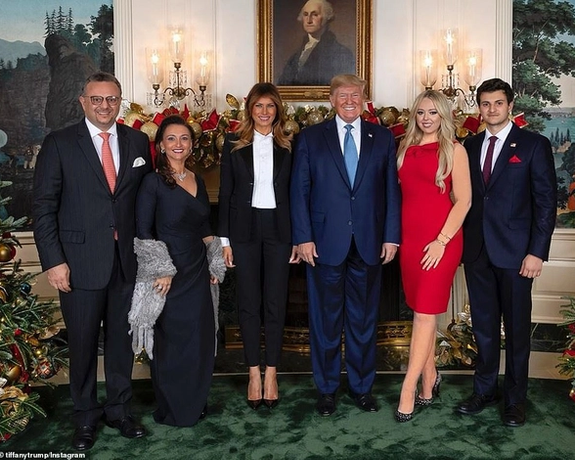
Donald Trump's new Middle East advisor Massad Boulos (left) attends a holiday party hosted by Donald Trump at the White House in 2019
US president-elect Donald Trump will revive his maximum pressure strategy in dealing with Iran, his freshly appointed senior adviser on the Middle East Massad Boulos said, in the clearest indication yet the incoming administration would enforce Iran's isolation.
“Of course, he will once again pursue his maximum pressure [campaign] against Iran,” Boulos told the French outlet Le Point, adding that Trump will be open to diplomacy alongside his firm approach.
“[He] is very clear that he absolutely does not want Iran to have a nuclear program,” he said, and would be “ready to run serious negotiations” with Tehran to achieve that goal.
Trump in his first term followed a range of measures to weaken Iran’s economy and curb its regional influence. He withdrew the United States from the nuclear deal with Tehran but did not initiate talks that would lead to another agreement.
During his 2024 election campaign, Trump struck a diplomatic tone, saying he did not intend to harm Iran if his red line was not crossed.
“My terms are very easy. Iran can't have nuclear weapons” he said, casting his vote. “I’d like them to be a very successful country,” without going into details of his plans for US-Iran relations.
The relationship between Washington and Tehran remains deeply strained, marked by proxy conflicts across the Middle East. Both sides have traded accusations of fueling instability, further complicating any diplomatic overture.
The ongoing hostility has not made Trump consider regime change in Iran however, according to his senior adviser Boulos.
“He did not talk about regime change but only about a nuclear agreement,” Boulos told Le Point referring to his conversations with the president-elect.
Boulos is a Lebanese-American businessman and the father-in-law of Trump's daughter Tiffany. He may prove to be an important player in shaping the incoming US administrations’ policy in that region.
His appointment adds another voice deeply skeptical of Iran to a foreign policy team deeply supportive of the Islamic Republic's arch-foe Israel.
A top Iranian diplomat warned Tehran would withdraw from the Nuclear Non-Proliferation Treaty if a so-called snapback mechanism renews the UN sanctions lifted by a 2015 nuclear deal, underscoring Iran's determination to avoid being pressured into ditching its nuclear ambitions.
"In case of a snapback reinstatement, one of the options we proposed was withdrawing from the NPT ... we could leave the treaty," deputy foreign minister Majid Takht-Ravanchi was quoted as saying by a parliamentary spokesman on Tuesday.
The remarks followed Takht-Ravanchi's discussions in Geneva with representatives from the UK, France, and Germany — the three European signatories to the 2015 Iran nuclear deal, the Joint Comprehensive Plan of Action (JCPOA).
"We did not negotiate in Geneva because we had no text, and there was no text to negotiate on," Takht-Ravanchi said.
The Geneva talks were held in the wake of a controversial resolution passed by the International Atomic Energy Agency's (IAEA) Board of Governors, which calls for a report on Iran’s nuclear program and its lack of full cooperation with the IAEA by spring 2024.
This resolution could trigger the activation of the snapback mechanism, a provision within the JCPOA that would automatically restore international sanctions on Iran and potentially bring the country under Chapter VII of the United Nations Charter.
"Unfortunately, our enemies have made Iran’s nuclear file very complicated and politicized," said Behrooz Kamalvandi, spokesperson for Iran's Atomic Energy Organization.
The breakdown in negotiations between Iran and the three European countries reflects broader diplomatic tensions. Efforts to revive the JCPOA, which collapsed after the United States withdrew under President Donald Trump in 2018, have stalled under Presidents Hassan Rouhani and Ebrahim Raisi.
"We have no intention of negotiating with Washington at this time, as there is no basis for such talks," Iranian Foreign Minister Abbas Araghchi said recently, adding that Iran would reassess its approach once the new US administration’s policies become clearer.
However, some within President Masoud Pezeshkian’s administration have shown interest in potential talks with the United States, particularly those aligned with the more moderate camp.
Among them, Mohammad Javad Zarif, Pezeshkian's strategic deputy, wrote in an article in Foreign Affairs magazine that Trump should pursue an agreement that benefits both sides.
“The West needs a more constructive approach—one that takes advantage of Iran’s hard-earned confidence, accepts Iran as an integral part of regional stability, and seeks collaborative solutions to shared challenges," he wrote. "Such shared challenges could even prompt Tehran and Washington to engage in conflict management rather than exponential escalation.”
Iran's president says the country seeks greater cooperation with Beijing and Moscow to confront what he called Washington's unilateralism, just a few weeks before Donald Trump restores his so-called maximum pressure policy aimed at isolating Iran.
"The United States pursues authoritarianism and unilateralism on the international stage," Pezeshkian said in a meeting on Wednesday with China's vice premier Zhang Guoqing in Tehran.
"We are determined to expand our cooperation with China and Russia to counter unilateralism," the Iranian president said.
The government is working to implement the 25-year agreement between Beijing and Tehran, he said.
Announced in 2016, the comprehensive strategic partnership aimed to increase bilateral trade to $600 billion by 2026. However, trade volume reached just $12.5 billion last year according to the International Monetary Fund.
China remains Iran's largest trade partner and purchases nearly all of Iran's crude oil in defiance of US sanctions. Nonetheless, Chinese companies have secured substantial contracts with other regional players, including Saudi Arabia and the UAE, totaling billions of dollars.
The Iranian currency hit an all-time low of 719,500 rials to the US dollar on Wednesday, marking the fourth record drop since September, when Tehran began losing influence in the region to Israel and other players.
Compared to the same date last year, when the dollar was valued at 504,000 rials, the current rate represents a staggering 43% rise.
The rial began trading at 716,000 to the dollar on Wednesday morning but surged to nearly 720,000 rials by noon. Tether, which is an equivalent of US dollar in crypto markets, was being traded at 726,000 rials on the same day.
One notable shock to the currency market came on November 6, when the dollar initially jumped past 700,000 rials following the news of Donald Trump’s victory in the US presidential elections. But the currency began it decline in September after serious blows by Israel against Iran's main regional proxy, Hezbollah and an Israeli air strike that destroyed most of Iran's air defenses.
However, authorities temporarily stabilized the rate below that threshold, most likely by selling foreign currencies to support the rial. The downward trend resumed later that month after the International Atomic Energy Agency’s (IAEA) Board of Governors issued a resolution critical of Tehran for its nuclear program which has breached international regulations, producing 60% enriched uranium as Iran edges ever closer to nuclear weapons capability.
The rial has faced significant volatility throughout the year, influenced by volatility in the region and direct conflict between Iran and Israel.
Iran’s reliance on oil and gas exports for foreign currency earnings has made the country particularly vulnerable to international sanctions. Under Joe Biden’s presidency, sanctions enforcement eased somewhat, offering Tehran a lifeline. But the return of Donald Trump to the White House, combined with Europe’s increasingly tough stance to crack down on Iran's nuclear program, foreshadows greater economic strain for the Islamic Republic.
Inflation in Iran already exceeds 40%, and the rial’s devaluation will exacerbate price hikes, further eroding the purchasing power of ordinary Iranians.
Tens of millions have faced declining living standards over the past five years, with wages lagging behind inflation and around one third of the population now living below the poverty line.
The average worker now earns the equivalent of less than $200 per month, while official data suggests that $500 is the bare minimum required to meet basic needs.
As the dollar’s rise continues, the impact on daily life for Iranians grows more severe. Essential goods and services, already out of reach for many, are likely to see further price increases, deepening economic hardship and fueling public discontent.
An Iranian state TV interview with President Masoud Pezeshkian has sparked debate for its sharp line of questioning and well-worn remarks by a new leader facing deep economic and foreign policy challenges.
Reformist-leaning media in Iran criticized Elmira Sharifi-Moghaddam, a female anchor for state TV channel IRINN, for posing challenging questions to President Pezeshkian about the state of the economy.
Commentators seen as reformists argued that her questions were unfair, overlooking long-standing issues Pezeshkian faces, such as sanctions and a deeply inefficient economic system.
However, the questions raised during the interview were far less probing than those typically posed by European or American TV anchors. The interview's style appeared intentionally crafted to align with state TV's political leanings, closely tied to the ultraconservative Paydari party, whose members are known to influence the broadcaster's newsand current affairs policies.
A former Tehran mayor, Gholamhossein Karbaschi, who owns and runs the centrist daily Ham Mihan, criticized the President's decision to participate in a live one-hour interview on state television.
In an article for Iran, the state-owned newspaper, Karbaschi argued that Pezeshkian should have refused the format dictated by state television, instead asserting control over when and how he addressed the nation
"He should have changed the state TV's game and chosen when and for how long to speak to the public," Karbaschi suggested, adding that Pezeshkian could have delivered "just two sentences to convince the people."
Karbaschi argued that the interview was intended to undermine the president rather than facilitate meaningful communication with the public.
"What we saw on TV was an honest president speaking transparently while facing unfairly challenging questions," he wrote.
The former mayor also accused the anchor of frequently interrupting Pezeshkian and raising provocative topics, such as a potential gasoline price hike, to derail his explanations of the administration’s performance.
Karbaschi further claimed that the president was given limited time to express his views on the controversial hijab law.
Domestic media appeared to express frustration upon realizing that the interview with Pezeshkian, his second since taking office on August 1, differed from those with previous presidents – when anchors typically refrained from challenging their guests and even assisted in portraying their performance in a favorable light. This was especially true in interviews with former President Ebrahim Raisi, much of the media noted.
Conservative columnist Abdoljavad Mousavi commented that "Pezeshkian spoke in the same manner about everything, making it difficult to assess his weaknesses and strengths," but argued that the president spoke with candor and honesty.
In contrast, Amir Hossein Jafari, a columnist for the pro-reform outlet Rouydad24, argued that Pezeshkian's remarks on various issues "hardly convinced the public."
Jafari highlighted key topics addressed in the interview, such as gasoline price hikes, internet censorship, and pressures stemming from the new compulsory hijab law.
"Apart from hijab, the president did not say much about other matters," he noted.
The word "disparity" dominated Pezeshkian's interview, reflecting gaps between the government’s financial resources and expenditures, production and consumption levels, and public expectations versus what the government can realistically deliver.
Throughout the conversation, Pezeshkian emphasized the lack of funding as a core issue. He acknowledged several economic challenges, many of which have escalated into crises, but maintained that there is little the government can do to address these disparities.
Pezeshkian offered no tangible solutions for short- or medium-term problems, instead suggesting measures that would only have been effective had they been implemented years ago.
He frequently remarked, especially regarding cultural issues, "Things should have been addressed when people were in primary school. It’s too late and too difficult to fix them now."
After the interview, Pezeshkian invited feedback on his X account. Many Iranians criticized his approach, calling him too timid.
"You should talk like a hammer!" one social media user urged.
Others expressed discontent over Pezeshkian’s perceived failure to uphold campaign promises, such as improving the economy, lifting internet censorship, and easing pressures on women over the hijab.
As one observer noted, "He has realized that things are not as easy as he thought when he made those promises during his campaign."
Syrian President Bashar al-Assad's forces and Iran-backed militias are deploying to push back Islamist-led fighters from the edge of the city of Hama, Syrian army sources told Reuters, as a shock rebel advance continues southward.
It comes as Russian airstrikes hit civilian areas overnight in a bid to push back fighters gaining ground just kilometers away from the city.
Hama’s fall would put major pressure on President Bashar al-Assad after the capture last week of Aleppo, Syria’s second city.
As rebels in the country continue to advance, the speed of their assault has concerned Assad's allies, with Iran sending Iraqi and Afghan militias to support the long-serving President.
The Syrian government, which has deployed troops around the frontlines of Hama and begun a conscription drive amid the unrest, were supported by Iran-backed Afghan and Iraqi militia. Amid the shortage of troops, checkpoints in Damascus and eastern Deir al-Zor have been put in place to sign up young men to join the army, residents told Reuters.
Tehran is unnerved by the rebel offensive in Syria, as the country serves as a crucial smuggling route for weapons shipments to Hezbollah, Iran's primary military proxy in the region.
Islamic Revolutionary Guards Forces (IRGC) also have outposts there. According to Arabic journal Al Majalla, Iran has 55 military bases in Syria and 515 other military points.
The Israeli military has said it is just 13 bases but says Iran has "appropriated Syrian defense assets". The Atlantic Council also cites camps which are essential to the IRGC such as Damascus International Airport, al-Tayfour Airport, Azraa Base, Sayeda Zeinab Base, al-Kaswa Camp, Zabadani Camp, and al-Qusayr Camp.
Both Russia and Iran have supported the Assad ruling family for decades and between 2015-20 were vital in helping Damascus claw back most of the country from rebel control after they captured swathes of Syria since 2011.
It comes as Russia has been focused on its war on Ukraine and Iran in its proxy war on Israel, which has been surrounded by Iran-backed allies from Iraq, Syria, Yemen, Gaza, Lebanon and the West Bank.
Syria is a key location for both Russia and Iran. Assad is a key link in Iran’s network of Shia militias around the region while for Russia, the naval port of Tartous and Hmeimin air base near Latakia are strategic bases.