Q&A: All you need to know about IAEA resolution against Iran
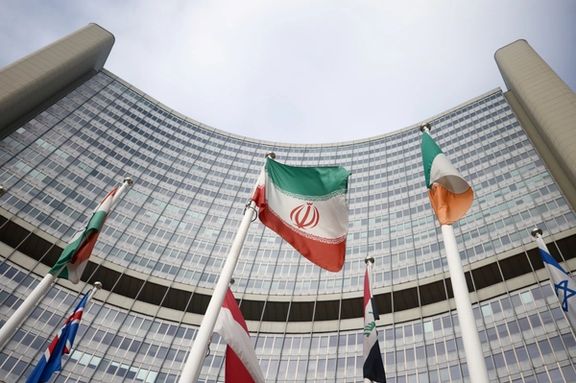
Iran's flag among the flags in front of the IAEA headquarters in Vienna, Austria
The UN nuclear watchdog has censured Iran over its perceived non-cooperation with international inspections, setting the stage for a new phase in the dispute over Iran's activities which could lead toward more sanctions.
Q: What is the IAEA resolution against Iran about?
The International Atomic Energy Agency (IAEA) says it is not convinced that Iran’s nuclear program is peaceful. It has been asking questions and seeking clarification on several issues for years. But many remain unresolved.
On November 21, 2024, the IAEA Board of Governors passed a resolution calling on Iran to urgently improve its cooperation with the agency and provide a comprehensive report on its nuclear activities.
The resolution was proposed by the US, UK, France, and Germany. It passed by 19 votes in favor (of 34). China, Russia, and Burkina Faso voted against and 12 countries abstained.
Q: Is the resolution binding?
No. IAEA resolutions are not legally binding in the way that treaties or UN Security Council resolutions are. However, they are significant politically, signalling a shift in international attitudes and an intent to take further action.
The resolution against Iran may prove a crucial step in building a case for more binding measures. It provides a basis for the parties to the 2015 nuclear deal - Joint Comprehensive Plan of Action, or JCPOA - to claim Iran is violating its commitments and potentially initiate what is known as the Trigger Mechanism.
Q: What is the Trigger Mechanism?
Trigger Mechanism is an informal term for a provision under the 2015 deal that allows signatories to reimpose Iran sanctions that were lifted under the agreement.
Any party can report alleged non-compliance to the Joint Commission, consisting of all current parties to the deal - which oversees the agreement. If the issue isn’t resolved within 35 days, the complaining party can notify the UN Security Council, effectively triggering a process that could result in snapback sanctions
Q: What is snapback?
Snapback refers to the concept that UN sanctions on Iran can be restored automatically.
The Security Council does not have to vote on reimposing sanctions. Once Iran’s case is referred to there, the sanctions that were lifted under the JCPOA will snap back into place in 30 days unless the council votes to continue lifting sanctions.
Q: Who can start this process?
Any party to the 2015 deal can allege that Iran is non-compliant and take their case to the Joint Commission.
The countries that can do so are France, Germany, UK, Russia and China. The United States was also a signatory to the JCPOA, but unilaterally withdrew in 2018 during President Donald Trump's first term.
Q: Who decides if Iran is compliant or not?
The IAEA is tasked with monitoring Iran’s nuclear activities and ensuring compliance with safeguards agreements under the Nuclear Non-Proliferation Treaty (NPT) and the JCPOA. Reports from the IAEA are critical in assessing whether Iran is fulfilling its obligations.
The JCPOA signatories assess Iran’s activities based on IAEA findings and their own intelligence inputs.
In short, the IAEA provides the technical foundation for judgments, but political decisions depend on consensus, or lack thereof, among JCPOA signatories.
Q: Has the Trigger Mechanism been used before?
Yes and no. In January 2020, France, and Germany and the UK (E3) initiated the Dispute Resolution Mechanism, the process that can lead to the Trigger Mechanism, after Iran moved away from some of its JCPoA commitments in response to the Trump administration withdrawing from the deal.
The E3 did not notify the UN Security Council, however, saying that their aim was to convince Iran to respect its obligations, not to impose snapback sanctions.
The West still has an opportunity to pursue engagement and abandon pressure, but Tehran is ready to confront any challenges, spokesperson and deputy head of Iran’s Atomic Energy Organization, announced on Saturday.
Addressing Western nations, Behrouz Kamalvandi wrote in a Tehran newspaper, “There is still time for engagement and for setting aside pressure and threats. While Iran has prepared itself to counter threats, it prefers dialogue over confrontation.”
Iranian officials have condemned a censure resolution adopted during the November 21 quarterly meeting of the UN’s International Atomic Energy Agency Board of Governors. While they claim Iran is ready to negotiate over its nuclear commitments, their calls for dialogue come against the backdrop of years of failed diplomatic efforts by the IAEA and Western powers to address concerns over Tehran’s reduced cooperation with the UN watchdog.
The IAEA Board of Governors approved a resolution proposed by four Western powers condemning the expansion of Iran’s nuclear activities and Tehran’s lack of necessary cooperation with the agency. The resolution passed with a majority vote.
This marked the second resolution adopted against the Islamic Republic by the Board of Governors in the past six months.
On Friday, Kamalvandi responded to the IAEA resolution by announcing a “significant increase” in uranium enrichment levels.
Speaking to state media, he said this step was part of Iran’s “compensatory measures in response to the new Board of Governors resolution” and noted that the process had “already begun immediately.”
The IAEA Board of Governors meeting in Vienna
The spokesperson for Iran’s Atomic Energy Organization stated that the Islamic Republic had informed the IAEA it would respond "immediately": "Before the agency officials left the Secretariat, we informed them, and today we also sent a DIQ (Design Information Questionnaire). This process is ongoing."
Kamalvandi provided details of Iran’s retaliatory measures, saying: "The enrichment sector is the most impacted area, and we are significantly increasing our enrichment capacity."
He added: "We are utilizing advanced centrifuges, accelerating research and development on each of them, expanding infrastructure, and implementing additional measures to enhance security."
Earlier, Ali Larijani, a top advisor to Supreme Leader Ali Khamenei tweeted that if the Trump administration wants Iran to refrain from making a bomb, "They must accept Iran's conditions and grant necessary concessions, including #compensating_Iran for damages and similar measures, to reach a new agreement, rather than issuing unilateral demands."
The escalation of Iran’s nuclear activities comes as the IAEA Board of Governors stated in its resolution that the Islamic Republic has still not cooperated with the agency “clearly and comprehensively” and has failed to take “the urgent and necessary actions outlined in the June 2024 resolution of the Board.”
The Board expressed “deep concern” over the situation, adding: “This lack of cooperation impacts the agency’s ability to ensure and verify the non-diversion of Iran’s nuclear materials toward nuclear weapons or other explosive devices.”
The resolution was adopted shortly after the Islamic Republic formally invited Rafael Grossi, Director General of the International Atomic Energy Agency, to visit Iran on November 11.
Regarding topics raised during Grossi’s visit, Kamalvandi said, "Mr. Grossi proposed during his trip to Iran that we temporarily refrain from increasing our 60% uranium stockpile, although not in a way that stops enrichment at various levels, including 60%."
He added: "We agreed to this with certain conditions, but we made it clear this would only apply if the resolution was not adopted."
Iran has amassed enough uranium enriched at 60% that it can quickly purify to 90% and produce four nuclear warheads, the IAEA and Western countries have said.
The IAEA resolution, combined with likely revival of the so-called maximum pressure campaign of sanctions on Iran from Trump's first term may set US-led Western countries on a collision course with Tehran over the nuclear dossier.
The US dollar surged past the 700,000 rials mark on Saturday again, reversing a brief period of relative stability, after Iran was censured for lack of cooperation with the UN's nuclear watchdog this week.
The milestone highlights the deepening economic strain in Iran, fueled by escalating geopolitical tensions and challenging domestic policy decisions.
A recent resolution from the International Atomic Energy Agency (IAEA) Board of Governors criticized Iran’s lack of cooperation on nuclear matters, prompting Tehran to threaten an escalation in uranium enrichment. Calls for producing nuclear weapons by some Iranian officials, combined with fears of more and stricter international sanctions, have further shaken confidence in the Iranian economy.
The rial’s value has plummeted over 20-fold since the 2015 nuclear agreement with world powers. Compared to its value at the time of the 1979 revolution, the currency has depreciated to just 1/10,000 of its original worth.
Last year in November, the dollar was trading at approximately 500,000 rials. By contrast, the sharp rise in recent months has been fueled by escalating tensions between the Islamic Republic and Israel.
Since the Iranian calendar year began in March, military confrontations—such as missile and drone attacks launched by the Islamic Revolutionary Guard Corps on Israeli targets also contributed to the rial's fall.
October marked the beginning of another downward trend. The dollar climbed to 690,000 rials on October 26 following an Israeli airstrike on military targets in Iran.
This upward momentum was reinforced by geopolitical developments, such as Donald Trump’s victory in the US presidential election and news of the IAEA resolution. On November 23, the dollar reached the 700,000 rials threshold again, signaling potential inflationary pressures in the months ahead.
The IAEA resolution on Thursday, supported by the United States, Britain, France, and Germany, called on Tehran to improve cooperation and clarify its nuclear activities. In response, Iran’s Atomic Energy Organization announced plans to increase uranium enrichment.
The potential activation of the snapback mechanism after the resolution could reintroduce sanctions lifted under the 2015 nuclear deal, likely deepening Iran’s economic woes. Such measures would mirror the international pressure during Mahmoud Ahmadinejad’s presidency, when the country faced severe economic and diplomatic isolation.
Iran's economy is also facing other challenges, such as shortages of natural gas and electricity, reducing industrial production, exports and earnings in foreign currency.
The Iranian prison system continues to expose political prisoners to significant risks by failing to adhere to the principle of separating inmates based on the nature of their crimes, according to an investigation by Iran International.
This neglect, despite being mandated in the Islamic Republic’s own regulations, has led to threats, violence, and deteriorating conditions for political detainees.
Human rights organizations have repeatedly warned that mixing political prisoners with those accused of violent offenses endangers their safety. Yet, officials from the judiciary and Prison Organization remain indifferent to these violations.
One notable case is Mehdi Meskinnavaz, a political prisoner serving a 13-year sentence in Bandar Anzali prison, north of Iran. After returning to incarceration on September 3 following a temporary suspension of his sentence, Meskinnavaz has faced repeated threats and physical abuse from an inmate accused of murder. His suffering highlights the dangers of housing political detainees with violent offenders.
Maryam Akbari Monfared, among Iran’s longest-serving female political prisoners, was transferred from Semnan prison to Gharchak women’s prison on October 22. Currently held in section six of Gharchak alongside approximately 120 other inmates, she faces dire conditions.
Gharchak Prison is a prison for women located in in Gharchak County, previously part of Varamin County, Tehran Province, (30 km SSE of the capital).
Jila Baniyaghoob, a journalist and activist, wrote on the Focus on Iranian Women website about the inhumane circumstances in Gharchak. She reported that section six has only one bathroom and one toilet for all inmates, forcing prisoners into long waits and frequent conflicts over access.
Baniyaghoob also noted that at least 20 inmates in the section are on death row, primarily for murder. These prisoners require both healthcare and psychological support, but such services are lacking in the overcrowded and unsanitary environment.
The systematic failure to separate prisoners is not limited to individual cases. The death of Alireza Shir Mohammad Ali in June 2019 is a reminder of the consequences. Shir Mohammad Ali, detained after the 2018 protests, was killed by two violent inmates in Tehran’s Grand Prison, where he was held without proper separation.
In another example, political prisoner Saeed Gharibi at Adelabad prison in Shiraz attempted self-immolation on November 16 to protest his conditions and the lack of adherence to the separation principle.
According to the Islamic Republic’s prison regulations, security detainees, including political prisoners, should be held in special facilities. These rules explicitly require the segregation of inmates by the nature of their crimes to prevent ideological, political, or personal conflicts. However, these regulations remain largely unenforced.
An influential Iranian lawmaker has proposed that Tehran respond to Thursday's IAEA Board of Governors' censure resolution by escalating uranium enrichment levels and initiating nuclear weapon production.
"Under current circumstances, Iran should first move toward increasing uranium enrichment, potentially raising the enrichment level to 70% or 80%. In the second phase, Iran should pursue nuclear weapon production,” Ahmad Bakhshayesh Ardestani, a member of the National Security and Foreign Policy Commission of Iran’s Parliament told Didban news website in Tehran.
The Islamic Republic is stockpiling 60-percent enriched uranium, which can be quickly refined to 90%, the level required for nuclear weapons production. While estimates suggest Iran could achieve this enrichment threshold within weeks, building an operational bomb involves additional processes, expertise, and technology. The extent of Iran's progress in developing a nuclear warhead remains unclear.
Ardestani argued that Tehran has little to lose by pursuing nuclear weapons, since it is already under US sanctions. “Currently, we are already deeply entrenched in the boiling pot of sanctions, and the West cannot impose additional sanctions on us beyond recycling existing measures, which primarily have psychological impacts but bring no real change."
While formal US sanctions target Iran’s oil exports and international banking, the incoming Trump administration could significantly ramp up enforcement—a step the outgoing Biden administration avoided in hopes of negotiating over Iran's nuclear program.
Currently, Iran ships over one million barrels of crude oil to small Chinese refineries, bypassing US-imposed third-party sanctions. Despite steep discounts, these exports provide Tehran with critical funds to address its pressing needs. If the Trump administration succeeds in curbing these shipments, Iran’s already fragile economy could face severe consequences.
The Iranian lawmaker emphasized the Islamic Republic’s need for establishing deterrence against Israeli or other military attacks and dismissed the risk of an effective Western response. "If we produce a nuclear bomb, the resulting tension will last no more than six months. Western countries will object to why we developed nuclear weapons, and we can respond by pointing out that they have sanctioned us enough already and have no new sanctions left to impose.”
Ardestani downplayed the likelihood of a Western military response if Iran were to develop nuclear weapons, claiming that the country already possesses sufficient deterrence to prevent such an attack. “Claims about Western military threats against Iran seem unlikely to materialize. Iran already enjoys a high level of military deterrence, making it improbable for Western countries to wage war against us."
However, this stance appears to contradict his own assertion that Tehran requires nuclear weapons to strengthen its deterrence against potential military strikes.
Earlier, Ali Larijani, a senior advisor to Supreme Leader Ali Khamenei, suggested that the United States should compensate Iran for damages as a condition for Tehran to abandon nuclear weapons development.
Since March 2024, ambiguous statements from Islamic Republic officials regarding moving toward nuclear weapons development have increased. In May, Kamal Kharrazi, Khamenei's international affairs advisor and head of his Strategic Council on Foreign Relations, warned about the Islamic Republic's potential shift toward building nuclear weapons.
In October, 39 members of Iran’s parliament sent a letter to the Supreme National Security Council, calling for a change in the Islamic Republic’s defense doctrine to include nuclear weapons development.
In contrast to these statements, officials from Masoud Pezeshkian’s administration, including Pezeshkian himself, have positioned themselves as proponents of diplomacy, advocating for de-escalation and citing the Supreme Leader’s fatwa against nuclear weapons as justification for their stance.
Larijani's new demand for compensation and Ardestani’s threat to build nuclear weapons come as Tehran's regional influence faces significant setbacks, with Hamas’s military infrastructure largely destroyed, Hezbollah under relentless Israeli attacks in Lebanon, and key militant leaders, including Hamas’s Ismail Haniyeh and Hezbollah’s Hassan Nasrallah, killed.
One day after suggesting a new nuclear deal with President-elect Donald Trump, a top advisor to Iran's Supreme Leader tweeted that Iran would avoid a nuclear bomb if the US accepted its terms, including payment of compensation.
Ali Larijani wrote that if the Trump administration wants Iran to refrain from making a bomb, "They must accept Iran's conditions and grant necessary concessions, including #compensating_Iran for damages and similar measures, to reach a new agreement, rather than issuing unilateral demands."
The earlier suggestion, also conveyed by Ali Larijani in an interview with Khamenei’s official website on Thursday, suggested Iran pledging not to produce weapons but retaining uranium enrichment capabilities.
Larijani directed both messages squarely at the incoming administration of President-elect Trump, who withdrew from the JCPOA nuclear agreement in 2018.
“You now have only two options: either return to the JCPOA that was already agreed upon … or, if you do not accept it as I have heard that the new US administration has said, then fine. It is not divine revelation. Come and discuss a new deal,” he had said on Thursday.
“You say, ‘We accept a nuclear Iran as long as it does not move toward a bomb!’ Fine. We have enrichment at this level. So, come to an agreement, bearing in mind that Iran has certain conditions for this based on past experiences." he added. "We will not move toward a bomb, and you must accept our conditions. Make a new agreement.”
Larijani said Iran had increased its enrichment to over 60%, a key concern of Western powers but well short of weapons-grade levels. He was speaking before a censure resolution against Iran was passed by the UN nuclear watchdog.
Larijani's new demand for compensation comes as Tehran's regional influence faces significant setbacks, with Hamas’s military infrastructure largely destroyed, Hezbollah under relentless Israeli attacks in Lebanon, and key militant leaders, including Hamas’s Ismail Haniyeh and Hezbollah’s Hassan Nasrallah, killed.
Larijani returns
Khamenei’s decision to entrust Larijani to speak publicly on key diplomatic issues may signal a move to assign the relative moderate a more prominent role in Iran's foreign affairs apparatus.
During two high-profile visits last week to Syria and Lebanon amid Israeli air strikes, Larijani delivered personal messages from Ali Khamenei to key regional players, Syrian President Bashar al-Assad and top Lebanese officials.
A former head of state broadcaster IRIB for a decade up to 2004, Larijani led Iran's Supreme National Security Council until 2008 and then served as speaker of parliament before a relative ebb in his public stature.
Now his bold offer to the Trump administration in an interview with the Supreme Leader's website may suggest a high-level new role for him in the nuclear dossier.
Following Trump's victory in the US presidential election, Iran extended an official invitation to Rafael Grossi, the director-general of the International Atomic Energy Agency, to visit Tehran in a possible renewed bid at diplomacy.
Last Friday, Grossi inspected two of Iran's key nuclear facilities as Tehran signaled its willingness to resume negotiations over its disputed nuclear program in a bid to alleviate sanctions which have dogged the Iranian economy.
With pressure mounting on Tehran following the IAEA’s 35-nation Board of Governors' resolution demanding improved cooperation with the UN nuclear watchdog, the Islamic Republic pledged to activate advanced centrifuges in retaliation.
The resolution, combined with likely revival of the so-called maximum pressure campaign of sanctions on Iran from Trump's first term may set US-led Western countries on a collision course with Tehran over the nuclear dossier.