Iran to boost uranium enrichment after IAEA censure
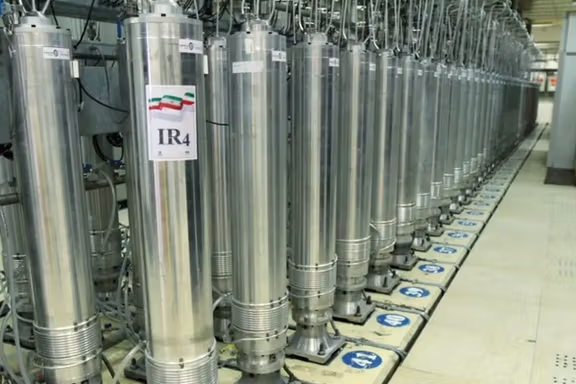
Centrifuges in Natanz, Iran
Tehran plans to activate a series of advanced centrifuges in response to the IAEA Board of Governors' resolution censuring Iran for its lack of cooperation, according to the deputy head of Iran’s Atomic Energy Organization.
"We will significantly increase enrichment capacity," Behrouz Kamalvandi said Friday, after earlier threats to respond sharply against a censure resolution.
On Thursday, the International Atomic Energy Agency's (IAEA) 35-nation Board of Governors passed a resolution criticizing Iran and ordering better cooperation with the UN nuclear watchdog.
Nineteen countries voted in favor and three - China, Russia and Burkina Faso - against, with 12 abstaining during the quarterly meeting of the Board of Governors.
"The Westerners are trying to push our nuclear industry backward through pressure tactics. The votes in favor of the new resolution against Iran were significantly fewer than before," Kamalvandi added.
An earlier resolution in June, tabled by France, Britain, and Germany (E3), received significant support, with 20 member states voting in favor. The two countries who voted against the resolution were Iran's allies, China and Russia. The decision saw 12 countries abstaining from the vote.
Kamalvandi said Iran showcased its enrichment complex, equipped with thousands of centrifuges, during International Atomic Energy Agency (IAEA) chief Rafael Grossi's visit to Tehran last week.
"The director-general proposed a temporary pause on reserves of 60% and higher enrichment levels—not a permanent halt, but a temporary measure," Kamalvandi added.
He noted that Iran accepted Grossi's proposal but "with conditions," declining to provide further details.
The latest IAEA Board of Governors' resolution, backed by the E3, follows months of heightened tensions over Iran’s uranium enrichment and a deepening confrontation between Iran and Israel, with mutual missile attacks and air strikes.
Earlier on Friday, an Iranian lawmaker also called for the immediate removal of nuclear enrichment restrictions, following Thursday’s IAEA Board of Governors' resolution against the Islamic Republic.
"We must set aside previous considerations regarding our nuclear issues," Mohammadreza Mohseni Sani, a member of Iranian parliament’s National Security and Foreign Policy Committee said.
Tehran’s interim Friday prayer leader Ahmad Khatami also criticized the IAEA Board of Governors’ resolution, calling it a show of support for the “murderous Zionist regime.” He urged Iran’s foreign policy officials to deliver a "decisive response."
Iranian officials had previously dismissed the resolution, accusing the E3 and their allies of undermining recent diplomatic efforts. Foreign Minister Abbas Araghchi told his French counterpart on Wednesday that the move complicates matters and contradicted the "positive atmosphere created between Iran and the IAEA.”
President Masoud Pezeshkian, in a speech on Friday, highlighted Iran’s significant shortcomings and shortages across various sectors, warning that in some areas, “we are standing on the edge of an abyss.”
The president referred to water, electricity, and natural gas shortages as well as the environmental crisis and emphasized the urgency of dealing with serious problems, and “to be accountable to the people.”
"We are currently facing a variety of problems and significant imbalances in water, electricity, gas, and the environment—some of which are on the brink of collapse," Pezeshkian said.
The Iranian government has been forced to implement rolling blackouts this month as winter approaches and a natural gas shortage jeopardizes the well-being of its 85 million citizens and disrupts industrial production. Meanwhile, it is unable to pay for gas imports from its northern neighbor, Turkmenistan, to sustain supply in nearby provinces.
Pezeshkian highlighted an apparent impasse within the Islamic government, stating, “We must address these imbalances and be accountable to the people, which is not achievable through the current governmental and bureaucratic processes.”
His remarks seemed to suggest the need for grassroots or non-traditional solutions to overcome challenges. However, Iran's economic system remains heavily state-controlled, with centralized decision-making. Compounding the crisis are US and other sanctions that restrict oil exports and isolate Iran from the global banking system. These sanctions are tied to Tehran's contentious nuclear program and regional influence building interventions through armed proxies—issues ultimately decided by its authoritarian ruler, Supreme Leader Ali Khamenei.
Pezeshkian suggested that if the government can successfully tackle the numerous challenges it faces, opposition to the Islamic Republic may weaken. Since 2017, Iran has witnessed multiple waves of popular protests, resulting in thousands of deaths and tens of thousands of arrests. Amid current shortages, media and commentators warn that the possibility of renewed unrest cannot be ignored.
The president’s remarks on Friday came after a one-day visit to the impoverished southeast, a region marked by instability and militant opposition from some Baluch elements in the barren lands bordering Pakistan, who are the majority and predominantly Sunni, in contrast to the Shiite-led government.
Pezeshkian informed the media that he had intended to extend his visit to the region and travel to several towns, but was forced to cut the trip short due to “security reasons.” He did not elaborate on the nature of these concerns or clarify whether they were tied to the region itself or other potential issues requiring his attention in the capital.
Foreign Minister Abbas Araghchi asserted that the Islamic Republic will respond to an October 26 series of airstrikes by Israel but said the retaliation will be calculated and executed under the right circumstances.
Araghchi was speaking with the Tehran-affiliated Al-Mayadeen television as Iran was censured at the meeting of the International Atomic Energy Agency for its lack of cooperation with the UN nuclear watchdog.
The foreign minister asserted that “Israel is well aware that the Islamic Republic poses the most significant threat to its regime.” Clearly linking Tehran and its proxies, he added, “The Resistance is not merely an organizational structure or an institution comprised of leaders and fighters; it is an ideology and a school of thought with broad social foundations.”
The Islamic government in Iran has yet to conduct a military response to Israel’s October 26 airstrikes on its air defenses and military installations. The attack marked the latest in a series of tit-for-tat exchanges between the two arch-enemies in the Middle East, following over a year of conflict between Israel and Iranian proxies; Hamas, Hezbollah, Yemeni Houthis and a variety of militia groups in Syria and Iraq.
Araghchi further emphasized that the Hamas movement remains steadfast, and that halting the war would represent a major defeat for the Zionist regime, which is why it opposes all ceasefire proposals. He added, "I have no doubt that the end of this battle will be a victory for the Resistance."
On Friday, chief commander of the Revolutionary Guard, Hossein Salami warned that the continuation of regional conflict can only result in Israel’s destruction.
Speaking at the venue of large drills by the IRGC’s Basij forces in southwestern Iran, Salami said, “Israeli officials are unsettled and demoralized, their army is exhausted, while, in contrast, Hezbollah and the resistance front have been energized.”
Salami is notorious for frequently issuing threats and declaring victories, a tactic some observers believe is intended to bolster morale among the government’s military and security ranks. Since September, Iran and its allies have suffered significant setbacks from Israel, which has launched an offensive against Hezbollah in Lebanon and carried out a series of targeted assassinations of key leaders.
Salami reassured supporters in his speech that Israel’s destruction is a certainty and stressed that Iran’s allies remain strong, facing a weakened Israel.
At the same time, Israel’s Prime Minister Benjamin Netanyahu sharply criticized the International Criminal Court for issuing his arrest warrant, calling it an antisemitic act.
“No outrageous anti-Israel decision will prevent us — and it will not prevent me — from continuing to defend our country in every way,” Netanyahu said, referring to the Islamic Republic in a video statement. “We will not yield to pressure,” he declared.
Unyielding hardliners in Iran, who hold significant sway over decisions regarding lifting internet access restrictions, have left the public uncertain about when they might no longer need anti-filtering software.
Nearly four months have passed since President Masoud Pezeshkian took office, pledging to lift internet restrictions. However, despite ongoing negotiations behind closed doors among politicians and multiple government agencies, no decisions have been announced.
Khabar Online, a news website close to moderate conservative politician and former Parliament Speaker Ali Larijani, reported on Thursday that President Pezeshkian has so far been unable to overcome hardliners’ resistance. Supporters and opponents of filtering remain locked in a battle within the Supreme Cyberspace Council over a final decision.
The website also accused the Council’s ultra-hardliner spokesman, Hossein Dalirian, of playing a major role in the secrecy surrounding the Council’s proceedings.
Iranian media say members of the Council and Dalirian who was appointed by Pezeshkian’s predecessor, Ebrahim Raisi, refuse to comment on the Council’s discussions or the decisions being taken behind closed doors.
The news website also said government sources claim that the Council’s members who insist on the continuation of censorships have ignored Pezeshkian’s order to form a committee to investigate the matter.
Lifting internet filtering would be a welcome relief for many Iranians, whose online experience—whether for business, education, or personal use—is persistently hindered by blocked access to thousands of websites and all major social media and messaging platforms.
Over eighty percent of Iranians use one or several paid anti-filtering software to access these websites and platforms.
Removing this obstacle would significantly boost Pezeshkian’s confidence and help his government avoid growing voter discontent. Many perceive him as powerless against hardliners, especially amid the economic and security crises gripping the country—challenges for which the president lacks immediate solutions.
Mohammad Mohajeri, a conservative politician and journalist, highlighted that internet filtering and the mandatory hijab are the two key issues Pezeshkian’s voters most expected him to resolve. Earlier this week, he urged the president to instruct his telecommunications minister to “push the button and end it all,” warning that continuing on the current path would only deepen societal disappointment and despair.
“This is not inflation, liquidity growth, or sanctions to be a hard thing to fix,” he insisted.
But making the final decision on the removal of filtering lies with the Supreme Cyberspace Council.
As president, Pezeshkian leads the Council which includes several key cabinet members, such as the ministers of telecommunications, intelligence, culture and Islamic guidance, science and technology, education, and defense.
The Council has around twenty other members including the commander of the Revolutionary Guards, the chairman of the Parliament’s Cultural Committee, and the head of the State Propaganda Organization. Nearly all of them are hardliners who oppose the removal of filtering. The President and his cabinet, therefore, are a minority in the Council.
Pezeshkian said earlier this week that he had reached an agreement with the Parliament Speaker Mohammad-Bagher Ghalibaf and Chief Justice Gholam-Hossein Mohseni-Ejei, two other members of the Council, about ending the restrictions but did not offer any further details.
From behind bars, Iranian rapper and one of the country's most prominent activists Toomaj Salehi pleaded with fellow dissident Hossein Ronaghi to end a hunger strike and not risk death.
Ronaghi, who has frequently been jailed for his criticism of the Iran's ruling system, began his fast from solid foods by sewing his lips shut on Sunday. He pledged to continue until the demands of late journalist and close personal friend Kianoosh Sanjari to free several political prisoners were met.
Sanjari committed suicide last weekafter warning he would take his own life unless several prisoners, including Salehi, were released. Activists including Ronaghi have blamed the Islamic Republic for Sanjari's death.
“Hossein, please break your strike. For the sake of all of us, break your strike,” Salehi said in a social media post from Dastgerd prison in the central Iranian city of Isfahan late on Wednesday. Detainees in Iran frequently pass messages to confidants who publish them on social media.
Salehi, a prominent voice in Iran’s protest movement, was arrested in October 2022 during the Woman, Life, Freedom uprising after expressing support in his music. Initially sentenced to death on charges of “corruption on Earth,” his sentence was overturned by Iran’s Supreme Court in June yet he remains imprisoned.
“After Kianoosh, I can no longer bear even a scratch on a member of this family. Hossein, please break your strike,” Salehi added in his message on Wednesday, in an apparent reference to the dissident community.
However Ronaghi vowed to persist in pursuit of Sanjari’s demands.
"My decision is this: I will continue with my lips sewn shut until Kianoosh's wishes are fulfilled," Ronaghi wrote on social media Thursday. He had previously reported feeling weaker and that he was imbibing only water, tea and medicine.
"My action with sewn lips is a political protest, and the responsibility for it, whether I am in prison, whether I am out of prison, whether you lock me in at home and prevent the sit-in, is with the Islamic Republic," he added.
Ronaghi later said that he was barred from continuing with his sit-in at Charsou - the site of Sanjari’s suicide in Tehran and described escalating harassment by authorities.
“I now face new forms of restrictions and imprisonment,” he said. “I am constantly monitored, both visibly and covertly, by security forces. They block my movements or detain me in undisclosed locations. It feels as though a prison has been built on this side of the bars.”
Earlier this week Ronaghi said security forces abused him sexually and verbally when he was arrested for a few hours in Tehran on Monday following another sit-in.
Despite these challenges, Ronaghi has planned another sit-in on Friday in Ekbatan, a neighborhood in western Tehran where security forces have been accused of coercing protesters into false confessions.
Last week Iran's judiciary issued death sentences for six individuals accused of involvement in the killing of a Basij militia member during the nationwide protests that erupted in 2022 in what has come to be known as the Ekbatan case.
His sit-in is also due to honor Aida Rostami, an Iranian doctor who treated protesters in Ekbatan and died under unexplained circumstances with state security forces widely blamed by activists for her death.
Rostami, 36, was caring for injured protesters during the Woman, Life, Freedom protests when she disappeared. Her body was returned to her family a day later showing signs of physical abuse according to her family, which says she was tortured to death.
“On Friday, November 22, I will conduct a sit-in at the Ekbatan Complex in honor of the dedicated doctor, Aida Rostami, and for the 'children of Ekbatan' who have endured two years of suffering imposed on them and their families," Ronaghi said Thursday night in a post on social media.
"In the place where you tried to destroy the environment to strip these people of their spirit for life, I will be present,” Ronaghi added. “Kianoosh's path will continue, even if I am left with no strength or if I am no longer here. Do whatever you wish."
The International Atomic Energy Agency's (IAEA) 35-nation Board of Governors passed a resolution on Thursday criticizing Iran and ordering better cooperation with the UN nuclear watchdog.
Iran condemned the move and ordered the activation of advanced centrifuges in response.
The resolution, backed by Western nations including France, Germany, and the United Kingdom (E3), follows months of heightened tensions over Iran’s uranium enrichment.
It cites ongoing violations of a 2015 international deal called the Joint Comprehensive Plan of Action (JCPOA), with Tehran now holding a stockpile of enriched uranium more than 32 times the limit under the agreement.
Nineteen countries voted in favor and three - China, Russia and Burkina Faso - against, with 12 abstaining during the quarterly meeting of the Board of Governors.
Iran bashed the resolution, saying it lacked the support of nearly half of the IAEA's member states and was pushed through by the United States and the three European sponsors to advance their political agendas.
Referring to a recent visit to Tehran by IAEA chief Rafael Grossi, Iran's foreign ministry said on X: "This politicized, unrealistic, and destructive approach undermines the positive atmosphere created and the understandings that have resulted from it."
The statement added that Iran was activating advanced centrifuges in retaliation but that the country's nuclear program would remain peaceful.
The resolution follows a similar IAEA rebuke in June calling on Iran to step up cooperation with the watchdog and reverse its recent barring of inspectors despite concerns Tehran would respond by boosting its activities.
The IAEA Board of Governors
E3 flags nuclear escalation
In a joint statement delivered to the IAEA board, France, Germany, and the UK expressed alarm over Iran’s stockpile of uranium enriched to 60%, a level well beyond civilian use and close to weapons-grade.
“Iran now has well over four IAEA significant quantities of uranium enriched up to 60%, the approximate amount of nuclear material from which the possibility of manufacturing a nuclear explosive device cannot be excluded,” The E3 said.
The statement said that over the past five months, Iran had installed six additional cascades of advanced centrifuges at its Natanz facility, significantly increasing its enrichment capacity.
It also criticized Iran’s continued restrictions on IAEA inspectors, including the de-designation, or revocation of accreditation, of experienced personnel which has impeded the Agency’s ability to verify Tehran’s claims of peaceful intentions.
Iran responds with warnings
Iranian officials had previously dismissed the resolution, accusing the E3 and their allies of undermining recent diplomatic efforts. Foreign Minister Abbas Araghchi told his French counterpart on Wednesday that the move complicates matters and contradicted the "positive atmosphere created between Iran and the IAEA.”
International Atomic Energy Agency (IAEA) Director General Rafael Grossi arrives on the opening day of the agency's quarterly Board of Governors meeting at the IAEA headquarters in Vienna, Austria, November 20, 2024.
Tehran had recently proposed halting its enrichment of uranium to 60% but only after accumulating a stockpile of 185 kilograms. While this offer was mentioned in Grossi’s latest report, Western diplomats dismissed it as insufficient, noting that the material could easily be further enriched for weapons purposes.
Iran has maintained that its nuclear program is solely for peaceful purposes, a claim met with skepticism by Western powers citing Iran’s lack of transparency and history of non-compliance.
Long-running disputes
The IAEA resolution also addressed unresolved issues, including the presence of unexplained uranium traces at undeclared sites and limited access for inspectors to critical facilities. Grossi’s recent trip to Tehran aimed to persuade Iranian leaders to improve cooperation and return to broader negotiations.
The resolution is seen as a step toward potentially referring Iran’s nuclear dossier back to the UN Security Council, where Western nations could trigger a so -called snapback mechanism to reinstate international sanctions lifted under the JCPOA.