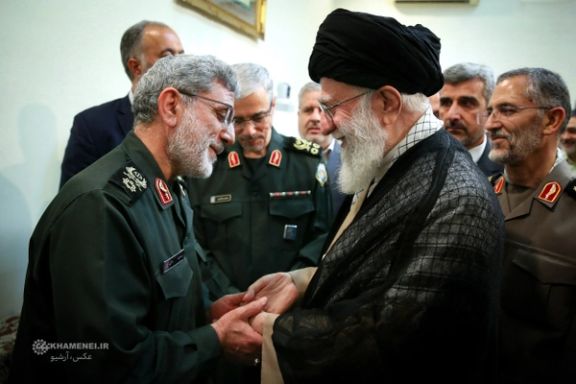
Iran's Supreme Leader Ali Khamenei and the IRGC's Qods Force Commander Esmaeil Qaani
Some Iranian ultra-hardliners online are blaming the ouster of Tehran's Syrian allies on the Revolutionary Guards and the commander of its foreign arm the Quds Force in cautious but rare social media broadsides at a key ruling institution.
Ultra-hardliners who refer to themselves as 'arzeshi' or guardians of Islamic Republic's values were venting their frustrations against Esmail Qaani in closed groups such as the homegrown Eitaa cast platform and on Telegram.
“Why doesn’t anyone say anything? Why were Iran Air’s flights to Damascus and Iraq to Damascus halted? Why was the Lebanese border to Syria blocked? Why didn’t they let us go there [to fight]?” one user wrote, asking why has the Quds (Qods) Force - the regional spear of Iran's Islamic Revolutionary Guards had not acted or spoken up.
Deploying the hashtags Qaani and Quds Force on Tuesday, another user snapped: “Leaders of Hezbollah were martyred, the Axis of Resistance withdrew from Syria, yet no one heard anything from the Quds Force commander."
Others pointed out that Qaani was not present at the Parliament’s closed meeting with the Revolutionary Guards’ Commander-in-chief General Hossein Salami on Thursday and wondered whether he had been dismissed by Supreme Leader Ali Khamenei.
Qaani has been seen in public only rarely since October.
Commentators at the time viewed his absence as a sign of possible disfavor given huge setbacks dealt to Hezbollah by Israel including the assassination of its leader Hassan Nasrallah alongside a top Quds force commander.
The last time Qaani appeared was at a mourning ceremony on the death anniversary of Prophet Mohammad's daughter, Fatima, at Khamenei’s residence on Dec. 7. Iranian media noted that Qaani appeared in civilian clothing, unlike other military commanders at the ceremony.
Iranian Islamic Revolutionary Guard Corps (IRGC) forces and foreign militias such as the Fatemiyoun and Zeynabiyoun brigades were deeply involved in defending Assad during Syria’s civil war for over a decade.
Unusually, state television did not give live coverage of the speech and only aired two excerpts as the Islamic Republic faced some of the biggest blows to its regional influence in its near half-century existence.
Assad’s fall has presented a serious challenge to commentators who claim to be guardians of so-called Islamic revolutionary values on how to interpret the events but steer clear of questioning the system's ultimate ruler Khamenei.
Most have directed their ire toward the country’s military institutions according to a commentary titled in part, “Has the Revolutionary Current Lost Its Trust in the Military?” by the relatively independent Rouydad24 news website on Thursday.
“With the fall of Damascus and the end of Bashar al-Assad’s rule in Syria, groups in cyberspace which until now interpreted the equations in the Middle East in Iran's favor are facing an analytic crisis and blaming parts of (the Iranian) government,” the commentary added, noting that many among the arzeshi groups are silent “mostly because they do not dare to speak openly” about the matter.
Iran's Attorney General’s Office on Thursday warned media outlets and online activiststo avoid discussions of the downfall of Tehran's ally Bashar al-Assad in Syria that could undermine domestic security. Iranian media on Thursday reported that the judiciary has indicted at least eight commentators, journalists, and activists in relation to their social media comments in this relation.
Israeli Prime Minister Benjamin Netanyahu said the downfall of Iran's Islamic rule might be around the corner in a video message to its people, days after the buoyant premier took credit for toppling Tehran's ally Bashar al-Assad in Syria.
“Woman, Life, Freedom is the future of Iran,” Netanyahu said, echoing the slogan that gained international prominence during 2022 protests in Iran against mandatory Islamic veiling.
"I have no doubt that we’ll realize that future together a lot sooner than people think.”
The video is the latest of a series of messages posted on Netanyahu’s account on X in recent months aimed apparently at wooing Iranians and fanning the flames of their discontent with their clerical rulers who are Israel's arch-enemies.
Netanyahu emphasized Iran’s largesse for armed allies abroad while millions at home suffer economic hardship.
“Your oppressors spent over $30 billion supporting Assad in Syria, and only after 11 days of fighting his regime collapsed into dust,” Netanyahu said. “You must be furious, imagining the new roads, schools, hospitals that could have been built with the tens of billions of dollars your dictators wasted backing terrorists who lose over and over and over again.”
Netanyahu’s remarks come shortly after the collapse of the Syrian government led by Bashar al-Assad. Assad was Tehran’s main ally in the region and the ripples of his fall are strongly felt in Iran.
On Monday, he took credit for Assad's downfall and said the Jewish state has overcome doubters of its war aims to dismantle the Mideast-wide axis led by Iran.
"If we were to agree to those who said time after time, we must stop the war ... we wouldn't have exposed Iran in its weakness," he told reporters in a speech. "(We) broke apart this axis, brick by brick."
Iran's exiled Prince Reza Pahlavi re-tweeted Netanyahu's message, praising his initiative to directly address the Iranian people. "Prime Minister @netanyahu's direct, repeated dialogue with the Iranian people is a positive step...I invite other world leaders, instead of engaging in useless negotiations with the criminal regime, to engage the Iranian nation directly," he wrote.
Meanwhile Iran's judiciary warned critics of the Islamic Republic’s foreign policy to avoid discussions of the downfall of Assad that could undermine domestic security.
“Media and online activists in the country should refrain from addressing topics that disrupt the psychological security of society and frighten the public about the situation,” the office of Iran’s Attorney General said on Wednesday.
The statement followed a speech by supreme leader Ali Khamenei who characterized talks of Iran’s weakening position in the Middle East as criminal.
Syrian armed forces hollowed out by low pay and corruption folded easily to a rebel advance after Iranian forces and militias backed by Tehran pulled out following Israeli airstrikes, Reuters reported citing Syrian military and militia sources.
The shock exit of President Bashar al-Assad from the country his family has ruled for half a century deprived Iran of one of its oldest and most stalwart allies.
Damascus was a key bridge in a so-called Shi'ite crescent which projected Iran's influence over Iraq and Syria to its armed Lebanese allies Hezbollah.
Iranian, Hezbollah and Iraqi militia forces had been a key bulwark for Assad in his fight against armed rebels which spectacularly faltered in a shock offensive which seized the capital on Sunday after less than a fortnight.
Those foreign units were Assad's top asset, Reuters cited the regional sources as saying, and Iranian military advisors and the militias ran the operational command structure that defended the Syrian state.
Many of the Iranian advisers quit Syria following Israeli air strikes on the capital in the spring and the rest left as the insurgent thrust gained steam last week, Reuters reported citing Iraqi militia commanders.
A source familiar with Hezbollah thinking was cited as saying fighters from the group had mostly left the country in October to confront an Israeli air and ground assault at home.
Alone, the Syrian military lacked a coherent strategy to defend their lines especially around the northwestern city of Aleppo - the country's second largest - which fell rapidly to radical Islamist-led rebels with little fighting.
US sanctions, mismanagement and corruption had taken its toll on the Syrian economy and military for years, undermining morale and willingness to fight.
Many rank-and-file soldiers and officers simply discarded their uniforms and weapons as opposition fighters made gains and melted into the civilian population.
For years before the government's ouster on Wednesday, monitoring groups reported that the Syrian military had been reduced to a militia-style organization focused on repression and was less prepared for a conventional military campaign.
US President-elect Donald Trump declined to rule out a war with Iran in an interview with Time magazine published on Thursday after repeatedly saying on the campaign trail that he did not seek to overthrow Tehran's theocratic rulers by force.
Trump was asked by a reporter from Time - which for the second time named him as the magazine's person of the year - what the chances of a war with Iran might be and citing allegations by US law enforcement that Iran sought to assassinate him.
"Anything can happen. Anything can happen. It's a very volatile situation," Trump replied, then quickly pivoting toward Ukraine and criticizing a decision by the Joe Biden administration to allow Ukraine to fire US long range missiles into Russia.
Trump lamented Biden policies he said have enriched and emboldened Iran and its armed allies in the region, again saying he would have kept them in check.
"We have some tremendous world problems that we didn't have when I was president. You know, when I left, we had, we had an Iran that was not very threatening. They had no money. They weren't giving money to Hamas. They weren't giving money to Hezbollah."
Trump's pick for national security advisor Mike Waltz on Wednesday credited Israel with weakening Iran by defeating its armed allies - "taking down the tentacles of the (Iranian) octopus" - but the incoming 47th president was appeared more circumspect.
"I don’t trust anybody," he said, when asked if he trusted Israeli Prime Minister Benjamin Netanyahu.
Asked about a meeting between world's richest man turned Trump superfan Elon Musk and Iranian diplomats in New York last month which was reported by US media outlets, the president-elect said he had no knowledge of it.
"I don't know that he met with them ... I don't know. He didn't tell me that."
Trump had said on election day November 5 that he wished Iran no harm but that Tehran cannot have nuclear weapons.
“My terms are very easy ... (Iran) can't have nuclear weapons," Trump said. "I’d like them to be a very successful country,” he added, but declined to detail specific plans for US-Iran relations.
Trump has repeatedly expressed his desire to resolve US enmity with Iran through diplomacy and in a pre-election interview appeared to rule out seeking regime change there, saying: “We can't get totally involved in all that. We can't run ourselves".
But Trump in his first term withdrew the United States from an international deal over Iran's nuclear program, saying the Barack Obama-era agreement allowed Iran to shore up its finances and step up aid to armed allies in the Mideast.
His order to assassinate top Iranian general Qassem Soleimani in a drone strike in 2020 earned him the lasting ire of Iran's rulers, who according to US law enforcement have been seeking to assassinate Trump and key aides in retaliation.
President-elect Donald Trump's pick for national security advisor credited Israel with weakening their mutual Mideast foe Iran by devastating its armed allies in the region and promised a muscular new US approach against the Islamic Republic.
"We have to give credit where credit's due, and that's Bibi Netanyahu in Israel," President-elect Donald Trump's pick for national security advisor Mike Waltz told Fox News on Wednesday, referring to the Israeli Prime Minister.
"(Israel has) taken down the tentacles of the octopus, so to speak: Hamas, Hezbollah, some of the militias in in Syria. Iran has been so weakened that it made Assad so weak that clearly the HTS, Turkey and others saw opportunity," he added, referring to the Hayat Tahrir al-Sham radical Islamist group leading the Syrian rebels.
Waltz lamented the extension last month of a US sanctions waiver for Iran's transfer of electricity to neighboring Iraq, but did not explicitly commit to ending the policy beyond saying Iraq needed to wean itself off its neighbor's supplies.
The Trump administration will work to put greater strain on Iran's economy through sanctions, Waltz added, and would revive the so-called maximum pressure campaign imposed during Trump's first term.
"You're going to see a huge shift on Iran. We have to constrain their cash. We have to constrain their oil. We have to go back to maximum pressure ... which was working under the first Trump administration."
Channeling comments by Trump on the campaign trail, Waltz said the new administration would stop short of any military adventure to unseat Iran's rulers.
"I think the President has been crystal clear on, and his mandate from the voters was to do everything he can to avoid us getting drug into more Middle East wars."
Iran's Attorney General's Office has warned media outlets and online activists to avoid discussions of the downfall of Tehran's ally Bashar al-Assad in Syria that could undermine domestic security.
The statement, issued Wednesday, emphasized the importance of controlling narratives during what it described as “sensitive internal and regional conditions.”
“Media and online activists in the country should refrain from addressing topics that disrupt the psychological security of society and frighten the public about the situation,” it added.
This announcement follows remarks by Supreme Leader Ali Khamenei, who characterized public discussions about Iran’s weakening position after the fall of Bashar al-Assad’s government in Syria as criminal acts.
“Some do this abroad through Persian-language media, and they must be dealt with differently, but no one inside the country should do this. If someone, in their analysis or statements, speaks in a way that discourages the people, it is a crime and must be addressed,” Khamenei said during his first speech after Assad’s collapse on Wednesday.
This speech by Khamenei, unlike the usual practice of recent years, was not broadcast live on state TV per his office's decision.
Criticism of Iran’s costly support for Assad has surged in recent days, with former officials and commentators questioning the billions spent and thousands of lives lost during Tehran’s involvement in Syria.
The collapse of Assad’s government has undermined Iran’s influence in the region, dealing a blow to what it terms the Resistance Axis, which relies heavily on strategic connections to Hezbollah.
Khamenei, while addressing the Syrian situation, sought to portray resilience and determination. He said that areas in Syria lost to opposition forces would be reclaimed and expressed confidence in the eventual removal of US influence from the region.
However, he also acknowledged potential lapses in Iran’s intelligence communication with Syrian officials.
“Our intelligence apparatus had conveyed warning reports... I do not know if these reports reached high-ranking officials or were lost somewhere in the process,” he said.
The Attorney General’s call to action highlights a renewed focus on controlling internal discourse amid mounting criticism.
Western observers, including European Union foreign policy chief Kaja Kallas, have framed Assad's downfall as evidence of declining influence for his allies, including Iran.
This crackdown underscores the challenges faced by Iran’s leadership in maintaining its regional aspirations while managing domestic criticism, leaving journalists and activists facing increasing risks for their reporting.