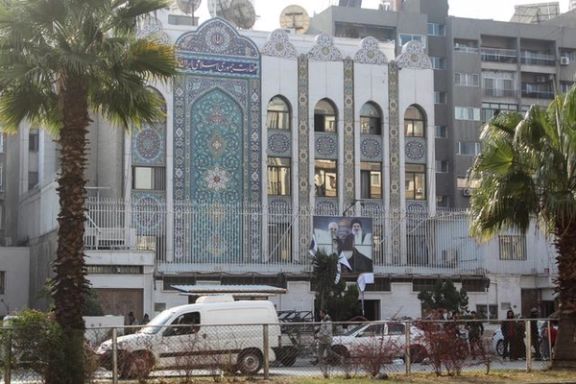
Rebel fighters stand near the Iranian embassy with a torn poster of Hezbollah leaderHassan Nasrallah and late Iran's Revolutionary Guards' top commander Qassem Soleimani after Syrian rebels announced that they have ousted President Bashar al-Assad, in Damascus, Syria December 8, 2024.
The fall of Bashar al-Assad’s government has prompted rare admissions of setbacks from Iran’s hardline media, with an outlet linked to the IRGC acknowledging losses for Iran's military allies across the region.
“The blows inflicted on the resistance movement should not be denied, nor should false remedies be applied to conceal the pain,” IRGC-affiliated Javan newspaper said Tuesday.
Specifically, Iran's largest militia, Hezbollah in Lebanon, considered a terrorist organization by countries including the US and UK, has seen huge blows since September as Israel ramped up airstrikes and targeted killings. It has seen massive losses to its military infrastructure and leadership.
Iran's Gaza-based ally, Hamas, also considered a terrorist organization by countries such as the US and UK, has also suffered huge blows since the retaliatory offensive launched by Israel in the wake of the group's invasion of Israel on October 7 last year.
The IRGC-linked paper focused on the implications of Assad’s fall for Iran’s proxy groups, known as the 'axis of resistance'. Syria, under the rule of Bashar Al-Assad, has long been a key component for these groups.
The paper acknowledged that Syria’s strategic location and logistical role made it a vital connection point for Iran and its allies, including Hezbollah. "Syria was both a cornerstone of the resistance axis and a vital link connecting Iran to Hezbollah in Lebanon," Javan wrote, warning that its loss disrupts coordination and weakens the operational capacity of the resistance axis, Syria a key smuggling route to Lebanon for Tehran.
The paper also addressed Israel's targeted assassinations, which saw top levels of the group killed including long-time leader Hassan Nasrallah, described as a significant blow, both symbolically and strategically.
Despite the admissions, Javan argued that the ‘resistance axis’ is built to endure such challenges. "The resistance is not overly reliant on individuals or states," the article said, adding that its structure prevents the loss of leaders or allies from crippling the movement entirely.
The article concluded with drawing on the Houthis in Yemen as an example of the “continued path of resistance” and comparing the ‘axis of resistance’ to a river that "always finds its way to the sea despite obstacles."
Kayhan ties Assad’s fall to Western compromise and internal missteps
The hardline daily Kayhan newspaper, closely aligned with Supreme Leader Ali Khamenei’s office, framed Assad’s fall as a cautionary tale on the dangers of compromising with Western adversaries, while justifying Iran’s expenditures in support of his government in Syria.
Kayhan argued that Iran’s involvement in Syria was essential, writing: “Our costs in Syria were never wasted. The threat of ISIS near Iran’s borders justified these expenses, which have brought security to the nation. Without this investment, Iran’s current situation could have been unpredictable.”
The paper attributed Assad’s fall to internal factors, including a lack of motivation within the Syrian army, intelligence compromises among officials, and economic mismanagement. “The Syrian government lacked the moral readiness to continue resisting, and Iran could not shoulder these costs alone,” Kayhan said.
In an editorial criticizing President Masoud Pezeshkian’s administration, Kayhan linked Syria’s crisis to leniency towards Western powers. “Compromising with the enemy brings nothing but losses,” it said. “The pro-Western approach weakens internal power structures and paves the way for the enemy. Syria’s recent collapse demonstrates the failure of such strategies.”
The paper also accused the media of discrediting Assad among Syrians and argued that infiltration projects and economic neglect contributed to his fall. Kayhan concluded by warning against compromise with the West and asserting: “Assad's failure and the fall of his government was turning away from the resistance front and leaning towards the West and Arab countries. Once again, it has been proven that the cost of compromise outweighs the cost of resistance.”
As Khamenei prepares his address on Wednesday, experts argue his speech is likely to reinforce this narrative, underscoring Iran's defiance in the face of adversity and its determination to sustain the ‘resistance axis’ despite the challenges.
Iran’s Supreme Leader Ali Khamenei accused the United States and Israel of orchestrating the overthrow of Bashar al-Assad, Syria's longtime president and a close ally of Tehran.
The remarks were Khamenei's first since Assad fled the country for Russia on Sunday in the face of a shock rebel advance, but offered little indication of what Iran's next strategic move would be after suffering the epochal setback.
“There should be no doubt that what has happened in Syria is the result of a joint American and Zionist plan. Yes, a neighboring country of Syria has played a clear role in this regard, continues to do so even now—this is evident to everyone. But the main conspirator, the primary planner, and the central command rooms are in the US and the Zionist entity," he said in his first remarks on the Syrian uprising since Assad's departure on Sunday.
Khamenei’s reference to a neighboring country was widely interpreted to mean Turkey. Over the years, Turkey has been a key backer of Syrian armed opposition groups. The power vacuum created by Assad’s fall has boosted Ankara’s regional position, weakening the influence of Iran and Russia on Syrian affairs.
“The aggressors I mentioned each have their own motives. Their goals are different—some seek to occupy land in northern or southern Syria, while America aims to solidify its foothold in the region," Khamenei added.
"These are their objectives, and time will show that, God willing, none of them will achieve these goals. The occupied regions of Syria will be liberated by the brave Syrian youth; have no doubt, this will happen,” he said.
Assad’s ouster has not only deprived Tehran of a strategic ally but also disrupted Iran’s ability to transport weapons to its biggest military ally, Hezbollah in Lebanon, through its land corridor. This route was a cornerstone of what is described as Iran’s Shia crescent, linking Tehran to the Mediterranean via Baghdad and Damascus.
In spite of the massive setbacks Israel has inflicted in recent months on both Hezbollah and Hamas in Gaza, also supported by Tehran, Khamenei said the Resistance - a term for Iran-backed militias across the region - would grow stronger.
"The more pressure you exert, the stronger the resistance becomes. The more crimes you commit, the more determined it becomes. The more you fight against it, the more it expands," Khamenei said. "Iran is strong and powerful—and will become even stronger."
The new government in Damascus, comprised of Sunni insurgents, signals a significant shift in the balance of power in the region. Syria's significance for Iran and the Islamic Republic's support for Hezbollah in Lebanon were so substantial that, over the years, Israel has also targeted several IRGC commanders in Syria as part of its efforts to counter Tehran and its regional influence.
In April, Israel struck the Iranian consulate compound in Damascus, killing Quds Force commander Mohammad Reza Zahedi, and other senior IRGC figures, triggering Iran's first ever direct attack on Israel in the same month.
Even after Assad's fall, Israel has continued to deliver significant blows to the remnants of both Assad's military forces and arsenal, and IRGC facilities, with around 300 airstrikes carried out since Sunday as Israel destroys any potential weapons falling into the hands of Syria's new extremist groups.
Iranian Islamic Revolutionary Guard Corps (IRGC) forces and militias such as the Fatemiyoun and Zainabiyoun brigades were deeply involved in defending Assad during Syria’s civil war.
These militias, composed mainly of Afghan and Pakistani recruits residing in Iran, were promised financial incentives and residency permits in exchange for their service. Despite Iran’s consistent denials of direct military intervention, these groups played a critical role on the ground.
The Iranian rial has hit new lows in the wake of Bashar al-Assad’s fall in Syria, in a sign that the ouster of Tehran's main Arab ally may be hollowing out economic confidence.
The dollar was trading at more than 730,000 rials in Tehran’s free exchange market on Tuesday, up from 700,000 just a week ago.
The downfall of Assad, whose ruling family has been the one of the Islamic Republic's earliest and strongest allies since 1979, severs Iran's land corridor to Lebanon which supplied weapons to Hezbollah for its periodic confrontations with Israel.
The slide adds to Iran’s vulnerabilities and could indicate its relative weakness in the region.
In addition to recent regional setbacks, the Islamic Republic faces the imminent challenge of Donald Trump assuming office in the United States, who will likely ramp up economic pressure on Tehran.
The euro was trading at almost 770,000 rials, as most other hard currencies rose in tandem with the US dollar in Tehran. The rial has fallen 18-fold since 2018, when the United States withdrew from the JCPOA nuclear deal and imposed sanctions on Tehran.
Before the establishment of the Islamic government in 1979, the US dollar was worth just 70 rials.
The rial’s steady decline signals further price hikes in Iran as imports grow more expensive, with inflation already nearing 50 percent. Meanwhile, oil exports constrained by sanctions have fail to generate sufficient foreign currency to stabilize the rial.
The only recourse for Tehran is to convince the US to lift its economic sanctions, but so far, Iran has not made sufficient concessions on its ambitious nuclear program or its regional policies to sway Washington.
Iran's Foreign Ministry has rejected the joint statement issued by the United Kingdom, France, and Germany criticizing Tehran for enriching uranium to near weapons-grade, saying Tehran was acting within its international rights.
Iran’s decision to employ advanced centrifuges and enrich uranium to higher levels falls within its rights under the Non-Proliferation Treaty (NPT), the ministry 's spokesperson Esmail Baghaei argued on Tuesday. These measures comply with International Atomic Energy Agency (IAEA) oversight protocols, he added.
"The Islamic Republic of Iran, as a responsible member of the IAEA, has proven its commitment to cooperation with this body," Baghaei said, referring to recent discussions with IAEA Director General Rafael Grossi in Tehran.
"It is regrettable that these European countries, instead of building on the constructive engagements, continue with unhelpful and confrontational approaches."
The European trio, collectively known as the E3, issued a statement on Tuesday condemning Iran's actions as undermining the Joint Comprehensive Plan of Action (JCPOA), the 2015 nuclear deal. Their statement highlighted concerns over uranium enrichment at the Fordow facility to near-weapons-grade levels and an increase in the number of centrifuges in operation.
"Iran’s actions have further hollowed out the JCPOA," they wrote, urging Tehran to reverse course and adhere to international safeguards.
Baghaei dismissed these remarks, insisting that the current nuclear standoff stems not from Iran’s actions but from the US's withdrawal from the JCPOA in 2018 and the failure of European signatories to uphold their commitments under the deal.
Iran has long contended that its nuclear program is peaceful and that its uranium enrichment—reported to have reached 60% purity, just short of the 90% threshold for weapons-grade material—serves civilian purposes. However, this has been met with skepticism from Western nations, who argue there is no credible civilian justification for such enrichment levels.
The ongoing dispute has fueled fears of regional instability. IAEA Chief Rafael Grossi has acknowledged in recent statements that dialogue with Iran is indispensable.
However, he has warned that the lack of implementation of safeguards continues to pose significant challenges.
While the IAEA continues its efforts to mediate between Tehran and the west, diplomatic progress remains elusive.
A prominent international football referee has left Iran due to threats and pressure from the country’s security forces, according to information exclusively obtained by Iran International.
The revelation that Mahsa Ghorbani departed follows a recent interview with the Shargh Network in which she highlighted challenges faced by female referees in Iran.
"I cannot continue my work or life in a country where my safety is constantly under threat," Ghorbani was quoted as saying.
Ghorbani could not be reached for comment and Iranian authorities have yet to comment on the case.
Iranian sport news website Tarafdari quoted a former Iranian referee as saying that Ghorbani intends to live in Europe but will not be seeking political asylum.
The referee had been slated to participate in high-profile competitions such as last year’s Tehran derby, officiating in the VAR room. However, opposition from government authorities and state-affiliated media prevented her involvement.
Ghorbani also missed the chance to officiate at the 2022 Qatar World Cup because she was barred from overseeing men’s matches in Iran due to her gender.
Last month, 15-year-old table tennis player Baran Arjmand sought police protection in Denmark, refusing to return to Iran after participating in a championship.
Iranian judoka Saeid Mollaei and alpine skier Atefeh Ahmadi have similarly sought asylum in recent years, citing political and social pressures.
Ghorbani’s departure underscores rising tension between Iranian authorities and professionals in sports, the arts and academia, many of whom are leaving the country due to safety concerns and economic hardships.
Amnesty International has condemned Iran's new compulsory veiling law, saying it intensifies the oppression of women and girls while exposing activists opposing the rules to charges carrying the death penalty.
“Iranian authorities have adopted a new draconian law that further erases the human rights of women and girls, imposing the death penalty, flogging, prison terms and other severe penalties to crush ongoing resistance to compulsory veiling,” Amnesty International said in a press release on Tuesday.
The "Law on Protecting the Family through the Promotion of the Culture of Chastity and Hijab," comprising 74 articles, is set to take effect this Friday. It imposes severe penalties on women and girls who defy veiling requirements, including exorbitant fines, prison terms, flogging, and travel bans.
Amnesty highlighted that activism against the hijab law may even be deemed “corruption on earth,” a charge punishable by death under Iran's penal code—a concern recently raised by Iranian women’s rights activists.
“This shameful law intensifies the persecution of women and girls for daring to stand up for their rights following the ‘Woman Life Freedom’ uprising,” said Diana Eltahawy, Amnesty International’s deputy regional director for the Middle East and North Africa.
Drafted in May 2023, less than a year after the Woman Life Freedom uprising sparked by the death in custody of Mahsa Amini in September 2022, the law was introduced in response to widespread defiance of compulsory veiling by women and girls, Amnesty said.
Amnesty detailed sections of the new law and how it, warning it criminalizes acts such as “nudity, indecency, unveiling and bad dressing.”
Article 50 of the law defines “unveiling” as failing to cover the head with a hijab, chador, or headscarf. “Bad dressing” is defined in Article 48 as exposing body parts below the neck, other than the hands and feet, or wearing clothing deemed to “contribute to or incite sin by others”.
However, the rights group warned terms such as “nudity” and “indecency” remain undefined in the new law, allowing for subjective interpretation and enforcement.
Under Article 48, fines for “bad dressing” begin at $160 for a first offense and rise to $4,000 for a fourth. Further infractions can result in $8,000 fines, up to five years in prison, a two-year travel ban, and a two-year ban on social media use. Article 49 mandates that “nudity” in public or online may lead to up to 10 years in prison or a $12,000 fine, with repeat offenses punishable by 15 years in prison or a $22,000 fine.
Amnesty noted that women unable to pay fines face severe restrictions, including being barred from reclaiming impounded vehicles, renewing driving licenses or passports or leaving the country. Article 56 also allows for asset seizures or imprisonment in such cases.
Article 38 prescribes up to five years in prison, travel bans, and fines for “insulting or ridiculing the hijab” or “promoting nudity, indecency, unveiling, and bad dressing.” Meanwhile, the law also bans the import and sale of clothing, dolls, mannequins, books, paintings, and other items that “promote nudity, indecency, unveiling, and bad dressing.”
“The complex web of fines, prison sentences and other severe punishments going as far as the death penalty demonstrates the state policy to control women and girls through fear and economic hardship. This law has particularly devastating consequences for the most economically disadvantaged in society,” Eltahawy added.
Amnesty warned the law grants sweeping powers to Iran’s intelligence and security forces, including the Revolutionary Guard and Basij militia, to enforce veiling rules.
Eltahawy called on the international community to act urgently, urging governments to use diplomatic and legal avenues to hold Iranian authorities accountable for systematic human rights violations.