Iran nears weapons-grade uranium in 'dramatic' escalation - IAEA chief | Iran International
Iran nears weapons-grade uranium in 'dramatic' escalation - IAEA chief
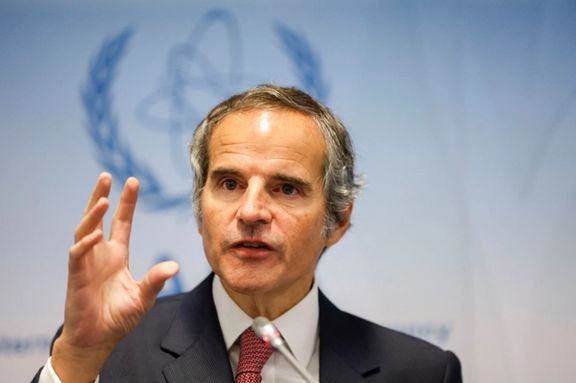
International Atomic Energy Agency (IAEA) Director General Rafael Grossi
Iran's capacity to produce uranium enriched to up to 60% purity, near weapons-grade, has seen a "dramatic increase," chief of the United Nations' nuclear watchdog the IAEA Rafael Grossi told Reuters on Friday.
"Today the agency is announcing that (Iran's) production capacity is increasing dramatically of the 60% inventory," he said in an interview with the agency in Bahrain.
Iran had been producing uranium enriched to up to 60% at a rate of approximately 5-7 kilograms per month, Grossi said, adding that figure is now expected to increase significantly.
When asked how much higher the production rate might rise, Grossi said: "Seven, eight times more, maybe even more."
The increase in the amount of uranium Iran has enriched to up to 60% purity is a serious escalation and worsens diplomatic efforts to resolve disputes over its nuclear program, Reuters reported Friday citing a German foreign ministry source.
“This is a serious escalatory step by Iran, which we strongly condemn. It is obvious that such measures significantly worsen the framework for diplomatic efforts,” the source added.
In November, Iran announced it had begun deploying advanced centrifuges to enrich uranium as part of its nuclear program. This move came in response to a resolution by the International Atomic Energy Agency (IAEA) demanding greater transparency in Iran's nuclear activities.
The IAEA resolution, supported by major Western powers, raised concerns about Iran’s lack of cooperation in addressing undeclared nuclear sites and called for full compliance with the Nuclear Non-Proliferation Treaty. Tehran rejected these concerns, accusing the agency of undermining trust through such measures.
Later, in a statement, France, Germany, the US, and the UK condemned Iran’s response, emphasizing that there is "no credible peaceful rationale" for the expansion of its nuclear program. They warned that Tehran's actions could deepen mistrust and further destabilize diplomatic efforts to resolve its nuclear ambitions.
Earlier this week, a senior Iranian diplomat said that Tehran might withdraw from the Nuclear Non-Proliferation Treaty (NPT) if the snapback mechanism reinstates UN sanctions lifted under the 2015 nuclear deal.
"In case of a snapback reinstatement, one of the options we proposed was withdrawing from the NPT... we could leave the treaty," Deputy Foreign Minister Majid Takht-Ravanchi was quoted as saying by a parliamentary spokesman on Tuesday.
These setbacks come as US President-elect Donald Trump prepares to revive his maximum pressure strategy on Iran, according to his newly appointed senior adviser on the Middle East, Massad Boulos.
"Of course, he will once again pursue his maximum pressure [campaign] against Iran," Boulos told the French outlet Le Point, adding that Trump would also be open to diplomacy alongside his firm approach.
During his first term, Trump implemented a series of measures to weaken Iran’s economy and limit its regional influence. He withdrew the United States from the nuclear deal with Tehran but did not initiate negotiations for a new agreement.
The hardline daily Kayhan in Tehran has criticized Iranian officials for presenting conflicting positions on talks with the West, particularly the United States, over the past four months since Masoud Pezeshkian assumed the presidency.
The Kayhan, which is linked with the office of Supreme Leader Ali Khamenei, noted that while Foreign Minister Abbas Araghchi ruled out negotiations with the United States for the time being, former Foreign Minister Mohammad Javad Zarif wrote in an article in Foreign Affairs magazine that Iran is open to negotiating with the West, particularly with the United States.
Meanwhile, Zarif, currently serving as Vice President for Strategic Affairs, revealed in an interview with the reformist daily Etemad that he is not part of President Pezeshkian's key decision-making team. He stated, "I have been excluded from all decision-making groups since the cabinet was formed, despite the expectation of many Iranians for me to play a role in shaping foreign policy."
The Kayhan charged that "While Araghchi's statements are based on Khamenei's policy, others in the government make statements diagonally opposing those policies." The daily said that conflicting statements on foreign policy particularly harm Iran's regional foreign policy and adversely affect negotiations with Europe.
Kayhan even criticized Pezeshkian for saying "We want to prove to Europeans that we do not want war and instability." The daily said that Iran does not need to prove its pacifist stances to the countries that insist Tehran has provided missiles to Russia despite Iran's denials.
Elaborating on Iran's stance regarding negotiations with Europe, Araghchi told Arab media that Iran has numerous reasons to distrust Europe’s positions on its nuclear program. He maintained, "At this time, we have no plans to initiate dialogue with Washington because there is no clear starting point for such talks. We are waiting to observe how the United States advances its foreign policy, after which we will define our approach to negotiations with America."
Meanwhile, Deputy Foreign Minister Majid Takht-Ravanchi, also known as Ravanchi, who led the Iranian delegation in last week’s discussions with the United Kingdom, France, and Germany, informed the Iranian Supreme Council of National Security that Tehran would continue exchanging views with Europe. However, he emphasized that these discussions should not be considered "negotiations."
Ravanchi further clarified that the talks adhered strictly to the red lines of the Islamic Republic and stressed that Iran approached the discussions with "no false optimism."
Ebrahim Rezaei the spokesperson for the SCNS told the press that Ravanchi and Deputy Foreign Minister Kazem Gharibabadi reported to the SCNS and tried to address the concerns and questions of its members. He quoted Ravanchi as saying that the objective of the meetings in Geneva was to "protect the achievements of the Islamic Republic" which possibly meant the delegation attempted to justify the deviations from the 2015 nuclear deal with world powers including a boost in the extent and level of uranium enrichment in Iran after 2018.
According to Rezaei, Ravanchi informed European negotiators that Iran might potentially withdraw from the Non-Proliferation Treaty (NPT). He did not elaborate on the European response but noted that no date has been set for the next round of talks.
Meanwhile, Gharibabadi accused the Europeans of failing to meet their obligations under the 2015 nuclear deal, the Joint Comprehensive Plan of Action (JCPOA), following the United States’ withdrawal from the agreement in 2018.
Rezaei also remarked that the atmosphere during the Supreme Council of National Security (SCNS) meeting with the two deputy foreign ministers was not positive. Members were critical of the discussions and expressed dissatisfaction with Europe’s recent sanctions and the International Atomic Energy Agency’s (IAEA) latest resolution against Iran.
Supreme Leader Ali Khamenei, with ultimate authority over Tehran’s nuclear policy, combined strict oversight with cautious deniability in the lead-up to the 2015 nuclear deal—using a dual strategy to safeguard domestic credibility while retaining international leverage.
Q: How and when did Khamenei approve the 2013 nuclear talks?
On September 17, 2013, Supreme Leader Ali Khamenei signaled his approval for nuclear talks with world powers, using a religious analogy in a speech to suggest that "flexibility" is sometimes necessary to achieve victory against adversaries.
Two weeks later, he expressed support for the diplomatic initiative of then-President Hassan Rouhani’s administration in another speech.
Between April and July 2015, as nuclear talks neared their conclusion, Khamenei cautioned military officials against allowing "aliens" to inspect military facilities "under the guise of supervision and inspection." He warned against halting Iran’s defense development or permitting the interrogation of Iranian nuclear scientists. Khamenei also pledged continued backing for the Islamic Republic’s "friends in the region," including the "peoples" of Palestine, Yemen, Syria, Iraq, Bahrain, and Lebanon.
Additionally, Khamenei insisted that all sanctions, whether imposed by the United Nations or the United States, must be lifted immediately once a deal was finalized.
Q: What role did Khamenei play in the 2015 nuclear deal?
Khamenei has consistently claimed that he was not directly involved in the details of the nuclear negotiations with world powers, which began in November 2013.
However, officials’ statements suggest that the negotiating team regularly reported to him, followed his instructions, and adhered to the “red lines” he established. A deal, by all accounts, required his ultimate approval.
In July 2013, Khamenei showcased his in-depth knowledge of the negotiations, citing technical terms and specific figures during a speech to government officials.
“Regarding the enrichment capacity, they aim to make the Islamic Republic consent to 10,000 SWU, but they began by demanding a limitation to 500 SWU or 1,000 SWU. 10,000 SWU is produced by the 10,000 old-type centrifuges we had and still have. Our officials say we need 190,000 SWU. This is the country’s definite need,” he said.
SWU (separative work units) refers to the amount of separation achieved in the uranium enrichment process.
Q: Did Khamenei accept responsibility for the 2015 nuclear deal?
Khamenei avoided taking direct responsibility for the nuclear deal, deferring its final approval to the conservative and hardliner-dominated Parliament. He neither explicitly endorsed nor opposed the agreement.
Speaker Ali Larijani expedited the parliamentary vote, reportedly acting on Khamenei’s instructions, and blocked debate on the legislation despite objections from hardliners. The deal passed with 161 lawmakers voting in favor, 59 opposing, and 13 abstaining.Some reports claimed that Khamenei had conveyed his desire for the deal’s approval through Asghar Hejazi, an official in his office. However, the office issued a statement denying such allegations.
Q: When did Khamenei first publicly criticize the 2015 nuclear negotiation team?
After the US withdrew from the nuclear deal – formally known as the Joint Comprehensive Plan of Action (JCPOA) – in May 2018, Khamenei described the negotiations as a mistake in an August speech.
He stated that he had permitted the talks because senior officials, likely President Hassan Rouhani and his negotiation team led by Javad Zarif, had insisted on pursuing them.
In the same speech, he accused the negotiators of crossing the “red lines” he had set.
Q: Has Khamenei issued a fatwa prohibiting the development of nuclear weapons?Iran's government has consistently stated that it will not pursue nuclear weapons, citing a fatwa (religious edict) by Supreme Leader Ali Khamenei banning all weapons of mass destruction, including nuclear arms.Iranian officials first referenced Khamenei’s fatwa at an IAEA meeting in Vienna in August 2005 and reiterated it at the International Conference on Nuclear Disarmament in April 2010.
According to Khamenei’s official website, Iran’s mission later pledged to submit a translation of the fatwa in several languages to the UN for registration as an official document.
In an October 2019 speech, Khamenei declared that building and maintaining nuclear weapons is "absolutely haram," meaning strictly forbidden under Islamic law. He stated that although Iran had the capability to develop a bomb, it chose not to. He emphasized there is no justification for pursuing a weapon that is religiously prohibited.
However, analysts argue that the so-called fatwa is merely an advisory opinion rather than a binding legal decree. They argue it was intended to mislead the international community about the true intentions of a nuclear program that Tehran insists is peaceful.
Q: Can Khamenei’s ‘nuclear fatwa’ be overturned?
Fatwas are issued by Shia Marja – senior clerics recognized as sources of emulation in Islamic jurisprudence.
Skeptics say that such fatwas are not immutable; they can be revised or revoked based on the “requirements of time and place.” This principle allows rulings to adapt to new circumstances, as shown by historical instances where one Marja or another has altered earlier decisions.
A top Iranian diplomat warned Tehran would withdraw from the Nuclear Non-Proliferation Treaty if a so-called snapback mechanism renews the UN sanctions lifted by a 2015 nuclear deal, underscoring Iran's determination to avoid being pressured into ditching its nuclear ambitions.
"In case of a snapback reinstatement, one of the options we proposed was withdrawing from the NPT ... we could leave the treaty," deputy foreign minister Majid Takht-Ravanchi was quoted as saying by a parliamentary spokesman on Tuesday.
The remarks followed Takht-Ravanchi's discussions in Geneva with representatives from the UK, France, and Germany — the three European signatories to the 2015 Iran nuclear deal, the Joint Comprehensive Plan of Action (JCPOA).
"We did not negotiate in Geneva because we had no text, and there was no text to negotiate on," Takht-Ravanchi said.
The Geneva talks were held in the wake of a controversial resolution passed by the International Atomic Energy Agency's (IAEA) Board of Governors, which calls for a report on Iran’s nuclear program and its lack of full cooperation with the IAEA by spring 2024.
This resolution could trigger the activation of the snapback mechanism, a provision within the JCPOA that would automatically restore international sanctions on Iran and potentially bring the country under Chapter VII of the United Nations Charter.
"Unfortunately, our enemies have made Iran’s nuclear file very complicated and politicized," said Behrooz Kamalvandi, spokesperson for Iran's Atomic Energy Organization.
The breakdown in negotiations between Iran and the three European countries reflects broader diplomatic tensions. Efforts to revive the JCPOA, which collapsed after the United States withdrew under President Donald Trump in 2018, have stalled under Presidents Hassan Rouhani and Ebrahim Raisi.
"We have no intention of negotiating with Washington at this time, as there is no basis for such talks," Iranian Foreign Minister Abbas Araghchi said recently, adding that Iran would reassess its approach once the new US administration’s policies become clearer.
However, some within President Masoud Pezeshkian’s administration have shown interest in potential talks with the United States, particularly those aligned with the more moderate camp.
Among them, Mohammad Javad Zarif, Pezeshkian's strategic deputy, wrote in an article in Foreign Affairs magazine that Trump should pursue an agreement that benefits both sides.
“The West needs a more constructive approach—one that takes advantage of Iran’s hard-earned confidence, accepts Iran as an integral part of regional stability, and seeks collaborative solutions to shared challenges," he wrote. "Such shared challenges could even prompt Tehran and Washington to engage in conflict management rather than exponential escalation.”
British and French intelligence chiefs have warned of the threat posed by Iran potentially developing nuclear weapons. At the same time, European and Iranian diplomats met in Geneva on Friday for uneventful talks.
"Our services are working side by side to face what is undoubtedly one of the threats, if not to say the most critical threat, in the coming months - the possible atomic proliferation in Iran," Nicolas Lerner, who heads France’s DGSE, said at the British embassy in Paris alongside his British counterpart Richard Moore.
“The intelligence will be crucial to enable our authorities to make the right decisions and define the right strategies,” Lerner said in rare public comments.
The head of Britain's Secret Intelligence Service known as MI6, echoed those comments. "The regime's nuclear ambitions continue to threaten all of us, especially friends of France and the UK in the Gulf region," Moore said.
“Iran’s allied militias across the Middle East have suffered serious blows,” he added. “But the regime’s nuclear ambitions continue to threaten all of us.”
The comments by the intelligence chiefs and Iran’s meeting with the United Kingdom, France and Germany came after the International Atomic Energy Agency (IAEA) Board of Governors passed a resolution, proposed by the UK, France, and Germany, criticizing Tehran's lack of cooperation with the UN nuclear watchdog.
The resolution emphasized the urgent need for Tehran to cooperate with the IAEA and called on IAEA Director General Rafael Grossi to prepare a comprehensive report on the status of Iran's nuclear program.
The censure resolution has set the stage for a new phase in the dispute over Iran's activities which could lead toward more sanctions through the activation of so-called "snapback mechanism".
The purpose of the Geneva meeting, the first such talks since Trump's election victory, was to assess the feasibility of engaging in serious negotiations before the official inauguration of the new US president on January 20, Reuters reported. The United States had previously announced it would not participate in the Geneva meeting.
Senior diplomats from Iran, Britain, France, and Germany convened a new round of talks on Tehran's disputed nuclear program in Geneva, Switzerland, on Friday to test diplomacy ahead of Donald Trump's return to power in the US but made little or no progress, media reports said.
The purpose of the Geneva meeting, the first such talks since Trump's election victory, was to assess the feasibility of engaging in serious negotiations before the official inauguration of the new US president on January 20, Reuters reported. The United States had previously announced it would not participate in the Geneva meeting.
Iran's deputy foreign minister Majid Takht-Ravanchi represented Iran in the negotiations. He was a member of the Iranian team that negotiated the 2015 nuclear deal, officially known as the JCPOA. In his previous term in office, Trump withdrew the US from the deal.
Following the Friday meeting in Switzerland, Kazem Gharibabadi, Iran's deputy foreign minister for legal and international affairs, wrote on X: "Another round of candid discussions with Political Directors of France, Germany and UK. We discussed and took stock of recent bilateral, regional and international developments, particularly nuclear and sanctions lifting issues."
"We are firmly committed to pursue the interests of our people, and our preference is the path of dialogue and engagement. It was agreed to continue diplomatic dialogue in near future," he added.
‘Nothing new, little progress’
The Geneva talks revolved around serious issues, including Iran's nuclear program, but resulted in little progress, Reuters reported citing diplomats.
There had been nothing of note in the meeting but that Tehran had shown an eagerness to explore how diplomacy could work in next few weeks, it added quoting a European official.
The Wall Street Journal also cited a European official saying "there was basically nothing new."
The Geneva talks were held after the International Atomic Energy Agency (IAEA) Board of Governors passed a resolution, proposed by the UK, France, and Germany, criticizing Iran's lack of cooperation with the UN nuclear watchdog.
The resolution emphasized the urgent need for Tehran to cooperate with the IAEA, and called on IAEA Director General Rafael Grossi to prepare a comprehensive report on the status of Iran's nuclear program.
The censure resolution has set the stage for a new phase in the dispute over Iran's activities which could lead toward more sanctions through the activation of so-called "snapback mechanism".