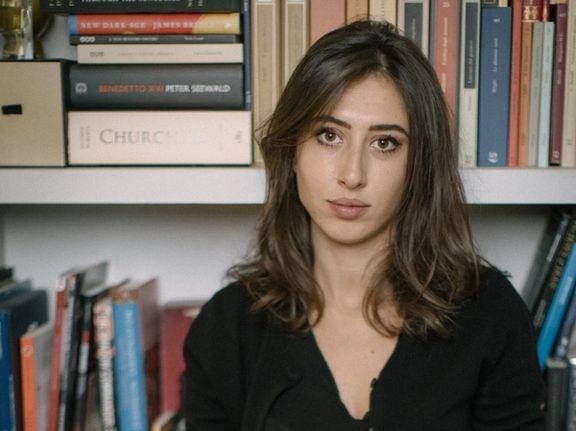
Italy scrambles to free journalist detained in Iran
Italy is pressing for the release of a journalist detained in Tehran for over a week, its defense minister said on Friday, weeks after Rome arrested an Iranian citizen in connection with a drone strike in Jordan that killed three US troops.
Cecilia Sala, 29, reports for Italian daily Il Foglio and podcast publisher Chora Media, which said she was arrested on December 19 while working in Iran with a valid journalist visa.
The Islamic Republic has since its inception sought to trade foreign detainees with host governments in exchange for prisoners or economic and political concessions.
Iran denies it engages in hostage diplomacy and has yet to comment on Sala's case.
Italy's Defense Minister called her detention "unacceptable", but said only political talks and not popular outrage could win her freedom.
"Negotiations with Iran cannot be resolved, unfortunately, with the involvement of Western public opinion and with the strength of popular indignation but only with high-level political and diplomatic action," Guido Crosseto wrote on X.
Italy's foreign ministry said it had been "following the case with the utmost attention since its inception." The ministry, it added, "has worked with the Iranian authorities to clarify Sala's legal situation and verify the conditions of her detention."
Italy's ambassador in Iran had visited her in detention and relayed information about her conditions back to her family, the ministry added without elaborating.
Chora Media said Sala is being held in solitary confinement at Tehran’s Evin prison with no explanation for her detention.
“Her free voice has been silenced, and neither Italy nor Europe can tolerate this arbitrary arrest. Cecilia Sala must be freed immediately,” the company said, launching a #FreeCecilia campaign on social media.
The newspaper Il Foglio criticized her detention.
"Cecilia was in Iran, with a regular visa, to report on a country she knows and loves, a country in which information is suffocated by repression," it said in a statement.
"Journalism is not a crime," it added.
Iran has not commented on her arrest, the reasons for which remain unclear.
Jordan drone attack
Iran last week summoned a senior Italian diplomat and the Swiss ambassador in Tehran, who represents US interests in the country, over their countries' arrest of two Iranian nationals, Iranian media reported.
Tehran has been trying to secure the release of Iranian citizen Mohammad Abedini, who was arrested at Milan airport over his involvement in a drone strike in Jordan earlier this year that killed US troops, IRGC-affiliated Tasnim News Agency reported last week.
Earlier this month, the US Justice Department charged Abedini and another Iranian, Mahdi Mohammad Sadeghi - who was arrested in the United States - with conspiring to export sensitive US technology to Iran’s Revolutionary Guards.
The technology was used in the navigation systems for the drone strike on the US counter-terrorism outpost in the Eastern Jordanian desert, in the deadliest attack on American personnel in 14 months of Mideast turmoil.
Iran last week summoned the Swiss ambassador in Tehran, who represents US interests in the country, and a senior Italian diplomat over their arrest by the United States and Italy, Reuters reported citing Iranian media.
'These are their actions'
Additionally, after the outbreak of nationwide protests over the death in custody of Mahsa Amini in mid-September 2022, Iran had detained dozens of foreign nationals including from France, Germany, Italy, Poland and the Netherlands.
Italian Instagram travel influencer Alessia Piperno was among those arrested during the protests.
At the time, Iranian authorities accused external forces—particularly the United States and its allies—of fueling the nationwide protests.
Member of the European Parliament (MEP) Hannah Neumann denounced Sala's detention as “another assault on media freedom, on women, on international law.”
She wrote on X:“For all those still saying: ‘We need to judge them by their actions’ – these are their actions."
The Arab League bloc of nations has called on Iran not to sow discord in Syria following the ouster of President Bashar al-Assad, a long-time ally of Tehran.
The Arab League bloc of nations has called on Iran to refrain from actions that could sow discord in Syria following the ouster of President Bashar al-Assad, a long-time ally of Tehran.
In a statement issued on Thursday, the Arab League warned against igniting strife in Syria and denounced statements by Iranian officials that risk destabilizing the country. The statement did not name any specific officials.
“The Arab League rejects the recent Iranian statements aimed at inciting strife among the Syrian people,” the bloc’s secretariat said, adding that “it is following with concern the events taking place in several Syrian cities and areas with the aim of igniting the sparks of conflict."
Deadly clashes between Syria's new rulers and forces loyal to Assad in recent days have fueled fears of rekindling the civil war in the country.
Syria’s new authorities said Tuesday that pro-Assad forces ambushed interior ministry troops near Tartous, killing 14 and wounding 10 in a direct challenge to de facto leader Ahmad al-Sharaa. On Thursday, the new leaders launched an operation in the area, historically a stronghold of Assad's minority Alawite Muslim sect.
“The General Secretariat stressed the need for all parties to respect Syria's sovereignty, territorial integrity and stability, to restrict weapons to the hands of the state, dissolve all armed formations and reject all destabilizing foreign interventions," said the Arab League, which last year welcomed back Assad after a decade of isolation.
The bloc also expressed confidence in the ability of the Syrian people, with all their components and leaders, through wisdom, to preserve civil peace and national unity at this critical stage.
Earlier this week, Syria’s new foreign minister warned Iran not to destabilize the country's fragile calm after a call by Iran’s Supreme Leader for Syrian youth to rise up against the new Sunni Islamist rulers.
"Iran must respect the will of the Syrian people and the sovereignty and safety of its country. We warn them against spreading chaos in Syria and hold them responsible for the consequences of their recent statements," Asaad Hassan al-Shaibani said on X.
In at least two public speeches this month, Ali Khamenei predicted "the emergence of a strong,” noting that the country's young men had nothing to lose.”
Iran's foreign ministry spokesman Esmail Baghaei said on Thursday that media reports about Iran interfering in Syria's internal affairs are baseless. “Tehran is committed to supporting the territorial integrity and national unity of Syria and the formation of an inclusive political system," he said in a statement.
Most recently, Mohsen Rezaei, former commander of the Revolutionary Guards (IRGC) and a member of the Expediency Discernment Council, wrote on X,"The resistant youth and nation of Syria will not remain silent against foreign occupation and aggression and the internal totalitarianism of one group. In less than a year, they will revive the resistance in Syria in another form."
In an interview with an Egyptian media outlet last week, Foreign Minister Abbas Araghchi said that Tehran had advised Assad to engage in talks with Turkey and opposition forces before his fall, adding that Assad rejected the idea.
“Assad believed that he would not engage in talks with Turkey until their forces withdrew from Syrian territory, questioning how it would be possible to negotiate with a country that had occupied his land,” he said.
The coming year is expected to bring significant developments in Iran's nuclear program, necessitating increased consultations, said Iranian Foreign Minister Abbas Araghchi upon arrival in China on Friday.
“Over the past years, we have had close consultations with China on all regional and international issues,” he said.
On December 6, the UN nuclear watchdog reported that Iran had significantly accelerated its production rate of 60% enriched uranium, which is now approximately five times higher than a month ago. Iran is now believed to possess enough 60% enriched uranium to produce four to five atomic bombs, should it choose to pursue nuclear weapons.
The International Atomic Energy Agency (IAEA) Director-General Rafael Grossi's said earlier this month that the 2015 Iran nuclear deal, known as the Joint Comprehensive Plan of Action (JCPOA), is no longer sufficient to curb Tehran’s uranium enrichment which has exceeded international limits.
"Iran is enriching uranium close to military levels and is rapidly moving towards becoming a nuclear state," Grossi said in an interview with Italy's ANSA news agency."The philosophy of the original accord with Iran can be used, but that agreement is no longer useful," he added.
Iran’s foreign minister has disclosed efforts to advise Syrian President Bashar al-Assad to engage in talks with Turkey, saying that Assad refused, insisting on Turkish withdrawal from Syrian territory first.
“I repeatedly advised the Syrian government, the foreign minister, and even Bashar al-Assad himself to enter into negotiations with Turkey. However, the Syrian government and Mr. Assad were not in favor of negotiating—whether with the opposition or with Turkey," Abbas Araghchi said in an interview with Egypt's Al-Ghad network. The interview took place last week when Araghchi was in Cairo for an economic event, but its text was published on Friday.
“Regarding Turkey, Assad believed that he would not engage in talks with them until their forces withdrew from Syrian territory, questioning how it would be possible to negotiate with a country that had occupied his land,” he added.
Araghchi noted that while Iran provided advice on dealing with Syria’s people, neighbors, and opposition groups, Damascus maintained its independence in decision-making. “The Syrian government acted independently, and we were merely friends offering counsel.”
Earlier this week, Syria’s new foreign minister warned Iran not to destabilize the country's fragile calm after a call by Iran’s Supreme Leader for Syrian youth to rise up against the new Sunni Islamist rulers.
An IRGC general has accused some among the public of “aiding the Americans” against the Islamic government, as Tehran faces mounting economic challenges and deals with its recent setbacks in the region.
"In the current situation, the Americans will likely attempt to amplify certain internal issues,” General Mojtaba Fada said on Thursday, referring to a host of domestic problems, chief among them the deteriorating economy.
Iran’s currency, the rial, has fallen by more than 30% since August and with cold weather arriving, the government has been unable to provide electricity on regular basis. The dollar has risen from 600,000 rials to around 800,000, while the British pound has surpassed one million rials. In power supply, current estimates point to a 30% daily deficit, which results in rolling blackouts, idling many industries.
“The issue of energy imbalances is not exclusive to the current administration; it has also existed during Mr. Raisi’s government and previous administrations. Therefore, some individuals within the country should avoid signaling to the Americans through their analyses,” Fada said, referring to a wave of criticism on social media. Even the state-controlled print media has become more outspoken about the closure of hundreds of factories and rising cost of living.
Iran relies heavily on imports for wheat, rice, and other essential goods. As the rial continues to depreciate against major currencies, the cost of imports has risen sharply, placing a greater burden on ordinary citizens. The monthly salaries of workers, when calculated in US dollars, have fallen from $200 last summer to approximately $130 this winter.
Iranian social media reflects a growing sense of crisis in the country and possible political unrest, as the Islamic government is seen defeated in the broader region and weakened at home.
General Fada told his audience on Thursday, “All citizens and officials have a duty to defend the Islamic government in the current situation. We have stood firm for 45 years for the Islamic Revolution of Iran, and we must continue to endure hardships, tolerate criticism, and bear the pain for its sake.”
Iran carried out 883 executions in 2024, marking a significant annual increase and representing the highest number in a decade, US-based rights group HRANA said on Thursday.
Among those executed, 772 were male, 26 were female and 5 were juvenile offenders at the time of their alleged crimes. Just over half of the executions were allegedly related to drug-related charges followed by murder charges at around 40%.
The report said that 94% of these executions were carried out in secrecy and without public notice. Additionally, the issuance of death sentences rose by a third compared to the previous year.
Last year Iran executed 853 people according to rights group Amnesty International.