Iran says weighing Trump factor, insists on nuclear talks only
US President Donald Trump looks on as reporters ask questions aboard Air Force One during a flight from Las Vegas, Nevada, to Miami, Florida, January 25, 2025.
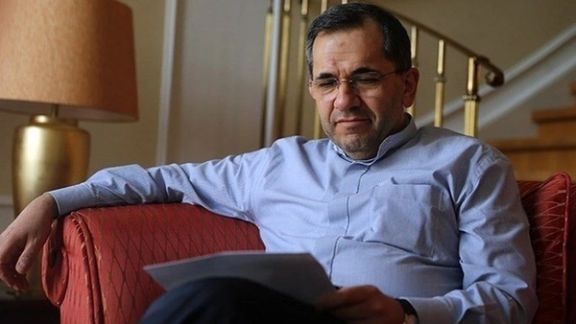
Iran’s Deputy Foreign Minister for Political Affairs Majid Takht-Ravanchi said on Monday that Tehran is "engaging and consulting" regarding President Donald Trump's policies toward Iran and has ideas and plans in place to address them.
Speaking to the semi-official ISNA news outlet, Takht-Ravanchi emphasized that Iran will not negotiate on matters beyond its nuclear program, possibly alluding to US demands that Tehran cease interference in regional affairs.
The deputy foreign minister also revealed divisions among the original signatories of the 2015 nuclear deal, known as the JCPOA, regarding Russia’s involvement in future negotiations. France, the United Kingdom, and Germany—the E3—appear to oppose Moscow playing a significant role in talks to either revive the JCPOA or draft a new agreement.
This stance aligns with the European Union’s broader efforts to diplomatically and economically isolate Russia.
Iran has so far held two rounds of what it describes as “consultations,” rather than negotiations, with the E3 in December and January.
While President Trump has yet to articulate his approach toward Iran, it is widely believed he will strengthen sanctions to pressure Tehran into talks favorable to Washington.
Iran engaged in 18 months of indirect negotiations with the Biden administration between 2021 and 2022 to restore the United States’ participation in the JCPOA after Donald Trump unilaterally exited the agreement in 2018, imposing harsh sanctions on Iran. However, the Vienna talks ended without a deal, particularly after Russia’s 2022 invasion of Ukraine, which fueled speculation about whether Tehran was genuinely interested in an agreement or merely seeking to ease sanctions.
Iran’s Deputy Foreign Minister for Political Affairs Majid Takht-Ravanchi
Takht-Ravanchi reiterated Iran’s official stance that Trump’s “maximum pressure” campaign had failed. “They even harbored the illusion that a few months after the US withdrawal from the JCPOA and the imposition of multiple pressures, Iran would eventually relent and agree to a deal based on their demands. As noted, this did not happen, proving that the policy of maximum pressure on Iran has failed,” he said.
However, many media outlets and social media users in Iran highlight the severe economic crisis gripping the country since 2019, following the enforcement of full US oil sanctions.
Iran’s currency has lost 95% of its value since 2018, while inflation has averaged around 40% annually over the past five years. An estimated 20-30 million Iranians have fallen below the official poverty line, defined as a $450 monthly income for a family of three. Despite this economic hardship, Iran has managed to sell over $100 billion worth of oil to China since 2021, partly due to a more relaxed enforcement of Trump-era sanctions under the Biden administration.
Takht-Ravanchi dismissed claims that the Islamic Republic’s influence has weakened over the past six months due to regional developments, including setbacks for Hezbollah and the fall of its ally Bashar al-Assad in Syria. These events have fueled speculation that Tehran is now in a weaker position ahead of any potential future talks with the United States.
“The Middle East is constantly changing, and today’s circumstances may not define tomorrow’s reality,” Takht-Ravanchi argued. “Those who take a deeper look at developments in West Asia agree that conclusions should not be drawn based on the fluctuations in events in the region.”
The senior diplomat, who previously served as Iran’s ambassador to the United Nations in New York, acknowledged uncertainty about Trump’s next moves. "At the moment, it is not entirely clear what Trump's policy toward Iran is, and we must wait for this policy to become defined," he remarked.
An Iranian-linked cyberattack targeted kindergartens in Israel on Sunday, disrupting public address (PA) systems and infiltrating emergency systems in at least 20 locations by exploiting vulnerabilities in a private company's infrastructure.
Handala, an Iranian cyber group linked to Iran’s Ministry of Intelligence (MOIS), claimed responsibility for the attack on its Telegram channel.
Additionally, the group used another system belonging to the same company to send tens of thousands of threatening text messages to Israeli citizens.
Israel's National Cyber Directorate confirmed the breach and is working with the affected company and the Ministry of Education to address the situation.
"Citizens who received these messages are advised to block the sender and disregard the message, as it poses no harm to mobile devices," the directorate said.
Kan, Israel's public broadcaster, reported that the affected systems have now been disconnected from the wider network, with the unnamed private company responsible for the compromised units saying that it is taking steps to resolve the issue and enhance its security measures.
Last April, a day after Iran's first-ever direct military strike against Israel, the Iranian-linked hacker group Handala claimed to have breached Israel's radar systems and sent hundreds of thousands of threatening text messages to Israeli citizens.
In September, the group claimed it had successfully breached the Soreq Nuclear Research Center, alleging the theft of 197 gigabytes of data.
The hackers also published around 30 photos they claimed were taken inside the center, along with screenshots allegedly showing the names of nuclear scientists involved in the facility's particle accelerator project.
In response, the Israeli prime minister's office, speaking on behalf of the Israel Atomic Energy Commission, denied the authenticity of the images. "Following a thorough examination, the images and blueprint do not belong to any of its facilities," the statement said.
According to cybersecurity expert Nariman Gharib, the group Handala Hack, Karma Below and Homeland Justice were created and are operated by a cyber unit within the counter-cyber threat division (CT) of Iran's Ministry of Intelligence's internal security department, specifically for advertising purposes.
Microsoft released a report last year which said that since the Gaza war, Iran "surged its cyber, influence, and cyber-enabled influence operations against Israel".
"From October 7, 2023, to July 2024, nearly half of the Iranian operations Microsoft observed targeted Israeli companies," said the Microsoft Digital Defense Report.
The US software giant's report in October said that from July to October 2023, only 10 percent of Iranian cyberattacks targeted Israel, while 35 percent aimed at American entities and 20 percent at the United Arab Emirates.
However, the war has seen a spike in cyber attacks on Israel alongside attacks by Iran's military allies against the Jewish state.
"Within two days of Hamas' attack on Israel, Iran stood up several new influence operations," Microsoft said.
The Iranian government stressed that any decisions on potential nuclear talks would be made within the framework of the Supreme National Security Council, in a nod to the conservative establishment.
The remarks from the spokeswoman of the relatively moderate government appeared aimed at reassuring hardliners that any talks will be subject to strict oversight and not diverge from the priorities of Supreme Leader Ali Khamenei.
President Masoud Pezeshkian’s said earlier this month he was ready to engage in talks with the US administration of Donald Trump.
However, the move prompted questions within Iran about whether he had higher-level approval for such an initiative.
Government spokeswoman Fatemeh Mohajerani addressed domestic concerns, particularly from hardliners wary of negotiations with the West, emphasizing the established and controlled nature of the decision-making process.
"In important matters such as the nuclear issue, the matter is raised and reviewed in the Supreme National Security Council (SNSC), and the approvals of the council also specify what path must be followed for implementation," Mohajerani said in an interview with ILNA news agency on Sunday.
Mohajerani further urged against internal political disputes affecting foreign policy: "We should all be aware that foreign policy issues and national issues in general should not become an arena for factional and transnational disputes. We must proceed with consensus and agreement on foreign policy issues."
The SNSC is tasked by the Constitution to define national security and defense policies within the framework set by Khamenei.
The Supreme Leader appoints the SNSC secretary and holds final approval power over all SNSC decisions, placing him and the council at the center of Iran's foreign policy apparatus.
The SNSC formulates Iran's nuclear policy, subject to the Supreme Leader's ratification. The SNSC secretary also led nuclear negotiations until 2013, when the responsibility was assigned to the foreign ministry.
In recent weeks, several politicians and commentators in Iran have indicated that President Masoud Pezeshkian has received approval from the Supreme Leader and the Supreme National Security Council to initiate negotiations with the United States despite the two nations breaking ties in 1980.
However, none of the authorities have officially confirmed that they have authorized any such negotiations with the United States regarding Iran's nuclear program or other contentious issues.
Pezeshkian has tacitly conveyed Tehran's willingness to engage in talks with the US, but Khamenei’s hardline allies have strongly criticized both his remarks and those of other officials who advocate for talks.
Such discussions in Iran come as the International Atomic Energy Agency (IAEA) continues to express concerns about the level of access its inspectors have to Iranian nuclear facilities.
IAEA chief Rafael Grossi, speaking at the World Economic Forum in Davos last week, said, "We are not inspecting at the levels or at the places that we believe we should be inspecting.”
He also highlighted that Iran has accumulated approximately 200 kg of uranium enriched to up to 60% purity, a level dangerously close to weapons-grade.
While Grossi acknowledged the IAEA has no concrete evidence of a current Iranian nuclear weapons program, he reiterated that Tehran is not fully cooperating with the agency.
UN Secretary-General Antonio Guterres also addressed the issue at Davos, calling on Iran to definitively renounce nuclear weapons and improve relations with its regional adversaries and the United States.
"The most relevant question is Iran and relations between Iran, Israel and the United States," Guterres said. "Here my hope is that the Iranians understand that it is important to once and for all make it clear that they will renounce to have nuclear weapons, at the same time that they engage constructively with the other countries of the region."
Two prominent Republican senators close to Donald Trump urged the President to rethink his decision last week to pull the security details of several former officials over what they called ongoing threats from Iran.
The advice from the close Trump allies who are also prominent Iran hawks is some of the first pushback yet on the administration by senior members of his party.
Trump ended the Secret Service protection for former national security advisor John Bolton, former secretary of state Mike Pompeo and former special envoy for Iran Brian Hook last week.
All had previously run afoul of Trump politically.
The security details had been in place during the administration of Joe Biden since intelligence and law enforcement officials assessed Iran sought to kill them for their role in Trump's decision to assassinate Iranian General Qassem Soleimani in 2020.
"I would encourage the president to revisit the decision for those people who are being targeted by Iran," chair of the US Senate intelligence committee and longtime Trump backer Tom Cotton told Fox News Sunday.
"I've reviewed the intelligence in the last few days. The threat to anyone involved in President Donald Trump's strike on Soleimani is persistent. It's real. Iran is committed to vengeance against all of these people," Cotton said.
Another longtime backer of the president Lindsey Graham said pulling the security of key officials who implement American policy was not the right move.
"Whether you like John Bolton or not, that's not the question for me ... We need to make sure that if you serve in our government and you take on a foreign power at the request of the administration that we do not leave you hanging," Graham told CNN.
Bolton told the network last week that the threat to his life from Iran persisted but Trump told reporters the men could afford security details with their own money.
Iraq will not be negatively impacted by Iran's declining regional influence, Iraq's deputy parliament speaker has said as Baghdad pursues an independent diplomatic course and seeks to curb the power of armed groups.
Mohsen al-Mandalawi made the comment in a recent interview with Reuters, reflecting on significant shifts in the Middle East, including the weakening of Iran-aligned armed groups in Gaza and Lebanon and the overthrow of Syria's President Bashar al-Assad by rebel forces.
"Today, we have stability. Foreign companies are coming to Iraq," said Mandalawi, himself a businessman with interests in Iraqi hotels, hospitals and cash transfer services.
"Iraq has started to take on its natural role among Arab states. Iran is a neighbor with whom we have historical ties. Our geographical position and our relations with Arab states are separate matters," he said, speaking at his office in Baghdad's fortified Green Zone, home to government institutions and foreign embassies.
"I don't think that the weakening of Iran will negatively impact Iraq."
Mandalawi’s support for limiting the power of Iran-backed armed groups comes despite his affiliation with Iraq's Shiite Coordination Framework, a bloc of politicians with close ties to the Islamic Republic of Iran.
Iraq attempts to balance its relations with Tehran and Washington has been complicated by attacks on US troops and Israel by these groups following the outbreak of the Israel-Hamas war on October 7, 2023.
Iraqi Foreign Minister Fuad Hussein recently said that Baghdad is actively working to persuade these factions to disarm.
Mandalawi acknowledged that this process will take time but believes it is achievable given Iraq's growing focus on political and economic development.
"Limiting arms to the state is important and I hope that it will be implemented," he said.
Iran has directed its allied forces across the Middle East to act with restraint, the Telegraph reported on Saturday, citing a senior Iranian official in Tehran, as the Trump administration sets in.
“Forces and allies in the region have been instructed to act with caution as [the regime] feels an existential threat with Trump’s return,” the Iranian official said.
“In Iraq and Yemen, forces have been told not to target any American assets, and if they do, they are explicitly warned against using Iranian weapons,” the official added.
“They have been told to keep defensive positions for a while and to avoid any actions that might provoke the Americans.”
Last week, Iraq's Foreign Minister Fuad Hussein said Baghdad is seeking to convince Iran-backed armed factions in the country to lay down their weapons or join the official security forces.
Iran’s UN ambassador also denied any involvement in or support for the training of Yemen's Houthis, just days before US President Donald Trump re-designated the group as a "foreign terrorist organization".
"As a result of the Biden administration’s weak policy, the Houthis have fired at US Navy warships dozens of times, launched numerous attacks on civilian infrastructure in partner nations, and attacked commercial vessels transiting Bab al-Mandeb more than 100 times," the announcement said.