Iran secretly looking for shortcut to build atomic bomb in months - NYT
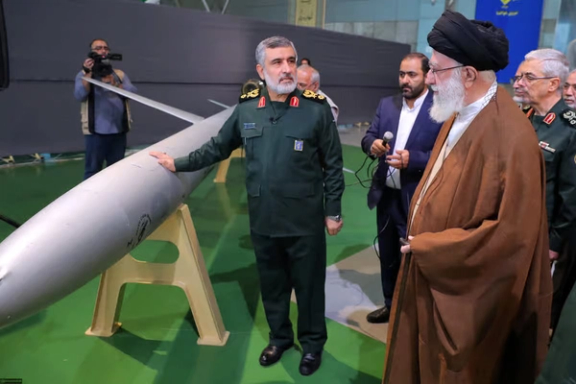
Iran's Supreme Leader Ali Khamenei visits an exhibition of the country's military achievements
The United States is convinced that a secret team of scientists in Iran is exploring a faster way to develop a nuclear weapon - within months - should Tehran decide to build one, The New York Times reported on Monday.
Iranian engineers and scientists are seeking to be able to turn nuclear fuel into a weapon within months rather than a year or more, the report said citing intelligence collected in the last months of the Biden administration.
The report cited US officials as saying Washington still believes that Iran and its Supreme Leader Ali Khamenei had not made a decision to develop a weapon.
In December, White House National Security Adviser Jake Sullivan said the Biden administration was concerned that a weakened Iran could build a nuclear weapon and that he was briefing President-elect Donald Trump's team on the risk.
The Biden administration's intelligence assessment has been relayed to Trump’s national security team during the transition of power, the New York Times added.
The report was released as the relatively moderate president of Iran, Masoud Pezeshkian, has publicly expressed willingness to re-engage with the United States in talks over its nuclear program, which it says is for peaceful purposes.
Setbacks dealt to Iran and its regional allies in a 15-month conflict with Israel and the inability of Iranian missiles to pierce US and Israeli air defenses, the New York Times reported, galvanized Iran to to seek new ways to deter its adversaries.
On January 10, then-CIA Director William Burns suggested that Iran’s weakened strategic position marked by regional setbacks could open the door to renewed nuclear negotiations.
"That sense of weakness could also theoretically create a possibility for serious negotiations," Burns said in an interview with NPR, referencing his experience with secret talks involving Tehran more than a decade ago.
Last month, Trump, Biden and Israeli Prime Minister Benjamin Netanyahu all described Iran as weakened, citing Tehran's reduced influence following the fall of its ally Bashar al-Assad in Syria, Israeli attacks on its air defenses and the killing of leaders of its armed Palestinian and Lebanese allies.
However, Iran's Supreme Leader denied his country's power has been undermined. "That delusional fantasist claimed that Iran has been weakened. The future will reveal who has truly been weakened."
Iranian security forces are torturing a former political prisoner in a bid to extract a confession that he provided a gun used in the assassinations of two senior judges last month, a source familiar with the matter told Iran International.
Bijan Kazemi's home was raided by security agents in the western town of Kuhdasht in Lorestan province on Jan. 21, the source added, and all electronic devices belonging to him and his family were confiscated.
Kazemi was allowed to make a quick phone call to relatives.
“Kazemi was transferred from Kuhdasht to Ward 209 of Tehran's Evin Prison after his arrest. Intelligence Ministry agents beat him and are trying to extract a forced confession claiming that the shooter who killed Razini and Moghiseh obtained his weapon from him,” added the source, who requested anonymity for security reasons.
The two judges, Mohammad Moghiseh and Ali Razini were shot dead in Tehran on January 18 at the Supreme Court in central Tehran, in a rare attack on veteran top players in the theocracy. Supreme Leader Ali Khamenei led their funeral prayers.
According to Iranian media, the shooter, whose identity has not been revealed, took his own life as he was pursued by security forces.
Since the killings of Razini and Moghiseh, the Intelligence Ministry has arrested several former political prisoners allegedly in connection with the incident. No details have been released on those detainees.
Kazemi was previously imprisoned for two years after an arrest in 2020. He was allegedly affiliated with the formerly armed opposition group, Mojahedin-e Khalq, also known as MEK, according to the Iran Prison Atlas published by the California-based human rights organization United4Iran.
The two jurists, both clerics, had decades-long histories of handing down death sentences and lengthy prison terms to dissidents in numerous cases, and were nicknamed the “hanging judges” by critics.
Judges Ali Razini (left) and Mohammad Moghiseh (right) were assassinated in Tehran on January 18, 2025
Moghiseh and Razini were known for their roles in the 1988 mass executions of political prisoners.
During the targeted attack, one of the guards of the Supreme Court’s 39th Branch was also injured, but his identity has yet to be disclosed.
Islamic Republic officials have given conflicting reports over how the killings took place.
“A note left by the attacker indicates that the People’s Mojahedin Organization of Iran (MEK) instructed him,” said Jafar Ghadiani, the Disciplinary Prosecutor for Judges in a statement on January 26.
A newspaper in Iran published a report on January 19 saying only 13 seconds passed from the moment the shooter entered the office to the time he left, during which he fired six rounds in rapid succession.
The deaths of Moghiseh and Razini struck a nerve in Iran particularly among former political prisoners, many of whom described harsh punishments they meted out.
The Swedish government has accused Tehran of using a Shi'ite Muslim mosque in Stockholm to spy on Sweden and the Iranian diaspora there.
The Swedish Security Service has assessed that the Imam Ali Islamic Center in Stockholm was used by Iran as a means of spying and conduct activities threatening security, said Sweden's Minister for Social Affairs Jakob Forssmed on his X account.
The Swedish minister called it "extremely serious," adding that Sweden had stopped all state monetary aid to the center. "State funds should not be used for activities that conflict with fundamental democratic values."
"An additional process" is under way, he added, without providing further details.
Iranian cleric Mohsen Hakimollahi, the Islamic Center's imam, was arrested nearly two weeks and faces deportation from Sweden, Expressen reported Friday.
“He has been missing for more than ten days, and we learned through various channels that he is in one of the Swedish Migration Board's detention centers and will soon be deported from the country,” added the source.
The Imam Ali Islamic Center, considered the largest Shi'ite institution in Northern Europe, has not issued a public statement on the matter.
Hakimollahi, aged 63, was transferred from Iran to Sweden to manage the Shi'ite center and had resided in the country for several years, developing connections with local political figures and religious organizations.
The Islamic Republic has long ruled out developing nuclear weapons, a top political advisor to Iran's Supreme Leader Ali Khamenei said, in dovish remarks pointing to a potential openness to reviving talks with the United States.
"Iran has never sought nuclear weapons and never will," said Ali Shamkhani during a visit to the Atomic Energy Organization in Tehran on Monday.
"However, we will fully defend our legal rights in political and technical aspects with all our strength," the former security chief added.
Western powers say Tehran's expansion of its nuclear program lacks any credible peaceful purpose.
As economic malaise in Iran has deepened, renewed talks with the United States over the disputed nuclear program are widely viewed as the best avenue to ease sanctions.
Iran maintains that it will not pursue nuclear weapons, citing a long-standing fatwa or religious edict by Khamenei banning all weapons of mass destruction, including nuclear arms.
In an October 2019 speech, Khamenei said that building and maintaining nuclear weapons is "absolutely haram," meaning strictly forbidden under Islamic law.
However, analysts argue that the fatwa is merely an advisory opinion rather than a binding legal decree. They say it was intended to mislead the international community about the true intentions of a nuclear program that Tehran insists is peaceful.
Kamal Kharrazi, a senior foreign policy advisor to Khamenei, said last year that Iran has the capacity to produce nuclear weapons and an existential threat could prompt a reconsideration of the Supreme Leader’s injunction.
Iranian authorities have consistently asserted that the country's nuclear program is intended for peaceful purposes.
However, Western powers and independent nuclear experts argue that the levels and quantities of enrichment undertaken by Iran since 2021 go far beyond those needed for energy or scientific research purposes.
"Iran continues to develop its nuclear program to levels that lack any credible civilian justification," France, Britain and Germany said in a joint statement to the United Nations in December.
The costs of Iran’s nuclear program are negligible compared to the achievement of gaining nuclear technology despite sanctions, the country’s atomic energy chief said on Sunday.
"We shouldn’t focus on weighing costs against benefits. While we are paying a heavy price due to sanctions, the emphasis is not on the costs," said Mohammad Eslami, an Iranian vice president and head of the Atomic Energy Organization.
When asked by a state TV interviewer to explain how the expenses are justified, he underscored the importance of acquiring advanced technology that so-called arrogant global powers seek to deny other nations, particularly Iran.
Eslami argued that evaluating the program’s costs and benefits should occur only after what he described as the required technological capabilities were achieved.
“We are now on this path. We’ve reached a stage where we can apply nuclear technology in various fields,” he added.
He maintained that Iran’s nuclear program is transparent and peaceful, accusing critics of using it to fuel what he called Iranophobia internationally.
Eslami's remarks came after Ali Larijani, an advisor to the Supreme Leader, signaled a softer stance on Iran’s nuclear program, calling it vital but stressing that it should not overshadow broader progress as “people must live their lives.”
The nuclear program is a pillar of our development, but not its entirety, he said on Saturday, stressing that despite his direct role in past negotiations, its scope must remain within defined limits.
"The nuclear issue is part of our national strength, but it is not all of it. People must live their lives, and progress must be achieved in various fields. The nuclear agreement [JCPOA] preserved nuclear knowledge, ensuring its continuation, but reduced the number of centrifuges from 9,000 to 5,000," Larijani, who is considered a moderate conservative in the Islamic Republic's political spectrum, argued.
Iran has faced ongoing electricity and gas shortages due to underinvestment and the impact of US-led sanctions which have hindered modernization efforts in its power, oil and gas sectors.
Iran’s leadership has been wrestling with the idea of re-engaging with Washington over the nuclear program in order to reduce US economic sanctions.
Iran's nuclear program: costs vs benefits
On January 23, Eslami highlighted the economic benefits of the Bushehr Nuclear Power Plant, saying it cost $1.8 billion but has supplied 70 billion kilowatt hours of electricity to the grid in more than a decade. He estimated that producing the same amount of energy from fossil fuels would have cost $8 billion. However, government data shows that the reactor produces just 2% of Iran's annual electricity needs.
Critics argue the program’s costs outweigh its benefits.
Outspoken reformist commentator Sadegh Zibakalam criticized the nuclear program in a post on X on January 23, questioning its value.
“Mr. Zarif says we had no intention of producing nuclear weapons and could have built them if we wanted. So why incur such enormous costs for over 20 years?” he wrote. Zibakalam also cited unfulfilled promises to build five nuclear plants comparable to Bushehr.
In a letter to hardline lawmaker Hamid Rasaei in February 2023, Zibakalam argued that Iran could procure fuel for its Bushehr power plant through the International Atomic Energy Agency (IAEA).
“Not only does our insistence on producing nuclear fuel domestically have no economic justification due to its high cost, but also other things like speaking of 'our proud nuclear achievements' are one-sided and exaggerated.”
Since US President Donald Trump imposed what he called maximum pressure sanctions in his first term starting in 2018, Iran’s national currency has depreciated nearly 20-fold, and inflation has surged to 40%.
The sanctions severely disrupted the economy, particularly in the banking, trade, transportation and insurance sectors.
Sanctions have severely disrupted multiple sectors of Iran’s economy, particularly international trade, which has been hit hard by rising costs in banking, transportation, shipping, and insurance.
In a recent state-run television program, Saeed-Reza Ameli, former secretary of Iran's Supreme Cultural Revolution Council, said sanctions have cost the Iranian economy $1.2 trillion over the past 12 years.
Economist Vahid Shaghaghi-Shahri echoed similar concerns in an interview with the Etemad newspaper last week, saying Iran’s gross domestic product has shrunk from $640 billion to $400 billion over the same period.
Without sanctions, he estimated, the economy could have grown to $1 trillion.
Iranian President Masoud Pezeshkian said on Monday that certain economic difficulties are beyond governmental control, stressing the need to be transparent with citizens regarding such limitations.
"The current situation of high prices and livelihood problems that are putting pressure on the people is unacceptable," he said. "Some of it is in our hands, and some of it is not," he added without elaborating.
Pezeshkian made the remarks during a joint meeting with Parliament Speaker Mohammad-Bagher Ghalibaf, Chief Justice Gholamhossein Mohseni Ejei, and other senior legislative and judicial officials.
Iran's current economic crisis stems from both US and European sanctions, as well as systemic mismanagement linked to the government's bureaucracy and its dominant role in the economy.
Official media often attributes economic responsibility to the presidential administration, but since foreign policy decisions rest with Supreme Leader Ali Khamenei, lifting sanctions is beyond the president's control.
(From left) Iranian President Masoud Pezeshkian, Chief Justice Gholamhossein Mohseni Ejei, and Parliament Speaker Mohammad-Bagher Ghalibaf during a meeting in Tehran on February 3, 2025
Last month, the Statistical Center of Iran reported significant price increases on essential goods, with some food items seeing prices multiply up to five times compared to last year.
Ordinary workers currently earn less than $150 a month, while official estimates indicate that a family of three needs at least $450 a month to cover basic necessities.
Pezeshkian said it is time to engage the population, at least one third of whom have been pushed below the poverty line, warning that more protests lie ahead.
"When we are unable to fulfill our commitments to the people... if they come to the streets and protest, we must engage in dialogue with them ... but instead, we treat them badly.
"Solving the people's problems is our duty; if we cannot, we should at least explain it to them in a kind manner... not treat them violently."
He accused the country's adversaries of taking advantage of the dire economic conditions, warning: "Of course, the people should also be careful that the enemy does not exploit their protests to disrupt society.”
Acknowledging declining public support for the government, he asked, "In the recent elections, 50 percent of the people did not participate. Are they not one of us, and are we not their servants? Shouldn't we ask ourselves why they are dissatisfied with us?"
Only 24 million of 61 million eligible Iranians voted on June 28 in snap presidential elections called after the untimely death of President Ebrahim Raisi in a helicopter crash.
The 39.9 percent turnout was the worst in the history of the Islamic Republic. Pezeshkian did not secure the 50 percent required to avoid a run-off. The turnout improved in the second round to 49.68%.