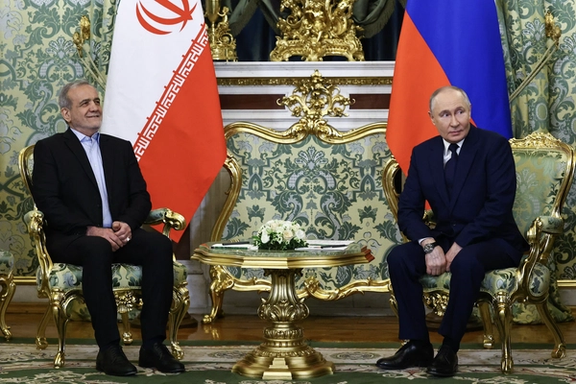
Russian President Vladimir Putin and Iranian President Masoud Pezeshkian meet in Moscow, Russia January 17, 2025
Political figures in Tehran are divided over ties with Moscow and Beijing. Some warn that Russia could exploit Iran’s tensions with the US, while others stress the importance of trade ties with both countries.
In an interview with Didban Iran website, reformist politician Mahmoud Mirlohi said that Iran must maintain an independent foreign policy and leverage its ties with Russia and China to improve relations with the United States.
"We should not allow Russia to use Iran as a pawn in its dealings with the United States," Mirlohi warned.
He also warned of the potential fallout from Iran's military support for Russia in its war against Ukraine, calling it "a serious cause for concern." He stressed that "Iran's strategic cooperation with Russia should not come at the expense of improving relations with other countries."
Russia is one of the signatories of the 2015 JCPOA nuclear agreement between Iran and world powers. Negotiations to revive the deal, which had been ongoing for 12 months in Vienna during the US President Joe Biden administration, were abruptly halted in March 2022 following Russia's invasion of Ukraine.
Earlier this year, Iran and Russia signed a treaty, their first major agreement since 2001, aimed at deepening bilateral ties, though it did not establish a military alliance or impose binding obligations on either side.
"The 20-year strategic cooperation agreement with Russia should not limit Iran's ties with other countries, nor should we allow Russia to use Iran as a bargaining chip in its negotiations with the West," Mirlohi said.
Mirlohi also argued that, historically, Iranians have few positive memories of their relationship with Russia.
"Beyond hostile relations before, during, and after the Qajar era, Russia in recent years has failed to uphold its commitments, including delays in completing the Bushehr nuclear power plant and withholding S-300 air defense systems and Sukhoi SU-35 fighters, despite Iran paying for them in advance. This history has fueled concerns about the recent agreement between Iran and Russia," the politician said.
Mirlohi cautioned that Iran must balance its relations between East and West. He noted that while agreements among BRICS countries, including Russia and Iran, offer opportunities, "we should not expect them to solve all of Iran's problems, as the global banking system remains dependent on Europe and the US." He added that the importance of continued engagement with the EU and the US to protect Iran's interests.
In an interview with Mehr News, Tehran-based economic analyst Albert Boghozian emphasized the importance of trade deals with China and Russia, saying that they could help drive Iran’s economic development.
He said, however, that Tehran's economic ties with Moscow are less significant than those with China.
“We conduct extensive transactions with China, which is seeking new markets. Given the sanctions, we are particularly interested in trade conducted in our partners’ currencies—using roubles for transactions with Russia and yuan for deals with China—since we cannot process payments for imports through Swift,” he told Mehr News.
Boghozian also warned of the risks associated with relying on roubles and yuan due to their lower value compared to the US dollar. “It is risky to hold our foreign currency reserves in these currencies, but it remains our only option for bypassing US sanctions.”
As an example of challenges in trade deals with China and Russia, Iranian media—including the IRGC-linked Fars News Agency—have recently scrutinized the Tehran Municipality's purchase of subway trains from China.
The deal has faced significant delays, prompting Tehran City Council Chairman Mehdi Chamran to urge the press to stop discussing the issue.
While media outlets have criticized the opacity of trade agreements with China, Chamran argued that public debate could make the issue even more complex, adding that Beijing is still in the process of manufacturing the trains Tehran has ordered.
Debate grows in Iran over ties with Russia and China | Iran International
Iran's president and parliament speaker once again acknowledged that the country is facing a severe economic crisis, with people under "immense" inflationary pressure, with no relief from sanctions in sight.
Speaking at a February 3 meeting of top state officials, led by the heads of the three branches of government, President Masoud Pezeshkian said his government is three months behind on some employee payments, while security forces arrest those who protest the delays in the streets.
"We owe them the money, and it is our responsibility to pay them," Pezeshkian said, adding that the government has to solve the people's problems. He further urged everyone at the meeting "to avoid angering the people."
He said some foreign officials continue to claim that "Iran has been badly weakened and protests are imminent," accusing foreign governments of seeking to exploit public unrest.
Pezeshkian noted that "nearly half of eligible voters did not participate in the latest presidential election, but we are still responsible for serving and addressing the demands of all citizens, including those who did not vote." He acknowledged that while the government aims to serve the people, "they are not satisfied with the way we work," according to Aftab News.
At the same time, Mohammad Hashemi, an influential centrist politician, pointed out that only Supreme Leader Ali Khamenei can authorize Iranian officials to negotiate with the United States to reach a deal on reducing sanctions.
Meanwhile, Iran's state-run news channel aired remarks from both President Masoud Pezeshkian and Parliament (Majles) Speaker Mohammad Ghalibaf, in which they said they "regret that the people are facing so many financial difficulties." However, some Iranian media outlets, including the state-owned ISNA news agency, only reported portions of their speeches that omitted references to the country's dire economic situation.
Politicians outside the government, including former lawmaker Ali Motahari also echoed Ghalibaf's comment about the dire situation of the economy.
The conservative website Nameh News quoted Pezeshkian as saying at the meeting, "We are duty-bound to solve the people's problems, and if we cannot, we must apologize. Instead, when we fail to pay our debts to them, we mistreat them and send them to jail. These people have worked hard and simply want to be paid for their labor. At the very least, we should speak to them with respect and ask for more time to fulfill our obligations."
Nameh News also quoted Pezeshkian as saying, "Iran's economic situation is unacceptable. Prices are high, people are under pressure, and we cannot fully resolve the crisis, as part of the solution is beyond our control."
Pezeshkian was likely referring to the fact that only Khamenei can authorize negotiations with the United States as a possible step toward addressing Iran's economic problems. The way the heads of the government's branches spoke about the issue on state TV suggests they were making a similar point, possibly attempting to persuade Khamenei to soften his stance on negotiations.
In an interview with the centrist daily Arman Melli, Mohammad Hashemi, a former chief of state television, emphasized that "negotiations with the United States are important for Iran, and only Khamenei, as Supreme Leader, can authorize Iranian officials to participate." He added that "the views of hardliners influenced by the ultraconservative Paydary Party will not determine the fate of the negotiations."
Meanwhile, Iranian media quoted a deputy intelligence minister as saying, "Iran will not negotiate with the United States, as those seeking talks want Iran to retreat from its positions or passively witness the collapse of its political system."
Shopkeepers in southern Tehran went on strike on Tuesday protesting runaway inflation and the rial’s steep devaluation, according to videos received by Iran International.
The shopkeepers protested around Molavi Street, Mohammadieh Square, and South Khayyam Street, an area known as a historic trading region of Iran's capital, holding up signs demanding economic stability and relief from soaring prices.
Similar protests were staged last year in late December when business owners and employees in Tehran’s historic bazaar staged a rare strike, spurring demonstrations in other commercial hubs in the capital.
On Tuesday, every US dollar was exchanged for 843,100 rials in the open market.
Iran’s currency has lost more than 30% of its value since early September last year, and inflation of consumer good has spiked to 50%, based on media reports from Tehran.
The Iranian rial’s sharp depreciation has had ripple effects across the economy. For merchants, it has created an untenable mix of higher costs and reduced consumer demand as at least one third of Iran is now living below the poverty line.
Since 2018, when the US re-imposed economic sanctions under the maximum pressure policy, Iranian currency has dropped nearly 20-fold. In the last five months alone, the rial has lost a further 30% of its value.
Over one third of Iranians are now living below the poverty line amid the worst economic crisis since the founding of the Islamic Republic.
A prominent conservative commentator in Iran says that Supreme Leader Ali Khamenei's implicit remark about "making a deal" with the United States signals a shift in approach as Tehran faces growing challenges.
However, Mohammad Mohajeri, the former editor of the hardline daily Kayhan, also noted that Khamenei's remark is likely to provoke backlash from hardliners and those cautious about a potential rapprochement with Washington.
In an interview with the Jamaran News website, which is linked to former President Mohammad Khatami of the reformist faction, Mohajeri noted that Khamenei's use of the term "making a deal" suggests the possibility of an agreement. He argued that this could signal support for President Masoud Pezeshkian's efforts to push for sanctions relief.
"It won’t be easy and will take time," Mohajeri added. "Nonetheless, the statement could mark the beginning of a new strategy."
According to Jamaran, Mohajeri was referring to a sentence in Khamenei's latest speech on January 28 this year, in which he said: "Behind the smiles of diplomacy, there are always hidden and malicious enmities and resentments. We must open our eyes and be careful with whom we are dealing, trading, and talking."
“When a person knows his opponent, he may make a deal, but he knows what to do," Khamenei added.
Khamenei made these remarks while sitting beside President Masoud Pezeshkian, who has publicly expressed Tehran's openness to talks. The media widely interpreted the Supreme Leader's statements as a "green light for negotiations."
Asked if Khamenei's statement indicated a green light for starting the talks, Mohajeri said: "I do not like that expression. However, I believe this highlighted a new strategy." He added, "It was interesting that while the hardliners expected Khamenei to endorse their views, he did not express any opposition to negotiations though he warned officials to be wary of the enemy's deceit."
Mohajeri said Khamenei’s remarks angered hardliners, who may remain silent for now but will soon find another pretext to attack the government. "Before long, you’ll see them lashing out over other issues," he said, adding that they may also target negotiators, including Foreign Minister Abbas Araghchi, who is set to lead the talks.
In recent weeks, former Foreign Minister and current aide to President Pezeshkian, Javad Zarif, has come under increasing attack, with hardliners accusing him of proposing negotiations with the Trump administration.
Zarif, however, denied the claim, telling Jamaran News, "We did not make any proposal. We simply responded to their suggestion for interaction."
While reformist-aligned media have strongly defended Zarif, some analysts in Tehran suggest that his position within the government is not particularly strong.
Some conservative figures in Iran, including former state TV chief and Tourism Minister Ezzatollah Zarghami, have also weighed in on recent calls for talks with the US.
While Zarghami had told Iranian media that such proposals had created a "bipolar situation" in the country, he wrote in an X post after Khamenei's remarks that "the Leader’s clever measure put an end to the bipolar situation between supporters and opponents of negotiations with the United States."
The Swedish government has accused Tehran of using a Shi'ite Muslim mosque in Stockholm to spy on Sweden and the Iranian diaspora there.
The Swedish Security Service has assessed that the Imam Ali Islamic Center in Stockholm was used by Iran as a means of spying and conduct activities threatening security, said Sweden's Minister for Social Affairs Jakob Forssmed on his X account.
The Swedish minister called it "extremely serious," adding that Sweden had stopped all state monetary aid to the center. "State funds should not be used for activities that conflict with fundamental democratic values."
"An additional process" is under way, he added, without providing further details.
Iranian cleric Mohsen Hakimollahi, the Islamic Center's imam, was arrested nearly two weeks and faces deportation from Sweden, Expressen reported Friday.
“He has been missing for more than ten days, and we learned through various channels that he is in one of the Swedish Migration Board's detention centers and will soon be deported from the country,” added the source.
The Imam Ali Islamic Center, considered the largest Shi'ite institution in Northern Europe, has not issued a public statement on the matter.
Hakimollahi, aged 63, was transferred from Iran to Sweden to manage the Shi'ite center and had resided in the country for several years, developing connections with local political figures and religious organizations.
The costs of Iran’s nuclear program are negligible compared to the achievement of gaining nuclear technology despite sanctions, the country’s atomic energy chief said on Sunday.
"We shouldn’t focus on weighing costs against benefits. While we are paying a heavy price due to sanctions, the emphasis is not on the costs," said Mohammad Eslami, an Iranian vice president and head of the Atomic Energy Organization.
When asked by a state TV interviewer to explain how the expenses are justified, he underscored the importance of acquiring advanced technology that so-called arrogant global powers seek to deny other nations, particularly Iran.
Eslami argued that evaluating the program’s costs and benefits should occur only after what he described as the required technological capabilities were achieved.
“We are now on this path. We’ve reached a stage where we can apply nuclear technology in various fields,” he added.
He maintained that Iran’s nuclear program is transparent and peaceful, accusing critics of using it to fuel what he called Iranophobia internationally.
Eslami's remarks came after Ali Larijani, an advisor to the Supreme Leader, signaled a softer stance on Iran’s nuclear program, calling it vital but stressing that it should not overshadow broader progress as “people must live their lives.”
The nuclear program is a pillar of our development, but not its entirety, he said on Saturday, stressing that despite his direct role in past negotiations, its scope must remain within defined limits.
"The nuclear issue is part of our national strength, but it is not all of it. People must live their lives, and progress must be achieved in various fields. The nuclear agreement [JCPOA] preserved nuclear knowledge, ensuring its continuation, but reduced the number of centrifuges from 9,000 to 5,000," Larijani, who is considered a moderate conservative in the Islamic Republic's political spectrum, argued.
Iran has faced ongoing electricity and gas shortages due to underinvestment and the impact of US-led sanctions which have hindered modernization efforts in its power, oil and gas sectors.
Iran’s leadership has been wrestling with the idea of re-engaging with Washington over the nuclear program in order to reduce US economic sanctions.
Iran's nuclear program: costs vs benefits
On January 23, Eslami highlighted the economic benefits of the Bushehr Nuclear Power Plant, saying it cost $1.8 billion but has supplied 70 billion kilowatt hours of electricity to the grid in more than a decade. He estimated that producing the same amount of energy from fossil fuels would have cost $8 billion. However, government data shows that the reactor produces just 2% of Iran's annual electricity needs.
Critics argue the program’s costs outweigh its benefits.
Outspoken reformist commentator Sadegh Zibakalam criticized the nuclear program in a post on X on January 23, questioning its value.
“Mr. Zarif says we had no intention of producing nuclear weapons and could have built them if we wanted. So why incur such enormous costs for over 20 years?” he wrote. Zibakalam also cited unfulfilled promises to build five nuclear plants comparable to Bushehr.
In a letter to hardline lawmaker Hamid Rasaei in February 2023, Zibakalam argued that Iran could procure fuel for its Bushehr power plant through the International Atomic Energy Agency (IAEA).
“Not only does our insistence on producing nuclear fuel domestically have no economic justification due to its high cost, but also other things like speaking of 'our proud nuclear achievements' are one-sided and exaggerated.”
Since US President Donald Trump imposed what he called maximum pressure sanctions in his first term starting in 2018, Iran’s national currency has depreciated nearly 20-fold, and inflation has surged to 40%.
The sanctions severely disrupted the economy, particularly in the banking, trade, transportation and insurance sectors.
Sanctions have severely disrupted multiple sectors of Iran’s economy, particularly international trade, which has been hit hard by rising costs in banking, transportation, shipping, and insurance.
In a recent state-run television program, Saeed-Reza Ameli, former secretary of Iran's Supreme Cultural Revolution Council, said sanctions have cost the Iranian economy $1.2 trillion over the past 12 years.
Economist Vahid Shaghaghi-Shahri echoed similar concerns in an interview with the Etemad newspaper last week, saying Iran’s gross domestic product has shrunk from $640 billion to $400 billion over the same period.
Without sanctions, he estimated, the economy could have grown to $1 trillion.