Threats will not push Iran to negotiating table, top diplomat says
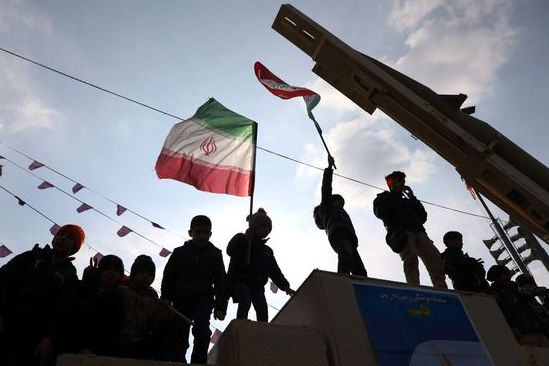
People wave flags next to an Iranian missile on display during the 46th anniversary of the Islamic Revolution in Tehran, Iran, February 10, 2025.
Washington's so-called maximum pressure campaign of sanctions and mooting of military force will not force Iran to negotiate about its nuclear program, Foreign Minister Abbas Araghchi said on Monday.
"Iran’s position is clear and explicit: We will not negotiate under pressure and threats," Araghchi told reporters in Tehran after a meeting with his Sudanese counterpart. "The presidential order for maximum pressure speaks for itself."
The remarks appear to represent a hardening line by Tehran to the suggestion by US President Donald Trump that Iran come to a deal with Washington about its disputed nuclear program or potentially face military strikes.
"Maximum pressure and resolutions have never been effective against Iran … We will not negotiate under threat," Araghchi added.
Trump this month signed a directive reviving his maximum pressure policy on Iran from his first term aimed at driving the Islamic Republic's oil exports to zero. After signing the memorandum, he said he would prefer a deal with Tehran to an Israeli attack on their nuclear sites.
"I would love to make a deal with them without bombing them," he later said on Fox News, drawing ire in Iran.
Iranian Supreme Leader Ali Khamenei appeared to reject the idea of talks with the hawkish Trump administration and senior leaders have fallen in with the position.
The Emir of Qatar Sheikh Tamim bin Hamad Al Thani is due to visit Tehran for a bilateral visit, Araghchi added, saying that there was no indication he carried a message or would be playing any mediating role.
A key go-between in regional conflicts, Qatar maintains good relations with both Tehran and Washington.
Al Thani's visit represents one of the most high-level foreign visits to Iran as it has been locked in over a year of direct and regional combat with Israel.
The Wall Street Journal and The Washington Post reported last week citing US intelligence assessments from January that Israel saw an opening for an attack on Iranian nuclear sites as early as the first of this year with Iran weakened and Trump seen as sympathetic to a strike.
Threats will not push Iran to negotiating table, top diplomat says | Iran International
Israel on Monday accused Turkey of cooperating with Iran to get much-needed money to Hezbollah to rebuild itself after the overthrow of the Assad dynasty in Syria deprived Tehran and the Lebanese group of an ally.
“There is an increased Iranian effort to smuggle money to Lebanon for Hezbollah in order to restore its power and status, including via Turkey and through its cooperation,” Israel’s foreign minister Gideon Sa’ar told a visiting delegation of US senators and Deputy Middle East Special Envoy Morgan Ortagus.
The allegations of cash deliveries to Hezbollah led to a suspension of flights between Iran and Lebanon last week, which met with harsh reaction from the Tehran-backed group.
“Hezbollah demands that the Lebanese government reverse its decision of preventing the Iranian plane from landing at Beirut airport and take serious measures to prevent the Israeli enemy from imposing its dictates and violating sovereignty,” a statement read on pro-Hezbollah outlet Al-Mayadeen.
Tehran denies that Iranian passenger flights have been used to ship cash to Hezbollah, but the Lebanese government has so far refused to back down, announcing on Monday that the suspension of flight from Iran has been extended.
Shortly after, Iran’s foreign minister Abbas Araghchi said he had discussed the issue with his Lebanese counterpart Abdallah Bou Habib.
“He emphasized that the decision in this matter was not political but rather technical and legal,” Araghchi quoted Bou Habib as saying.
Sa’ar’s accusations against Turkey could complicate matters as Tehran and Beirut try to find a solution to resume flights. Turkey has not publicly responded to the claims.
In his meeting with the American delegation, Sa’ar asserted that Iran is seeking to compensate for its recent regional setbacks by advancing its nuclear program, not elaborating on what those advances were and if his assessment was based on public or classified information.
Israel is said to have decided on a military attack on Iran if no agreement is reached between Tehran and Washington, according to Al-Hadath citing a senior European diplomat.
Tehran has reacted with suspicion to a report suggesting regional rival Saudi Arabia may mediate between Iran and US President Donald Trump, in the latest twist to a drama over whether Iran would accept Trump's overtures for a nuclear deal.
CNN reported on Sunday that Riyadh is open to brokering discussions between the US and Iran to curb Tehran’s nuclear program.
The kingdom is concerned, the US network reported, that Iran might pursue nuclear weapons more aggressively after Israel battered regional allies which had acted as Iran's deterrent to a direct Israeli attack for decades.
Asked about the CNN report at his weekly press briefing Monday, Iran's foreign ministry spokesman Esmaeil Baghaei denied any knowledge and said these were only “media speculations.”
An article titled "Will Saudi Arabia Mediate Iran-US Negotiations?" published by Nour News on Monday outlined key obstacles to Saudi mediation. It highlighted Iran's deep mistrust of the US, shaped by the policies of former President Donald Trump, who withdrew from the 2015 nuclear deal. The article also pointed to conflicting Iranian and Saudi interests in regional matters, including Lebanon, Iraq, and Syria, as additional challenges to mediation efforts.
Iranian authorities are “seeking strong guarantees of reduction of sanctions before entering new talks,” the media outlet close to former Iranian national security chief Ali Shamkhani, wrote.
Despite these challenges, Nour News acknowledged the potential for reduced tensions and even a new agreement if Saudi Arabia facilitates balanced, pressure-free negotiations.
Foreign affairs expert Ali Bigdeli, speaking to Nameh News on Sunday, noted that Saudi Arabia’s diplomatic influence had grown, citing an upcoming US-Russia meeting in Riyadh as evidence. He suggested Iran might view Saudi mediation positively. “Mr. Araghchi’s visit to Oman may not be unrelated to this matter,” he added.
Bigdeli also argued that Saudi mediation would differ significantly from that of Qatar, given Saudi Arabia’s dominant role in the Persian Gulf.
Iran's Supreme Leader Ali Khamenei repeatedly asserted in the past that the Islamic Republic would never engage in negotiations with the Trump administration. He also notably declined to respond to a message from Trump, delivered by former Japanese Prime Minister Shinzo Abe in June 2019.
In a speech on February 7, after Trump issued an executive order to reinstate his “maximum pressure” sanctions on Iran, Khamenei emphatically rejected talks with the United States.
Meanwhile, US Secretary of State Marco Rubio arrived in Riyadh on Monday ahead of planned talks between Trump and Russian President Vladimir Putin, to be hosted by Saudi Crown Prince Mohammed bin Salman. While Iran’s nuclear program may be discussed, no official announcements have been made.
On Sunday, US National Security Advisor Mike Waltz said President Donald Trump is willing to engage in talks with Iran only on condition that Tehran fully abandon its nuclear program.
"The President has also expressed a willingness to take whatever action is necessary. All options are on the table," Waltz told Fox News on Sunday, leaving the option of diplomatic channels open.
Oman acted as a mediator between Iran and the United States before the talks that led to the 2015 nuclear deal, and Qatar has recently offered to mediate new talks.
Speculation has risen that this topic may feature in the upcoming visit of Qatari Emir Tamim bin Hamad Al Thani to Tehran. However, Iranian Foreign Ministry spokesman Esmaeil Baghaei denied these claims during his weekly briefing on Monday.
Iran and Saudi Arabia restored diplomatic ties in 2023, facilitated by Iraq and China. The Saudi Embassy in Tehran reopened in August of that year, seven years after vigilantes attacked and torched the building in protest to the execution of dissident Shia cleric Nimr Baqir al-Nimr in Saudi Arabia.
The Iranian government has licensed 205 matchmaking websites in a bid to boost declining marriage rates among young Iranians, according to ILNA news agency.
"The government will be accountable for any problems these centers may cause," said Alireza Rahimi, Deputy Minister of Sports and Youth Affairs. He added that an expert group has been formed to evaluate the effectiveness of these websites in increasing marriage rates.
While Rahimi acknowledged what he called “some abuses" at these centers, he did not elaborate on the details of possible problems and oversight mechanisms. He added that the police are responsible for dealing with unlicensed matchmaking services.
The move comes as Iran faces a declining marriage rate and rising divorce rate. Government efforts to encourage higher birth rates have failed to produce results, according to data from the National Organization for Civil Registration.
According to the latest data from Iran's Civil Registration Organization, nearly 39% of marriages in the first seven months of the Iranian year 1403 (March to September 2024) ended in divorce. Data from the Statistical Center of Iran also reveals a 46% decrease in marriages between 2010 and 2023.
Economic hardship, rising awareness of individual and family rights, and access to legal and counseling services are among the factors contributing to young people's reluctance to marry.
In January, Iran's Science Ministry announced it is removing educational content discouraging childbearing and offering new incentives to boost declining fertility rates. These include more married student dorms, on-campus kindergartens, and increased financial aid for housing, loans, and other benefits for married students with children.
Days after the 46th anniversary of the 1979 Islamic Revolution, media in Tehran are sounding the alarm over deep flaws in the governing system and a worsening economic crisis, warning that the Islamic Republic's survival is increasingly at risk.
A leading article in the Jomhouri Eslami newspaper, a conservative outlet owned by Supreme Leader Khamenei's office, noted last week that 46 years after its establishment, the Islamic Republic has yet to restore justice in Iranian society. "The people are still suffering from injustice and discrimination," the daily wrote.
The article also criticized the governing system for undermining the independence and freedom it has long promoted. Highlighting "the divide between the people and the ruling clerics," the newspaper stressed that "the people should be the driving force and focal point in the Islamic Republic" and posed a pointed question: "What is the people's role and status in the government?"
Although Iran holds regular elections, political parties and the media face severe restrictions, and only approved candidates are allowed to run.
Jomhouri Eslami also criticized the stark contrast between officials leading lavish lifestyles—driving luxury cars under tight security to pay respects at the mausoleum of the Islamic Republic's founder—and ordinary people who struggle to reach them to voice their concerns.
The daily criticized the disparity between officials and the public, noting that officials earn several times more than ordinary citizens and enjoy government-funded travel and luxury while advocating austerity. The daily warned that such a lifestyle and governance approach could undermine the political system's stability.
Meanwhile, the pro-reform website Fararu warned, "A catastrophe is on its way as half of the population in Iran is getting poorer on a day-to-day basis."
It cautioned that the situation is becoming increasingly dire, particularly for low-income groups, due to rising inflation, soaring exchange rates, price fluctuations, and ongoing economic crises. The website argued that many Iranians are struggling to make ends meet amid the financial turmoil.
"At the same time, all initiatives aimed at improving the situation have failed and remained futile. This has caused a general dissatisfaction among the public and has led to serious questions about the government's ability to tackle the current crisis," the website wrote.
Fararu cited market expert Hamid Haj Esmaili, who attributed the worsening economic situation over the past two decades not only to sanctions but also to government inefficiency in resource distribution, which has exacerbated the crisis.
Haj Esmaili noted that nearly half of Iran's population relies on government support to survive, while the government must take stronger action against corruption. He emphasized that these challenges are all linked, in some way, to the impact of sanctions and urged authorities to engage with other countries to address the crisis.
Meanwhile, the pro-reform daily Setareh Sobh published a commentary last week by former lawmaker Yadollah Eslami, who highlighted "the wide gap between the people and the government." He argued that "the officials' indifference to people's increasing problems has made many people distance themselves from the government."
Eslami also criticized officials "for the arrogance in their rhetoric when they address the nation," describing their tone as "a mixture of insult and violence." He warned that "unfortunately, some Iranian officials believe that insults and violence are a virtue for them; and in this situation, what is being sacrificed is truth, justice, and freedom."
Iran rejected the latest G7 statement that criticized Tehran's ongoing nuclear activities and support of regional militant groups.
“The G7 members unequivocally condemned Iran’s destabilizing actions, including its rapid advancement of uranium enrichment without credible civil justification, its facilitation of terrorism organizations and armed groups across the Middle East and Red Sea, its proliferation of ballistic missiles and drones, and its transnational repression and violation of fundamental human rights,” read the statement issued on Saturday.
The G7 ministers held a meeting on the sideline of the Munich Security Conference.
Foreign Ministry Spokesman Esmail Baghaei on Monday and during his weekly briefing rejected the statement as politically motivated, arguing that Western powers themselves were responsible for fueling instability.
“The return of stability and security to West Asia requires these countries to stop their interventionist policies in regional affairs,” he said, referring to the United States, Canada, and three European members of the G7.
Iran pushes back on military, nuclear criticism
In response to criticism concerning the military capabilities of Iran, Baghaei said that Iran’s defense facilities follow all prevailing international laws.
“Iran’s military and defense advancements are necessary for national security and contribute to stability in West Asia,” he added.
Over the nuclear issue he dismissed concerns raised over enrichment of uranium as being politically driven.
“Our peaceful nuclear activities are fully in line with the Non-Proliferation Treaty and international safeguards,” he said, adding that Iran would continue its program based on its technical and industrial needs.
Baghaei accused the G7 of ignoring Israel’s nuclear capabilities. “The biggest obstacle to a nuclear-free Middle East is the Zionist regime, which has stockpiled weapons of mass destruction while enjoying full support from the same G7 countries,” he said.
Diplomatic outreach continues despite tensions
Despite Western pressure, Baghaei highlighted Iran’s ongoing diplomatic efforts, pointing to high-level meetings in Oman by Foreign Minister Abbas Araghchi. “These engagements are part of a broader strategy to enhance economic and political cooperation,” he noted.
On restrictions faced by Iranian flights to Beirut, he said discussions are underway with Lebanese officials. “We will not allow external forces to disrupt the strong historical ties between Iran and Lebanon,” he said.
Last week two flights from Tehran were banned from landing in Lebanon's only international airport.
On Friday, the second flight banned from taking off from Iran triggered protests in Lebanon from supporters of the Iran-backed group who blocked the road to the airport. The Lebanese army fired tear gas at protesters.
Responding to Israeli threats, Hezbollah funeral plans
Baghaei also addressed Israeli Prime Minister Benjamin Netanyahu's recent comments on a possible attack on Iran.
“Such statements are a blatant violation of international law, and those who issue these threats should be held accountable,” he said.
Israel's Prime Minister Benjamin Netanyahu expressed his intention on Sunday "to finish the job against Iran" with the support of US President Donald Trump.
Regarding Iran’s involvement in the funeral of the assassinated Hezbollah Secretary-General Hassan Nasrallah, killed by Israel last year, Baghaei said Tehran will be participating at a high level.