Poland swats away Iran criticism of drone transfer | Iran International
Poland swats away Iran criticism of drone transfer
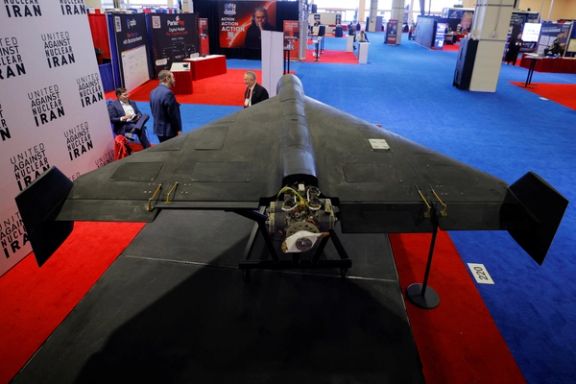
An Iranian Shahed Drone is displayed by the United Against Nuclear Iran at the Conservative Political Action Conference (CPAC) annual meeting in National Harbor, Maryland, US, February 22, 2025.
Poland helped put an Iranian Shahed-136 drone on display in Washington and the United Nations to expose Tehran's destabilizing activities, Polish Foreign Minister Radek Sikorski told Iran International, dismissing the Islamic Republic's objections.
"The first credit for bringing this evidence here goes to the brave soldiers of Ukraine, who shot down this missile," Sikorski said, standing next to the drone on the sidelines of a UN Security Council meeting on Ukraine.
Iran’s foreign ministry on Monday said it has summoned Poland’s chargé d'affaires in Tehran following Sikorski's criticism of Iran and Russia's military cooperation amid the latter's full-scale invasion of Ukraine.
Semi-official IMNA news agency reported that the summons followed Sikorski’s role in facilitating the transfer of an Iranian-made drone from Ukraine to the US for display at the Conservative Political Action Conference (CPAC).
"We just helped Ukraine to get it out of Ukraine and to bring it here, for the world to see that Iran is still exporting its destabilization, it's trying to export its ideology," Sikorski added.
Despite evidence to the contrary, Tehran has repeatedly denied its provision of drones to Russia for its war on Ukraine, which has seen Iran levied with heavy sanctions from countries such as the UK, US and EU.
Following the exhibition, Iran’s Mission in the United Nations said, “There is no legal prohibition on its sale.”
Addressing Iranian authorities, Sikorski added, "This is a warning. We know what you're doing. It is cruel against the principles of the UN Charter.
"Stop doing it now."
Sikorski made the remarks during an exhibition organized by United Against Nuclear Iran (UANI). UANI first unveiled the drone during the CPAC meeting last week.
"Many, many hundreds of people have already died from the use of this imprecise, indiscriminate weapon. We believe over 7,000 have already been launched against Ukraine," Sikorski said.
According to the Wall Street Journal, the Shahed-136 drone is considered the most widely used military drone in the world, manufactured in Iran's military industries under the supervision of the IRGC, which designated as a terrorist organization by the United States.
Russian forces have used thousands of these drones—rebranded as Geran-2—in Ukraine, with one striking Chernobyl’s radiation containment shelter earlier this month.
Iranian-backed militants also launched a Shahed that killed three US service members in Jordan in January.
UANI CEO Mark D. Wallace unveiled the Shahed-136 drone alongside CPAC Chairman Matt Schlapp.
Speaking to Iran International, Wallace described the drone as "the most ubiquitous WMD terror weapon of our time," citing its extensive use across the Middle East.
"This system has been fired at and killed American troops and service members across the Middle East," Wallace said. "It's been fired on Israel from Iran. It's been fired against Saudi Arabia's oil facilities. It's been fired against the Arab Emirates, including the iconic skyscraper, the Burj Khalifa."
The United States first warned in July 2022 that Iran was preparing to supply Russia with battlefield drones, and September 13 marked the anniversary of the first Shahed drone being shot down by Ukraine.
Russia soon began large scale use of the Iranian drones in attacks on Ukraine’s infrastructure and civilian targets. The Shahed 136 drones have been used alongside cruise and ballistic missile attacks to overwhelm Ukrainian air defenses.
‘CPAC for Iranians in Exile’
Following the drone unveiling, CPAC and UANI announced the formation of "CPAC for Iranians in Exile," a platform designed to unite the Iranian diaspora against the Islamic Republic.
Wallace emphasized the need for unity, saying, "The civil and collegial discussion amongst Iranian diaspora members of diverse views, backgrounds and heritage is the Ayatollah’s greatest fear."
According to UANI, the group aims to provide a space for dialogue and engagement with US policymakers, focusing on ending the "Ayatollah's despotic rule."
Wallace expressed hope that the event would mark "the beginning of a new era" for the Iranian diaspora, fostering unity and cooperation in their fight for a free and democratic Iran.
Germany's likely next Chancellor Friedrich Merz is likely to promulgate a tougher stance on Iran by Europe's top economy after inviting Tehran's arch-enemy Israeli premier Benjamin Netanyahu to Berlin and previous pointed statements.
After his conservative bloc won the most votes of any party in elections on Sunday, Merz hopes to quickly form a government with reluctant social democrats.
Should he emerge as Germany's leader, the top European economy and trading partner with the largely sanctioned and shunned Islamic Republic could be set to take a stronger tack against Tehran.
Merz told Israel's Netanyahu in a phone conversation following his strong showing at polls that he would invite him to Germany despite of an arrest warrant from the International Criminal Court (ICC), Netanyahu's office said on Monday.
The previous coalition government led by social democrat Olaf Schultz had taken a more measured line toward Netanyahu as war has gripped the Mideast for over a year, incurring criticism by some Iranian dissidents.
Iran this month repatriated the body of German-Iranian citizen Jamshid Sharmahd after his death in an Iranian prison while awaiting execution.
German-Iranian citizen Jamshid Sharmahd during his trial in Iran
Sharmahd was convicted of heading a pro-monarchist group accused of a deadly 2008 bombing at a religious center in Shiraz, which killed 14 people - charges he denied.
Late last year, Merz decried Sharmahd's death as a "horrible crime," writing on X: "The trial was a mockery of the international standards for due process of law. The Iranian regime is once again showing its inhuman character."
"The approach of 'quiet diplomacy' with #Iran has failed ... Germany #Iran policy in recent years has been characterized by the idea of a cooperative government in Tehran – this illusion was to be abandoned," he said.
Merz advocated heavier sanctions, downgrading relations and expelling Tehran's ambassador.
Iran's highest-ranking military officer has publicly advocated for privatization as the nation faces chronic energy shortages and rampant inflation.
“The model for the country's salvation is to turn to the people. If we want to solve the economy, the solution is to turn to the private sector and entrust work to the people," Major General Mohammad Bagheri said.
Iran's armed forces, the Islamic Revolution Guard Corps (IRGC) in particular, have benefited from previous waves of privatisation, taking over fully or in part the companies and businesses that the government puts up for sale.
Bagheri's call comes amid reports that the Iranian Armed Forces, including the IRGC, will receive a substantial 51% (approximately €12 billion) of the government's €24 billion oil and gas export revenues in the upcoming budget.
The budget bill for the next Iranian year (starting March 21) details that while 37.5% of oil and gas revenue goes to the government, over half of that portion funds the military.
Last year, a Reuters report indicated that the IRGC already controls up to half of Iran's oil exports, funding military operations and allies.
Recent Central Bank statistics also show a significant decline in private sector involvement in foreign trade, replaced by government entities that receive the majority of foreign currency.
Customs data further shows that government-controlled petrochemical, steel, oil, and gas products dominate exports.
The country’s new budget allows the Oil Ministry to contract with third parties for oil and gas field operations to settle debts, raising fears that these contracts will fall into the hands of the so-called "Khosoulati" entities—quasi-state organizations controlled by insiders of the ruling system, rather than genuine private sector businesses.
HamMihan newspaper warned last year that such a policy risks transferring national resources to entities lacking the necessary capacity and resources, further entrenching government-linked organizations in the economy.
European Union foreign policy chief Kaja Kallas said on Monday that a planned ministers-only discussion on Iran was postponed due to the absence of key foreign ministers.
“On Iran, we were supposed to have discussions, ministers-only format, regarding Iran today but because very important foreign ministers were missing, so we postponed this,” Kallas said.
“The point was to have ministers-only discussion to get the understanding where we are so that we are able to come out with initiatives and concrete proposals,” she added, confirming that the meeting has been postponed to March.
Last week, Laurence Norman of The Wall Street Journal reported that that European Union foreign ministers we due to meet on Monday for a ministerial discussion focusing on Iran.
In a post on X, Norman said the agenda "will span Tehran’s support for Russia, its nuclear advances, its arrest of European citizens among other issues."
"First @kajakallas move to tighten EU stance on Iran," he added, referring to EU foreign policy chief Kaja Kallas. Norman cited the EU diplomat as saying the Joint Comprehensive Plan of Action (JCPOA) will be one of five key topics discussed.
Iran defended its human rights record and condemned Western sanctions at a United Nations Human Rights Council meeting in Geneva.
“For decades, the Iranian people have faced grave challenges, including unjust economic sanctions and terrorism, which have had many devastating impacts on their social and economic rights,” Foreign Minister Abbas Araghchi said in a speech on Monday.
Araghchi, however, did not acknowledge that sanctions against Iran include those for human rights violations, which have targeted both individuals and entities across government sectors from the IRGC to the prison services. Other sanctions have been for Iran's support of Russia's war on Ukraine and its ongoing nuclear program.
The number of people executed in Iran rose from 834 to 901 in 2024, including 31 women, the UN Human Rights Office said in January. The figures have reached record highs since 2022.
While Araghchi said Tehran is committed to improving human rights and cited achievements in education, healthcare, and women's rights, Iran has restricted women's freedoms, including the violent enforcement of hijab laws.
Iran has frequently used violence to suppress demonstrations, including the 2022 protests following the death of Mahsa Amini in morality police custody. Iranian forces killed hundreds of protesters, and arrested thousands more.
Iran's top diplomat also warned against the “politicized use of human rights” as a tool for pressure saying, “Human rights may not be used as a leverage of political and economic pressure or interference in the internal affairs of countries.”
The Islamic Republic has been accused of detaining foreign nationals and dual nationals on vague charges as a means of gaining leverage in diplomatic negotiations—a practice rights groups describe as 'hostage diplomacy'.
Government offices, banks, and schools across most of Iran remained closed on Monday as a worsening energy crisis forced authorities to shut down public services in at least 22 of Iran's 31 provinces.
The closures, driven by severe gas shortages and electricity cuts, have left Iranians accustomed to working weeks of just two or three days.
With snow, rain, and plunging temperatures further straining the country’s already fragile energy infrastructure, provincial officials announced the shutdowns late Sunday, impacting regions including Tehran, Mazandaran, Gilan, Golestan, Isfahan, Markazi, Kerman, Hamedan, etc.
In Tehran, schools, courts, and government offices suspended operations entirely, with authorities mandating that all heating systems be turned off to conserve fuel.
“This isn’t about bad weather,” said Nima, a wholesaler of car spare parts in the capital. “The government announces these closures to cover up its energy failures. They know if they don’t shut things down, people will protest over the lack of heating and electricity,” he told Iran International.
A large number of Iranians said on social media that in some provinces, schools were declared closed without arrangements for online classes. However, many said that virtual education is unreliable anyway, as power outages also disrupt internet access.
The country’s aging telecommunications infrastructure lacks backup battery systems, further limiting connectivity.
The frequent shutdowns have hit businesses hard, particularly as Iran nears Nowruz, the Persian New Year, when many retailers rely on a seasonal surge in consumer spending. Hamid, 38, who runs a clothing boutique in Tehran’s Gisha neighborhood, said sales have plummeted.
“We wait 11 months for this last stretch before Nowruz to make a profit, but every week, we lose two or three working days,” he told Iran International. “This morning, I sold just two pairs of pants and a shirt, which were already discounted. Meanwhile, my bounced checks are piling up.”
Iran’s work week has long been out of sync with the global economy, with weekends falling on Thursday and Friday instead of Saturday and Sunday. Nima said the latest wave of shutdowns has made the situation even worse.
“Iranian businesses already struggle because we only overlap with the international market for three days a week,” he said. “Now, with these extra closures, we’re essentially shut down half the month. How can there be an economy in a country that’s closed for business?”
Compounding the crisis, the Iranian rial continues to weaken against the US dollar amid economic pressures from US sanctions. The falling currency has further eroded purchasing power, leaving many consumers unable to afford even discounted goods.
Public sector closures have become a frequent occurrence in Iran, with schools and offices repeatedly shut in recent months due to pollution, dust storms, cold weather, and fuel shortages.
While officials cite weather conditions for the latest round of shutdowns, weather tracking services have not predicted subzero temperatures or heavy snowfall for many of the affected provinces.
For business owners like Hamid and Nima, the pattern is clear. “It’s not about the cold,” Nima said. “It’s about the country running on empty.”