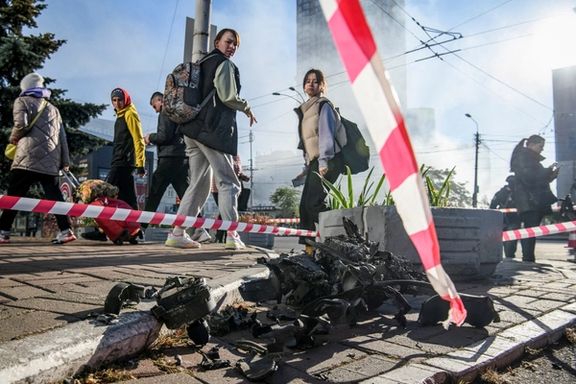
Local residents look at parts of an unmanned aerial vehicle (UAV), what Ukrainian authorities consider to be an Iranian-made drone Shahed-136, after Russian drone strike, amid Russia's attack on Ukraine, in Kyiv, Ukraine October 17, 2022.
The US Treasury on Wednesday levied sanctions on six entities in Hong Kong and mainland China it said facilitate the acquisition of parts for armed drones produced by Iran, as part of Washington's "maximum pressure" campaign on Tehran.
The entities, the treasury said, acquire parts for US-sanctioned Iranian firm, Pishtazan Kavosh Gostar Boshra, and its subsidiary company Narin Sepehr Mobin Isatis, which it said supplied Iran's drone and ballistic missile programs.
The two Iranian companies were hit by US sanctions last year.
“Iran continues to try to find new ways to procure the key components it needs to bolster its UAV weapons program through new front companies and third-country suppliers,” Treasury Secretary Scott Bessent said in a statement on Wednesday, referring to unmanned aerial vehicles.
The US state department said Washington was determined to thwart the program.
"We will continue to act against the complex schemes Iran employs to conceal its acquisition of sensitive technology for its missile and UAV programs," it said in a statement on Wednesday.
"These programs produce missiles and drones that Iran uses against our allies and exports to its terror proxy groups and Russia."
The newly sanctioned entities helped procure millions of dollars worth of Western-origin technology for Iran's drone program.
Western powers accuse Iran of providing drones and missiles to Russia for its full-scale invasion of Ukraine.
Russia launched 267 attack drones overnight on Saturday, marking the largest single assault since the use of Iranian-made projectiles began.
Iranian drones have repeatedly been deployed in attacks on Ukraine’s infrastructure and other civilian targets. The Shahed 136 drone is typically launched alongside cruise and ballistic missile attacks to overwhelm Ukrainian air defenses.
A five-year-old was killed and his mother lost her unborn child when Iran's security forces opened fire on the family's vehicle in the country's turbulent province of Sistan and Baluchestan.
Halvash, a local news website, reported that the child, Yousef Shahli-Bar, who had sustained five gunshot wounds, died after a prolonged wait for medical attention due to the absence of a surgeon.
The mother, Maryam Shahli-Bar, remains in the Intensive Care Unit (ICU) at Khatam al-Anbiya Hospital in Iranshahr.
Halvash reported that after firing on the vehicle, tactical unit forces transported the injured to a hospital before leaving the scene.
The driver of the vehicle, Ramin Shahli-Bar, was arrested by security forces in plain clothes and taken to an undisclosed location, the report added.
No official explanation has been provided regarding the reason for the shooting.
Security forces in Iran have previously been accused of unjustified shootings at vehicles. According to statistics compiled by the Human Rights Activists News Agency (HRANA), 484 civilians were shot by military personnel in Iran in 2024, with 163 killed and 321 injured.
HRANA reported that in 2023, 402 civilians were targeted, and in 2022, the number was 845.
The shooting comes amid heightened tensions in the Sistan and Baluchestan region following armed clashes between Iranian military forces and Jaish al-Adl, a militant group operating in the region.
A video showing drones flying over Jakigour, a district in Rask County, caused concern among residents.
In Chabahar port, Iranian security forces on Tuesday launched a raid on a residential building using light and semi-heavy weapons, including rocket propelled grenade.
According to Halvash, the house was completely destroyed, and surrounding buildings were damaged. Iranian authorities confirmed that two members of Jaish al-Adl were killed and six arrested. However, in a statement, Jaish al-Adl disputed this, saying no members were detained.
The recent escalation follows a series of attacks attributed to the group. On Saturday, a sound bomb explosion damaged the Chabahar Rural Development Organization headquarters.
In a separate incident, gunmen attacked the Housing Foundation of Sistan and Baluchestan, injuring one staff member. Jaish al-Adl claimed responsibility, saying the attacks were in response to government actions against Baloch communities. The minority group is among the most persecuted in Iran, according to rights groups.
The 2025 report from Human Rights Watch said: "The Iranian government also discriminates against some religious minorities, including Sunni Muslims, and restricts cultural and political activities among the country’s Azeri, Kurdish, Arab, and Baluch ethnic minorities.
Jaish al-Adl has been designated as a terrorist organization by both the Iranian government and the United States.
The group has carried out multiple attacks against Iranian security forces in Sistan and Baluchestan in recent years, the region a hotbed of clashes.
Countries such as the UK sanctioned individuals and entities in Iran following the violent crackdown on protests in the 2022 uprising, including in Sistan and Baluchestan, where in one day, over 80 people were killed by security forces in Zahedan.
Ray Hunt, a 71-year-old Alabama resident, has been sentenced to five years in prison for orchestrating the export of US-manufactured industrial equipment to Iran, defying US trade sanctions.
Hunt, operating under aliases including Abdolrahman Hantoosh, Rahman Hantoosh, and Rahman Natooshas, pleaded guilty in July 2024 to charges under the International Emergency Economic Powers Act.
Court documents show that Hunt, through his company Vega Tools LLC, engaged in a systematic effort to supply equipment for Iran's oil, gas, and petrochemical industries.
From at least 2015 until his arrest in November 2022, he worked with two Iranian companies based in Tehran to help them circumvent sanctions.
Hunt's scheme involved a complex network of third-party transshipment companies located in Turkey and the United Arab Emirates (UAE), designed to obscure the true destination of the exported goods.
He also used UAE-based banks to conceal financial transactions.
Hunt deliberately provided false information to shipping companies about the value of his exports, thereby avoiding the mandatory filing of Electronic Export Information with US authorities.
He also misrepresented the intended recipients of the equipment, falsely claiming they were destined for Turkey and the UAE, while fully aware they were ultimately bound for Iran, according to the US Department of Justice.
He also provided false statements to US Customs and Border Protection officers regarding his business operations during questioning following a 2020 trip to Iran.
The Iranian government published a detailed public letter alleging that Europe and the International Atomic Energy Agency are under pressure from the US to be tougher on Iran.
The unsigned 2,000 word article on the government's news website, IRNA, argued that the postponement of a meeting of European foreign ministers with Iran and critical remarks made by the head of IAEA, the UN nuclear watchdog, shows pressure from Washington.
“Has Europe once again settled into the safe zone of inaction, completing Donald Trump's puzzle and allowing him to dominate the scene?", the article said.
European Union foreign policy chief Kaja Kallas said on Monday that a planned ministers-only discussion on Iran was postponed due to the absence of key foreign ministers.
“On Iran, we were supposed to have discussions, ministers-only format, regarding Iran today but because very important foreign ministers were missing, so we postponed this,” Kallas said.
IRNA accused Europe and the IAEA of making contradictory statements about Iran’s nuclear program, arguing that Tehran has the right to unlimited uranium enrichment, as international conventions do not prohibit it. The article also blamed Israeli Prime Minister Benjamin Netanyahu for orchestrating international opposition to Iran.
The article then went on to suggest “confidence building” measures between Europe, the IAEA and Iran, acknowledging that for three decades the two sides have spelled out their positions.
“The JCPOA formula offers the most cost-effective and efficient way to build trust," the letter on IRNA stated, while many consider the deal outdated and even dead.
"Through a series of strategic calculations and negotiations among the parties involved, the 2015 JCPOA became one of the most significant agreements of the past century. These dynamics can be replicated if the European Union abandons its outdated carrot-and-stick approach and engages in transparent dialogue," it added.
Last week, amid Iran's continued denials of building a nuclear weapon, the IAEA chief said the UN body was prepared to help Iran prove it did not seek nuclear weapons.
"We want to make ourselves available, providing technically sound alternatives to eliminate the possibility that Iran develops a nuclear weapon, to prevent Iran, or to help Iran prove that they don't want to develop a nuclear weapon," Rafael Grossi told reporters at Japan’s National Press Club.
However, only last year, Grossi warned that Iran, which has limited IAEA inspections of its nuclear facilities since 2021, was "weeks not months" away from a nuclear weapon.
Trump withdrew from the 2015 JCPOA nuclear agreement in May 2018, calling it a bad deal and demanding more concessions from Tehran. He then imposed strict economic sanctions, which the Biden administration was accused of not fully enforcing.
However, earlier this month, the US president announced the revitalization of these sanctions under his “maximum pressure” policy. He underlined that his main demand is for Iran never to acquire nuclear weapons.
Iran, facing a serious economic crisis, needs to reach an agreement with the Trump administration if it wants to reduce or eliminate the sanctions, but its Supreme Leader Ali Khamenei this month banned talks with Washington.
Iranian officials insist that they will not negotiate under Trump’s pressure.
Security forces carrying out a raid on a house in Iran's restive southeastern province of Sistan and Baluchestan became embroiled in an ongoing gunbattle involving rocket-propelled grenades on Tuesday.
Outlets affiliated with the Islamic Republic’s security forces published videos of the attack in the town of Chabahar, saying the forces were targeting individuals linked to Jaish al-Adl, a militant group that has previously carried out attacks in the region.
Videos published on Tuesday show government forces firing RPG rounds at the house as clashes continued.
According to reports from Halvash, a local news website, people inside the house returned fire, leading to an armed standoff.
Surveillance and combat drones were also seen in the area, as security forces in nearby buildings deployed heavy weapons in a bid to end the confrontation.
The site remained surrounded at around noon Eastern Standard Time, and the nature the gunmen and any casualties remained unclear.
Jaish al-Adl, a Sunni Islamist militant organization hailing from the Baloch ethnic minority, has not officially commented on the incident.
The raid follows a series of incidents in Chabahar. On February 22, a bomb blast destroyed the headquarters for the coordination of eastern Chabahar villages.
Around the same time, an armed attack on the Housing Foundation building in the province left one employee injured.
Jaish al-Adl claimed responsibility for the attacks, saying hey were in retaliation for government policies to displace local Baloch communities.
The group has been designated a terrorist organization by both the Islamic Republic and the United States. The group has carried out several attacks on Iranian military and IRGC positions in recent years.
Iran has placed its nuclear sites on high alert, deploying additional defenses amid escalating fears of a joint Israeli-US attack, The Telegraph reported on Tuesday.
Citing two unnamed government sources, the outlet said the Islamic Republic has also been bolstering defenses around key nuclear and missile sites, which include the deployment of additional air defense system launchers.
According to the sources, the measures are in response to growing concerns of potential joint military action by Israel and the United States.
“They [Iranian authorities] are just waiting for the attack and are anticipating it every night and everything has been on high alert – even in sites that no one knows about,” one source said.
“Work to fortify nuclear sites has been ongoing for years but it has intensified over the past year, particularly since Israel launched the first attack,” he added referring to Israel’s October attack that damaged Iran's air defense systems.
“Recent developments, including Donald Trump’s comments and reports about potential plans from his administration to strike Iran, have further intensified activities.”
The report follows warnings from US intelligence to both the Biden and Trump administrations that Israel would likely target key Iranian nuclear sites this year.
In February, the Wall Street Journal and The Washington Post cited US intelligence findings from January suggesting that Israel saw an opening for an attack on Iranian nuclear sites as early as the first half of this year.