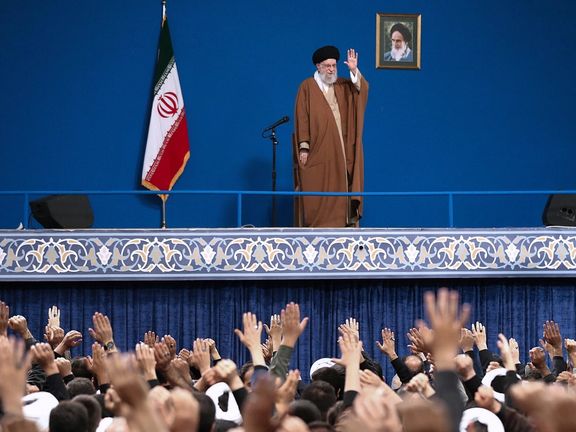
Supreme Leader Ali Khamenei waving to his supporters, Tehran, Iran, March 21, 2025
Iran's supreme leader Ali Khamenei shrugged off warnings of a potential military confrontation with the United States if a nuclear deal was not reached, asserting that any aggression against Tehran will be met with a 'harsh slap'.
Khamenei dismisses Trump ultimatum, vows firm response if attacked | Iran International
“Americans must know that threats will get them nowhere in confronting the Islamic Republic,” he said during a nationally broadcast speech in Tehran on Friday. “If anyone commits villainy against the Iranian people, they will be struck with a harsh slap.”
The remarks follow reports that US President Donald Trump sent Khamenei a direct letter earlier this month offering negotiations under a limited timeframe. According to Axios, the message included a two-month window to reach a new nuclear agreement, paired with a warning of consequences should Iran further expand its nuclear program.
The letter was described as firm in tone and was reportedly shared in advance with close US allies, including Israel, Saudi Arabia, and the United Arab Emirates.
Tehran has acknowledged receiving the letter, but has not commented publicly on its contents. The Iranian foreign ministry has criticized Washington’s approach, accusing the US of sending mixed signals, and said any official response would remain private.
While Khamenei has publicly ruled out negotiations under pressure, other officials have appeared more flexible. Last week, Iran’s Foreign Minister Abbas Araghchi suggested that indirect talks with the United States could be possible, potentially through intermediaries such as Oman.
“It is not a strange method, and it has happened repeatedly throughout history,” Araghchi said in an interview with the Iran newspaper. “What is important is the will to negotiate under fair and equal conditions; the form it takes does not matter.”
Khamenei, however, offered no acknowledgment of that possibility in his speech. “We have never been the ones to start a conflict,” he said. “But if someone acts with malice, the response will be firm.”
He also rejected Western descriptions of Iran’s role in the region, denying that Tehran relies on proxy forces. “The Islamic Republic has no need for proxies,” he said. “The people of Yemen and the resistance centers stand and fight on their own.”
The comments come as the US escalates military strikes on Yemen’s Houthi fighters, who have attacked shipping in the Red Sea in support of Gaza. Washington blames Tehran for arming the group with advanced weaponry.
This week, Trump demanded Iran end all Houthi support, warning of “dire” consequences. “Iran must stop the sending of these supplies IMMEDIATELY,” he posted on TruthSocial. Over the weekend and again Monday, US airstrikes hit Houthi positions, with Yemeni officials reporting dozens killed.
Despite denials from Tehran, US officials view the Houthis as a key pillar of Iran’s regional strategy.
Friday's speech came one day after Khamenei’s annual New Year message, in which he described the past year as turbulent, drawing comparisons to the early 1980s, a period marked by war, political assassinations, and deep internal crises. He cited the death of President Ebrahim Raisi, the killing of Iranian advisors in Damascus, and ongoing economic difficulties as major national challenges.
While neither speech referenced the US letter or the possibility of renewed nuclear talks, both struck a tone of resilience and resistance. The absence of traditional New Year greetings or Nowruz symbolism in either address underscored the gravity of the moment. This is the second consecutive year Khamenei has remained in the capital during Nowruz, a decision that may reflect the overlap with Ramadan, or broader concerns about regional security.
The timing of his remarks also comes as the United States and Israel prepare to hold high-level consultations in Washington early next week, focusing on Iran’s nuclear program and regional posture. Israeli officials have expressed skepticism about the prospects for diplomacy and are reportedly preparing for a range of scenarios, including potential military confrontation.
Meanwhile, international concern over Iran’s nuclear program continues to grow. A recent report by the International Atomic Energy Agency raised questions about the purpose of Iran’s enriched uranium stockpile, which the agency said could not be fully explained by civilian uses.
A US jury has found Rafat Amirov and Polad Omarov guilty on all charges related to a plot to assassinate Iranian-American journalist Masih Alinejad.
The charges against them included murder for hire, firearms possession, and conspiracy to commit money laundering.
The judge gave federal prosecutors one last chance to make a final statement to the jury before they made their final decision.
""It doesn't matter who she was or what she offered to this world. They only cared about money and power."
The jury received the case just before 1 p.m. on Thursday. The jury had initially asked for transcription material but while the attorneys were gathering materials, the jury sent another note saying that they had reached a verdict.
Alinejad was not in court on Thursday but was quoted by the Associated Press as saying she cried upon hearing the verdict.
“I am relieved that after nearly three years, the men who plotted to kill me have been found guilty. But make no mistake, the real masterminds of this crime are still in power in Iran,” she said.
On X, Alinejad called the guilty verdict a win for all the women of Iran against the Islamic Republic.
"I and the women of Iran have today won and you @khamenei_ir and your hated regime have lost!," she posted to X.
"For the first time, the regime of the Islamic Republic is being held accountable for bringing its campaign of terror to U.S. soil," Alinejad wrote, "This is just the beginning of exposing and dismantling its network of violence."
“This verdict should send a clear message around the world: if you target US citizens, we will find you, no matter where you are, and bring you to justice,” acting US attorney Matthew Podolsky said in a statement.
FBI Assistant Director in Charge Leslie R. Backschies said: “The convictions of Rafat Amirov and Polad Omarov send a clear message to all foreign governments who violate our laws and attempt to commit violence against Americans — they and their proxies will face justice for any attempt to silence Americans on US soil. The Iranian government’s shameless conduct and attempt to violate our laws and assassinate a critic of their human rights atrocities will not be tolerated.”
The verdict was announced at the Manhattan federal court following jury deliberations where on Tuesday Alinejad took to the stand recounting the chilling moment she came face-to-face with the man who had been sent to kill her.
"He was in the sunflowers staring straight into my eyes," she said, coming face to face with Khalid Mehdiyev, who admitted he intended to kill Alinejad at the behest of the Iranian government allegedly and testified against the two found guilty.
Prosecutors said the convicted men, Rafat Amirov and Polad Omarov, were crime bosses in the Russian mob. Their lawyers argued that they were innocent and trial evidence was flawed.
Mehdiyev, a member of the Thieves in Law gang said he received orders from the two to kill the journalist who uses her platform to expose the Islamic Republic’s repression.
As a government witness, who has made a deal with the Feds, Mehdiyev pleaded guilty to attempted murder and gun charges, but Omarav and Amirov stood trial.
The courtroom on 500 Pearl Street in Manhattan was frequented by supporters and friends of Alinejad, including Women Life Freedom protestors who had their eyes blinded by Iran's security forces at the height of the nationwide uprisings in 2022.
The United States and Israel are set to discuss Iran's nuclear program and potential talks with Tehran early next week, Axios reported on Thursday citing Israeli and US officials.
The consultations, planned to take place in the White House according to the report, comes amid heightened tensions between Iran and the US, with Trump asking Iran's leadership to choose between a deal and potential military confrontation.
Israel's prime minister Benjamin Netanyahu remains skeptical about the chances of a new deal and seeks to coordinate a response should tensions escalate to military action, Axios said citing an Israeli official.
Iran's supreme leader Ali Khamenei has rejected talks with the US under Trump, recalling that he withdrew the US from a multilateral deal agreed in 2015.
The discussions are expected to be led by Israeli strategic affairs minister Ron Dermer and national security adviser Tzachi Hanegbi and will include senior officials from the the military, Mossad, and Israel's Atomic Energy Commission.
They are set to meet with a US team led by national security adviser Mike Waltz, along with officials from the State Department, Pentagon, and intelligence agencies.
This marks the first gathering of the US.-Israel Strategic Consultative Group since Trump took office.
The forum, which serves as the highest-level platform for U.S.-Israeli discussions on Iran, is expected to lay the groundwork for future policy coordination between the two allies.
Iran's exiled prince Reza Pahlavi urged world leaders, including US President Donald Trump, to stand with Iranians in their struggle for freedom in an address marking their New Year on Thursday.
"Together, we can dismantle the Islamic Republic and end decades of global terror, blackmail, and hostage-taking," he said in the video, titled A Norooz Message to the World: Imagine a New Iran.
"I extend our hand in friendship and partnership— to our neighbors from Israel and the Arab states, to our steadfast allies in the West, including President Trump and the United States, and to leaders across Europe and the G7," he added.
Pahlavi's remarks come amid rising tensions between Washington and Tehran, following an ultimatum from Trump, who sent a letter to Iran's Supreme Leader Ali Khamenei proposing direct negotiations for a new nuclear agreement or face potential military consequences.
Khamenei rejected Trump's letter last week as deceptive, saying Trump's demands would intensify sanctions and increase pressure on Iran.
"A free Iran is no longer a distant dream; it is a reality being forged today by the hands of its own people," Pahlavi said. "The question is not whether Iran will be free, but which nations will be with us in the fight and make our victory sweeter."
He framed the fall of the Islamic Republic as a turning point for global security, arguing that Iran’s current leadership has fueled instability across the Middle East and beyond.
"This new reality will profoundly benefit not only Iranians but citizens everywhere—from the cities of America to the capitals of Europe, from Israel to the Arab world."
Calling himself a servant of the Iranian people, he declared his commitment to leading what he described as historic change, promising a clear and actionable plan to dismantle the Islamic Republic.
While Pahlavi's supporters view him as a unifying figure in the opposition, some Iranians—particularly those skeptical of monarchy—express reservations about his political vision for Iran’s future.
Pahlavi has made clear in interviews, including in an interview with the German outlet Spiegel, that he does not advocate for either a monarchy or a republic, emphasizing that the Iranian people should determine their future governance through a democratic vote.
Tens of thousands of Iranians gathered at major historical sites across the country on Thursday to mark Nowruz, chanting national and pro-monarchy slogans in defiance of the Islamic government.
"Imagine the Middle East liberated from the shadow of nuclear blackmail and threats. Imagine our region without endless proxy wars, extremist ideologies, and terrorism—all driven by a regime whose policies have caused mass migration, instability, and suffering far beyond Iran’s borders," he added.
Iranians gathered at major historical sites across the country to celebrate the New Year with patriotic chants calling for the return of the pre-Islamic Revolution monarchy.
At Persepolis, the ancient ceremonial capital of the Achaemenid Empire in Fars province, large crowds counted down to the arrival of spring, undeterred by state efforts to downplay the celebration in favor of religious mourning.
At several locations people chanted the name of Reza Shah, the founder of the Pahlavi Dynasty, who began modernizing Iran a century ago.
Authorities had promoted religious programming tied to the anniversary of Imam Ali’s killing, which coincided with Nowruz this year, but videos circulating online showed Iranians defying the official narrative.
In Shiraz, at the tomb of the 14th-century poet Hafez, a large crowd sang Ey Iran, a patriotic anthem often associated with opposition to the current leadership.
Even in Khorasan Razavi province, home to the Shiite shrine city of Mashhad where Supreme Leader Ali Khamenei’s representative Ahmad Alamolhoda has banned concerts and other cultural events, people gathered at the tomb of Ferdowsi. The 10th-century poet is known for his epic Shahnameh, which extols Iran’s pre-Islamic history.
Chants of “Reza Shah, rest in peace” and “Shah, come home” were heard in Tous, 30 kilometers from Mashhad, where Ferdowsi’s tomb stands.
Demonstrators invoked the name of exiled crown prince Reza Pahlavi and compared Khamenei to Zahhak, the mythical tyrant from the epic of Shahnameh whose reign was marked by oppression and corruption.
The anger directed at Khamenei was also fueled by Iran’s worsening economic conditions. According to the Iranian Statistics Center, inflation surged by 4.1% in February 2025, the highest monthly rate in two years. The US dollar reached 1,000,000 rials just days before Nowruz, reflecting deep economic instability.
Khamenei, in his annual address, did not extend Nowruz greetings and instead focused on Ramadan’s Nights of Qadr, calling the economy the year's main issue.
The confluence of Nowruz and Ramadan has heightened tensions, with authorities emphasizing religious adherence.
In the wake of the 2022 uprising, New Year celebrations been turned into an ever growing display of defiance, and in some cases, open protests against the government.
On Tuesday, protests broke out in cities such as Tehran, Karaj, Mashhad and Isfahan, with young Iranians setting fire to images of Supreme Leader Ali Khamenei.
While the government attempted to impose a somber tone on the holiday, the scenes across Iran highlighted a growing divide between state ideology and public sentiment.
The United States issued new Iran-related sanctions on Thursday, targeting one individual, several entities and vessels linked to Iranian oil trade as part of President Trump's pressure campaign on Tehran.
“Teapot refinery purchases of Iranian oil provide the primary economic lifeline for the Iranian regime, the world’s leading state sponsor of terror,” said Secretary of the Treasury Scott Bessent in a press release announcing the new measure.
“The United States is committed to cutting off the revenue streams that enable Tehran’s continued financing of terrorism and development of its nuclear program.”
The sanctions target a Chinese refinery, Luqing Petrochemical, which the US Treasury accused of purchasing Iranian crude worth half a billion dollars.
The refinery allegedly received oil from vessels linked to the Yemen's Houthis and Iran’s Ministry of Defense and Armed Forces Logistics. Its CEO, Wang Xueqing, was also sanctioned.
Nineteen more entities and vessels were also designated that the US treasury said involved in transporting Iranian oil as part of Iran’s "shadow fleet," which US officials say engages in deceptive shipping practices.
Among them are the Natalina 7, Catalina 7, Aurora Riley, Viola, Montrose, Volans, Brava Lake, and Titan. Companies registered in Hong Kong, Panama, Liberia, Seychelles, and the British Virgin Islands were also sanctioned for allegedly owning or operating these vessels.
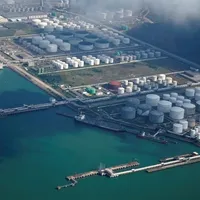
In a separate announcement, the State Department said it is sanctioning a crude oil and petroleum products storage terminal in the port of Huizhou, China, for receiving and storing Iranian-origin crude oil from a blocked tanker.
The terminal, owned and operated by Huaying Huizhou Daya Bay Petrochemical Terminal Storage Co., Ltd (Huaying Petrochemical), offloaded approximately one million barrels of Iranian crude in late January 2025 from the US-designated tanker formerly known as Spirit of Casper and Nichola. The State Department said Chinese terminals play a critical role in facilitating Iran’s energy exports and sustaining its revenue streams.
The new sanctions come a day after the US State Department’s Rewards for Justice program announced it is offering up to $15 million for information on four Chinese individuals accused of supplying Iran’s Islamic Revolutionary Guard Corps (IRGC) with US-controlled technology.
Last Thursday, US Treasury sanctioned Iran's Oil Minister Mohsen Paknejad, several oil tankers, and commercial entities.
Washington has been ramping up sanctions on Iran's oil exports since the latter days of the Joe Biden administration, as part of US President Donald Trump renewed "maximum pressure" campaign, aimed at cutting Iran’s oil exports to zero in a bid to force Tehran into talks over its nuclear program.
The sanctions mark the fourth round of US measures targeting Iran's oil sector since Trump took office on January 20, 2025.