Iran hints at indirect US talks via Oman despite Khamenei's rejection
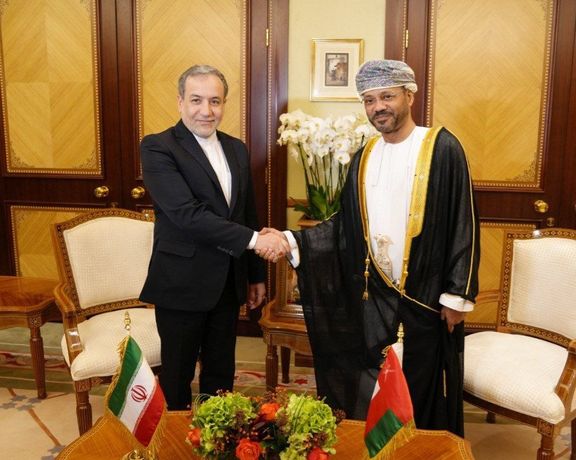
Iranian Foreign Minister Abbas Araghchi (left) and Oman's Foreign Minister Badr al-Busaidi in Muscat on October 14, 2024
Iran’s foreign minister on Thursday signaled Tehran's willingness to engage in indirect negotiations with the United States through Oman, just a day after the Supreme Leader publicly ruled out talks.
During an interview with the Iran newspaper, Araghchi, when asked about using indirect channels like those in Muscat, said, "Yes, it is not a strange method, and it has happened repeatedly throughout history."
"Therefore, indirect negotiation is feasible... What is important is that the will to negotiate and reach a fair and just agreement comes up in equal conditions, and the form of it does not matter."
His remarks coincides with a trip by Anwar Gargash, diplomatic advisor to the UAE president, who delivered a letter from US President Donald Trump to Iranian authorities on Wednesday.
However, Supreme Leader Ali Khamenei, in a public address on the same day, dismissed the possibility of talks, saying that Trump's offer was aimed at deceiving public opinion.
"The US president's claim that 'we are ready to negotiate with Iran' is a deception aimed at misleading global public opinion," Khamenei said in a speech to student supporters, who, as usual, repeatedly chanted "Death to America!"
Talks of Muscat mediating between Tehran and Washington follows earlier reports of Omani Foreign Minister Badr Albusaidi's visit to Tehran in December, during which he was said to have carried a message from the Sultan of Oman to President Masoud Pezeshkian.
At the time, Araghchi deniedthat any message from Washington had been relayed. Oman has historically served as a diplomatic channel between Tehran and Washington.
Araghchi added that multiple countries are now involved, with close consultations taking place with Russia and China. "Negotiations are ongoing indirectly, and the channel with the three European countries remains open," he said.
Araghchi stressed that while the United States must ultimately lift sanctions, Iran will only engage in direct negotiations free from pressure and threats, and with assurances that national interests will be protected.
"If we enter negotiations in a situation where the other side is imposing maximum pressure, we will enter negotiations from a position of weakness and will not achieve any results," Araghchi explained.
Trump reinstated his "maximum pressure" campaign in February, aiming to reduce Iran’s oil exports to zero—reviving Washington’s hardline approach from his first term.
In 2018, during his first term, Trump pulled out of the 2015 nuclear deal known as the Joint Comprehensive Plan of Actions or JCPOA, and imposed 'maximum pressure' sanctions on Tehran, reducing Iran’s oil exports to less than 300,000 barrels per day and implementing international banking sanctions.
Araghchi added, "This is not a matter of stubbornness or idealism, it is a matter of expertise. The other side must be shown that the pressure policy is not effective, so that we can sit at the negotiating table on equal terms."
New idea
Araghchi also said a new idea has been proposed to resolve outstanding nuclear issues between Iran and UN's nuclear watchdog, adding that the two sides are currently examining the proposal to resolve remaining disputes.
"We are cooperating with [IAEA chief Rafael] Grossi and the IAEA, and a new idea has been put forward to resolve the issues, which we are currently reviewing," he said, without elaborating.
Earlier this month, Grossi said Iran has significantly increased its supply of near-weapons-grade uranium in just three months, highlighting Tehran's unique position as the only non-nuclear weapon state enriching to such levels.
"Iran’s stockpile of uranium enriched up to 60% U‑235 has increased to 275 kg, up from 182 kg in the past quarter," Grossi said in his statement to the agency’s Board of Governors on Monday.
Since 2021, when Iran began enriching uranium at higher levels, it has also significantly restricted the UN watchdog's ability to monitor its nuclear activities, including banning one third of the inspectors since 2023.
On Wednesday, the UN Security Council convened amidst escalating pressure on Iran regarding its nuclear program.
The United States urged the Councilto take decisive action, accusing Iran of flagrantly defying resolutions and violating IAEA safeguards. The call came as Britain signaled its willingness to trigger the so-called snapback of UN sanctions if Iran fails to curb its uranium enrichment activities.
The meeting, requested by six Security Council members—France, Greece, Panama, South Korea, Britain, and the US—focused on Iran's persistent non-compliance with IAEA requests for information.
The urgency of the situation was underscored by the approaching October 18th deadline, after which Britain, France, and Germany will lose their ability to unilaterally initiate the reinstatement of international sanctions.
These nations have already informed the Council of their readiness to utilize the snapback mechanism to prevent Iran from developing nuclear weapons.
Iran's Ministry of Foreign Affairs has summoned the ambassadors of the United Kingdom, France, and Germany in protest against their cooperation with the United States in convening a closed-door meeting of the UN Security Council regarding Iran's nuclear program.
The meeting, held on Wednesday, was criticized by Iran as an "abuse of Security Council mechanisms."
The summons was issued by Mohammad Hassan-Nejad Pirkouhi, Director-General for Peace and International Security at Iran's Foreign Ministry.
During the meeting, Pirkouhi cited the "irresponsible and provocative" actions of the three European countries, emphasizing that Iran's peaceful nuclear program complies with its obligations under the Nuclear Non-Proliferation Treaty (NPT) and does not violate the Joint Comprehensive Plan of Action (JCPOA).
He criticized the closed UN Security Council session as lacking legal and technical justification, labeling it as a politically motivated move influenced by the US's unilateral policies.
The summons comes amid rising tensions after the United States called on the UN Security Council to confront Iran over its nuclear program, accusing Tehran of violating IAEA safeguards and defying the Council.
The closed-door meeting was called by six of the council's 15 members - the US, France, Greece, Panama, South Korea and Britain.
Additionally, the United Kingdom has signaled its readiness to trigger the snapback mechanism—a process to reinstate UN sanctions if Iran does not curb its uranium enrichment.
Concerns were amplified following the February IAEA report which revealed that Iran had accumulated 275 kilograms of uranium enriched to 60% purity, a level far exceeding civilian needs.
With the UN's sanctions relief from the 2015 nuclear deal set to expire in October, European powers have indicated that they may resort to the snapback mechanism if diplomacy fails to prevent Iran from advancing its nuclear capabilities.
Supreme Leader Ali Khamenei rejected US President Donald Trump’s overture for a deal with Tehran even before opening Trump’s letter. Still, like commentators and diplomats in Iran and abroad, he was likely aware of its contents.
Around the same time Khamenei was speaking in Tehran on March 12, Iranian and Russian sources revealed that Trump’s proposal was not limited to the nuclear issue, as Iran had expected, but also included discussions on Iran’s regional proxy groups.
While Iranians traditionally view negotiations as a lengthy process of bargaining, much like haggling over a carpet in the bazaar, Trump’s approach appears more like a spring storm—starting with thunder and lightning, followed by a brief but intense downpour, before quickly subsiding into calm.
Former Iranian diplomat Kourosh Ahmadi, in an article in Shargh newspaper, wrote that Khamenei’s earlier refusal to engage with the United States—widely interpreted as a rejection of negotiations—was not fundamentally different from remarks by Iran’s envoy in New York, Saeed Iravani. Iravani stated that "if negotiations are meant to address concerns about the militarization of Iran’s nuclear program, such talks are possible."
Ahmadi added that Iravani’s remarks show a change and indicate a new development in Iran’s position. This comes while Khamenei had stressed that negotiation over “Iran’s defense capabilities, its international power and the range of its missiles and so on will certainly not be accepted."
Nonetheless, the former diplomat noted that “the nuclear issue is by far Trump’s most important, and possibly his only, priority” when it comes to Iran. Ahmadi argued that the United States recognizes Iran’s regional proxies have been significantly weakened and that restoring their previous strength is no longer feasible. Additionally, he pointed out that both Iran’s neighbors and Washington understand that Iran’s missiles have a limited range and that its regional presence is largely justified by the absence of a conventional air force.
In another development, centrist politician Ezzatollah Yousefian Molla told the conservative Nameh News website that "Trump will gradually retreat from his current positions." He added that Iran has no issue with logical negotiations and realistic demands but emphasized, "If the other side intends to impose its views, that can no longer be called negotiation."
Several other politicians and commentators also stated last week that most of Trump’s threats are mere "bluffs." Yousefian Molla argued that Trump will walk back his more extreme proposals, recognizing that preventing war serves everyone's interests. He also claimed that "Trump understands that engaging in an all-out war is not in the United States’ interest, as Iran would respond forcefully to any military conflict."
However, Iranian academic Kiumars Yazdanpanah warned that "both Iranian and US officials have adopted increasingly confrontational stances, making the possibility of an actual conflict quite real. At this moment, conflict appears to be the most likely outcome."
Yazdanpanah outlined three possible scenarios for the near future. First, he suggested there could be limited military exchanges between Iran and the United States, with one or two swift retaliatory actions. The second scenario, he said, is a temporary state of war, in which the US launches extensive military strikes against Iran while simultaneously working to isolate the country, incite unrest, and exploit geopolitical tensions. The third possibility, according to Yazdanpanah, is that the current standoff—whether through continued escalation or negotiation—leads to a compromise aligned with both sides’ national interests, potentially facilitated by international mediation.
He added that Saudi Arabia is best positioned to act as a mediator and help prevent a war between Iran and the United States. However, he emphasized that regardless of whether a conflict occurs, Iran must rethink its current regional strategy.
China has said it will urge Iran to avoid conflict as tensions over its nuclear program grow, ahead of a trilateral meeting with Russia and Iran on Friday, as Beijing ramps up efforts to be seen as a diplomatic power.
"In the current situation, we believe that all parties should maintain calm and restraint to avoid escalating the Iran nuclear situation, or even walking towards confrontation and conflict," said Foreign Ministry spokeswoman Mao Ning during a press briefing on Thursday.
The upcoming meeting will be chaired by Chinese Vice Foreign Minister Ma Zhaoxu and attended by Russian Deputy Foreign Minister Sergey Ryabkov and Iranian Deputy Foreign Minister Kazem Gharibabadi.
While the agenda has not been disclosed, the talks are expected to focus on reviving diplomatic efforts concerning Tehran’s nuclear program, which has faced increased scrutiny following the US withdrawal from the Joint Comprehensive Plan of Action (JCPOA) in 2018 during President Donald Trump's first term.
Now in his second term, Trump has intensified his stance by reintroducing the "maximum pressure" campaign against Iran, aimed at curbing Tehran's nuclear activities and regional influence through renewed sanctions and diplomatic isolation.
Russia, a key diplomatic actor and original signatory of the JCPOA, has expressed support for restoring the agreement. Russian Foreign Minister Sergei Lavrov recently emphasized Moscow’s position. "We are in favor of restoring the original program from which the Americans dropped during the first Trump government," Lavrov said.
However, he also expressed concern over Washington's insistence on adding political conditions to any future deal, including restrictions on Iran's support for regional groups, which he warned "is not going to fly."
Beijing echoed similar sentiments. "China sincerely hopes that all parties can work together, continuously increase mutual trust and dispel misgivings, and turn the momentum of restarting dialogue and negotiation into reality at an early date," Mao said.
The Beijing talks follow a closed-door United Nations Security Council meeting in New York on Wednesday, where concerns were raised over Iran's expanding stockpile of uranium close to weapons-grade.
Beijing, a permanent member of the Security Council, cautioned against applying further pressure on Iran. "Applying maximum pressure on a particular country will not yield the desired outcome," China's UN envoy, Fu Cong, said.
China was one of the key mediators to help revive diplomatic ties between Iran and Saudi Arabia in 2023. Russia has also offered to mediate between the US and Iran over the nuclear issue.
US President Donald Trump's letter to Iran's Supreme Leader Ali Khamanei urging nuclear talks may represent a bid to engage directly with the country's veteran strongman and cut out technocrats who shepherded a previous agreement.
"The main aim was to directly engage the Supreme leader because normally these negotiations take place between ministers or senior officials," said Kamran Matin, a senior lecturer in International Relations at Sussex University, "The Americans know who's wielding the actual power in Iran."
Trump announced he had sent the letter in an interview which aired on Sunday. While he did not disclose its contents, the White House confirmed he was inviting Iran to negotiate on its nuclear program.
"There are two ways Iran can be handled, militarily or you make a deal," Trump had told Fox Business. "I would prefer to make a deal, because I'm not looking to hurt Iran."
Tehran denies seeking a nuclear weapon but has rapidly stepped up nuclear enrichment in recent years and now its stockpile could in principle be refined further into six atomic bombs, according to the United Nations nuclear watchdog.
Just a day after Trump had revealed his letter gambit, Khamenei delivered another speech rejecting the idea of US talks, fulminating that Tehran will not be bullied.
On Wednesday the Supreme Leader said Trump's pullout from a 2015 nuclear deal means he cannot be trusted and that Washington would come off worst in any war.
But Khamenei's rhetoric may indicate the door is not yet completely closed , said Alex Vatanka, director of the Iran program at the Middle East Institute in Washington DC.
That deal was mostly championed by relative moderates in the Iranian government.
Khamenei's message may lie not so much what he said but what he left out.
"(The Supreme Leader) hasn't said no to talking to Trump forever and ever," said Vatanka, "He hasn't even mentioned the assassination of Qassem Soleimani. And that was supposed to kill the notion of Iran ever talking to Trump again. But we haven't heard anything about Qassem Soleimani in the last sort of signals from Khamanei."
Trump ordered the assassination of Iran's most formidable military commander Qassem Soleimani in a 2019 drone strike in Baghdad, causing Khamenei and other hardliners to seethe and vow revenge.
Trump in his first term had also sought to convey a letter to Khamenei which he refused to even accept.
Letter vs Oral Message
Iran's fortunes are far bleaker now, however, providing more of an opening for talks.
Iran, Vatanka argued, suffered a huge setback with the fall of its greatest Arab ally in Syria, while other proxies like Hamas and Hezbollah were also severely weakened by Israel. US-led sanctions have brought Iran's economy to its knees and threaten unrest.
The US president could have sent an informal message through a third country but chose to send a letter to Khamenei, as his predecessors Barack Obama and Joe Biden had done previously.
Obama, whom Trump blasted as being too lenient on Iran in the 2015 deal, reached out to Iran's Supreme leader with a direct and secret letter in 2009.
"Sending a message written rather than orally does convey greater diplomatic urgency, greater importance," said Greg Brew, an Iran analyst with the Eurasia Group.
"An official message from the president would carry more weight," he added.
All options means all options
Despite Trump's apparent desire for a diplomatic solution with Iran, he still has maintained a tough stance by reinstating the "maximum pressure" campaign of sanctions on Iran from his first term.
Trump vowed the alternative to a new deal would be a military intervention.
"American alternative exit options are, such as Israeli or even American military force," said Behnam Ben Taleblu, senior director of the Iran Program at the Washington DC-based Foundation for the Defense of Democracy. "But make no mistake, I think when the president intimates that all options are on the table, all options are on the table."
While showing the world Washington aims for a diplomatic resolution is a good thing, Taleblu said the rift between the Islamic Republic and the Trump administration may be too wide to bridge.
"Realistically today in 2025, there is no real a zone of possible agreement that gives the US everything it needs from a nonproliferation perspective," Taleblu said, "let alone all the lingering non-nuclear issues that exist between the US and Iran.
The United States on Wednesday called on the United Nations Security Council to confront Iran over its nuclear program, hours after Britain suggested it could trigger a return of UN sanctions if Tehran does not curb its uranium enrichment.
"Iran continues to flagrantly defy the Security Council, violate its IAEA safeguards obligations, and ignore the clear and consistent concerns of both the Council and the international community," the US mission to the United Nations said in a statement.
"The Council must be clear and united in addressing and condemning this brazen behavior," the statement added, recalling the so-called maximum pressure strategy advanced by the administration of President Donald Trump as the most effective way to stop Tehran acquiring nuclear weapons.
Iran’s foreign ministry on Wednesday dismissed the Security Council meeting as "without technical or legal justification," insisting its nuclear activities are peaceful.
UN sanctions coming back?
Earlier in the day, a UK ambassador to the UN said London could trigger a so-called snapback mechanism to restore United Nations sanctions on Iran if Tehran does not curb its uranium enrichment.
"We will take any diplomatic measures to prevent Iran acquiring a nuclear weapon, and that includes the use of snapback if needed," UK Deputy Permanent Representative to the UN James Kariuki told reporters ahead of the closed-door meeting on Iran.
Six UN Security Council members—France, Greece, Panama, South Korea, Britain, and the US—called for the urgent meeting to discuss Iran's non-compliance with IAEA requests.
Kariuki said the meeting was called due to serious concerns over a recent International Atomic Energy Agency report which found Iran had accumulated 275 kilograms of uranium enriched to 60% purity.
"That’s way beyond anything needed for civilian use, and no other non-nuclear state has anything like that amount," he said.
He added that London welcomed overtures by US President Donald Trump to Tehran on renewed talks, saying, "We would encourage Iran to engage seriously. We would like diplomacy to work, so we're going to give it our best shot."
Beijing pushes for diplomacy
China, another permanent member of the Security Council, suggested before the closed-door meeting that pressuring Iran further may not be helpful.
Applying maximum pressure on a particular country will not yield the desired outcome," Beijing's UN envoy Fu Cong said.
"We should use the limited time left until the deadline in October to reach a new and sustainable agreement, because that is the best solution," he added, referring to the date when the UN's sanctions relief agreed as part of the 2015 nuclear deal with Iran expires.
In 2015, Iran signed the Joint Comprehensive Plan of Action (JCPOA) with Britain, Germany, France, the US, Russia, and China, trading sanctions relief for nuclear program curbs.
Washington withdrew from the JCPOA in 2018 under President Donald Trump, prompting Tehran to scale back its commitments.
Britain, France, and Germany have informed the UN Security Council of their readiness to trigger a snapback of international sanctions to prevent the Islamic Republic from acquiring nuclear weapons, a measure they will lose the ability to enact on October 18th.