2015 nuclear deal remains basis for Iran talks, Russia says
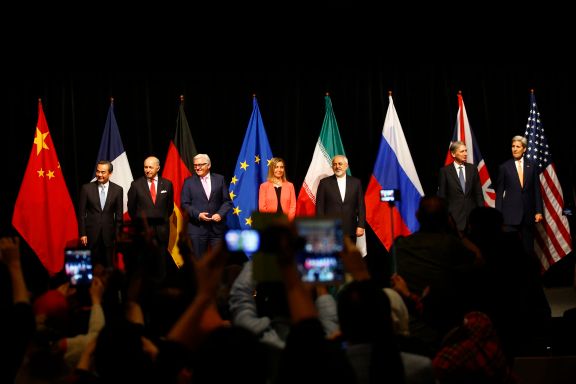
Nuclear deal negotiators pose for a photo at the UN building in Vienna, Austria. (2015)
The 2015 Joint Comprehensive Plan of Action (JCPOA) remains the essential foundation for any future negotiations on Iran's nuclear program, Moscow's envoy to the UN nuclear watchdog said on Monday.
In an interview with Russian daily Izvestia, Russia's Permanent Representative to International Organizations in Vienna, Mikhail Ulyanov, said that the JCPOA is irreplaceable and will serve as the starting point for new talks, warning that the current impasse risks uncontrolled escalation.
“The JCPOA is still in a half-disassembled state,” he said but noted that “the JCPOA will remain the starting point for new negotiations.”
Ulyanov added, "The current uncertain situation with the JCPOA is fraught with the risk of uncontrolled escalation. Therefore, we see the best way forward in the return of the main players to the negotiation table."
Ulyanov dismissed concerns over the recent increase in Iran's highly enriched uranium reserves, saying, "Such an increase in stockpiles is not critical, since production remains under the effective control of the agency [IAEA]."
He also acknowledged IAEA Director General Rafael Grossi's concerns, having called the JCPOA an "empty shell", but cautioned against making categorical judgments regarding the effectiveness of the agreement.
"There is nothing to replace it at the moment," Ulyanov said regarding the JCPOA. "Therefore, it is likely that we will now talk about some kind of modified agreement if the interested parties come to a consensus on the need to develop one."
He argued that the real threat to nuclear non-proliferation lies in "the inability of the main parties involved to find a common language and move from megaphone diplomacy to genuine diplomacy."
The JCPOA, signed by Iran, Russia, the United States, Britain, France, China, and Germany, aimed to lift sanctions on Iran in exchange for limitations on its nuclear program. However, the US withdrew from the deal in 2018, reimposing sanctions and prompting Iran to scale back its commitments.
Additionally, Ulyanov criticized Western nations for undermining progress, specifically citing a November 2024 anti-Iranian resolution at the IAEA Board of Governors, which he said largely undermined previous agreements.
The Iranian government has just three months to finally implement Article 64 of the constitution which mandates an increase in the number of parliamentary seats, forcing better representation for Iranians in underrepresented regions.
The directive requires the government to facilitate the addition of 40 new representatives from densely populated regions to the Islamic Consultative Assembly (Majlis or Majles).
The plan, approved by the parliament last month and ratified by the Guardian Council, aims to address significant demographic shifts that have occurred since the last adjustment to the parliament composition in 1999.
The changes have resulted in an unequal distribution of representation, with some sparsely populated districts having the same number of representatives as significantly larger ones.
Article 64 of the constitution stipulates that 20 representatives should be added to the parliament every 10 years. However, no adjustments have been made since 1999, despite four previous attempts to increase the number of seats, which were blocked by government opposition.
Unnamed experts cited by Fars news agency argue the current seat distribution is severely imbalanced, pointing to districts with 30,000 residents having equal representation to those with millions. For example, Alborz province, with 4.2 million residents, has only three representatives.
Supporters of the plan believe its implementation will strengthen the parliament and rectify social injustices caused by the current disparities in representation.
The Kremlin said on Monday it is not consulting Iran on Tehran's response to a letter from US President Donald Trump urging talks on a nuclear deal, days after Russia said it was willing to mediate their disagreements.
Asked by a reporter whether Moscow was influencing Tehran's response to the letter from Trump, Kremlin spokesman Dmitry Peskov said: "Iran is a sovereign country and independently formulates its position on key foreign policy issues."
"It is clear that Iran is seeking negotiations based on mutual respect, constructive negotiations."
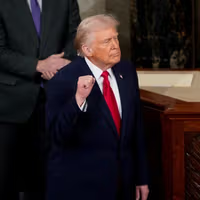
Trump on Friday said that he had sent a letter to Iran's Supreme Leader Ali Khamenei, offering negotiations while warning of military consequences if talks over its nuclear program failed.
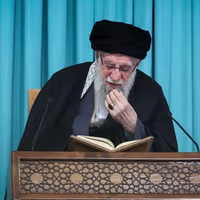
A day after Trump publicly revealed his letter, Khamenei made a speech in which he made no mention of the letter but declared that the Islamic Republic would not negotiate with "bullying" powers. Iranian media and observers interpreted this as a rejection of Trump's overture.
Last week, Moscow offered to mediate in talks between its ally Iran and the United States on the various disagreements between the old foes, including Tehran's nuclear program and military activities in the region.
"We, of course, for our part, will continue to do everything that depends on us, everything that is possible, in order to bring this process of settling the Iranian nuclear dossier into a peaceful direction," Peskov added.
On Monday Iran’s foreign ministry reiterated its denials, claiming that Tehran had not received a letter from Trump.
Acknowledging the fragility of the situation as pressure on Tehran ramps up, Peskov said, "It is clear that very tense contacts are ahead."
Iran's Foreign Ministry summoned Sweden’s ambassador in Tehran to protest comments by Sweden’s education minister, who criticized Iran following a Swedish media report alleging that an Iranian student at Lund University had ties to Iran’s intelligence services.
"The Swedish Ambassador in Tehran, Mathias Otterstedt, was summoned to the Iranian Foreign Ministry by the Director of the Western Europe’s Third Department Shahram Ghazizadeh in response to the inappropriate and interventionist positions of some Swedish officials against the Islamic Republic of Iran," a statement by the foreign ministry released on Monday read.
During the meeting with the Swedish ambassador, Iran communicated its "formal protest to the Swedish envoy and criticized the inappropriate statements, baseless accusations, and interventionist remarks made by the Swedish minister of education against the Islamic Republic of Iran."
An investigative report by Swedish daily newspaper Expressen last month revealed that an individual who had worked for Iran's intelligence service for two years was subsequently employed as a doctoral student at Lund University. The student had not mentioned his background in Iran's intelligence service in his CV.
The report quoted the student as confirming he "worked for an institute that later turned out to be part of the intelligence service."
Reacting to the repot the Swedish Minister of Education Johan Pehrson said: "Iran is a rogue state that many Swedes have fled from. They have institutionalized misogyny, anti-Semitism and sponsor terrorism. The Swedish Security Service classifies Iran as one of the greatest security threats to Sweden. Iran not only engages in espionage and influence work, but is also interested in acquiring technology and innovations that are developed in Swedish companies and universities."
Iran's foreign ministry also said that during the meeting, Ghazizadeh also criticized Sweden for summoning Iran’s ambassador in Stockholm over the case of detained Swedish Iranian Ahmadreza Djalili on death row in Tehran.
It also stated that Ghazizadeh raised concerns over the case of Niloufar Zareh, an Iranian citizen who was killed in a school shooting in Sweden last month, and requested details on the judicial process.
Brooklyn-based Iranian dissident activist Masih Alinejad says she will testify in a Manhattan federal court trial starting Monday against three men accused of plotting to assassinate her on behalf of the Islamic Republic.
"The US Department of Justice is prosecuting these three men in federal court, and I must look them in the eye and testify," Alinejad said in a video message on Sunday.
The two-week trial will begin on Monday, March 10, according to Alinejad.
Rafat Amirov, 43, from Iran, Polad Omarov, 38, a citizen of both the Czech Republic and Slovenia, and Khalid Mehdiyev, 24, from Yonkers, New York, were indicted in a New York federal court on charges of money laundering and murder-for-hire in 2023.
The Justice Department charged the three men in an alleged plot that originated in Iran to kill Alinejad.
The Islamic Republic "is not only killing innocent people in Iran but is also targeting them in the heart of America and Europe," Alinejad said in her message.
"Here, in a federal court in Manhattan, the truth will be laid bare before the world."
Mehdiyev was arrested in New York in 2022 for possessing a rifle near the residence of Alinejad. Amirov was taken into custody in the Southern District of New York in January 2023. Omarov was extradited to the US by the Czech Republic in February 2024 after his arrest in January 2023.
The three were part of an Eastern European criminal organization called the "Thieves in Law".
Iran’s partnership with criminal gangs is partly born out of necessity. According to Western officials, the government’s own operatives face increasing scrutiny and surveillance from intelligence services, limiting their ability to conduct missions abroad. By turning to these criminal groups, the Islamic Republic circumvents the obstacles while tapping into networks that are already embedded in the West.
In 2021, US officials uncovered a plot involving two Hells Angels members hired to kill an Iranian defector and his wife in Maryland.
Moscow does not rule out the possibility that its staunch allies in Tehran may consent to restricting their nuclear program and enhancing transparency in return for the lifting of Western sanctions, Haaretz reported citing the Russian foreign ministry spokeswoman.
In an interview published by the Israeli newspaper on Sunday, Maria Zakharova referred to the 2015 nuclear deal with Tehran and said, "A similar approach might be useful now in order to stabilize the situation."
"We are prepared for the closest cooperation with Tehran and with the other involved parties for the sake of reducing tension and finding sustainable solutions that will enable an effective and long-term accord," she was quoted as saying.
Iran had largely restricted its nuclear program in exchange for some sanctions relief as per the agreement it signed in July 2015 with world powers, officially known as the Joint Comprehensive Plan of Action (JCPOA).
However, the deal reached under US President Barack Obama was criticized by his successor Trump, who pulled out of the agreement, as too lenient on Tehran.
Trump warned on Friday that the situation with Iran had reached a critical stage, adding that he preferred to reach a deal over Tehran's nuclear program.
“We can’t let them have a nuclear weapon,” Trump told reporters at the Oval Office. “We are at final moments with Iran. Something’s going to happen very soon."
There’ll be some interesting days ahead, that’s all I can tell you. You know, we’re down to final strokes with Iran,” he added.
He also said he has sent a letter to Iran's supreme leader. However, Ali Khamenei on Saturday ruled out the possibility of negotiation with the United States, in his first public speech after Trump's remarks.