Iran’s foreign ministry on Monday reiterated that Tehran has not received a letter from US President Donald Trump, who said it was sent last week requesting talks on Iran’s nuclear program.
Esmail Baghaei, the ministry's spokesperson, responded to a reporter’s question during his weekly briefing on Monday, saying, “I will answer your long question with a short response: No letter has been received.”
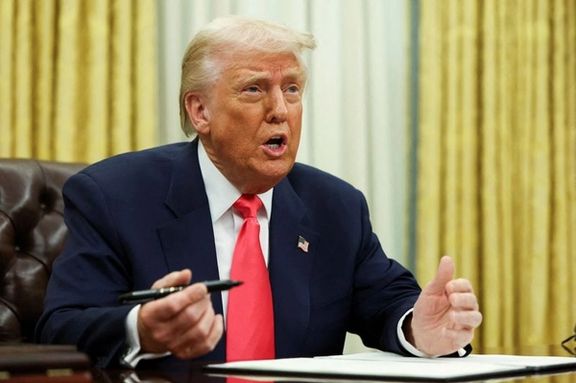
President Trump revealed on Friday that he had sent a letter to Khamenei, offering negotiations while warning of military consequences if talks failed. Speaking to Fox Business Network, Trump said, “There are two ways Iran can be handled: militarily or through a deal. I would prefer to make a deal.”
The next day, Iran’s Supreme Leader Ali Khamenei, in a speech, made no mention of a letter from Trump but declared that the Islamic Republic would not negotiate with "bullying" powers. Iranian Media and observers interpreted this as an indirect response to Trump's demand for talks.
Trump’s explicit threat—both in his public statements and the reported letter—that the United States might consider military action if Tehran refuses genuine negotiations has put Khamenei under pressure to deliver a clear response. Whether the denial of receiving a letter is intended to delay such a response remains uncertain.
It is also possible that Trump sent a message rather than a formal letter, using intermediaries such as Russia or Qatar. This could allow Tehran to deny having received a letter and avoid the pressure to publicly respond.
Abbas Golroo, a member of the Parliament's National Security and Foreign Policy Commission, told Borna News Agency in Tehran on Monday that he had no precise information on Trump’s letter and suggested that what was being referred to as a letter was likely a message.
It is entirely possible that Trump sent a message in some form and that Iran may have already responded through indirect channels or intends to do so, while maintaining the pretense that no letter was involved.
In any case, the foreign ministry spokesperson condemned Trump's threats of keeping a military option on the table. “Various Iranian officials have spoken on this matter. The threat of using force is a criminal act under international law,” Baghaei said.
Iran, under intense economic pressure and a weakened regional position, also sees Trump’s maximum sanctions policy as a coercive tactic. Last month, when Trump reaffirmed his maximum pressure strategy, Tehran similarly rejected negotiations, citing its refusal to engage in talks under duress.
Tehran has long sought sanctions relief as a condition for engaging in talks. During the Biden administration, when indirect negotiations lasted more than a year, Washington informally eased enforcement, leading to a significant surge in Iran’s oil exports and nearly $100 billion in additional revenue.
Warships from Russia and China entered Iran's territorial waters ahead of joint naval exercises set to begin Tuesday, a move dismissed by US President Donald Trump as inconsequential.
The Security Belt-2025 drills, taking place annually near the Iranian southeastern port of Chabahar, in the northern part of the Indian Ocean, mark the fifth such exercise between the three nations since 2019, showcasing their deepening military ties amidst geopolitical tensions.
Asked on Sunday if the drills concerned him, Trump told Fox News, “No. Not at all. We’re stronger than all of them. We have more power than all of them. I rebuilt the military.”
The exercises involve warships and support vessels from the Iranian Navy and the Islamic Revolutionary Guard Corps (IRGC) Navy, alongside Russian and Chinese naval forces. Observers from Azerbaijan, South Africa, Oman, Kazakhstan, Pakistan, Qatar, Iraq, the United Arab Emirates, and Sri Lanka are also present.
Russia's Defense Ministry confirmed the participation of 15 combat ships, support vessels, and gunboats, as well as helicopters. China deployed a guided-missile destroyer and a supply ship.
The drills will include simulated attacks on maritime targets, search and seizure operations, and search and rescue exercises.
The location of the drills, the Gulf of Oman, is a critical waterway for global oil trade, linking the Indian Ocean to the Strait of Hormuz and the Persian Gulf.
This year's exercises come at a time of heightened tensions in the region, with Trump recently reiterating his "maximum pressure" campaign on Iran, aimed at curbing its nuclear program.
The US maintains a significant military presence in the region, with its Fifth Fleet based in Bahrain.
Iran's Foreign Ministry summoned Sweden’s ambassador in Tehran to protest comments by Sweden’s education minister, who criticized Iran following a Swedish media report alleging that an Iranian student at Lund University had ties to Iran’s intelligence services.
"The Swedish Ambassador in Tehran, Mathias Otterstedt, was summoned to the Iranian Foreign Ministry by the Director of the Western Europe’s Third Department Shahram Ghazizadeh in response to the inappropriate and interventionist positions of some Swedish officials against the Islamic Republic of Iran," a statement by the foreign ministry released on Monday read.
During the meeting with the Swedish ambassador, Iran communicated its "formal protest to the Swedish envoy and criticized the inappropriate statements, baseless accusations, and interventionist remarks made by the Swedish minister of education against the Islamic Republic of Iran."
An investigative report by Swedish daily newspaper Expressen last month revealed that an individual who had worked for Iran's intelligence service for two years was subsequently employed as a doctoral student at Lund University. The student had not mentioned his background in Iran's intelligence service in his CV.
The report quoted the student as confirming he "worked for an institute that later turned out to be part of the intelligence service."
Reacting to the repot the Swedish Minister of Education Johan Pehrson said: "Iran is a rogue state that many Swedes have fled from. They have institutionalized misogyny, anti-Semitism and sponsor terrorism. The Swedish Security Service classifies Iran as one of the greatest security threats to Sweden. Iran not only engages in espionage and influence work, but is also interested in acquiring technology and innovations that are developed in Swedish companies and universities."
Iran's foreign ministry also said that during the meeting, Ghazizadeh also criticized Sweden for summoning Iran’s ambassador in Stockholm over the case of detained Swedish Iranian Ahmadreza Djalili on death row in Tehran.
It also stated that Ghazizadeh raised concerns over the case of Niloufar Zareh, an Iranian citizen who was killed in a school shooting in Sweden last month, and requested details on the judicial process.
Successive rounds of US sanctions on tankers and companies involved in Iran's oil trade are slowing shipments to China but trade with one of Iran's most important allies continues in 'dark mode' in spite of maximum pressure, according to Bloomberg.
Sanctions are having an impact on the trade link by increasing costs and logistical hurdles, Bloomberg reported, citing Chinese refinery executives and shipping analysts.
Private Chinese refineries, which are the primary buyers of Iranian crude, have faced supply disruptions in recent weeks due to seller defaults, Bloomberg reported, citing industry sources.
While no specific reason was given, refinery executives attributed the issues to rising expenses and logistical challenges caused by US sanctions.
Washington has blacklisted more than two-thirds of the 150 vessels that transported Iranian crude last year.
The sanctions announced on February 24 followed similar measures by the US Treasury in late 2024, targeting ultra-large crude carriers in Iran's shadow fleet.
More than half of the tankers sanctioned by the United States have ceased operations outside Chinese or Iranian terminals, an investigation by Iran International revealed last month.
The increased restrictions have led to record-high freight costs, with the chartering rate for a non-sanctioned supertanker moving Iranian oil from Malaysia to China reaching up to $6 million—an increase of 50% from last year, Bloomberg reported, citing traders.
Some Chinese port authorities are also taking precautions. Shandong Port Group, which operates in a key refining hub, recently advised against handling blacklisted tankers, Bloomberg's report said.
Despite these obstacles, flows surged to a four-month high last month, partly due to a backlog of delayed cargoes, Bloomberg said.
However, an increasing number of ship-to-ship oil transfers are being conducted in "dark" mode, where vessels switch off their transponders to avoid detection, Bloomberg reported, citing satellite images and analysts.
In the waters off Malaysia, a key hub for Iranian crude shipments, up to seven such transfers were observed in a single day last month. Analysts noted that most of these operations were entirely "dark," indicating that shippers are taking greater precautions as Washington signals increased enforcement efforts.
On Wednesday, Reuters reported that the Trump administration is considering a plan to inspect Iranian oil tankers under an international accord designed to curb the spread of weapons of mass destruction.
Anoop Singh, the global head of shipping research at Oil Brokerage Ltd, told Bloomberg that financial institutions working with private Chinese refiners importing Iranian oil may come under fresh scrutiny. He added that Washington could choose to pressure countries such as India and the United Arab Emirates, where key shipowners and dark fleet operators are based.
He said that so far, the US has focused its sanctions on ships and owners, but the market has managed to create workarounds. “However, there are more critical parts of the network to target, from banks to governments to flag states and insurers — and regulatory avenues to explore,” Singh told Bloomberg.
The US will maintain its maximum pressure campaign on Iran if Tehran refuses to reach an agreement, a State Department spokesperson told Iran International, after Iran's Supreme Leader Ali Khamenei ruled out the possibility of negotiations with Washington.
"If the Iranian regime does not want a deal, the President is clear, Iran will remain under the restored maximum pressure campaign," the spokesperson said.
"President Trump has been clear that the United States is committed to preventing Iran from acquiring a nuclear weapon and expressed his willingness to discuss a deal with Iran," the spokesperson added.
Khamenei dismissed the prospect of talks with the United States on Saturday in his first public speech after President Donald Trump said he sent a letter to him.
"The insistence of some bullying governments on negotiations is not aimed at resolving issues but rather at asserting dominance and imposing their demands," Khamenei said in a meeting with Iranian officials in Tehran.
"The Islamic Republic of Iran will certainly not accept their demands," he added.
His comments followed Trump’s revelation that he had sent Khamenei a letter offering negotiations on Iran's nuclear program while warning that military intervention was the alternative.
Iran's Foreign Minister Abbas Araghchi said on Saturday Tehran has not yet received Trump's letter to Khamenei.
Trump warned on Friday that the situation with Iran had reached a critical stage, adding that he preferred to reach a deal over Tehran's nuclear program than turn to military force.
The expiration of a US sanctions waiver permitting Iraq to purchase Iranian energy poses short-term operational difficulties, the Iraqi prime minister's foreign affairs adviser told Reuters on Sunday.
Farhad Alaaeldin said that the expiration of the waiver “presents temporary operational challenges,” adding that “Iraq was committed to its strategic goal of achieving energy self-sufficiency".
The Trump administration revoked Iraq’s sanctions waiver to pay Iran for electricity on Saturday as part of President Donald Trump's so-called campaign of maximum pressure against Tehran.
"The government is actively working on alternatives to sustain electricity supply and mitigate any potential disruptions," Alaaeldin said.
"Strengthening energy security remains a national priority, and efforts to enhance domestic production, improve grid efficiency and invest in new technologies will continue at full pace," he added.
A State Department spokesperson said that the decision "ensures we do not allow Iran any degree of economic or financial relief,” adding that Trump's campaign on Iran aims "to end its nuclear threat, curtail its ballistic missile program and stop it from supporting terrorist groups."
The spokesperson said: "We urge the Iraqi government to eliminate its dependence on Iranian sources of energy as soon as possible ... Iran is an unreliable energy supplier."
The spokesperson played down the impact of Iranian electricity imports on Iraq's power grid, saying, "In 2023, electricity imports from Iran were only 4% of electricity consumption in Iraq."
Washington seeks to isolate Iran economically and cut its oil revenues to hinder nuclear development—claims Tehran denies, insisting its program is peaceful.
"President Trump has been clear that the Iranian Regime must cease its ambitions for a nuclear weapon or face Maximum Pressure," said National Security spokesperson James Hewitt. "We hope the regime will put the interests of its people and the region ahead of its destabilizing policies."
The US has long urged Iraq to reduce reliance on Iranian energy. The waiver’s removal is also seen as part of Washington’s push for Baghdad to resume Kurdish oil exports via Turkey to help stabilize global prices.
"Iraq’s energy transition provides opportunities for US companies, which are world-leading experts in increasing the productivity of power plants, improving electricity grids, and developing electricity interconnections with reliable partners," the State Department spokesperson noted.