US weighs halting tankers at sea to squeeze Iran oil trade
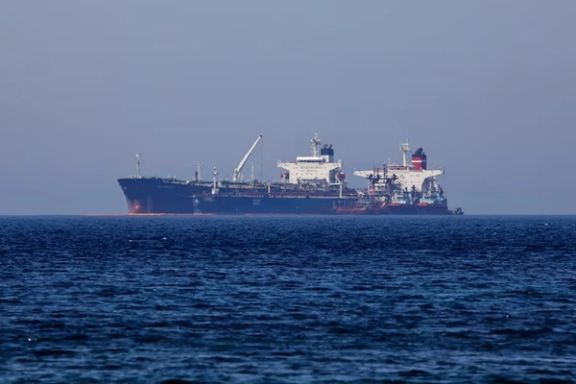
The Liberian-flagged oil tanker Ice Energy transfers crude oil from the Iranian-flagged oil tanker Lana (former Pegas), off the shore of Karystos, on the Island of Evia, Greece, May 26, 2022.
The administration of US President Donald Trump is considering a plan to inspect Iranian oil tankers under an international accord designed to curb the spread of weapons of mass destruction, six sources familiar with the matter told Reuters.
The move would be part of US President Donald Trump’s renewed "maximum pressure" campaign, aimed at cutting Iran’s oil exports to zero.
More than half of the tankers sanctioned three days ago by the United States for carrying Iran's oil have ceased operations outside Chinese or Iranian terminals, an investigation by Iran International last month revealed.
Since returning to office, Trump has imposed fresh sanctions targeting companies and the so-called shadow fleet of older oil tankers transporting Iranian crude without Western insurance.
Sources said the administration is exploring ways for allied countries to stop and inspect vessels in key maritime chokepoints, including the Malacca Strait in Asia.
“You don’t have to sink ships or arrest people to have that chilling effect that this is just not worth the risk,” one source said. Another added: “The delay in delivery … instills uncertainty in that illicit trade network.”
The US is examining whether the inspections could be carried out under the Proliferation Security Initiative, signed by over 100 countries, a 2003 multinational framework aimed at stopping the trafficking of weapons of mass destruction.
John Bolton, who helped establish the initiative, said: “It would be fully justified” to use it against Iranian oil shipments, arguing that Tehran relies on crude revenue to fund nuclear activities and militant groups.
Two sources said the White House National Security Council is reviewing the proposal, but it remains unclear if Washington has approached any governments to gauge their willingness to participate. The National Security Council declined to comment as reported by Reuters. Iran's oil and foreign ministries also did not respond.
Iranian President Masoud Pezeshkian, addressing parliament on Sunday, acknowledged Trump’s latest sanctions, saying Iran’s tankers now face uncertainty in unloading their cargo. Iran has previously retaliated when its oil shipments were seized.
In 2023, the US tried to interdict two Iranian oil cargoes under Biden, prompting Iran to seize foreign vessels, including one chartered by Chevron.
Despite past US sanctions, Iran’s oil exports brought in over $50 billion annually in recent years, largely from sales to China. Meanwhile, European countries have raised concerns about environmental risks from tankers but have taken little action to inspect Iranian oil shipments.
Since early September, Iran’s national currency, the rial, has lost half of its value due to military and geopolitical setbacks in the region and Trump’s election, as he has pledged to significantly cut Tehran’s oil exports.
A US diplomat will attend a meeting in Baghdad Thursday focusing on resuming Kurdish oil exports via Turkey, sources told Reuters, as Washington pushes Iraq to boost global supply while curbing Iranian oil exports.
The talks, hosted by Iraq's oil ministry, come as the US increases pressure to restart the pipeline, seeking to reduce Iranian oil's market share while Iran views Iraq as a key economic lifeline.
US President Donald Trump's administration is pressuring Iraq to allow Kurdish oil exports to restart to help offset a potential fall in Iranian oil exports, Reuters reported last month, citing eight sources with direct knowledge of the matter.
In early February, Trump reinstated the so-called maximum pressure campaign on Iran from his first term, with the stated aim of pushing down Tehran's oil sales to zero.
Meanwhile, during a meeting in Tehran on Wednesday, Iran’s Oil Minister Mohsen Paknejad and Iraq’s Electricity Minister Ziyad Ali Fadel voiced their commitment to expanding energy cooperation across oil, gas, petrochemicals, and electricity sectors.
Iraq’s oil minister announced late in February that exports from the Kurdistan region would resume next week.
Sources cited by Reuters said Trump’s administration was a key force behind the announcement.
Reuters cited two US administration officials confirming that the US had asked the Iraqi government to resume Kurdish exports. One of them said the move would help dampen upward pressure on oil prices, the report added.
Iran has been a major recipient of cut-price Kurdish oil. Last July, a Reuters report detailed how the closure of the pipeline transporting Kurdish crude to Turkey in 2023 led to an increase in oil smuggling to Iran, with an estimated 200,000 barrels per day being transported by truck.
In December 2024, Reuters also reported on a fuel oil smuggling network generating at least $1 billion annually for Iran and its military allies, which had flourished in Iraq since Prime Minister Mohammed Shia al-Sudani took office in 2022.
Liberal senator Dave Sharma urged Australian Foreign Affairs Minister Penny Wong to investigate whether Iran’s state-backed English-language broadcaster, Press TV, is violating Australian sanctions and acting as a channel for foreign interference.
In a letter sent Wednesday, Sharma pressed for a “full investigation and proper enforcement of the sanctions regime as it applies to Press TV.”
The Albanese government sanctioned the broadcaster in 2023, a year after the death in custody of Iranian woman Mahsa Amini, which sparked months of nationwide protests across Iran in 2022.
"Press TV constitutes a tool of foreign interference of the Iranian state," Sharma said in an interview. He cited the broadcaster’s interview with Labor defector Fatima Payman, in which she suggested women were treated better in Iran than in the West.
Payman later apologized, calling the event a propaganda exercise.
Australia’s Autonomous Sanctions Act 2011 makes it a criminal offense to provide assets to a sanctioned entity or handle its funds indirectly. Sharma argued that Press TV’s continued operation in Australia could constitute such violations, which carry penalties of up to 10 years in prison.
Last month, Kylie Moore-Gilbert, a researcher and former prisoner in Iran, criticized Australian Senator Payman for defending Iran’s treatment of women in an interview with the state-run Press TV.
In a post on X, Moore-Gilbert called Payman’s remarks “nonsense,” rejecting the senator’s claim that Iran allows women to participate in democracy.
She pointed out that Payman had previously attended a Senate inquiry into Iran’s human rights abuses and questioned why she would agree to speak with Press TV.
“The English-language propaganda arm of the Islamic Republic [is] known for broadcasting false confession videos and forced interviews with prisoners before they are executed," she said.
Sharma recently chaired a bipartisan inquiry into Australia’s sanctions regime, which criticized the government’s enforcement efforts. The inquiry’s report found “very limited evidence” that authorities had tracked assets in Australia linked to Iran’s Islamic Revolutionary Guard Corps or sanctioned Russian individuals.
A spokesperson for Wong dismissed Sharma’s call as “a crass attempt at a headline.”
Earlier this week, UK Security Minister Dan Jarvis told parliament that Britain will put Iran's intelligence and security establishment on the highest tier of a foreign influence watchlist, toughening London's stance on perceived political interference by Tehran.
Under the designation, Iran and anybody acting on its behalf would be deemed a potential security threat and compelled to register their activities in the UK. Not doing so would potentially incur a five-year prison sentence.
The US Department of the Treasury placed sanctions on Behrouz Parsarad, an Iran-based administrator of Nemesis, a darknet marketplace selling narcotics, dismantled last year.
The platform, which facilitated the sale of narcotics and illicit services, had over 30,000 active users and facilitated transactions worth nearly $30 million between 2021 and 2024, according to the Treasury.
“As the administrator of the Nemesis darknet marketplace, Parsarad sought to build—and continues to try to re-establish—a safe haven to facilitate the production, sale, and shipment of illegal narcotics like fentanyl and other synthetic opioids,” said Acting Under Secretary for Terrorism and Financial Intelligence Bradley T. Smith.
“Treasury, in partnership with US law enforcement, will use all available tools to dismantle these darknet marketplaces and hold accountable the individuals who oversee them.”
Parsarad controlled Nemesis and its virtual currency wallets, according to the Treasury, and profited from transaction fees that amounted to millions of dollars. He is also accused of laundering virtual currencies for drug traffickers and cybercriminals operating on the platform.
The US, German, and Lithuanian law enforcement agencies seized Nemesis’ servers last March, but the Treasury says Parsarad has since been in discussions with former vendors about launching a successor platform.
The sanctions block all Parsarad-related property under US jurisdiction and prohibit financial transactions with him. Treasury also identified 49 virtual currency addresses linked to him. Financial institutions engaging with Parsarad may face penalties.
When Nemesis was taken down, German authorities said that more than 150,000 user accounts and over 1,100 seller accounts were registered on the site, accessible on the Tor network.
Other than drug trafficking, the site had facilitated the trade of fraudulently obtained goods and data, as well as cybercrime services such as DDoS attacks, phishing, and ransomware.
Iran’s ambassador to the International Atomic Energy Agency (IAEA) said on Wednesday that the three European parties to the 2015 nuclear deal (E3) have no legal or moral standing to trigger the deal’s dispute mechanism, known as the snapback.
Speaking during a meeting of the IAEA’s Board of Governors on Wednesday, Mohsen Naziri Asl accused Britain, France and Germany (known as the E3) of violating both the 2015 nuclear deal, or JCPOA, and UN Security Council Resolution 2231 – the basis for the deal.
"Since the E3 are in violation of Resolution 2231 and the JCPOA, they lack the legal and moral standing to trigger the dispute resolution mechanism in response to Iran's limited and legitimate actions, which are explicitly recognized in the JCPOA," he said.
He argued that they had no grounds to reactivate the dispute process in response to what he called Iran’s legitimate measures, which he said were explicitly permitted under the agreement.
“Any attempt to trigger the dispute mechanism or pursue this futile path is legally baseless, unjust and unlawful, and will be firmly rejected,” he added.
The snapback mechanism allows for the reinstatement of United Nations sanctions on Iran if it is deemed to have violated the JCPOA.
Iran has progressively reduced its compliance with the nuclear deal in response to the United States' 2018 withdrawal from the agreement and the subsequent reimposition of sanctions, including reducing access to IAEA inspectors.
The E3 has repeatedly expressed concern over Iran's nuclear activities, but Tehran maintains its actions are justified and within the framework of the JCPOA.
During another session of the IAEA Board of Governors on Tuesday, the European Union warned that Iran’s continued nuclear expansion poses a growing risk of proliferation, calling on Tehran to return to its commitments under 2015 deal and adhere to UN Security Council Resolution 2231.
The United States also said Iran's accelerating nuclear program is imperiling world peace and either aims to get Tehran closer to a bomb or force the world to ease sanctions.
The European Union warned that Iran’s continued nuclear expansion poses a growing risk of proliferation, calling on Tehran to return to its commitments under 2015 deal and adhere to UN Security Council Resolution 2231.
The statement was delivered in Vienna during the quarterly meeting of the International Atomic Energy Agency (IAEA) Board of Governors on Tuesday.
“The EU remains deeply concerned by the continued alarming expansion of Iran’s nuclear program. Iran has gravely departed from its the Joint Comprehensive Plan of Action (JCPOA) commitments and has gained irreversible knowledge.
"The EU notes with particular concern Iran’s significantly increased production and accumulation of highly enriched uranium and the expansion of its nuclear enrichment capability and operations,” the EU representative in Vienna said.
The EU praised IAEA Director General Rafael Grossi and his team for their independent monitoring and reaffirmed that ensuring Iran does not develop a nuclear weapon remains a key security priority.
“We call on all countries to support the implementation of UN Security Council Resolution 2231 (2015) endorsing the JCPOA, which provides the basis for the IAEA's monitoring and reporting. We regret that Iran has not made the necessary decisions to return to its nuclear-related commitments under the JCPOA.”
According to the EU, Iran’s uranium enrichment has reached levels that raise significant proliferation concerns. “The DG’s report documents a sharp increase of material enriched at 60% which is now produced at an unprecedented rate, with a 50% increase in the reporting period," the statement said.
"Iran already accumulated more than 6 significant quantities of 60% enriched material [which the Agency defines as the approximate amount of nuclear material for which the possibility of manufacturing a nuclear explosive device cannot be excluded] and is currently producing one significant quantity of highly enriched uranium every month.”
The EU also condemned Iran’s decision to remove JCPOA-related surveillance and monitoring equipment, arguing that it has compromised the IAEA’s ability to verify the nature of Iran’s nuclear activities.
In addition, the EU criticized Iran’s rejection of four additional IAEA inspectors on the back of 2023's ban around one third of the inspectors.
“We echo the DG’s deep regret that Iran, despite having initially accepted to consider it, has finally refused the designation of four additional experienced inspectors recently proposed by the Agency," a statement said.
The United States also said on Tuesday that Iran's accelerating nuclear program is imperiling world peace and either aims to get Tehran closer to a bomb or extort the world to extract concessions.
Tehran denies seeking a nuclear weapon and has branded suspicions over its intentions as a way for outside powers to meddle in internal affairs.
Grossi reported that Iran's uranium stock refined to up to 60% purity grew by 92.5 kilograms (kg) in the past quarter to 274.8 kg. According to an IAEA parameter, the amount is enough in principle for six nuclear bombs if enriched further.
Trump has mooted a deal over the program but Iranian Supreme Leader Ali Khamenei has ruled out talks while the administration imposes 'maximum pressure' policies including toughened sanctions.