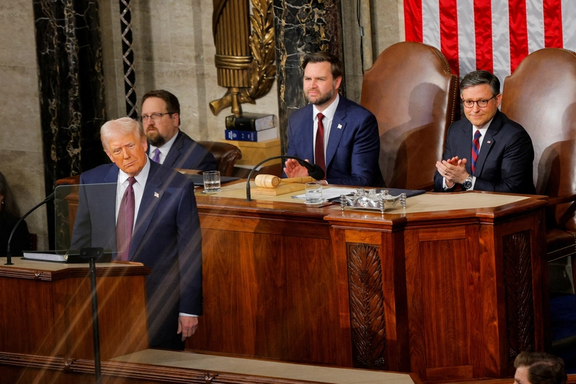
US President Donald Trump attends a joint session of Congress at the US Capitol in Washington, DC, US, March 4, 2025.
US President Donald Trump should clarify the objectives of his initiative to hold direct negotiations with Iran, Democratic Senator Chris Murphy told Iran International on Tuesday, questioning the veracity of the president's assertions.
"The President should share with the Congress what his goals are," Murphy said. "I have no idea what he thinks he's going to achieve."
Trump announced on Monday during a joint Oval Office appearance with Israel's prime minister Benjamin Netanyahu that 'top level' negotiations will commence between the United States and Iran in Oman on Saturday.
Murphy cast doubt over the event's significance, accusing Trump of lying and not discussing his plans with lawmakers.
“Most of the stuff he says isn’t real ...He lies every single day," the Connecticut Senator said. "He engages in all sorts of negotiations that go nowhere and have no point. So this could be another version."
Trumps Middle East envoy Steve Witkoff and Iran's foreign minister Abbas Araghchi will lead the talks, the exact arrangement of which remains unclear as Tehran insists it would be indirect.
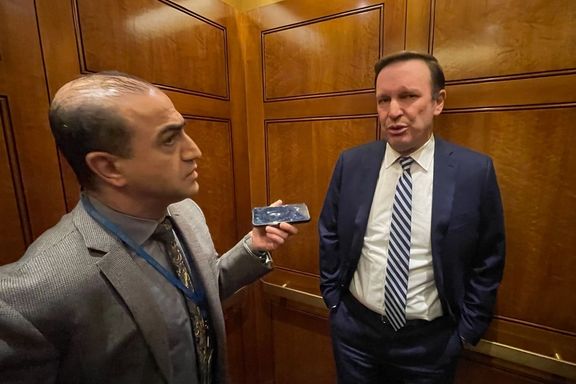
Senator Chris Murphy (D-CT) speaking to Iran International's Arash Alaei
Iran's supreme leader rejected direct negotiations with the United States last month, warning his officialdom that the Trump administration was not to be trusted after withdrawing from the 2015 nuclear deal during his first term.
Broder context
Republican Senator John Hoeven was more supportive of the plan to engage with Iran while it was weakened by Israeli onslaught in Gaza and Lebanon and American attacks on Houthis in Yemen.
“It’s very important that we have direct negotiations,” he told Iran International on Tuesday, adding that a deal that stops Iran from acquiring nuclear weapons would be unlikely without face-to-face engagement while hitting Tehran's regional allies.
“The Houthis are funded and supported by Iran. They are a proxy of Iran's,” he said. “So when we go after the Houthis, that's another way of going after Iran.”
President Trump has ordered several airstrikes on the rebel group, warning Tehran that it will be held responsible for all attacks emanating from Yemen.
Hoeven said the strikes were a message to Tehran that it has to stop supporting armed groups across the region.
“This state backed terror by Iran has to stop,” he said, listing groups like Hamas, Hezbollah and the Iran-backed groups in Iraq.
Iran insists that upcoming nuclear talks with the United States in Oman will be indirect, pushing back against US President Donald Trump’s announcement that direct negotiations will be underway.
The Iranian side, as reiterated by government spokeswoman Fatemeh Mohajerani and Foreign Minister Abbas Araghchi, maintains that Araghchi’s upcoming talks with US envoy Steve Witkoff in Oman will be conducted indirectly. However, Mohajerani did not explicitly rule out the possibility of direct negotiations, noting that Araghchi will lead Iran’s nuclear negotiating team as its highest-ranking official.
Both Araghchi and foreign ministry spokesman Esmaeil Baqaei had previously denied any negotiations were taking place—until Trump’s surprise Monday evening announcement during his meeting with Israeli Prime Minister Benjamin Netanyahu changed the calculus.
Shahram Kholdi, a Middle East and international relations expert, told Iran International TV that Iran’s insistence on indirect talks stems from Supreme Leader Ali Khamenei’s stance that direct negotiations with the US would be dishonorable.
Jason Brodsky, policy director at United Against Nuclear Iran (UANI), offered a different interpretation. In a post on X, he suggested that Tehran may have been caught off guard by Trump’s announcement. According to Brodsky, the announcement was likely meant “to pressure Tehran and make it look unreasonable should it reject the meeting.” He added that indirect negotiations might still occur on Saturday, but both sides would be creative in defining what counts as direct or indirect.
Meanwhile, Nour News, a website close to Iran’s Supreme National Security Council, dismissed suggestions that Iran was responding to US pressure. In a post on X, the outlet stated that Iran had set the time and location of the talks in Oman and communicated them to the US through Omani intermediaries. “No one-sided narratives—the initiative was in Tehran's hands,” the post read.
Ali Nasri, a Tehran-based foreign relations expert, criticized the ongoing obsession with terminology. “The bias regarding the words ‘direct’ or ‘indirect’ in the matter of negotiations does not benefit the lives of the Iranian people,” he wrote on X. “What matters is whether the negotiation process is effective or ineffective. Whichever method is more effective in securing national interests is the right path.”
Hossein Mousavian, Iran’s ex-ambassador to Germany (1990–1997) and a former senior nuclear negotiator, offered a historical analogy. In an X post, he recalled how negotiations during the Obama administration in Istanbul began under the supervision of EU’s supervision Catherine Ashton but soon transitioned to direct talks between Iranian and American officials. He predicted a similar setup in Oman. “It seems that Washington and Tehran have adopted a wise approach, and there is a chance for an agreement. Both negotiators [Witkoff and Araghchi] are capable, experienced, moderate, and wise,” he wrote.
Reza Nasri, another political commentator, argued that Iran has strategic reasons to consider negotiating with Trump. “Biden couldn’t deliver due to internal weakness and fear of the anti-Iran lobbies. Obama reached a deal, but Republicans killed it. Ironically, Trump may be the only U.S. president strong enough to defy the establishment, bypass Washington’s foreign policy elite, and strike a deal that actually lasts,” he posted on X.
The Iranian market has responded favorably to the prospect of talks, whether direct or indirect. Tehran’s Stock Exchange (TSE) rose by 59,000 points, reaching 2.8 million, while the rial rebounded slightly from last week’s record low, climbing to around 960,000 per dollar from 1,050,000.
New nuclear watchdog data indicates Iran has significantly expanded its uranium mining, suggesting much larger reserves than previously estimated, with plans to operate six more mines by the first quarter of 2024.
“The AEOI (Atomic Energy Organization of Iran) also indicates that Iran’s uranium reserves are much larger than previously estimated,” said the 2014 biennial Red Book report by the International Atomic Energy Agency (IAEA) and the Nuclear Energy Agency' published Tuesday.
It added that Iran planned to operate six more uranium mines by the end of the first quarter of 2024.
A screengrab of the 'Uranium 2024: Resources, Production and Demand' report showing Iran's mid-term uranium production projections
Iran could increase its ore production by almost four times, reaching 71 tons this year, according to the report.
In addition to the current Ardakan uranium production facility in Yazd Province, feasibility studies are underway for the development of the Narigan production center, also located in the same province.
Iran has always maintained that its uranium enrichment activities are for peaceful purposes. However, last year, the US-based Institute for Science and International Security said that while Iran's uranium resources could support a nuclear weapons arsenal, they are insufficient to fuel its growing nuclear power reactors.
Last month, the UN nuclear watchdog found that Iran's stock of near-bomb-grade uranium rose to levels which in principle could be refined further into the equivalent of six nuclear bombs.
Iran’s nuclear program remains a focal point of international tensions, particularly following Washington’s withdrawal from the 2015 nuclear deal and the imposition of economic sanctions.
The United States, meanwhile, has reinstated its "maximum pressure" policy on Iran, with President Donald Trump insisting that Tehran must never acquire nuclear weapons and has threatened military action against the country should it fail to reach a deal on its nuclear program.
The volume of coverage in Iranian newspapers about potential talks with the United States highlights the significance of the issue for both the public and the government.
Following a flurry of reports on Monday, news broke late in the evening Tehran time that Iran and the US will hold official talks on Saturday—the first since 2022.
Earlier in the day, the reformist and pro-Pezeshkian daily Etemad featured two front-page articles on Iran-US relations. In a report headlined "Tension Before Agreement," columnist Mehdi Beigoghlou reviewed calls for indirect negotiations and quoted prominent reformist figure Ali Shakouri-Rad, who said, "The fact that the top leaders of both countries—Donald Trump and Ali Khamenei—ultimately decide on the negotiations increases the chances of a lasting agreement."
Shakouri-Rad, sounding perhaps overly optimistic, also suggested that direct involvement by the two countries’ top leaders reduces the likelihood of military conflict in the region. “A meeting between Trump and Khamenei in Tehran is more probable than a regional war,” he said.
The article also noted that while some hardliners—including the editor of the Kayhan daily, which is funded by the Supreme Leader’s office—have called for Trump’s assassination, many conservative figures in Iran have distanced themselves from Kayhan’s provocative rhetoric and rejected the suggestion outright.
Meanwhile, in another article in Etemad, prominent commentator Abbas Abdi emphasized that hardliner calls for Iran to pursue nuclear weapons are ultimately futile, as Supreme Leader Ali Khamenei’s decree banning the development of nuclear and other weapons of mass destruction remains in effect. He noted that the ruling reflects a principled stance rooted in Islamic values.
Writing in the reformist daily Shargh, columnist Ardavan Amiraslani argued that "the start of negotiations between Iran and the United States is inevitable." He added that "Donald Trump is committed to a policy of non-intervention and has no interest in launching a new war in the Middle East."
However, Amiraslani acknowledged that Iran’s position on negotiations with the United States remains ambiguous. He pointed to the gap between Tehran’s official stance in favor of indirect talks and President Trump’s recent comment suggesting he sensed Iran was beginning to lean toward direct negotiations. Amiraslani also noted internal divisions among Iranian officials—some continuing to back hardline positions, while others recognize the urgent need for an agreement with the United States to address the economic crisis before it poses a serious threat to the system’s stability.
The centrist daily Ham Mihan, in its Monday editorial, sharply criticized the Supreme National Security Council, the Ministry of Foreign Affairs, and other relevant authorities for their silence over the hardline newspaper Kayhan's call for the assassination of former US President Donald Trump. The editorial argued that Kayhan’s article played directly into the hands of conservative US media, particularly Fox News, and appeared intended to provoke Trump. Ham Mihan also condemned the Culture Ministry’s mild response to the article, saying the warning issued was disproportionate to the severity of the provocation. It added that had any other media outlet published similar content, it would have faced far more serious consequences.
Another centrist daily, Sazandegi, featured an unusually large photo of Kayhan editor Hossein Shariatmadari alongside former US Vice President Mike Pence under the headline "Defenders of War," writing that "warmongers and radicals in both Iran and the United States are escalating tensions and undermining diplomacy." It is not clear why the paper featured Pence’s photo as a warmonger, except perhaps to emphasize his differences with Trump.
The conservative daily Farhikhtegan quoted Amir Ali Abolfath, a US politics analyst, as saying that "the United States is likely to favor a political approach over a military one in dealing with Iran." He added, "Trump wants peace with Iran, but the kind of peace he envisions is certainly different from what Iran has in mind."
Iranian exiled prince Reza Pahlavi on Monday argued against the use of US military force on Tehran, saying the Iranian people are the only ones who can overthrow the clerical establishment that toppled his father's rule in 1979.
"We're not denying the fact that having to act militarily is always an option," Pahlavi told a Washington DC event hosted by the Foundation for Defense of Democracies (FDD) and National Union for Democracy in Iran (NUFDI).
"But I think it will be historically criminal not to give the Iranian people a chance to make that happen before you have to resort to those less likable scenarios," he added.
US President Donald Trump has extended an offer to Iran for direct negotiations aimed at addressing concerns over its nuclear program. But the overture was accompanied by a stern warning: failure to engage would result in bombing "the likes of which they (Iran) have never seen before."
Pahlavi added that moving straight from diplomacy to military action would be ill advised. "Once again, you're throwing the people of Iran under the bus, which will only add salt to injury."
In response to Trump's bombing threat, Iran elevated its military readiness and cautioned neighboring countries against supporting any US military actions, warning of repercussions for neighbors who might facilitate an attack.
Addressing the same event, South Carolina Congressman Joe Wilson said "preventing Iran's regime from acquiring a nuclear weapon, which is existential for the United States and for American families and has been cited about the missile programs, is the foremost urgency."
He referred to the recent downfall of Iran's staunch ally Syrian President Bashar al-Assad, adding that he is "very hopeful that the success of the people of Syria should be the equivalent for the Middle East of the fall of the Berlin Wall, for the Europe and Central Asia for ultimately liberation of countries around the world."
Last week, Wilson introduced a new bipartisan bill pushing for measures to empower Iranians to help overthrow the government in favor of a democratic alternative including facilitating greater internet access and funding for dissidents.
The Maximum Support Act, introduced by Wilson and Jimmy Panetta (D-CA), would require the administration to develop an aggressive interagency strategy aimed at backing Iranian dissidents who would be pivotal in the process.
The legislation outlines a set of initiatives including facilitating secure communications for activists, appointing a special representative for coordinating support efforts and forming multi-agency teams to counter online censorship and government surveillance.
It also calls for offering safe channels for defection by Iranian officials and utilizing information shared by defectors.
“The Iranian regime will fall sooner rather than later,” Wilson said after introducing the bill.
Tehran and Washington have begun direct talks over Iran's nuclear program and will hold a "very big meeting" at a senior level on Saturday, US President Trump said in a surprise announcement on Monday.
“We’re having direct talks with Iran, and they’ve started,” Trump told reporters during an Oval Office meeting with Israeli Prime Minister Benjamin Netanyahu. “It'll go on Saturday. We have a very big meeting, and we’ll see what can happen.”
Officials in Tehran had consistently ruled out direct talks with Washington — until just hours before Trump’s surprise announcement.
The US president said the negotiations are being conducted “almost at the highest level,” brushing aside Iran's public preference for indirect talks.
“A lot of people say, ‘Oh, maybe you’re going through surrogates,’” he said. “No, we’re dealing with them directly.”
The announcement came amid heightened tensions in the region and growing concern in the United States and Israel over Iran’s nuclear activities.
The talks pursued by the Trump administration have been cast as a last-ditch effort to avoid military action.
“I think everybody agrees that doing a deal would be preferable to doing the obvious,” he said. “And the obvious is not something that I want to be involved with, or, frankly, that Israel wants to be involved with, if they can avoid it.”
Trump did not specify what concessions the United States might be willing to offer or what demands it would bring to the table, but his comments suggested a focus on Iran’s nuclear capabilities.
“Iran cannot have a nuclear weapon. That’s all there is,” he said, adding that "it'll be a very bad day for Iran," if the negotiations were to yield no results.
Netanyahu, sitting beside Trump, did not speak at length but nodded as the president spoke. Israel has long been skeptical of diplomacy with Tehran.
The announcement follows weeks of backchannel maneuvering and comes at a moment when both nations face domestic and international pressure.
Iranian officials did not immediately comment on the planned meeting.