Trump says 'top level' talks with Iran scheduled for Saturday
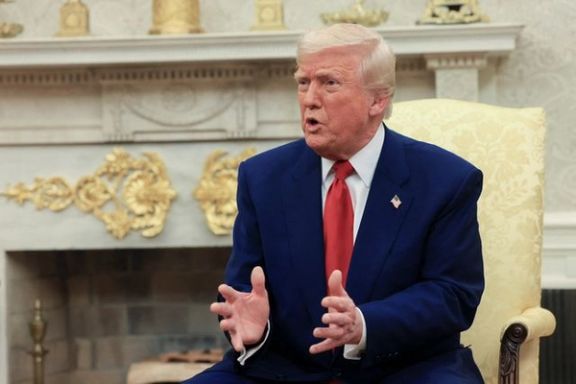
US president Donald Trump talking to reporters at the Oval Office, April 7, 2025
Tehran and Washington have begun direct talks over Iran's nuclear program and will hold a "very big meeting" at a senior level on Saturday, US President Trump said in a surprise announcement on Monday.
“We’re having direct talks with Iran, and they’ve started,” Trump told reporters during an Oval Office meeting with Israeli Prime Minister Benjamin Netanyahu. “It'll go on Saturday. We have a very big meeting, and we’ll see what can happen.”
Officials in Tehran had consistently ruled out direct talks with Washington — until just hours before Trump’s surprise announcement.
The US president said the negotiations are being conducted “almost at the highest level,” brushing aside Iran's public preference for indirect talks.
“A lot of people say, ‘Oh, maybe you’re going through surrogates,’” he said. “No, we’re dealing with them directly.”
The announcement came amid heightened tensions in the region and growing concern in the United States and Israel over Iran’s nuclear activities.
The talks pursued by the Trump administration have been cast as a last-ditch effort to avoid military action.
“I think everybody agrees that doing a deal would be preferable to doing the obvious,” he said. “And the obvious is not something that I want to be involved with, or, frankly, that Israel wants to be involved with, if they can avoid it.”
Trump did not specify what concessions the United States might be willing to offer or what demands it would bring to the table, but his comments suggested a focus on Iran’s nuclear capabilities.
“Iran cannot have a nuclear weapon. That’s all there is,” he said, adding that "it'll be a very bad day for Iran," if the negotiations were to yield no results.
Netanyahu, sitting beside Trump, did not speak at length but nodded as the president spoke. Israel has long been skeptical of diplomacy with Tehran.
The announcement follows weeks of backchannel maneuvering and comes at a moment when both nations face domestic and international pressure.
Iranian officials did not immediately comment on the planned meeting.
Israeli Prime Minister Benjamin Netanyahu will seek to persuade the Trump administration during a visit to Washington to push for the complete dismantling of Iran’s uranium enrichment program, diplomatic sources in the Middle East told Iran International.
Israel believes that if the Islamic Republic is allowed to retain even a small part of its nuclear program, the sources added, it could rapidly resume enrichment once Trump’s presidency ends or anytime it deems conditions favorable.
The diplomats told Iran International that Israel assesses that Tehran’s sole aim in pursuing talks with the United States is to preserve its enrichment program.
The Israeli prime minister is meeting the US president at the White House, with Iran's nuclear issue among the key focuses of their negotiations, according to Netanyahu's office.
Netanyahu will not advise American officials against engaging in negotiations with Iran, the diplomats told Iran International, but he will urge them to make any talks conditional on the enrichment program's total end.
Earlier in the day, Axios reported that Netanyahu believes the chances of a nuclear deal between Tehran and Washington are extremely low but will present to Trump today how "a good deal should look like".
"Netanyahu wants the Libya model. Full dismantling of Iran's nuclear program", the report said, citing an Israeli official referring to a 2003 decision by Libya's leader Muammar Qadaffi to surrender weapons of mass destruction.
The veteran autocrat was deposed and killed in a Western-backed uprising in 2011.
Iran's Foreign Minister Abbas Araghchi said on Sunday that Washington can only dream of an agreement with Iran similar to the 2003 deal with Libya.
His comments came after Republican Senator Tom Cotton said the deal President Trump wants with Iran would be one that neutralizes Tehran's threat completely.
"He prefers a deal like Libya cut with the United States in 2003," Cotton said in an interview posted on X.
Iran's President Masoud Pezeshkian said Tehran remains committed to negotiations but rejected engaging under pressure, signaling no shift in its stance toward the United States as tensions have flared.
“We believe in negotiations, but not at any price,” Masoud Pezeshkian said during a meeting with political party representatives late Sunday, according to the official news agency IRNA.
“We are not seeking war, unrest or nuclear weapons. But how can we talk when the US puts us under maximum pressure and threatens us daily?”
US President Donald Trump has extended an offer to Iran for direct negotiations aimed at addressing concerns over its nuclear program.
But the overture was accompanied by a stern warning: failure to engage would result in bombing "the likes of which they (Iran) have never seen before."
Iran's Supreme Leader, Ali Khamenei, swiftly rejected the proposal for direct talks, deeming them meaningless under the prevailing circumstances. Instead, Tehran expressed openness to indirect negotiations facilitated by intermediaries such as Oman.
In response to the US threats, Iran elevated its military readiness and cautioned neighboring countries against supporting any US military actions, warning of repercussions for neighbors who might facilitate an attack.
The escalation has raised international concerns, prompting nations like Russia to offer mediation.
During the meeting, Pezeshkian added that he had phone conversations with all the regional leaders, saying that Tehran’s relations with these countries have improved significantly compared to the past. However, he distinguished the US as a separate case, citing Washington’s longstanding sanctions and coercive policies.
“We negotiate with the world and we are not looking for conflict,” he said. “But we will not submit to humiliation.”
Pezeshkian once again said Iran's nuclear program is not geared toward military purposes. “This isn’t just my personal assurance,” he said. “It’s a religious ruling by the Supreme Leader.”
In 2003, at the onset of Iran's nuclear crisis, Khamenei first said the production, stockpiling, and use of nuclear weapons are forbidden. Six years later, during a more complex phase of the crisis in February 2008, he announced the prohibition in a public speech.
The fatwa by Ali Khamenei prohibiting nuclear weapons has frequently been cited by Iranian officials as evidence of the peaceful nature of the country’s nuclear activities.
However, critics have pointed out that legal opinions can be reversed and public figures in Iran are more frequently mooting the desirability of seeking a bomb.
The official government newspaper - Iran - said on Monday that Khamenei’s alleged fatwa against atomic weapons does not necessarily ban their production – only their deployment and use.
“The issue of nuclear weapons generally involves three components: production, stockpiling, and use or deployment,” the newspaper wrote—drawing a distinction that is rarely considered meaningful in academic or military discussions on nuclear strategy. The article went on to assert, “In the modern era, the possession of nuclear weapons—rather than their use—is inherently deterrent in nature.”
The government’s official newspaper appears to be suggesting that producing and stockpiling atomic bombs is not a big issue as long as Iran says it has a fatwa prohibiting their use.
Iran's Press Supervisory Board issued a rare warning to the ultra-hardline Kayhan newspaper for threats of assassination against President Donald Trump for the 2020 killing of IRGC's Qasem Soleimani.
The supervisory board announced that it had issued an official warning to Kayhan’s managing editor following the publication of a provocative, anonymous daily column in Kayhan’s Saturday edition, written in a satirical style, that openly supported violent revenge against Trump. The piece mocked the US president’s past threats and invoked Soleimani’s death, declaring, “A few bullets are going to be fired into that empty skull of his.”
The board’s statement reiterated that the Islamic Republic’s official policy regarding revenge for Soleimani is the legal prosecution of his killers, particularly Trump, in an international tribunal.
The rhetoric was escalated further in a follow-up column on Sunday. "The shot hasn’t even been fired yet, and already a bunch of local lackeys and US bootlickers are totally freaking out …They’ve gotten scared because their skulls are as empty as Trump’s," the outlet wrote on Sunday referring to extensive criticisms voiced by public figures on social media.
Trump and several of his aides were placed on an Iranian hit list after Soleimani's killing. However, in recent months, the issue had somewhat faded amid Trump’s renewed 'maximum pressure' campaign and growing calls to renegotiate a new nuclear deal.
Though unattributed, the column, which often voices very controversial views, is widely believed to have been written by Kayhan’s ultra-hardliner editor-in-chief, Hossein Shariatmadari.
As the Supreme Leader’s official representative at Kayhan Publications, Shariatmadari’s statements are often seen—both inside and outside Iran—as indicative of the thinking of at least some elements within Ali Khamenei’s inner circle. He has held the position for 32 years and is widely known for his hardline views, including repeated calls to close the Strait of Hormuz and frequent threats against the United States, Israel, and regional countries such as Saudi Arabia and the United Arab Emirates.
"Such threats ring hollow the demands of Iranian officials for there to be ‘mutual respect’ during future negotiations with the United States," Jason Brodsky, the policy director of United Against Nuclear Iran (UANI), was quoted as saying in an article published by Fox News Digital on Saturday.
“Kayhan has been aligned with the regime’s past plots that US law enforcement has disrupted,” Brodsky added. He urged US officials to make it clear that negotiations are impossible while Iran is “threatening and plotting to kill American citizens.”
Referring to the Fox News article, Iranian media and public figures have widely criticized Kayhan newspaper and Shariatmadari for what they say is very damaging rhetoric to Iran's possible talks with the United States.
A commentary titled “Causing crisis, Shariatmadari style”, published by Rouydad 24 website in Tehran on Sunday, said when Shariatmadari speaks, “the story is different, and it boils down to creating a crisis." Another commentary described his statements as a "shooting diplomacy in the heart".
Ettela’at newspaper, also overseen by Khamenei's office, also sharply criticized Kayhan and other hardline media outlets for advocating nuclear armament, the assassination of Trump, and retaliatory attacks following Israel’s strike on Iran in October. “At such a critical juncture in Iran’s confrontation with the United States, these calls are damaging the credibility and stature of the armed forces and the government in both the media and public opinion,” the commentary said. “If this trend continues, we may find ourselves fighting a domestic fifth column masquerading as super-revolutionaries.”
The recent warning against Kayhan is notably mild compared to actions taken against reformist publications. In these cases, the board has suspended or revoked licenses and referred journalists for prosecution under national security charges. Such unequal enforcement has long fueled criticism that the board operates with double standards, cracking down harshly on reformist voices while tolerating or excusing hardline rhetoric.
Kayhan and Ettela’at, which is also under Khamenei's control, are among Iran’s oldest newspapers.
Both newspapers have a circulation of less than 5,000 and are mainly distributed to government offices, but carry political weight.
Satellite images show that US Navy aircraft carrier USS Carl Vinson has entered the Indian Ocean via the Malacca Strait, marking a step up in the US military's presence in the region amid tensions with Iran, Newsweek reported on Monday.
The report said that the move signals the potential for a more aggressive US stance in the coming days and weeks, amid rising tensions between Iran and Yemen's Houthis which continues to target US vessels amid its blockade of the Red Sea.
The imagery showed that the USS Carl Vinson, originally deployed in the western Pacific, has now moved into the Indian Ocean, on its way to join the USS Harry S. Truman in the Middle East, which has specifically come under fire from the Houthis.
The two aircraft carriers were deployed by Defense Secretary Pete Hegseth, the Associated Press (AP) reported last month citing a US official.
AP's report said that Hegseth signed orders on March 20 to keep the USS Harry S. Truman in the Middle East for at least an additional month and ordered the USS Carl Vinson, which had been operating in the Pacific, to make its way toward the Middle East, extending its scheduled deployment by three months.
The rare deployment intended to bolster US strikes against the Houthis, whose primary benefactor is Iran. This buildup follows persistent Houthi attacks on commercial and military vessels in the Red Sea, which the group frames as a response to the Israeli war in Gaza.
Last month, the US military deployed long range bombers at a strategic Indian Ocean airbase, a spokesperson told Iran International, as Washington ramped up rhetoric against Iran and continued strikes against Houthi fighters in Yemen.
"B-2 Spirit bombers have arrived at Naval Support Facility Diego Garcia," a US Strategic Command spokesperson said, referring to the strategic British territory.
Trump recently said that all military actions carried out by the Houthis will be attributed to Iran, though Tehran denies it controls the group.
The US has launched multiple strikes on Houthi infrastructure, which has stepped up in recent weeks as Trump vows to end the blockade which, while intended to target Israeli-linked ships, has disrupted global shipping on the key maritime route.
Iran is waiting for a decision from the United States on whether to engage in indirect negotiations, foreign ministry spokesman Esmail Baghaei said on Monday.
“We have conveyed our position to the US and are now awaiting their response on entering talks,” Baghaei said.
While US President Donald Trump has recently pushed for direct diplomacy with Tehran, Baghaei said that indirect talks remain Iran’s preferred path for now—but left the door open to future adjustments.
“Decisions will be made in line with conditions and at the appropriate time.”
He confirmed that technical discussions had already taken place covering both nuclear cooperation and sanctions relief.
“There have been exchanges and consultations on various aspects of the matter, including some technical details,” Baghaei said.
Confirming speculation, he finally said Iran will be looking to Oman as a mediator. “Should a new process begin, Oman would be one of the main candidates for this important task,” he added, Oman one of the mediators which helped Iran resume diplomatic relations with Saudi Arabia in 2023.
Baghaei also said the country had given approval for a visit by International Atomic Energy Agency chief Rafael Grossi, who earlier said he hopes to travel to Tehran by late April, showing the country's readiness to cooperate with international nuclear oversight.
Iran has always said its nuclear program is for peaceful purposes. Amid threats from the US to push Tehran into a new nuclear deal or risk being bombed, he added that Iran’s military remains vigilant.
“Our armed forces maintain and upgrade their readiness moment by moment to face any potential scenario,” Baghaei said.
In response to Trump's latest threats, Supreme Leader Ali Khamenei said that the Islamic Republic would deal a "strong blow" in retaliation for any attack.
Iran has also threatened to target American interests in the region, including the strategic US naval base, Diego Garcia in the Indian Ocean, if attacked.