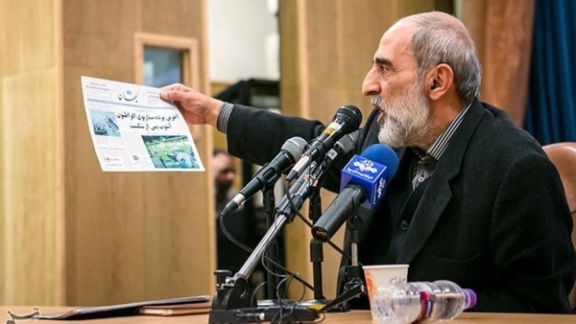
Ultra-hardline managing editor of Kayhan newspaper, Hossein Shariatmadari
Iran's Press Supervisory Board issued a rare warning to the ultra-hardline Kayhan newspaper for threats of assassination against President Donald Trump for the 2020 killing of IRGC's Qasem Soleimani.
The supervisory board announced that it had issued an official warning to Kayhan’s managing editor following the publication of a provocative, anonymous daily column in Kayhan’s Saturday edition, written in a satirical style, that openly supported violent revenge against Trump. The piece mocked the US president’s past threats and invoked Soleimani’s death, declaring, “A few bullets are going to be fired into that empty skull of his.”
The board’s statement reiterated that the Islamic Republic’s official policy regarding revenge for Soleimani is the legal prosecution of his killers, particularly Trump, in an international tribunal.
The rhetoric was escalated further in a follow-up column on Sunday. "The shot hasn’t even been fired yet, and already a bunch of local lackeys and US bootlickers are totally freaking out …They’ve gotten scared because their skulls are as empty as Trump’s," the outlet wrote on Sunday referring to extensive criticisms voiced by public figures on social media.
Trump and several of his aides were placed on an Iranian hit list after Soleimani's killing. However, in recent months, the issue had somewhat faded amid Trump’s renewed 'maximum pressure' campaign and growing calls to renegotiate a new nuclear deal.
Though unattributed, the column, which often voices very controversial views, is widely believed to have been written by Kayhan’s ultra-hardliner editor-in-chief, Hossein Shariatmadari.
As the Supreme Leader’s official representative at Kayhan Publications, Shariatmadari’s statements are often seen—both inside and outside Iran—as indicative of the thinking of at least some elements within Ali Khamenei’s inner circle. He has held the position for 32 years and is widely known for his hardline views, including repeated calls to close the Strait of Hormuz and frequent threats against the United States, Israel, and regional countries such as Saudi Arabia and the United Arab Emirates.
"Such threats ring hollow the demands of Iranian officials for there to be ‘mutual respect’ during future negotiations with the United States," Jason Brodsky, the policy director of United Against Nuclear Iran (UANI), was quoted as saying in an article published by Fox News Digital on Saturday.
“Kayhan has been aligned with the regime’s past plots that US law enforcement has disrupted,” Brodsky added. He urged US officials to make it clear that negotiations are impossible while Iran is “threatening and plotting to kill American citizens.”
Referring to the Fox News article, Iranian media and public figures have widely criticized Kayhan newspaper and Shariatmadari for what they say is very damaging rhetoric to Iran's possible talks with the United States.
A commentary titled “Causing crisis, Shariatmadari style”, published by Rouydad 24 website in Tehran on Sunday, said when Shariatmadari speaks, “the story is different, and it boils down to creating a crisis." Another commentary described his statements as a "shooting diplomacy in the heart".
Ettela’at newspaper, also overseen by Khamenei's office, also sharply criticized Kayhan and other hardline media outlets for advocating nuclear armament, the assassination of Trump, and retaliatory attacks following Israel’s strike on Iran in October. “At such a critical juncture in Iran’s confrontation with the United States, these calls are damaging the credibility and stature of the armed forces and the government in both the media and public opinion,” the commentary said. “If this trend continues, we may find ourselves fighting a domestic fifth column masquerading as super-revolutionaries.”
The recent warning against Kayhan is notably mild compared to actions taken against reformist publications. In these cases, the board has suspended or revoked licenses and referred journalists for prosecution under national security charges. Such unequal enforcement has long fueled criticism that the board operates with double standards, cracking down harshly on reformist voices while tolerating or excusing hardline rhetoric.
Kayhan and Ettela’at, which is also under Khamenei's control, are among Iran’s oldest newspapers.
Both newspapers have a circulation of less than 5,000 and are mainly distributed to government offices, but carry political weight.
Satellite images show that US Navy aircraft carrier USS Carl Vinson has entered the Indian Ocean via the Malacca Strait, marking a step up in the US military's presence in the region amid tensions with Iran, Newsweek reported on Monday.
The report said that the move signals the potential for a more aggressive US stance in the coming days and weeks, amid rising tensions between Iran and Yemen's Houthis which continues to target US vessels amid its blockade of the Red Sea.
The imagery showed that the USS Carl Vinson, originally deployed in the western Pacific, has now moved into the Indian Ocean, on its way to join the USS Harry S. Truman in the Middle East, which has specifically come under fire from the Houthis.
The two aircraft carriers were deployed by Defense Secretary Pete Hegseth, the Associated Press (AP) reported last month citing a US official.
AP's report said that Hegseth signed orders on March 20 to keep the USS Harry S. Truman in the Middle East for at least an additional month and ordered the USS Carl Vinson, which had been operating in the Pacific, to make its way toward the Middle East, extending its scheduled deployment by three months.
The rare deployment intended to bolster US strikes against the Houthis, whose primary benefactor is Iran. This buildup follows persistent Houthi attacks on commercial and military vessels in the Red Sea, which the group frames as a response to the Israeli war in Gaza.
Last month, the US military deployed long range bombers at a strategic Indian Ocean airbase, a spokesperson told Iran International, as Washington ramped up rhetoric against Iran and continued strikes against Houthi fighters in Yemen.
"B-2 Spirit bombers have arrived at Naval Support Facility Diego Garcia," a US Strategic Command spokesperson said, referring to the strategic British territory.
Trump recently said that all military actions carried out by the Houthis will be attributed to Iran, though Tehran denies it controls the group.
The US has launched multiple strikes on Houthi infrastructure, which has stepped up in recent weeks as Trump vows to end the blockade which, while intended to target Israeli-linked ships, has disrupted global shipping on the key maritime route.
Iran's ultra-hardliners and vigilantes associated with them are increasingly warning that the Islamic Republic risks alienating its staunchest supporters if authorities continue suspending strict hijab enforcement.
In a viral video circulating on social media last week, ultra-hardliner lawmaker Mohammad-Mannan Raisi blasted the Supreme National Security Council (SNSC) for its mid-September decision to halt the implementation of the proposed Hijab and Chastity Law.
The proposed law had been slammed globally for its draconian measures, the UN branding it "gender apartheid".
“The new hijab law marks an intensification of state control over women’s bodies in Iran and is a further assault on women’s rights and freedoms,” the UN said at the time.
Raisi argued that the clerical rule’s “solid core” supporters have endured severe economic hardship out of loyalty to the Islamic Republic, expecting it to uphold the Sharia law. However, by showing indifference to religious beliefs and values, he claimed, authorities are behaving like a secular government and eroding trust among their most devoted base.
“The solid core of the system will be disillusioned if you suspend God’s commandments and fail to implement them based on unjustified expediency,” Raisi warned, suggesting these loyalists could lose their motivation to defend those in power whom they hold responsible for enforcing the Sharia.
The decision of the Supreme National Security Council (SNSC) not to enforce the controversial law could not have been made without the approval of Supreme Leader Ali Khamenei, who has avoided discussing the issue in his speeches for months despite his firm stance in April 2023, declaring that disregarding hijab was “religiously and politically haram (forbidden).”
Authorities appear to be treading carefully, as enforcing the controversial law—punishing violators, including businesses, with hefty fines and prison sentences—could spark fresh anti-government protests.
Defiance of hijab rules has significantly grown among Iranian women since the violently suppressed 2022-2023 protests that followed the death of the 22-year-old Mahsa Amini in the custody of morality police.
The young woman was arrested for not wearing her hijab properly, leading to a tidal wave of opposition to the decades-long law.
Many women now refuse to wear the compulsory head covering, long tunics, and trousers as dictated by the country's Shariah law. They are also now often seen singing and dancing in public in defiance of the religious establishment.
The crackdowns, which led to more than 500 deaths of protesters at the hands of security forces during the initial uprising, and thousands more arrests, have seen Iran levied with global sanctions, which come in addition to sanctions for its nuclear program and support of Russia's invasion of Ukraine.
Sanctions have seen Iran land in its worst economic crisis since the founding of the Islamic Republic, at least one-third of the country now living below the poverty line, and Iran increasingly isolated on the world stage.
Raisi, who led hardliner Saeed Jalili’s campaign in Qom during June’s snap presidential election, is closely aligned with the ultra-conservative Paydari (Steadfastness) Party and its allies, including Jebhe-ye Sobh-e Iran (Iran Morning Front).
His remarks came just days after an unprecedented police crackdown on pro-hijab vigilantes who had camped outside the Iranian parliament for over 45 days. While no arrests were reported, religious vigilante groups claim police used excessive force—an unexpected turn for those who have long operated with impunity and, at times, direct security force backing.
Hossein Allahkaram, a spokesman for the pro-hijab protesters, condemned the police response and vowed that demonstrations would resume after the Iranian New Year holidays.
Vigilante groups have historically played a key role in suppressing opposition movements and even participated in high-profile attacks like the storming of the British embassy in 2011 and the Saudi embassy in 2016—both of which triggered diplomatic crises.
Raisi’s warning has ignited intense debate on social media, with critics, particularly supporters of Parliament Speaker Mohammad-Bagher Ghalibaf, accusing him of issuing veiled threats against the authorities.
So far, most expressions of frustration from vigilante groups are directed at top officials. However, there are also some highly veiled complaints over Khamenei's silence, or approval, of the relative leniency shown in the hijab matter on domestic social media platforms such as Eitaa, a popular forum among ultra-hardliners and their associates.
Their waning influence has not gone unnoticed by those opposing their interference in national governance.
Former IRGC commander turned reformist figure, Ghorbanali Salavatian, wrote in an X post, “They constantly call themselves the ‘solid core’ of the system, as if the country would collapse without them and as if they alone have protected it".
Iran’s Foreign Minister Abbas Araghchi said on Saturday that the removal of US sanctions could serve as a confidence-building measure to pave the way for negotiations with Washington.
Speaking to foreign diplomats in Tehran, Araghchi’s remarks marked a re-emphasis on a position Iranian officials have frequently taken since the US withdrawal from the 2015 nuclear deal (JCPOA) in 2018. It is unclear whether his comments signaled a policy shift or were intended to test the international response ahead of any potential talks.
Following the US exit from the JCPOA under President Donald Trump, senior Iranian officials, including then-Foreign Minister Mohammad Javad Zarif and Supreme Leader Ali Khamenei, maintained that Tehran would not enter into new negotiations unless sanctions were lifted or the US returned to the deal. That stance remained largely consistent throughout the Trump administration’s “maximum pressure” campaign.
Now, with Trump back in office and reportedly considering a tougher approach—including military threats—Iran’s renewed insistence on lifting sanctions before any negotiations may be seen either as a negotiating tactic or as a reaffirmation of a long-standing position.
It is not yet known whether this demand was included in the official letter Tehran sent to President Trump recently. Public discourse has increasingly focused on the format of possible talks, with Iranian officials emphasizing their preference for indirect negotiations over face-to-face meetings. Analysts suggest this preference could be driven by both domestic political considerations—such as preserving the government's image after years of hostile rhetoric toward Trump—and strategic calculations, including buying time in the hope that future developments may shift the diplomatic landscape.
Insisting on sanctions relief as a precondition could also function as a means of slowing down the diplomatic process, allowing Tehran to manage expectations and retain leverage. While such a stance could be seen as obstructive, it may also be calculated to prompt a measured response from Washington. Notably, the Biden administration, which preceded Trump’s return, took a more restrained approach to sanctions enforcement even before formal nuclear talks resumed in April 2021.
Iranian oil exports to China began to rise prior to the 2020 US election and have remained high into 2024. This trend may factor into Tehran’s thinking, with the possibility that pressing the issue of sanctions could influence US decision-making or encourage a pause in new restrictions as a way to facilitate dialogue.
Iran’s ultra-hardline Kayhan newspaper, managed by a representative of the Supreme Leader, has repeated weekend calls to assassinate US President Donald Trump to avenge the 2020 killing of IRGC commander Qassem Soleimani.
On Sunday, the daily expressed support for what it described as revenge for the drone strike in Iraq, ordered by Trump during his first time in office, just one day after a piece had warned "a few bullets are going to be fired into that empty skull of his".
"The shot hasn’t even been fired yet, and already a bunch of local lackeys and US bootlickers are totally freaking out,... since their skulls are as empty as Trump’s, they’ve gotten scared," the outlet wrote on Sunday.
Since the assassination, Trump and several of his aides were put on a hit list but the issue of Soleimani's killing had been somewhat dulled down in recent months amid Trump's renewed campaign of 'maximum pressure' and calls to make a fresh nuclear deal.
The column, presented as a fictional conversation, called advocates of nuclear talks with the US “America’s bootlickers”. Iran's Supreme Leader continues to refuse to engage in direct talks, but has warmed to the idea of using mediation in the wake of Trump's warning that if a new nuclear deal is not reached within two months, the US will bomb Iran.
The former head of the Parliament's National Security Committee reacted to the newspaper's piece on Saturday, criticizing it as inflammatory while the situation remains so volatile.
Heshmatollah Falahatpisheh wrote on X, “Iranians hate those who promote war and terrorism. If you had the courage for war, you would’ve gone to Lebanon. If you have an assassination plan, don’t attribute your recklessness to Iran.
“The nation pays the price for the extremists’ warmongering and terroristic bluffs. The government must disavow this destructive movement.”
Tabnak website also criticized the article, warning of its costs to a nation already suffering a social and economic crisis.
"A newspaper, which happens to be state-affiliated, is publicly promoting a slogan whose cost will ultimately be paid by the people. It seems that if these ultra-revolutionary individuals truly have the motivation to sacrifice for the country, there are plenty of real opportunities to demonstrate that sacrifice," it wrote.
The paper said assassinating Trump would be “a good thing and would bring joy to Palestinians” and armed groups.
The US continues to confront Iran's Houthi militia in Yemen in the Red Sea region amid the group's maritime blockade on commercial shipping.
Ordered by the Supreme Leader in 2023 as a means to target Israeli shipping in order to force a ceasefire in Gaza, the blockade has since affected global shipping, with Trump vowing to tackle the group head on.
A new US THAAD aerial defense battery has been supplied to Israel amid President Donald Trump's threats of military action against Iran unless it agrees to a nuclear deal.
An extremely heavy American military cargo plane, a C-5M Super Galaxy, landed at Israel's Nevatim airbase in the south of the country on Saturday.
Flight trackers such as MenchOsint reported that the plane, which is capable of carrying the THAAD air defense systems, stayed at Nevatim for around eight hours.
The first THAAD system was given to Israel in October, in the wake of two attacks from Iran as the once long-time shadow war came to the fore.
The existing THAAD system has been used by Israel in recent weeks to defend against ballistic missiles fired at the Jewish state by Iran's Houthis in Yemen.
An Israeli intelligence source, speaking on condition of anonymity, told Iran International that the THAAD system had indeed arrived this weekend.
The delivery was first reported in the Saudi Arabian Al-Hadath channel and then across Israeli media, though it has not been publicly confirmed by either the US or Israel. Iran International has approached Israel's military for comment.
Last month, Trump told Iran it must reach a nuclear deal or risk being bombed. While the president said he prefers diplomatic means, he said a military solution will be used if Tehran does not cooperate within two months.
Iran's Supreme Leader Ali Khamenei continues to refuse direct negotiations but he and the president, Masoud Pezeshkian, have said the country is open to mediation.