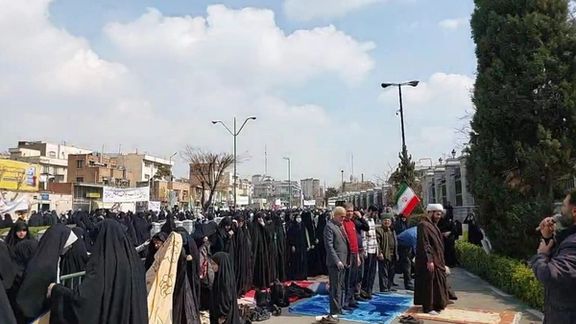
Hijab protesters pray outside the Parliament during rally
Conservatives farther to the right even of Iran's Supreme Leader Ali Khamenei have become more assertive in their demands to implement a new restrictive hijab law which has been stalled for months.
During a speech on Saturday, Khamenei appeared to avoid responding to an ultra-hardline lawmaker who interrupted the session to ask Iran's ultimate authority on religion and policy why the hijab law had not come into force.
The situation turned awkward when Mohammad-Taghi Naghdali attempted to move closer after Khamenei said that he could not hear him and the veteran theocrat's security guards swiftly led him away to the back of the audience.
Enforcing the morality legislation - which imposes harsh penalties including heavy fines and prison sentences on women who violate strict hijab rules and on businesses that fail to comply - could be highly provocative in the current climate and risk sparking anti-government protests.
In an unprecedented move, lawmaker Mahmoud Nabavian, a member of the ultra-hardline Paydari Party, attempted to distance himself from those he labeled radicals following recent protests outside the Parliament by hardliner vigilantes.
Nabavian accused these radicals of deepening societal divisions and provoking those who oppose mandatory hijab.
“Calling for nationwide protests over [the imposition of hijab] aligns with the enemy’s plans to incite unrest in the country,” he wrote. More significantly, he suggested that these radicals are using social media to directly draw Khamenei into the issue.
Khamenei has conspicuously avoided addressing the hijab issue in his speeches in recent months, including during his December 17 address to an all-female audience.
However, in April 2023, he had taken a firm stance, declaring that disregarding hijab was “religiously and politically haram (forbidden).” In the same speech, he accused foreign intelligence agencies of encouraging Iranian women to defy the mandatory hijab.
A woman in Karaj, near Tehran, arguing with a hijab enforcer in 2024
Currently, most expressions of frustration from vigilante groups toward Khamenei are veiled and circulated on domestic social media platforms such as Eitaa, a popular forum among ultra-hardliners and their associates.
Earlier this week, a small group of female vigilantes staged a rally in the religious city of Qom outside the office of Ayatollah Abdollah Javadi-Amoli, a prominent grand ayatollah recently praised by Khamenei for his scholarly contributions to seminaries.
The rally’s speaker criticized grand ayatollahs for their silence regarding the delayed enforcement of the hijab law. Such direct criticism of senior clerics, particularly those aligned with state ideology, is rare and highly frowned upon.
A widely circulated social media post anonymously criticizing Khamenei for the Supreme National Security Council’s (SNSC) decision in September to shelve the controversial new hijab law has sparked controversy.
Some of Khamenei’s own loyalists have shared the post, interpreting it as an act of disrespect toward the Supreme Leader.
Although the SNSC is chaired by the president, its decisions require Khamenei’s endorsement to be implemented.
This faction played a key role in drafting the controversial hijab law and supports former nuclear negotiator Saeed Jalili, their preferred candidate in the June snap elections.
Despite their professed allegiance to Khamenei, ultra-hardliners strongly back Mohammad-Mehdi Mirbagheri, a mid-ranking cleric known for his extreme religious and political views, particularly on the hijab issue.
Small groups of vigilantes have staged protests after Friday prayers several times in recent months. A dozen women held a sit-in outside the Parliament, erecting makeshift shelters to demand the hijab law’s implementation.
Their protests intensified this week as hundreds were bused in from other cities to join the demonstrations outside Parliament. Unlike other political protests, security forces did not attempt to disperse the roughly 1,500 protesters gathered on Tuesday.
The growing assertiveness of vigilante groups has raised concerns even among conservatives.
Criticizing the “super-revolutionary Paydari associates” for their rigid stance on the hijab law, the conservative Tabnak news website warned on Wednesday that they “are striving to create new challenges for the administration and, perhaps, from an analytical and in-depth perspective, exert pressure on the governance.” In Iranian political discourse, the term “governance” is often used to indirectly refer to Khamenei and the policies he dictates to top officials.
Foreign Minister Abbas Araghchi’s suggestion on Thursday about pursuing indirect talks with the United States may signal a sudden shift in Supreme Leader Ali Khamenei’s previously uncompromising stance on negotiations.
This apparent change came shortly after Tehran acknowledged receiving a letter from President Donald Trump, which reportedly outlined the terms of a possible agreement on Iran’s nuclear program and, potentially, other issues, including Tehran’s regional proxies.
As these developments gain momentum, many seem to have overlooked Iran’s scheduled participation in trilateral negotiations with Russia and China in Beijing on Friday. Meanwhile, Russia’s offer to mediate between Tehran and Washington remains on the table, with neither side having rejected it thus far.
Araghchi’s suggestion that indirect negotiations would be a “natural solution” for reaching a deal with Washington may also indicate that Iran is aiming to buy time. The strategy could be to push past the October deadline for the reactivation of the UN trigger mechanism, which would reinstate all previous international sanctions against Iran. Additionally, Iran may be looking ahead to the 2028 US election, hoping to outlast the Trump administration, with which it remains reluctant to engage in direct talks.
Araghchi’s suggestion of Oman as a possible mediator may lead observers to overlook why Qatar, the UAE, and possibly Russia have been sidelined as potential mediators—and why Tehran is now proposing indirect talks in Muscat.
Qatar’s leaders may already be preoccupied with issues related to Gaza, Syria, and Afghanistan, leaving little capacity to take on another complex diplomatic challenge. At the same time, Iran’s handling of Qatar’s recent mediation efforts suggests a degree of distrust. When the Qatari emir delivered a message to Tehran earlier this month, Khamenei largely dismissed it, instead questioning why Qatar has not released Iran’s oil revenues from South Korea frozen in Doha under a US arrangement.
Meanwhile, Iran is unlikely to trust the UAE as a diplomatic intermediary, given its close alliance with Saudi Arabia and the ongoing territorial dispute over three islands in the Persian Gulf.
Furthermore, many politicians in Tehran, including Heshmatollah Falahatpisheh, the former head of the parliament's Foreign Policy and National Security Committee, as well as several centrist and conservative newspapers such as Jomhouri Eslami, have repeatedly questioned Moscow's goodwill as a mediator. They argue that Russia is primarily focused on its own interests rather than genuinely helping Iran navigate a major foreign policy and economic crisis.
Notably, Nour News, a media outlet close to Iran’s Supreme Council of National Security, revealed that Russia refused to deliver Trump's message to Tehran, reportedly objecting to its content. Instead, Moscow passed the task on to the UAE.
At the same time, Iranian officials see indirect negotiations as an effective way to buy time and wait for a more favorable international climate. With the Iranian delegation in one room and US representatives in another, and Omani mediators shuttling messages between them, the process could stretch on for months, if not years. Meanwhile, shifting developments and ad-hoc decisions in Tehran and Washington could continuously delay and extend the talks.
Iranian media have made it clear over the past week that China and Russia have little interest in finalizing a deal between Tehran and Washington. Meanwhile, the low level of officials participating in the upcoming talks further diminishes any hope for a breakthrough.
Instead of sending a senior negotiator like career diplomat Majid Takht-Ravanchi, Iran is dispatching Deputy Foreign Minister Kazem Gharibabadi to Beijing—a lower-profile figure with less influence to advance the discussions.
Whether Iran can navigate multiple diplomatic channels to buy time remains uncertain. Its ability to do so depends on whether it can manage the country’s worsening economic crisis, stave off a major socio-political upheaval, and counter the growing pressure from European countries, some of which have signaled their intent to activate the UN trigger mechanism—all while the clock continues to run out.
Supreme Leader Ali Khamenei rejected US President Donald Trump’s overture for a deal with Tehran even before opening Trump’s letter. Still, like commentators and diplomats in Iran and abroad, he was likely aware of its contents.
Around the same time Khamenei was speaking in Tehran on March 12, Iranian and Russian sources revealed that Trump’s proposal was not limited to the nuclear issue, as Iran had expected, but also included discussions on Iran’s regional proxy groups.
While Iranians traditionally view negotiations as a lengthy process of bargaining, much like haggling over a carpet in the bazaar, Trump’s approach appears more like a spring storm—starting with thunder and lightning, followed by a brief but intense downpour, before quickly subsiding into calm.
Former Iranian diplomat Kourosh Ahmadi, in an article in Shargh newspaper, wrote that Khamenei’s earlier refusal to engage with the United States—widely interpreted as a rejection of negotiations—was not fundamentally different from remarks by Iran’s envoy in New York, Saeed Iravani. Iravani stated that "if negotiations are meant to address concerns about the militarization of Iran’s nuclear program, such talks are possible."
Ahmadi added that Iravani’s remarks show a change and indicate a new development in Iran’s position. This comes while Khamenei had stressed that negotiation over “Iran’s defense capabilities, its international power and the range of its missiles and so on will certainly not be accepted."
Nonetheless, the former diplomat noted that “the nuclear issue is by far Trump’s most important, and possibly his only, priority” when it comes to Iran. Ahmadi argued that the United States recognizes Iran’s regional proxies have been significantly weakened and that restoring their previous strength is no longer feasible. Additionally, he pointed out that both Iran’s neighbors and Washington understand that Iran’s missiles have a limited range and that its regional presence is largely justified by the absence of a conventional air force.
In another development, centrist politician Ezzatollah Yousefian Molla told the conservative Nameh News website that "Trump will gradually retreat from his current positions." He added that Iran has no issue with logical negotiations and realistic demands but emphasized, "If the other side intends to impose its views, that can no longer be called negotiation."
Several other politicians and commentators also stated last week that most of Trump’s threats are mere "bluffs." Yousefian Molla argued that Trump will walk back his more extreme proposals, recognizing that preventing war serves everyone's interests. He also claimed that "Trump understands that engaging in an all-out war is not in the United States’ interest, as Iran would respond forcefully to any military conflict."
However, Iranian academic Kiumars Yazdanpanah warned that "both Iranian and US officials have adopted increasingly confrontational stances, making the possibility of an actual conflict quite real. At this moment, conflict appears to be the most likely outcome."
Yazdanpanah outlined three possible scenarios for the near future. First, he suggested there could be limited military exchanges between Iran and the United States, with one or two swift retaliatory actions. The second scenario, he said, is a temporary state of war, in which the US launches extensive military strikes against Iran while simultaneously working to isolate the country, incite unrest, and exploit geopolitical tensions. The third possibility, according to Yazdanpanah, is that the current standoff—whether through continued escalation or negotiation—leads to a compromise aligned with both sides’ national interests, potentially facilitated by international mediation.
He added that Saudi Arabia is best positioned to act as a mediator and help prevent a war between Iran and the United States. However, he emphasized that regardless of whether a conflict occurs, Iran must rethink its current regional strategy.
Iran’s Supreme Leader on Wednesday said President Trump's past withdrawal from a nuclear deal renders diplomacy with him pointless now and vowed harsh retaliation to any attack by the United States or its allies.
"The US President saying 'we are ready to negotiate with Iran' and calling for negotiations is meant to deceive global public opinion," Khamenei said in a speech to student supporters who per usual practice repeatedly chanted "death to America!"
The remarks by Iran's veteran theocrat were a rare barbed commentary on the policies of an individual US President and again strongly rejected Trump's fresh overtures for a new agreement.
"What’s the point of negotiating when we know he won’t stick with it," Khamenei said, referring to a 2015 international nuclear deal from which Trump withdrew after bashing it as too lenient on Iran.
"We sat down and negotiated for several years, and this very person took the completed, finalized and signed agreement off the table and tore it up."
Iran denies seeking a nuclear weapon but the UN's nuclear watchdog last week pointed to a sharp rise in Tehran's stockpile of highly enriched uranium.
"If the Islamic Republic intended to build nuclear weapons, the United States would not be able to stop it," Khamenei added, again saying Iran had decided against seeking a bomb.
As he delivered his speech, an Emirati diplomat arrived in Tehran carrying a direct letter from Trump to Khamenei urging talks. "I have not received the letter that the US president claims has sent," Iran's supreme leader said.
President Trump revealed on Friday that he had sent a letter to Khamenei offering negotiations while warning of military action if talks failed.
“There are two ways Iran can be handled: militarily or through a deal. I would prefer to make a deal," Trump told Fox Business Network.
Trump later added that the standoff with Iran had reached a critical stage: “We are at final moments with Iran."
Khamenei said Washington would come off the worst if it attacked Iran.
"The United States is threatening militarization. In my view, this threat is irrational because war is not a one-sided blow; Iran is capable of retaliating and will certainly do so," he said.
"If the Americans or their allies make a wrong move, they will be the ones to suffer the greater loss."
Israel sees Iran's nuclear sites as more vulnerable than ever after Oct. 26 Israeli air strikes on its air defenses, defense minister Israel Katz said in November.
Iran's arch-foe sees Tehran's perceived weakness and Trump's hawkish stance providing a window for an attack on the nuclear program it views as an existential threat, according to US intelligence assessments cited by the Wall Street Journal and Washington Post.
Iran stands alone
Khamenei proudly declared in his speech that Iran was the sole holdout in resisting the demands of the world's bullies.
"Today, the world's bullies say everyone must obey us and must put our interests ahead of their own, but Iran is the only country that has categorically rejected this." Khamenei said in a speech to student supporters.
Iranian officials have cited a blowup between Trump and Ukraine's President Volodymyr Zelenskyy in the White House as a sign of the United States' fickleness and bullying on the world stage.
Khamenei, a champion of defying the West and Israel, has repeatedly ruled out talks with the United States since Trump took office.
Addressing Iran's dire economic straits, Khamenei appeared to dismiss hopes from political moderates including his own president Masoud Pezeshkian that a diplomatic breakthrough could ease punishing US-led sanctions.
"If the goal of negotiations is to lift sanctions, negotiating with this US government will not remove them. Rather, it will tighten the knot."
"Sanctions are not without impact, but if our economic situation is struggling, it is not solely because of sanctions. Our own negligence also plays a role," he added, saying domestic ingenuity could mitigate sanctions' pain.
The Islamic Republic, he insisted, had not been weakened by the deaths and killings of key political and military figures in recent years.
Over a year of punishing direct and regional combat pitting US-armed Israel against Iran and its militant allies in the Middle East has hollowed out Iran's influence and may have dealt its geopolitical standing a historic setback.
"This year, in some matters, we are stronger than last year," the Supreme Leader said.
Criticism of President Masoud Pezeshkian is no longer confined to his political rivals, whom he sought to appease by allocating many cabinet positions. Even the Reformist faction is growing frustrated with his lack of direction and inaction.
In a YouTube debate on good governance, both Reformist commentator Payam Borazjani and hardline conservative figure Saeed Ajorlou criticized President Pezeshkian for inaction and inefficiency. Ironically, Borazjani faulted the president for attending a meeting on potato prices instead of addressing deeper structural flaws in the economic system.
Elsewhere in the debate, Borazjani remarked, "The President's office still has a helicopter in a shelter at the airport, and this country is full of mountains," in what appeared to be an allusion to former President Ebrahim Raisi's sudden death in a helicopter crash last year. Some speculate that Raisi’s death was not accidental but rather a move to sideline him due to his ineffectiveness.
Borazjani said that Reformists had high expectations of Pezeshkian, when after Raisi’s death he announced his candidacy, but he has let down and disappointed everyone.
While Pezeshkian is viewed as an ineffective president amid the country’s deep economic crisis, some argue that the crippling US sanctions are beyond his control and that he lacks the authority to negotiate or reach a nuclear agreement with Washington.
Although President Donald Trump has demanded talks, Supreme Leader Ali Khamenei last month ruled out any negotiations, and officials cited Trump’s threats as a reason for Tehran’s refusal to negotiate.
Tehran University academic Kiumars Yazdanpanah argued in an article on the conservative Nameh News website that the deadlock in negotiations with the United States is not merely a result of Trump's pressure, as officials claim.
"The political impasse within Iran is just as significant as its isolation on the international stage," Yazdanpanah stated. He further suggested that the government should seek an alternative path out of the crisis—one that avoids both war and an imposed agreement.
The academic criticized Pezeshkian and other Iranian politicians for dwelling on missed opportunities to revive the 2015 nuclear deal instead of seeking new solutions. He also faulted the government for adopting a confrontational approach rather than maintaining its earlier push for rapprochement, which was abandoned after Khamenei ruled out negotiations with Washington.
Meanwhile, politicians and media commentators continue to criticize Pezeshkian's national reconciliation initiative. Some, including Borazjani and Ajorlou, argue that his efforts are limited to reconciling with his hardliner rivals.
Others, such as reformist commentator Ahmad Zeidabadi, maintain that "reconciliation has not succeeded and is unlikely to succeed, even between the parliament and the administration."
On Monday, media reports indicated that parliament has summoned 11 of Pezeshkian's cabinet ministers, demanding explanations about their performance. This marks the first formal step in any impeachment process. By Tuesday, reports suggested that at least one minister, Labor Minister Ahmad Maydari, had failed to satisfy lawmakers with his responses, making it likely that his case will advance to an impeachment motion following a review by the Majles Economic Committee.
Meanwhile, reformist cleric Rassoul Montajabnia told Khabar Online that the ultraconservative Paydari Party is determined to unseat Pezeshkian. However, as demonstrated by the March 2 vote to dismiss minister of economy Abdolnaser Hemmati, opposition to Pezeshkian in parliament extends far beyond Paydari, whose numbers, even in the most optimistic estimates, do not exceed 100 MPs.
Former lawmaker Jalal Mahmoudzadeh commented on Instagram that following the impeachment of Hemmati and the forced resignation of Vice President Javad Zarif, "opponents of the administration now hold 75 percent of the posts in Pezeshkian's cabinet, while radicals control key economic institutions. If the administration does not rethink its approach to reconciliation, it should brace for even more difficult days ahead."
Iran's President Masoud Pezeshkian lambasted US President Donald Trump's threat of military action if Tehran did not come to a nuclear deal, saying the Islamic Republic would not be forced to negotiate.
"What (Trump) did to that Zelensky is truly shameful," the relative moderate president said, referring to an oval office scrap between Trump and the Ukrainian president - Washington's erstwhile wartime partner.
Iranian officials have cited the blowup as a sign of the United States' fickleness and bullying on the world stage. Tehran has resisted Trump's overtures for a new deal over its nuclear program and its Supreme Leader Ali Khamenei has ruled out talks.
"It is unacceptable to say, ‘We give orders to do this (or) not to do that," Pezeshkian said. "I will not come to (negotiate with you). Do whatever the hell you want!"
Faced with deepening economic malaise wrought by US-led sanctions, Pezeshkian had repeatedly advocated for talks with Washington to chip away at Iran's isolation and mitigate deepening financial pain which threatens unrest.
Khamenei, Iran's top decision-maker, has repeatedly rejected the notion after insisting the United States cannot be trusted.