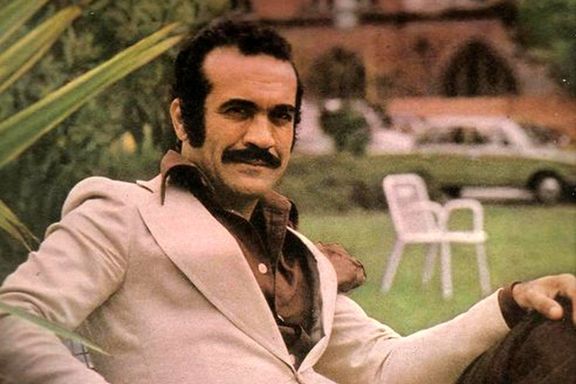
Germany’s Federal Prosecutor says the investigation into the 1992 murder of dissident Iranian singer Fereydoun Farrokhzad remains open, following claims by an ex-IRGC official that the Islamic Republic ordered the killing in Bonn.
Mohsen Rafiqdoost, a founding member of the Islamic Revolutionary Guard Corps (IRGC) and its minister from 1980 to 1999, recently described his role in funding covert operations abroad. His statements indicated that Iran was directly involved in orchestrating political assassinations beyond its borders, including the 1992 murder of Farrokhzad in Bonn, Germany.
Ines Peterson, a spokeswoman for the German Federal Prosecutor, told Iran International that “I can only inform you that the case of Mr. Fereydoun Farrokhzad is not closed, but still under investigation. As a rule, however, we do not comment on details or alleged suspects. Likewise, we do not comment on motions or requests made by third parties to our office. Therefore, I can only confirm that we have received the email you have mentioned.”
The E-mail that Peterson referenced was a letter sent by the German-Iranian activist Behrouz Asadi from the group Forum Woman, Life, Freedom.
The group urged the Federal Prosecutor, Jens Rommel, “to intensify the criminal investigation into these matters – regardless of political considerations. It is of utmost importance that the Federal Prosecutor's Office exhaust all legal means at its disposal to identify those responsible, hold them criminally accountable, and take appropriate measures to protect democracy and public security in Germany.”
The German Federal Criminal Police Office (BKA) proposed, according to a 2024 report by North German Broadcasting, the theory that Iran’s government executed Farrokhzad because he mocked Iran’s religious leaders during his concerts. The BKA reported said Farrokhzad said during one concert appearance that he had sex with Islamic clerics.
Farrokhzad, who publicly declared his homosexuality at a time when many gay entertainers remained in the closet, frequently ridiculed the Islamic government's restrictions on sexuality.
German-Iranians have long criticized the authorities in the Federal Republic for showing no appetite to solve Farrokhzad's murder case.
Asadi continued that “There is increasing evidence that the IRGC is directly involved in the planning, organization, and execution of assassinations and attacks against opposition figures and dissidents in Europe,” especially in Germany and France, the statement notes. It highlighted the 1992 killing of Farrokhzad as a particularly serious case, adding that legal proceedings are still pending.
When questioned about Farrokhzad’s murder in Bonn, a spokesman for the prosecutor’s office for the former capital of Germany, Martin Kriebisch, told Iran International “The exclusive responsibility for any statements concerning your inquiry is with the Federal Public Prosecutor General, so I kindly ask you again to address further inquiries directly there.”
Kriebisch initially sent Iran International’s press query to the Munichprosecutor’s office, which replied that the crime was in Bonn and Munich would be the wrong place to refer to.
Asadi’s letter added that “ In particular, there are statements indicating that high-ranking IRGC representatives—including Mohsen Rafiqdoost - were directly involved in the planning and execution of this crime. In several interviews, he has spoken openly about the elimination of opposition figures, particularly the targeted killing of Mr. Farrokhzad.”
Mina Ahadi, a German-Iranian dissident who is slated to start a speaking tour this month in the US, brought up the case of Iran’s former ambassador to Germany, Seyed Hossein Mousavian, who is currently a researcher at Princeton University, and called for his arrest by authorities because of his alleged role in the murder of Farrokhzad.
Mousavian wrote on X that “After reading the interview with Mohsen Rafiqdoust, ex-IRGC minister, I was stunned, amazed, and shocked...At that time, I was the Iranian Ambassador to Germany, and along with my colleagues at the embassy, I made extensive efforts for the return of Iranians residing in Germany who wanted to return to Iran.”
Iran International reported that Mousavian allegedly played a role in the assassinations of more than 20 Iranian dissidents in Europe in the 1990s, including Farrokhzad. Mousavian, who was Iran’s ambassador to Germany from 1990 to 1997, has vehemently denied the allegations that he was involved in the mass assassination of Kurdish dissidents at the Berlin restaurant Mykonos in 1992.
The former high-level Islamic Republic of Iran intelligence agent, Abolghasem Mesbahi, said during the Mykonos trial in 1997 that "Mr. Mousavian had a role in most of the assassinations committed in Europe."
AAIRIA organized a protest in at Princeton in April 2024 to demand Mousavian’s dismissal. Mousavian and Princeton University’s President Christopher Eisgruber refused to answer multiple Iran International press queries about Farrokhzad.
Iran’s president said Wednesday the country has never sought nuclear weapons, as officials marked National Nuclear Technology Day with a showcase of domestic achievements, days ahead of renewed talks with the United States.
“We do not want a nuclear bomb and never have,” President Masoud Pezeshkian said at a ceremony in Tehran. “We seek peace, security and dialogue — but dialogue rooted in dignity and independence. We will not retreat from our scientific and technological achievements.”
The president spoke at an exhibition of nuclear developments, where he inaugurated several new projects. He criticized Western powers for what he called leading the world into “war and destruction under the banner of civilization and peace,” and insisted Iran would not allow others to dictate its path.
Atomic Energy Organization head Mohammad Eslami said Iran was entering a new phase of nuclear development, including the production of medical radioisotopes and advancements in agriculture and power generation.
“Despite all threats and sabotage, our scientists are moving forward stronger than ever,” Eslami said.
In a separate statement, the Iranian parliament’s National Security and Foreign Policy Commission warned that “any threat to the peaceful nuclear industry will face a serious, decisive and destructive response.” The statement reiterated Iran’s right to nuclear technology under the Non-Proliferation Treaty.
The comments come as Iranian and US negotiators prepare to meet Saturday in Oman for indirect talks focused on Iran’s nuclear program and potential sanctions relief. Tehran has signaled openness to diplomacy but remains wary of US intentions.
Foreign Minister Abbas Araghchi has said the talks are “a new opportunity for diplomacy” and the sole focus will be confirming the peaceful nature of Iran’s program in exchange for lifting what he called “cruel sanctions.”
The upcoming talks have drawn attention amid rising regional tensions and diverging views in Washington and Tehran on the path forward.
Iran's nuclear program has advanced to a stage where it could potentially enrich sufficient uranium for several nuclear fission weapons within weeks.
Iran’s enriched uranium stockpile remains under monitoring and verification by the UN’s nuclear watchdog, but the agency has no longer daily access to the Natanz and Fordow enrichment facilities.
A new Iran-backed militant group, Uli al-Baas, has emerged in Syria, positioning itself against the United States and its regional allies, Newsweek reported on Tuesday.
Newsweek quoted the group, officially known as the "Islamic Resistance Front in Syria - Uli al-Baas," as saying it is aligned with the broader Axis of Resistance, a coalition of Iran-backed political and military actors in the Middle East such as Hamas in Gaza, the Houthis in Yemen, and Hezbollah in Lebanon.
"Uli al-Baas is a faith-based, revolutionary, nationalist movement with an Arab nationalist dimension, unaffiliated with any existing organization in Syria," the group's political office told Newsweek, adding that it does not support the current ruling government.
"It [the group] has its own political project of resistance that guarantees the establishment of a strong, capable, and freedom-supporting state," the group added.
While Uli al-Baas said that it is "not affiliated with any regional party or any country," logos used, particularly the raised Kalashnikov-style rifle, mirrors the signature style of Iran's Revolutionary Guards (IRGC) and has been adopted by other Axis of Resistance groups, including Hezbollah and Iraqi militias.
Newsweek also quoted the group speaking about the Islamic Republic, in what appeared to echo similar manifestos of Tehran's allied groups.
"As for the constant threat posed to the Islamic Republic of Iran, this is because it maintains an independent identity and refuses to submit," Uli al-Baas said,
"However, the truth is that Iran is challenging the advanced state in West Asia, namely the Zionist entity," the group added.
Experts suggest that the group may have originated from Iran’s efforts to maintain influence in Syria, a key Arab ally under the ousted Bashar al-Assad government.
“While UAB’s kinetic capabilities remain unproven, its emergence could signal the early stages of a new Iran-backed militia formation in Syria, an outcome that was always likely post-Assad,” a Washington Institute analysis said in March.
The group has since published the Newsweek story on their Telegram channel.
Iran’s Quds Force is overseeing the transfer of weapons, equipment and money to Hezbollah in Lebanon via maritime routes, a Western security source told Al Arabiya on Tuesday.
Iran’s Quds Force is managing the operation through its Unit 190 and Unit 700, according to the unidentified source. Shipments are arriving either directly to Lebanon or through intermediary countries.
Intelli Times also reported the same information about Quds Force involvement, citing the same two units.
“Hezbollah has refocused and reimposed its control over the port of Beirut,” the source said, referring to the facility’s gradual return to normal operations following the August 2020 explosion.
The Iran-backed group turned to sea routes after losing access to overland supply lines through Syria following the fall of former Syrian president Bashar al-Assad and after Lebanese authorities curtailed its influence at Beirut’s Rafic Hariri International Airport following a US-French brokered ceasefire with Israel in November.
The source said Hezbollah operates freely at the port through a network inside customs and port oversight bodies, directed by senior Hezbollah official Wafiq Safa.
“Safa is seeking, through his agents at the port, to facilitate the smuggling of equipment, weapons and money without any inspection or oversight,” the source said.
The source warned that the use of Beirut Port by Hezbollah - designated a terrorist group by countries such as the UK and US - risks Lebanon’s economic interests and may deter foreign investment.
“The Lebanese state must act urgently in light of Hezbollah’s violations and plans, which could repeat the August 2020 catastrophe,” the source said.
Speaking in a separate interview with LBCI aired Sunday, US Deputy Special Envoy for the Middle East Morgan Ortagus said Hezbollah and all militias in Lebanon must be disarmed “as soon as possible.”
“We, of course, always bring up disarming Hezbollah, but not just Hezbollah, all militias in this country,” Ortagus said.
“Only by disarming militant groups could the Lebanese people be ‘free from foreign influence, free from terrorism, free from the fears that have been so pervasive in society.’”
Ortagus added that President Joseph Aoun had made it clear in his inaugural speech that “he wanted the state to have the monopoly of force, he wanted the state to be the one with the weapons. That is a position that we support.”
New nuclear watchdog data indicates Iran has significantly expanded its uranium mining, suggesting much larger reserves than previously estimated, with plans to operate six more mines by the first quarter of 2024.
“The AEOI (Atomic Energy Organization of Iran) also indicates that Iran’s uranium reserves are much larger than previously estimated,” said the 2014 biennial Red Book report by the International Atomic Energy Agency (IAEA) and the Nuclear Energy Agency' published Tuesday.
It added that Iran planned to operate six more uranium mines by the end of the first quarter of 2024.
A screengrab of the 'Uranium 2024: Resources, Production and Demand' report showing Iran's mid-term uranium production projections
Iran could increase its ore production by almost four times, reaching 71 tons this year, according to the report.
In addition to the current Ardakan uranium production facility in Yazd Province, feasibility studies are underway for the development of the Narigan production center, also located in the same province.
Iran has always maintained that its uranium enrichment activities are for peaceful purposes. However, last year, the US-based Institute for Science and International Security said that while Iran's uranium resources could support a nuclear weapons arsenal, they are insufficient to fuel its growing nuclear power reactors.
Last month, the UN nuclear watchdog found that Iran's stock of near-bomb-grade uranium rose to levels which in principle could be refined further into the equivalent of six nuclear bombs.
Iran’s nuclear program remains a focal point of international tensions, particularly following Washington’s withdrawal from the 2015 nuclear deal and the imposition of economic sanctions.
The United States, meanwhile, has reinstated its "maximum pressure" policy on Iran, with President Donald Trump insisting that Tehran must never acquire nuclear weapons and has threatened military action against the country should it fail to reach a deal on its nuclear program.
Iran’s Revolutionary Guard naval forces have seized an oil tanker in the Persian Gulf over allegations of fuel smuggling, Iranian state media reported on Tuesday.
Fars News Agency said the vessel was intercepted by the Islamic Revolutionary Guard Corps (IRGC) Navy and that six individuals were arrested. It did not specify the nationality of the tanker or those detained. Fars added that 100,000 liters of smuggled fuel were discovered during the inspection of the tanker.
The reported seizure follows an operation last month in which the IRGC detained two foreign tankers allegedly carrying over three million liters of smuggled diesel fuel. Those vessels, intercepted by the IRGC’s Second Naval District, were said to be systematically involved in fuel trafficking and were being moved to the port of Bushehr under judicial orders.
The IRGC regularly announces such actions, saying they are part of efforts to combat fuel smuggling in the Persian Gulf, a vital maritime route through which a significant share of global oil shipments passes.
Iran has previously seized tankers over alleged maritime violations or as retaliatory measures.
In April 2023, the Iranian Navy detained the Advantage Sweet, a Marshall Islands-flagged tanker, in the Gulf of Oman, citing a collision with an Iranian vessel.
In January, Iran seized the St. Nikolas, also Marshall Islands-flagged, in response to a US confiscation of Iranian oil the previous year.
Tensions between Iran and the United States have flared in recent years over a series of maritime incidents in the region, often involving oil shipments and sanctions enforcement.