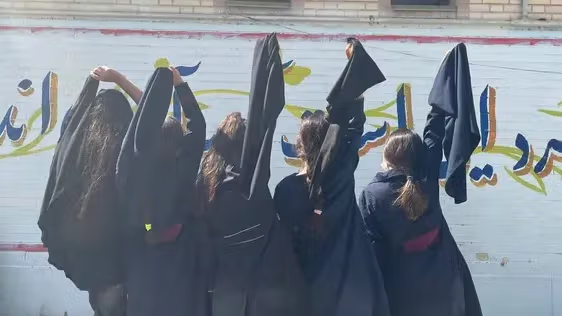
Iran’s police-school pact sparks fear of hijab policing in classrooms
Students without mandatory hijab
A cooperation agreement between Iran’s police and the education ministry has sparked backlash from the teachers' union, which fears the deal aims to reassert control over increasingly relaxed hijab compliance in schools.
“Teachers across the country will not allow schools to be turned into military barracks,” reads a statement by the Coordination Council of Iranian Teachers' Trade Associations, which condemned the move on Monday.
The pact, signed between police chief Ahmadreza Radan and Education Minister Alireza Kazemi, grants security forces a role in shaping school policies in the name of cultural guidance.
“This is a degrading and alarming stance,” said Mohammad Habibi, the council’s spokesperson. He criticized the minister for calling himself a soldier of police and accused him of surrendering civilian education to military influence.
“The education ministry is not the minister’s private estate or a parade ground for security forces,” Habibi said.
Teachers and rights groups say the agreement violates students’ rights and threatens the safety of schools. “Any intrusion of police into the secure space of schools is blatantly illegal, repressive, and a violation of both student and teacher rights,” Habibi added.
Kazemi defended the agreement in a televised ceremony, calling hijab “one of today’s challenges that requires cultural efforts.”
Radan, who is under US, EU, and Canadian sanctions for human rights abuses, said cooperation between police and schools must go further.
"While this memorandum of understanding and the militarization and policing of schools is very painful and aims to exert pressure on our teenagers, it also reflects a kind of acknowledgment of the regime's failure in enforcing compulsory hijab," Roghayeh Rezaei, a member of the IranWire website editorial team said in an interview with Iran International.
The Council’s warning follows mounting pressure on students and teachers since the 2022 protests that were sparked by the death of Mahsa Amini in morality police custody. The young woman was arrested for not wearing her hijab properly.
In recent months, pro-government outlets such as Tasnim News have called for surveillance cameras in classrooms and tighter controls on student behavior.
“Schools are no place for batons or coercive forces. Don't entrust cultural matters to colonels. The consequences will come back to haunt you,” Morteza Beheshti Langroudi, a teacher and former political prisoner wrote on X.
The law was due to impose harsh penalties on women and girls who defy veiling requirements, including fines, prison terms, flogging and even the death penalty.
Many women now refuse to wear the compulsory head covering, long tunics, and trousers as dictated by the country's Shariah law. They are also now often seen singing and dancing in public in defiance of the religious establishment.
Iran's judiciary has announced legal action against the heads of two media outlets following their commentary on the ongoing nuclear negotiations between the Islamic Republic and the United States.
The judiciary's news agency Mizan reported on Saturday that "disrespectful remarks by the directors of two media outlets regarding the Iran-America negotiations led to charges being filed against them."
The agency did not initially name the individuals involved.
However, the Revolutionary Guard-affiliated Fars news agency later identified the two as Mostafa Faghihi, owner of the Entekhab News Website, and Sajjad Abedi, managing editor of Talkhand-e Siasi (Political Satire).
The move comes shortly after a commentary on Raja News, another outlet linked to the Revolutionary Guard, criticized what it described as a rise in "fake news, rumors, and false accusations" against Supreme Leader Ali Khamenei in both online spaces and some official media.
Raja News specifically accused Faghihi of labeling critics of the nuclear talks as "hardliners with clichéd and nauseating" rhetoric.
The outlet also said that Abedi had dismissed Khamenei's recent statement about not making the country's issues dependent on negotiations as "nonsense."
Abedi responded on the social media platform X, saying that his comment was directed at the hardliners' remarks, not Khamenei's.
Khamenei has shifted his stance on talks since February when he described negotiating with US President Donald Trump as "dishonorable" and "irrational," but less than two months later, he greenlit indirect talks with the US.
This is not the first instance of the Iranian judiciary taking action against media figures commenting on the nuclear issue.
Earlier this month, Mizan reported charges against Hesamoddin Ashena, a former head of the Strategic Studies Center under former president Rouhani's administration, for a social media post criticizing the Islamic Republic authorities regarding Iran's approach to negotiations with the US.
The reformist Shargh daily also offered a public apology after it published a report about the potential renewed role of Mohammad Javad Zarif in the US talks.
Additionally, the Press Supervisory Board issued a warning to the editor-in-chief of the hardline Kayhan daily, which is managed by Khamenei's representative, for threats of assassination against President Donald Trump for the 2020 killing of IRGC's Qasem Soleimani.
Twelve Iranian lawyers who represented protesters during nationwide antigovernment protests in 2022 have been sentenced to three years in prison and fined, a human rights group said, underscoring a continuing crackdown on civil society.
A Revolutionary Court in Mashhad handed down the verdicts on charges of propaganda against the establishment and propaganda in favor of Israel according to the Human Rights Activists News Agency (HRANA).
Speaking to Iran International, defense attorney Mohammad Olyaifard said the lawyers were punished for doing their jobs.
“These verdicts are part of the ongoing crackdown on civil institutions,” Olyaifard said.
Initially charged in 2022, the lawyers were briefly included under a general amnesty directive but in January 2025 Iranian authorities reopened the case and launched a new round of investigations.
The Islamic Republic has long targeted independent lawyers and civil society advocates. After the nationwide protests beginning in September 2022 were quashed with deadly force, the state has kept a tight lid on civil and political activism with arrests and executions of demonstrators.
The planned amputation of three men’s fingers in Iran amounts to torture and must be halted immediately, the UN Special Rapporteur on Human Rights in Iran told Iran International in an interview.
"Today, I’m very concerned about the possibility of amputation of fingers that may be implemented to three men who have been convicted of theft,” said Mai Sato.
"Corporal punishment, including amputation, is absolutely prohibited under international law. And if executed, will amount to torture or ill-treatment," she said.
Earlier, rights group Amnesty International said the three men — Hadi Rostami, Mehdi Sharfian, and Mehdi Shahivand — held in Urumieh Central Prison in northwestern Iran, were informed by prosecution authorities last month that their sentences would be implemented as early as 11 April.
Amnesty said the same prison carried out amputations on two brothers last October using a guillotine device, raising alarm that authorities are prepared to enforce further amputation sentences.
Despite violating Article 7 of the International Covenant on Civil and Political Rights (ICCPR), to which Iran is a party, Amnesty said the court had sentenced the three men to “have four fingers on their right hands completely cut off so only the palm of their hands and thumbs are left”.
Sato urged the Iranian authorities to halt the amputation sentence on the men.
Amnesty said the three men have consistently maintained their innocence and said that their confessions were forced under torture, including beatings, flogging and suspension by their limbs.
At least 223 amputations have been carried out by Iranian authorities out of 384 known sentences since 1979, according to the US-based rights group the Abdorrahman Boroumand Center.
Iranian authorities had removed several organs from dual national Jamshid Sharmahd before transferring his body to Berlin after his sudden death in an Iranian prison while awaiting execution, the family's lawyers said Friday.
The lawyers said autopsy results revealed that several organs, including his tongue, larynx, thyroid, and heart had been removed before his body was transferred to Germany, hindering a full investigation into the cause of his death.
The possibility that Sharmahd may have been poisoned cannot be dismissed, according to lawyer Patrick Kroker.
His body was in poor condition Kroker said, adding that the corpse had only two teeth remaining.
Sharmahd was abducted by Iranian agents during a visit to the United Arab Emirates in 2020 and forcibly taken to Iran. According to Sharmahd family's lawyers, he was taken to Iran via Oman.
In February 2023, the Iranian judiciary sentenced him to death on charges of endangering national security.
He was convicted of heading a pro-monarchist group called Tondar accused of a deadly 2008 bombing at a religious center in Shiraz, killing 14 and injuring 215 more. The accusation, which Sharmahd repeatedly denied, was never substantiated by any public evidence.
'Mutilation'
At the memorial ceremony on Friday co-organized by the Berlin-based rights group Hawar Help, Sharmahd's daughter, Ghazaleh, told Iran International that the removal of his organs served two purposes: to traumatize the family and conceal evidence of his fate.
"They took out his tongue, the one with which he spoke about what they didn't want him to and they removed his heart, the one that beat for Iran," Ghazaleh said.
She added that in death by hanging, examiners might look for external evidence such as marks from a tight noose. However, after a few months these marks fade and internal organs must be investigated.
“The organs they removed are the very things that could show he was executed,” she said.
On October 28 last year, Iran's judiciary website Mizan announced that Sharmahd was executed. However, a week later on Nov 5, the judiciary spokesperson Asghar Jahangir said that Sharmahd died of a stroke before his scheduled execution.
The conflicting accounts of the Iranian authorities at the time raised questions about the truth behind his death.
Nearly four months after his demise was announced by Iranian authorities, German authorities informed Ghazaleh that her father’s body would be transferred to Berlin.
"We had to try really hard to bring him here, and German authorities didn’t want to help," Ghazaleh told Iran International.
Activist Mina Khani said that rights group Hawar Help, led by founder Düzen Tekkal and co-initiator of the group’s German political sponsorship program for Iranians detained in Iran, Mariam Claren, were deeply involved in pushing the German government to pressure Iran to repatriate Sharmahd's body.
“The most shocking part was the Islamic Republic’s mutilation of Jamshid Sharmahd's body, where parts of his body including his tongue, larynx, thyroid, and heart were removed before being sent,” Khani added.
In a statement following the ceremony, Julia Duchrow, Secretary General of Amnesty International said: "The shocking finding of the autopsy is that the cause of Jamshid Sharmahd's death cannot be determined due to the condition of the body."
Duchrow called on the German Federal Prosecutor's Office to immediately launch criminal investigations against Iranian officials suspected of being responsible for Sharmahd's death.
Iran plans to amputate the fingers of three men convicted of theft on Friday just days after executing five political prisoners, prompting alarm from UN human rights experts and international rights groups.
"Three men in Iran face imminent finger amputations that may be carried out as early as tomorrow (11 April 2025). The prohibition of torture and ill-treatment is absolute and allows no exceptions," Mai Sato, Special Rapporteur on the situation of human rights in the Islamic Republic of Iran, said in a post on X.
UN experts, which include Sato, expressed deep concern over the planned amputations, saying it violates international law and called for the immediate halt of such punishments.
In their statement, the UN experts said the three men were convicted of theft in 2019 and sentenced to amputation, with the Supreme Court upholding the verdict in 2020 despite allegations of torture.
Iran executes five political prisoners
The planned amputations come just days after Iran executed five political prisoners on Tuesday in Mashhad Central Prison, in northeastern Iran.
Left to right- Farhad Shakeri, Abdolhakim Azim Gorgij and Abdolrahman Gorgij.
The five prisoners, identified as Farhad Shakeri, Abdolhakim Azim Gorgij, Abdolrahman Gorgij, Taj Mohammad Khormali, and Malek Ali Fadayi Nasab, were convicted of “armed rebellion” for their affiliation with banned political groups, according to Norway-based rights group Iran Human Rights (IHR).
In a statement on Wednesday, IHR said the five men were executed without the opportunity for a final visit with their families. Their executions came after years of detention, including long periods in solitary confinement and allegations of torture during their trials.
“These prisoners were subjected to torture and sentenced to death following an unfair trial in the Revolutionary Court,” said Mahmood Amiry-Moghaddam, Director of Iran Human Rights (IHR). "The international community and the people of Iran must respond seriously to these executions."
The executions of the five men came on the same day as Amnesty International warned that the vast majority of the executions in Iran last year were linked to political repression.
The rights group reported that Iran accounted for 64% of all known global executions in 2024, with at least 972 people executed, in what Amnesty said is the government's ongoing campaign of mass suppression of dissent.