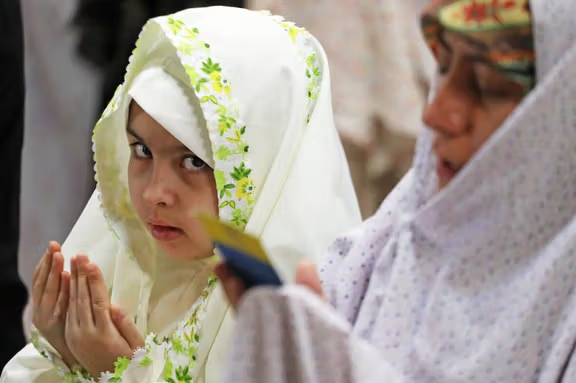
A young girl looks at the camera while praying, Zanjan, Iran, March 31, 2025
Camel-denominated blood money and minutes-long temporary marriages are among the peculiar features of a medieval theocratic legal system by which Iran systematically enforces second-class citizenship on women.
Iran’s Sharia-based legal system contains a litany of provisions that discriminate against women, particularly in the areas of criminal, family, and inheritance law.
The measures go far beyond state enforcement of the Islamic face veil, which has become a symbol of the system's attempt to control and dominate women for the Islamic Republic's near-half-century existence.
Under Iran’s interpretation of Shia Islamic law, the age of legal responsibility differs significantly between girls and boys. Girls are considered legally responsible at the age of 9 lunar years (approximately 8 years and 9 months), while boys reach legal responsibility at 15 lunar years.
This age disparity has been repeatedly criticized by child rights advocates and international organizations. Some have proposed that the age of criminal responsibility for both girls and boys be equal, with a minimum threshold of at least 18 years. However, no such legal reform has been enacted to date.
Moreover, in criminal proceedings, the testimony of two women is considered equivalent to that of one man in most cases.
The concept of blood money (diyeh)—financial compensation paid by an offender to the victim’s family in cases of murder or manslaughter—is also unequal.
The amount paid for a female victim is half of what is paid for a male victim. The base amount is determined annually by Iran's Chief Justice, based on the value of 100 camels.
In some cases, women may face harsher penalties than men. Women can receive the death penalty for killing their children, whereas the legal response is legally and practically often less when a man commits a similar crime.
In addition to legal punishment for murder or manslaughter, for instance, a woman who kills her child must pay blood money to the father. Fathers and paternal grandfathers, however, are exempt from paying blood money to the mother in such cases due to their sole legal entitlement to their children’s blood money.
Marriage, Polygamy and Divorce
Regardless of age, women require the consent of their father or paternal grandfather to enter into a first marriage. Men, however, face no such restriction.
Men are also legally permitted to engage in polygamy, with the possibility of marrying up to four wives simultaneously through a court order.
They may enter into temporary marriages (known as sigheh or mut'ah) for a fixed period—ranging from minutes to years—without court approval or official registration.
These marriages automatically dissolve when the agreed-upon time expires.
For divorce, men legally hold the unilateral right to dissolve a marriage at will. Women, on the other hand, must apply to a court and present proof of their husband’s failure to fulfil obligations such as providing housing, food or healthcare.
They must also demonstrate that they have fulfilled their own marital duties, including obedience to their husband in areas such as sex and permission to leave the home.
Iranian law allows men to prevent their wives from traveling or taking up certain jobs, unless the woman obtains a power of attorney from her husband—either at the time of marriage or afterward—granting her the right to travel, work or initiate divorce.
Guardianship and Custody
Fathers have exclusive legal guardianship over their children. Mothers can only obtain guardianship if the father is dead and the paternal grandfather does not object.
In divorce cases, mothers retain custody only until the child reaches age seven, after which custody typically reverts to the father. Once a girl reaches 9 and a boy reaches 15 (the ages of adulthood in Shia law), they may choose which parent they will live with.
However, the father - or paternal grandfather, if the father has passed away - continues to be the legal guardian of children, often maintaining control over key aspects of their lives.
Additionally, women automatically lose custody of their children if they remarry, as long as the father is still alive.
Inheritance
In inheritance, a woman’s share is half that of a male heir in comparable circumstances.
For example, a daughter inherits half the amount her brother does. A widow is entitled to one-eighth of her husband's estate if they had children, or one-fourth if childless. The remaining assets typically go to the husband’s family.
The Netherlands summoned Iran's envoy on Thursday after Dutch intelligence accused Tehran of an attempted assassination of an Iranian dissident in the country.
It is likely that Iran ordered the attempted assassination of an Iranian activist Siamak Tahmasbi in Haarlem, Netherlands, in the summer of 2023, the agency’s annual report on Thursday of the General Intelligence and Security Service (AIVD) said.
An attempted assassination in Madrid of former Spanish lawmaker Alejo Vidal-Quadras, a vocal critic of the Islamic Republic, at the end of 2023 was also attributed to Iran, Dutch news outlet Nieuwsuur added citing the report.
"Iran used a tried and tested method in both cases: using criminal networks to silence opponents of the regime," Nieuwsuur's report said citing AIVD in reference to the alleged assassination attemp against Tahmasebi and Vidal-Quadras.
"This makes it difficult to prove under criminal law that the order actually came from Tehran," it added.
The report said that on June 6 2023, Tahmasebi noticed two men attempting to enter his home. Tahmasebi alerted the police, who arrived in time to arrest the armed intruders. The northern Netherlands prosecutor's office confirmed the arrests and the possession of firearms by the intruders.
One of the two suspects, Mehrez Ayari, is a 38-year-old Tunisian criminal from Villejuif, Val-de-Marne, France. Ayari had been sought by French police since August 2022 and is accused of murdering a cannabis dealer.
Nieuwsuur reported that the two detained were in contact by phone with a third man, who sent them instructions. The report added that the third person who allegedly directed them by telephone on behalf of Iran remains at large.
The leader of a Swedish criminal network accused of assisting Tehran in attacks on Israeli-linked targets in Europe is currently living in Iran under the protection of the Islamic Revolutionary Guard Corps (IRGC), sources told Iran International.
Rawa Majid received funds from Iran’s embassy in Denmark to help coordinate attacks against Israeli diplomatic facilities in Copenhagen and Stockholm, according to a source familiar with the matter inside the IRGC.
The source also said the gang leader travels between Iran and Afghanistan for operations overseen by the IRGC.
Majid leads a criminal group, Foxtrot, recently sanctioned by the UK and the US for its alleged role in orchestrating attacks on Israeli interests. Both governments accused the group of working as a proxy force for Iran in Europe. Tehran has denied the charges.
"Iran’s brazen use of transnational criminal organizations and narcotics traffickers underscores the regime’s attempts to achieve its aims through any means, with no regard for the cost to communities across Europe,” US Treasury Secretary Scott Bessent said in a statement in March as the US sanctioned Majid and Foxtrot.
Rawa Majid
The US Treasury said the group has carried out operations targeting Israeli and Jewish institutions, including an attempted bombing outside the Israeli embassy in Stockholm and grenade attacks near the Israeli embassy in Copenhagen in October 2024.
The attacks are part of an apparent broader strategy that has alarmed European security services. In a December 2024 report, Bloomberg detailed how Iran-affiliated groups have increasingly recruited local criminals — including minors — to carry out assaults on Jewish and Israeli institutions across Europe.
Iran’s expanding covert footprint in Europe is linked to the broader regional conflict between Israel and Iranian proxy forces, Bloomberg reported, and the strategy may be aimed at fueling social tensions in countries already divided over immigration and integration.
Sweden’s Security Service (Säpo) and Israeli intelligence agency Mossad have both identified the Foxtrot criminal network as one of the groups recruited by Tehran for sabotage operations in Europe.
While Iranian officials deny using criminal organizations abroad, leaders of the Islamic Republic have repeatedly praised attacks on Israeli interests globally.
Enforcing Iran's new hijab law is the top priority for the parliamentary cultural committee, its spokesperson said as authorities come under mounting conservative pressure to implement legislation expanding surveillance and penalties.
“A group of devout citizens has a rightful demand, and that is the enforcement of the hijab law — a demand that holds value for the Islamic system,” said spokesman Ahmad Rastineh on Thursday.
The law was passed by parliament in September 2023 but is yet to be fully enforced as the government tries to avoid mass backlash. It mandates harsh penalties for women and girls who defy compulsory veiling and has been branded by the UN as amounting to gender apartheid.
Punishments under the strict new law include travel bans, social media restrictions, prison sentences, lashes, and fines. It also criminalizes promoting hijab resistance.
The legislation was introduced following mass protests triggered by the death of Mahsa Amini in police custody in 2022 which led to nationwide hijab rebellion and a loss of control by authorities.
Although the law’s enforcement was postponed in December following public outcry and international pressure, calls for its immediate implementation have intensified.
Last month, a group of pro-hijab activists staged a sit-in outside parliament, demanding the law be enacted. The protest, which coincided with Quds Day, was dispersed by police on the grounds that it lacked official authorization.
As measures to enforce hijab continue, a recent cooperation agreement was signed between Iran’s police and the education ministry which has sparked outrage from teachers’ unions.
Critics say the deal, which allows police input on school policies, could militarize schools and enforce hijab compliance among students.
“Teachers across the country will not allow schools to be turned into military barracks,” said the Iranian Teachers' Trade Association.
“This is a degrading and alarming stance,” added Mohammad Habibi, the group’s spokesman, accusing the education minister of surrendering the civilian space of education to security forces.
Many women around the country now openly reject the compulsory headscarf, long tunics, and trousers mandated by Iran’s Shariah law. Acts of defiance have become increasingly visible, with women frequently seen unveiled, singing, and dancing in public as a challenge to the religious establishment.
The man who shot dead two Iranian Supreme Court judges in a rare assassination of top officials in January has been identified as Farshid Asadi, a 31-year-old court service aide, a source familiar with the matter told Iran International.
Asadi, originally from Razan in Iran's Western Hamedan Province, worked at the Supreme Court in Tehran providing refreshments to judges and staff, said the source who spoke on condition of anonymity due to the sensitivity of the matter.
The assailant was initially assigned to the court’s fifth floor but was later relocated to the first floor after Judge Mohammad Moghiseh moved his office there.
On January 18, veteran judges Moghiseh and Ali Razini were shot and killed inside the Supreme Court building in central Tehran. The incident shocked the judiciary and remains largely unexplained by authorities.
The two clerics were central figures in Iran's theocratic establishment who had handed down death sentences and other harsh punishments on dissidents for decades. Supreme Leader Ali Khamenei led their funerals.
Their deaths marked a rare attack on senior officials as discontent over political repression and economic malaise festers in Iran.
The source told Iran International that Asadi first entered the room of a security guard and injured him before proceeding to the judges’ office. There, he shot Razini once, killing him instantly. As Moghiseh attempted to flee, Asadi fired again, striking him in the hand and then fatally in the back, piercing his heart.
Asadi, the source added, also intended to target another senior judicial figure, Mahmoud Toliyat, a former Revolutionary Court judge, but changed his mind for unknown reasons. He then turned the weapon on himself and died at the scene.
The full name, age and intended third target of the attacker was not previously reported.
Initial reporting by state-affiliated media suggested the attacker may have been an outsider or “armed infiltrator.” However, conflicting accounts followed, with judiciary-linked outlets later confirming the assailant was employed inside the court complex.
Following the shooting, several of Asadi’s relatives—including his father, uncle, maternal uncle, and two female cousins—were detained at different times by Iran’s Ministry of Intelligence, the source told Iran International.
It remains unclear how many are still in custody.
Separately, former political prisoner Bijan Kazemi has been held incommunicado for over 100 days in connection with the case. Authorities are reportedly attempting to extract a confession linking Kazemi to the firearm used in the attack. Asadi’s father is under pressure to admit involvement, the source added.
Judges Razini and Moghiseh, both clerics, were widely known for their roles in high-profile security cases and for issuing harsh sentences against political dissidents.
They were also involved in the mass execution of political prisoners in 1988, a chapter heavily criticized by human rights organizations.
Local authorities are deploying advanced surveillance technologies in Isfahan to identify and threaten women who defy the country’s strict hijab regulations, according to research by internet watchdog Filterwatch.
The NGO, which specializes in internet freedoms in Iran and the Middle East, released a report last week detailing new technologies and tools allegedly used by authorities in Isfahan, Iran's third most populous city, for hijab enforcement.
These include International Mobile Subscriber Identity-Catchers (IMSI-Catchers), data from contactless card readers, and urban surveillance cameras.
IMSI-Catchers—also known as fake cell towers—can intercept and track mobile phone communications by impersonating legitimate towers. A portable fake cell tower carried by a hijab enforcer, for instance, can connect to the cell phone of a woman not wearing the hijab on the street and identify her number.
“The combined use of IMSI-Catchers, contactless card readers, and surveillance cameras—along with access to government databases and the cooperation of telecom operators—has created a powerful, multilayered tool to systematically violate women’s rights through identification, tracking, and intimidation,” Filterwatch said in its report.
Stricter hijab enforcement in Isfahan
So far, this surveillance-driven enforcement strategy appears limited to Isfahan, a conservative bastion where hardliners have pushed for stricter hijab enforcement—even after the Supreme National Security Council (SNSC) temporarily shelved a controversial new 'hijab and chastity law' in September to avoid sparking unrest if it was brought into effect.
The law has been slammed globally by rights groups and the UN which said it amounted to gender apartheid.
In December, Iranian media unveiled the details of the new law which had been kept secret. Stricter measures against women who unveil in public would include travel bans, social media bans, prison sentences, and lashes. It also criminalizes anyone promoting the encouragement of hijab defiance.
“The Isfahan case is a serious alarm bell about the escalation of digital authoritarianism and the use of technology as a weapon against the rights of citizens, especially women, in Iran,” Nima Akbarpour, a tech expert and filmmaker, warned in a post on X.
Warning text messages reveal extent of data access
In recent weeks, dozens of women reported on social media that they received threatening text messages after visiting public places in Isfahan during the Nowruz (Iranian New Year) holidays in late March as the crackdown escalates.
Screenshots shared online show messages from various state entities, including the provincial branch of the Office for the Promotion of Virtue and Prevention of Vice, the Department of Justice, and the police.
The first two agencies warned recipients of potential legal prosecution should the violation of hijab rules be repeated. The third message, from the police, informed recipients that “evidence of the crime” had been submitted to the judiciary.
The messages included the women’s full names and specified the exact locations where the alleged violations occurred—indicating the authorities had access to their personal and location data.
In some cases, the same messages were reportedly sent to the recipient’s husband or father, demonstrating the extent of data collected.
While reports of such warnings first emerged in June 2023, local authorities only recently confirmed the practice after it appears to have become more widespread.
Last week, Amir-Hossein Bankipour, an ultra-hardline lawmaker from the province, said, "[Sending text messages] began some time ago, and its impact has already been observed, with approximately 80–90 percent of recipients complying after receiving the text message. This method has proven effective without causing social tension".
Public defiance continues
Public acts of defiance against the hijab have grown to new heights in the past year despite authorities' threats of severe legal crackdowns, occasional violence against women on the streets, and measures such as impounding vehicles if unveiled women are spotted in them.
A nationwide movement against compulsory hijab intensified following the death of Mahsa Amini in the custody of the morality police in September 2022. Her death sparked protests across Iran under the slogan "Woman, Life, Freedom," shifting public sentiment decisively against compulsory hijab.
Many women now refuse to wear the compulsory head covering, long tunics, and trousers as dictated by the country's Shariah law. They are also now often seen singing and dancing in public in defiance of the religious establishment.