Trump castigates Iran in lengthy speech before Saudi leadership
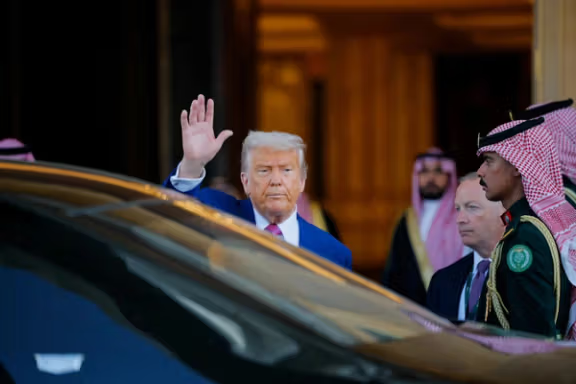
US President Donald Trump gestures following a Memorandum of Understanding (MOU) signing ceremony at the Royal Court in Riyadh, Saudi Arabia, May 13, 2025
Speaking before Crown Prince Mohammed bin Salman and other top Saudi and US officials, President Donald Trump spent much of a lengthy speech on Tuesday criticizing Iran while urging a deal over its disputed nuclear program.
Tehran as obstacle to regional peace
"The only thing still standing between this region and its unbelievable potential was a small group of rogue actors and violent thugs seeking constantly to drag the Middle East backward and into havoc, mayhem and indeed, into war. Unfortunately, instead of confronting these destructive forces, the last US administration chose to enrich them and empower them and give them billions and billions of dollars.
"Our task is to unify against the few agents of chaos and terror that are left and that are holding hostage the dreams of millions and millions of great people.
"The biggest and most destructive of these forces is the regime in Iran, which has caused unthinkable suffering in Syria, Lebanon, Gaza, Iraq, Yemen and beyond. There could be no sharper contrast with the path you have pursued on the Arabian Peninsula than the disaster unfolding right across in the Gulf in Iran."
A Persian Gulf of contrasts
"While you have been constructing the world's tallest skyscrapers in Jeddah and Dubai, Tehran's 1979 landmarks are collapsing into rubble and they had it going for a little while under a much different system but those buildings are largely falling apart.
"Iran's decades of neglect and mismanagement have left the country plagued by rolling blackouts lasting for hours a day ... While your skill has turned dry deserts into fertile farmland, Iran's leaders have managed to turn green farmland into dry deserts as their corrupt water mafia ... causes droughts and empty river beds. They get rich."
Syria and Lebanon
"Countless lives were lost in the Iranian effort to maintain a crumbling regime in Syria. Look at what happened with Syria and Lebanon, their Hezbollah proxies have pillaged the hopes of a nation whose capital Beirut was once called the Paris of the Middle East.
"Can you imagine all of this misery and so much more was entirely avoidable?
"If only the Iranian regime had focused on building their nation up instead of tearing the region down.
"In Syria, which has seen so much misery and death, there is a new government that will hopefully succeed in stabilizing the country and keeping peace. That's what we want to see in Syria, they've had their share of travesty, war killing many years.
"I will be ordering the cessation of sanctions against Syria in order to give them a chance."
Enmity or peace with Iran
"In the case of Iran, I have never believed in having permanent enemies. I am different than a lot of people think. I don't like permanent enemies ... I want to make a deal with Iran.
"But if Iran's leadership rejects this olive branch and continues to attack their neighbors, then we will have no choice but to inflict massive maximum pressure drive Iranian oil exports to zero like I did before."
"(The US will) take all action required to stop the regime from ever having a nuclear weapon."
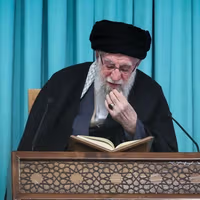
Iranian President Masoud Pezeshkian said any indirect negotiations with the United States will proceed in full coordination with Supreme Leader Ali Khamenei and reaffirmed that Iran will not retreat from its core principles.
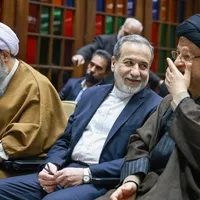
“These negotiations will be fully aligned with the Supreme Leader’s guidance, which will light our path,” Pezeshkian said during a meeting with a group of lawmakers. “We have not and will not tie the people’s livelihood to the outcome of the talks.”
Pezeshkian said that while Iran seeks dialogue without escalating tensions, it would not compromise on what he called national values. “We will not retreat from our principles under any circumstances,” he added. “At the same time, we are not seeking tension.”
Earlier in the day, Iran’s deputy foreign minister said the country is open to accepting temporary restrictions on uranium enrichment, though no detailed agreement has been reached.
Majid Takht-Ravanchi, speaking after the fourth round of indirect talks with the United States in Oman, said negotiations have yet to address the specifics of enrichment levels.
The talks, described by both sides as difficult but constructive, mark the highest-level contact between Tehran and Washington since the US withdrew from the 2015 nuclear deal in 2018 under former Trump administration.
Iran has since accelerated its enrichment to 60% purity—well above the deal’s 3.67% cap but below weapons-grade, according to the UN nuclear watchdog.
While US officials have called for a full dismantlement of Iran’s enrichment capabilities, Tehran insists the right to enrich is non-negotiable.
Iran’s atomic energy chief, Mohammad Eslami,said on Tuesday that the nuclear program remains a pillar of national strength and is not subject to bargaining.
Western powers accuse Iran of seeking nuclear weapons—an allegation Tehran denies. Despite diplomatic engagement, the US continues to expand sanctions targeting Iran’s nuclear and energy sectors.
Ethiopia and Iran signed a memorandum of understanding in early May to enhance cooperation between their national police forces on intelligence sharing, cross-border crime, and security training—an effort analysts say bolsters Tehran’s growing influence in the Horn of Africa.
The agreement signals Iran’s intent to deepen political and security ties with African states through its military and intelligence apparatus, according to Eric Lob, associate professor of politics and international relations at Florida International University, writing for The Conversation.
Iran has previously supplied surveillance and combat drones to Ethiopia, aiding government forces during the 2020–2022 Tigray conflict.
The US State Department reported last year that Iran had breached a UN Security Council resolution by sending armed drones to Ethiopia in the summer of 2021.
Similar equipment has reportedly been provided to the Sudanese army in its fight against the Rapid Support Forces, underlining Tehran’s broader regional strategy.
For Addis Ababa, the pact comes amid rising domestic insecurity and follows recent talks with Iran’s Persian Gulf rival, the United Arab Emirates.
Ethiopia is currently facing armed unrest from ethnic militias, including factions of the Tigray People’s Liberation Front and the Amhara Fano militia. It is also contending with economic challenges and renewed tensions with neighboring Eritrea.
The cooperation deal marks a continuation of a historically complex relationship. Ethiopia was the first sub-Saharan country to establish ties with Iran in the 1960s and resisted pressure to sever them in 2016 after Saudi Arabia and the UAE severed ties with Tehran.
“The agreement highlights Ethiopia’s pragmatic foreign policy, seeking support from both Iran and the UAE — rivals often on opposing sides of regional conflicts like those in Yemen and Sudan,” Lob wrote.
Iran’s nuclear chief said that the country’s nuclear industry will not be subject to any form of negotiation or compromise, describing it as a pillar of national power.
“The nuclear industry is a point of wealth and strength for the Iranian nation and is not subject to bargaining or negotiation,” Mohammad Eslami said speaking at an event in Karaj, near Tehran, on Tuesday.
“We have paid a heavy price to achieve nuclear knowledge, and nuclear technology is the key to progress in all fields of science and engineering,” he added.
Eslami’s remarks come as Iran and the United States concluded a fourth round of indirect nuclear negotiations in Oman on Sunday.
US President Donald Trump has said that the goal of the negotiations is to achieve "full dismantlement" of Tehran's nuclear program.
Tensions have mounted in recent days following comments by US envoy Steven Witkoff, who told Breitbart News last week that Washington's red line remains “no enrichment,” effectively calling for the dismantling of Iran’s nuclear infrastructure in Natanz, Fordow, and Isfahan.
Earlier on Tuesday, a senior Iranian lawmaker said Tehran will not give up uranium enrichment under any potential agreement with the United States, stressing that enrichment levels of up to 20% — or at least 5% — will be maintained on Iranian soil.
Ahmad Bakhshayesh Ardestani, a member of the Iranian parliament’s National Security and Foreign Policy Committee, told local media that the outlook for ongoing negotiations with Washington is positive, but insisted Iran will not concede to US demands.
“America ultimately has to accept our conditions,” he said.
Iran’s Deputy Foreign Minister Majid Takht-Ravanchi on Tuesday said that no specific details have been agreed regarding possible limits on uranium enrichment, after the latest round of talks in Muscat.
Iran has accelerated its enrichment activities since 2019, exceeding limits set under the 2015 nuclear deal, which the US exited unilaterally in 2018.
The UN nuclear watchdog has confirmed Iran’s enrichment of uranium to levels approaching weapons-grade, a move Tehran says is reversible if sanctions are lifted and credible guarantees are provided.
Iranian Foreign Minister Abbas Araghchi on Sunday said that Iran may consider temporary limits on enrichment “in terms of scope, level, and quantity” as a confidence-building measure, but also emphasized that the principle of enrichment itself is non-negotiable.
Amid the standoff, some Iranian commentators are reviving a long-standing proposal to break the impasse by forming a regional nuclear consortium that would include Iran, Arab states and the United States.
In February, the UN nuclear watchdog found that Iran's stockpile of near-weapons-grade uranium had risen to levels that, in principle, could be further enriched to produce enough material for six nuclear bombs.
Iranian commentators are floating a long-standing proposal to break the impasse in its nuclear negotiations with Washington: the formation of a regional nuclear consortium involving Iran, Arab states and the United States.
If Tehran has indeed introduced this idea in the fourth round of talks, it may represent new flexibility on the sticky point of enrichment and explain the positive assessment of both Iranian and American officials on the latest round of talks.
A commentary in the conservative Khorasan daily on Mondaysaid the idea of creating a consortium may have been among what Omani Foreign Minister Badr al-Busaidi referred to as “useful and original ideas reflecting a shared wish to reach an honorable agreement” after the completion of the fourth round of talks on Sunday.
Some signals suggest this idea may have been quietly floated in diplomatic channels: ahead of the Muscat talks on April 11, Iran’s Foreign Minister Abbas Araghchi visited Riyadh and Doha, followed by a trip to the UAE after the talks.
The idea was originally proposed by former Iranian nuclear negotiator Seyed Hossein Mousavian and Princeton physicist Frank von Hippel long before the current Tehran-Washington talks in an October 2023 article in the Bulletin of the Atomic Scientists.
Such a body consisting of Iran, Saudi Arabia,and other interested Middle Eastern countries would oversee enrichment under international safeguards and ensure that the enriched uranium it produced would be used only for peaceful purposes, they argued.
On the eve of the April 11 nuclear talks in Muscat, Mousavian addressed the risk of failure if the US refused to acknowledge Iran’s rights under the Nuclear Non-Proliferation Treaty (NPT).
“Steve Witkoff recently made an unreasonable statement, saying that Iran cannot benefit from the right to peaceful uranium enrichment technology. This stance is a clear violation of the NPT treaty. If this is the final US position, tomorrow's negotiations... will end in failure,” he warned.
In the same post, Mousavian again floated the consortium idea: “The solution is ... the establishment of a joint nuclear consortium among the Persian Gulf countries.” He argued this would resolve the US’s contradictory stance of supporting enrichment in Saudi Arabia while denying the same to Iran.
He also hinted at a broader vision: an Iran-US economic agreement worth up to $1 trillion, involving American investment in Iran’s nuclear, fossil, and renewable energy sectors. Such a deal, he suggested, could help “open the deadlock in US–Iran relations.”
Some commentators have described the idea as a possibility for a breakthrough.
“Araqhchi's visit to Saudi Arabia and the UAE is probably not unrelated to the proposal to create a joint regional enrichment consortium,” Rahman Ghahremanpour, a commentator and analyst of Middle East politics in Tehran, posted on X.
“Iran is trying to break the deadlock on zero enrichment, and if the countries in the region agree to this proposal, perhaps the Trump administration will change its position. This is an important confidence-building measure in arms control,” he added.
Abdolreza Davari, a conservative politician who supports Pezeshkian, also supported the idea in a post on X on May 10. This, he said, would be “similar to the model implemented in Europe that supplies fuel even to the United States.”
“This consortium could be the center of regional cooperation in the areas of nuclear technology exchange, safety, environment, production of fresh water and radiopharmaceuticals, and also include a regional non-proliferation regime," Reza Nasri, another commentator in Tehran, wrote on X before Araghchi’s visit to Riyadh.
Hossein Aghaei, a Turkey-based senior security and geopolitics analyst, referred to Saudi Arabia’s wish to create a consortium in collaboration with the US and possibly Russia in a post on X on May 8. He said Iran could be a participant in the consortium to ensure it will not be able to build nukes.
However, he warned that Israel’s vision is completely different. “In the nuclear matter, Israel may not even trust Saudi Arabia, let alone the Islamic Republic.”
Commentator in Tehran are warning that Iran’s economy has become to dependent on news from Washington, with markets reacting sharply even to personnel changes in the US president’s inner circle.
Iran's official strategy to jumpstart a sputtering economy must look beyond talks with Washington and address root problems, several analysts and editorials have said.
“The reality is that our economy reacts intensely to political developments,” former central bank deputy Kamal Seyyed-Ali told reporters in Tehran. “If the possibility of a full-scale war rises again, the dollar rate will once again break records.”
Seyyed-Ali, a senior economist, pointed to a March spike in the dollar-to-rial exchange rate—reaching 1.05 million—after Donald Trump warned of possible military action if Tehran refused to negotiate.
The rate dropped when talks began in Oman, then crept back up when negotiations stalled. This increasing sensitivity, he said, underscores how economic expectations in Iran have become “tethered to political headlines.”
Policymakers and markets alike, he added, are behaving as if diplomacy with Washington will dictate the fate of the economy.
The hardline daily Kayhan recently questioned the government’s economic strategy, asking in a published commentary: “What is the government doing besides negotiating with the United States?”
The paper argued that diplomacy should be a tool to improve economic performance, not a substitute for internal reform.
Inflated hopes for a post-deal recovery have masked structural failings—among them, a banking system in crisis, outdated industry, underinvestment in agriculture, and widespread dysfunction in pensions and public services.
Repeated blackouts caused by power shortages have disrupted everything from water distribution to digital connectivity, triggering price hikes in housing, transport, and healthcare.
Energy Minister Abbas Aliabadi admitted in April that Iran’s power plants can generate only 65,000 megawatts against annual demand of more than 85,000. A vicious cycle compounds the problem: water shortages disable power plants, while power cuts prevent water distribution.
Citizens have voiced growing anger through Persian-language media abroad. Callers to Iran International describe how outages in major cities now affect phone signals, Internet access, and even access to clean water.
The latest round of US sanctions targets the petrochemical sector—already plagued by multi-billion-dollar corruption scandals. While the judiciary has acknowledged these cases, many remain suppressed or unresolved, a fact critics say reflects both impunity and systemic failure.
Despite poor growth and repeated economic shocks—Iran’s industrial output contracted 1.6% in January—officials continue to blame sanctions alone. Few in power acknowledge the depth of mismanagement. Instead, each government accuses its predecessor, avoiding accountability as public frustration mounts.
Even if sanctions are eased, economists say, Iran’s crisis will not be resolved by diplomacy alone. Without tackling the roots—corruption, dysfunction, and decay—any recovery will be fragile, temporary, and externally dependent.