UK summons Iranian ambassador after three charged under National Security Act
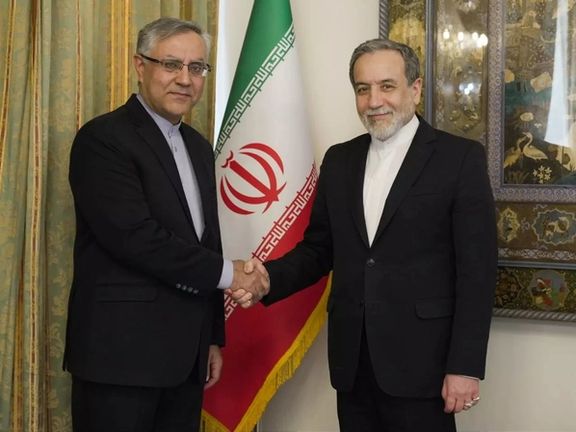
Iran's ambassador to the United Kingdom Ali Mousavi and foreign minister Abbas Araghchi
The United Kingdom summoned Iran’s ambassador Ali Mousavi on Monday after three Iranian nationals were charged with offences under the National Security Act, a spokesperson for the Foreign, Commonwealth and Development Office (FCDO) said.
"The UK Government is clear that protecting national security remains our top priority and Iran must be held accountable for its actions," the FCDO spokesperson said in a statement.
"The summons follows this weekend’s announcement which stated that three Iranian nationals had been charged with engaging in conduct likely to assist a foreign intelligence service," the statement added.
On Saturday, British counter-terrorism police charged three Iranian nationals with offences under the National Security Act, alleging they acted on behalf of Iran’s intelligence service and carried out surveillance targeting Iran International journalists.
The men — Mostafa Sepahvand, 39, Farhad Javadi Manesh, 44, and Shapoor Qalehali Khani Noori, 56 — were arrested at their homes in London on May 3 and charged on Friday.
All three are accused of engaging in conduct likely to assist a foreign intelligence service between August 14, 2024 and February 16, 2025, in breach of Section 3 of the National Security Act 2023.
In response, Iran's foreign ministry on Sunday summoned the UK chargé d'affaires in Tehran in protest over what it called the "unlawful and baseless" arrest of several Iranian nationals in the United Kingdom in two separate anti-terror operations.
Earlier on Monday, Iranian foreign ministry spokesman Esmail Baghaei said all signs of arbitrary detention were evident in the UK’s handling of the case.
“In the UK, as in other European countries, there is a pattern of imitation. All elements of arbitrary detention are present in the arrest of Iranian nationals in the UK. It is still unclear what charges they were arrested on,” he said.
Baghaei added that three individuals remain in custody while others have been released without clear explanation of the accusations. “The very notion of ‘connection with the Iranian government’ is vague, because a citizen must have contact with their own government for consular matters,” he said.
Iran’s top military commander has announced a sharp increase in the country’s air defense capabilities, including a fivefold boost in detection and tracking systems.
“The country’s air defense readiness—especially in detection, identification, and elimination of aerial threats—has advanced significantly compared to last year,” Major General Mohammad Bagheri, the chief of staff of Iran’s armed forces, was quoted as saying on Monday by IRGC-Tasnim News Agency.
Bagheri said radar and surveillance systems monitoring foreign movements have increased fivefold, while systems for intercepting and destroying enemy aircraft have improved by two to three times.
He added that Iran’s command-and-control systems are functioning efficiently and that the country’s airspace is under constant surveillance.
“Our air defense forces control the skies 24/7 and regularly conduct drills to prepare for any possible scenario,” he said.
Bagheri warned Iran’s adversaries that any violation of its airspace would have serious consequences. “Enemies of the Iranian nation should know that any intrusion will result in extensive damage and costs far greater than they expect,” he said.
Last October, Israel carried out a major strike on Iranian targets, destroying large sections of the country’s air defense infrastructure.
The attack followed two massive airstrikes from Tehran against the Jewish state while Israel was also fighting Iran's allies across its borders amid the Gaza war.
Reports in Fox News and the Wall Street Journal said all of Iran’s S-300s were taken out of action.
Israeli Prime Minister Benjamin Netanyahu said at the time: “We severely damaged Iran’s defense systems and its ability to export missiles."
At the time, the Institute For The Study of War said the Israeli military had conducted precision strikes targeting around 20 locations across Iran, including facilities tied to the Iranian drone and missile programs and air defense network.
"Even though the strikes caused relatively little visible destruction, they will likely have significant and long-lasting consequences by disrupting Iran’s ability to produce certain kinds of ballistic missiles for itself and its partners as well as by severely degrading Iran’s ability to defend against future air attacks," the analysis said at the time.
Iran on Monday criticized the United States for what it called inconsistent and hostile conduct in the ongoing nuclear talks, rejecting Washington’s demand for zero uranium enrichment ahead of a possible new round of negotiations mediated by Oman.
Speaking at a press briefing in Tehran, Iranian Foreign Ministry spokesman Esmail Bagahei said, “The difficulty of negotiating with the US lies in the fact that you are dealing with a party that respects none of the established norms of a diplomatic process.”
“The very act of imposing sanctions while claiming to pursue diplomacy with the Islamic Republic of Iran shows a lack of seriousness and goodwill,” he added, warning that Washington’s shifting positions undermined trust.
“The Americans’ shifting position on enrichment is like a game of snakes and ladders—just as we make progress, the US adopts a different stance,” Bagahei said, referring to recent comments by US nuclear envoy Steve Witkoff that Washington would not accept any level of uranium enrichment in a future agreement.
Bagahei stressed that Iran’s enrichment program was “non-negotiable,” calling it both a legal right under the Non-Proliferation Treaty (NPT) and a national achievement.
“Uranium enrichment is not some kind of fantasy that we can simply suspend or stop. It is a technology and a necessity to ensure the uninterrupted functioning of Iran’s nuclear industry,” he said. “We cannot give it up.”
Iranian Foreign Minister Abbas Araghchi also dismissed Witkoff’s remarks, saying they were “completely at a distance from the reality of the negotiations.”
In a post on X on Sunday, Araghchi wrote: “If the US is interested in ensuring that Iran will not have nuclear weapons, a deal is within reach, and we are ready for a serious conversation to achieve a solution that will forever ensure that outcome. Enrichment in Iran, however, will continue with or without a deal.”
He accused the US of contradictory messaging. “Iran can only control what we Iranians do, and that is to avoid negotiating in public—particularly given the current dissonance we are seeing between what our US interlocutors say in public and in private, and from one week to the other,” Araghchi said.
Next round of talks expected soon
Elsewhere in his press conference, Baghaei said the date and location for the next round of indirect US-Iran nuclear talks have not been set. Araghchi, however, said on Sunday that the date is set and will soon be announced by Oman, which is mediating.
Baghaei denied reports of parallel negotiations between other Iranian and US officials, specifically between Ali Shamkhani – Iran's former top security official and currently an advisor to the Supreme Leader -- and US Secretary of State Marco Rubio.
“There are no parallel negotiations. The only negotiation process that exists is this indirect one, led by the Iranian foreign minister and the US president’s special envoy,” Bagahei said.
The US and Iran have held four previous rounds of talks in Muscat and Rome. Witkoff said on Sunday that the next round could take place in Europe later this week.
President Donald Trump said Thursday the US was “very close” to a deal but issued a warning on Friday. “They have a proposal. More importantly, they know they have to move quickly or something bad—something bad’s going to happen,” he told reporters aboard Air Force One.
Baghaei said on Monday, “We have not received any written proposal from the United States, and their verbal offers constantly shift,” echoing remarks made by Foreign Minister Abbas Araghchi the previous day.
Iran to respond if E3 triggers snapback
Iran’s foreign ministry spokesman also warned on Monday that Tehran will respond to any hostile action, including a possible move by European countries to trigger the snapback mechanism—a process that would automatically reimpose UN sanctions on Iran under the 2015 nuclear deal.
“We will not leave any hostile action without a response,” Baghaei said. “There is no legal basis for activating the snapback mechanism, and the insistence of some European countries on doing so is baseless.”
“If the Europeans use the snapback mechanism, we will definitely take measures in response,” he added.
Iran’s foreign ministry has criticized the Arab League’s support for the United Arab Emirates’ claim to three Iranian islands in the Persian Gulf, calling the position a breach of international law.
“The three islands of Greater Tunb, Lesser Tunb, and Abu Musa are an inseparable part of the territory of Iran,” foreign ministry spokesman Esmail Baghaei said in a statement on Monday.
“The Islamic Republic of Iran considers any claim in this regard to be contrary to the fundamental principles of the United Nations Charter and international law—namely, respect for the territorial integrity and national sovereignty of countries, as well as the principle of good neighbourliness.”
His remarks came in response to the Baghdad Declaration issued at the conclusion of the 34th Arab League Summit, a gathering of Arab heads of state held Saturday in Iraq’s capital.
The statement repeated the Arab League's support, first announced last year, for the UAE’s sovereignty over the three islands administered by Iran since 1971.
The three Persian Gulf islands have historically been part of Iran, as supported by historical and geographical documents.
However, the United Arab Emirates has repeatedly laid claim to the territory, describing the situation as “the continued occupation by the Islamic Republic of Iran", and an issue which has now become a sticking point in the relationship between the two countries.
The Arab League called on Iran to resolve the dispute either through direct negotiations or by referring the matter to the International Court of Justice.
Baghaei said raising the issue in the final communiqué of the Arab League summit was unacceptable and urged the organisation to “refrain from addressing baseless claims.”
Iran's foreign ministry on Sunday summoned the UK chargé d'affaires in Tehran in protest over what it called the "unlawful and baseless" arrest of several Iranian nationals in the United Kingdom in two separate anti-terror operations.
In the absence of the British ambassador, the UK diplomat was summoned by Shahram Ghazizadeh, director of the Iranian Foreign Ministry’s Western Europe Department, who conveyed Tehran's strong objections to both the arrests and what he described as unfounded accusations against the Islamic Republic.
Ghazizadeh demanded explanations from the UK government regarding the legal grounds for detaining the individuals, according to a Foreign Ministry statement.
The Iranian Foreign Ministry official accused London of deliberately failing to notify the Iranian embassy in a timely manner and condemned what he described as Britain's refusal to provide evidence and its denial of consular access.
The Iranian official also warned that Britain would be held responsible for the consequences of actions that appeared politically motivated and aimed at pressuring Iran.
The UK police charged three of the Iranian detainees with offences under the National Security Act, alleging they acted on behalf of Iran’s intelligence service and carried out surveillance targeting Iran International journalists.
The men — Mostafa Sepahvand, 39, Farhad Javadi Manesh, 44, and Shapoor Qalehali Khani Noori, 56 — were arrested at their homes in London on May 3 and charged on Friday.
All three are accused of engaging in conduct likely to assist a foreign intelligence service between August 14, 2024 and February 16, 2025, in breach of Section 3 of the National Security Act 2023. The foreign state involved is Iran, police said.
The five other detainees who had been arrested as part of a "pre-planned" investigation into a suspected plot to "attack a specific location" were later released from custody.
The five men included four Iranians arrested in different parts of the UK under the Terrorism Act on suspicion of preparing a terror attack. The men, aged between 29 and 46, were arrested in Swindon, west London, Stockport, and Rochdale.
The fifth man, aged 24 and arrested in Manchester under the Police and Criminal Evidence Act, had previously been released on bail with conditions, pending a court date in May.
Iran and the United States remain at odds over uranium enrichment as the two sides prepare for a possible new round of nuclear negotiations, with Washington demanding a complete halt and Tehran insisting enrichment will continue under any circumstances.
President Donald Trump’s envoy to the Middle East on Sunday said Washington will not accept any level of uranium enrichment in a potential agreement with Tehran.
“We cannot allow even one percent of an enrichment capability,” he told ABC News.
“Everything begins from our standpoint with a deal that does not include enrichment.”
Iranian Foreign Minister Abbas Araghchi swiftly rejected Witkoff’s remarks, calling them unrealistic and disconnected from the state of negotiations. “I think he is completely at a distance from the reality of the negotiations,” Araghchi told IRGC-affiliated Tasnim News Agency.
In a post on X, Araghchi stressed that uranium enrichment in Iran will not be halted under any scenario.
“If the US is interested in ensuring that Iran will not have nuclear weapons, a deal is within reach, and we are ready for a serious conversation to achieve a solution that will forever ensure that outcome,” Araghchi posted on X. “Enrichment in Iran, however, will continue with or without a deal.”
He also accused the United States of inconsistency in its messaging. “Iran can only control what we Iranians do, and that is to avoid negotiating in public—particularly given the current dissonance we are seeing between what our US interlocutors say in public and in private, and from one week to the other."
Next round of US-Iran talks
Araghchi on Sunday said that a date for the next round of talks has been set and will be announced soon by Oman, which is acting as a mediator, but denied that Tehran had received any formal written proposal from the US.
Witkoff, for his part, said the US had already conveyed its position at the highest level. “(Trump) has directly sent letters to the supreme leader. I have been dispatched to deliver that message as well, and I've delivered it,” he said.
Witkoff said that the next round of negotiations may take place in Europe in the coming days.
“We think that we will be meeting sometime this week in Europe. And we hope that it will lead to some real positivity,” he said.
Iran and the United States have already held four rounds of talks in Muscat and Rome.
Trump said Thursday that the US was “very close” to securing a deal with Iran but warned on Friday that Tehran must act quickly. “They have a proposal. More importantly, they know they have to move quickly or something bad—something bad’s going to happen,” he told reporters aboard Air Force One.