Khamenei says US talks unlikely to succeed, rejects ban on enrichment | Iran International
Khamenei says US talks unlikely to succeed, rejects ban on enrichment
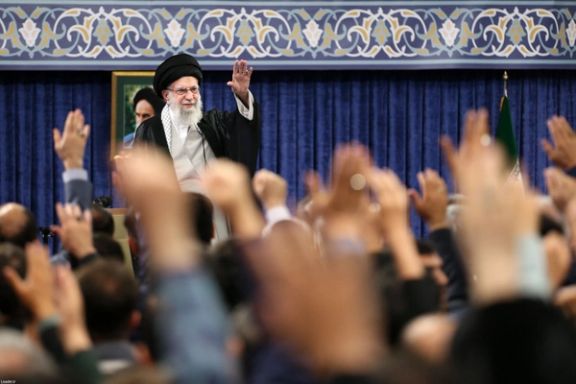
Iran’s Supreme Leader Ali Khamenei said on Tuesday that the current indirect nuclear talks with the United States are unlikely to succeed as he refused Washington's demands for Iran to halt uranium enrichment.
"Indirect negotiations took place (under Raisi) as well—just like now—but without results,” Khamenei said during a memorial ceremony for the late president and others killed in a helicopter crash last May. “We do not think it would yield results now either. We do not know what will happen.”
Turning to US calls for zero uranium enrichment, Khamenei said: “Since negotiations have come up, I want to give a warning to the opposing side. The American side that engages in these indirect talks and have discussions, should try not to spout nonsense.
"Saying things like 'we won’t allow Iran to enrich uranium' is way out of line. No one is waiting for anyone’s permission. The Islamic Republic has its own policy, its own approach, and it will continue to pursue it."
US President Donald Trump’s envoy to the Middle East on Sunday said Washington will not accept any level of uranium enrichment in a potential agreement with Tehran.
“We cannot allow even one percent of an enrichment capability,” Steven Witkoff told ABC News. “Everything begins from our standpoint with a deal that does not include enrichment. We cannot have that.”
Iran maintains its nuclear program is peaceful and Khamenei said that he would explain "at a later date" why the issue of enrichment is such a key focus of the talks, leaving the issue open.
On Monday, the United Arab Emirates-based The National cited an Iranian official as saying that Iran had not accepted Oman's invitation for a fifth round of talks with the US due to take place in Rome.
The American officials' insistence on "zero enrichment" has left Iran uncertain about the usefulness of more talks, the report said.
"Iran does not want to have another round of talks and them to fail", the official was quoted as saying. "With zero enrichment, we don't have a deal."
Iran is the only non-nuclear weapon state enriching uranium to 60% U-235, a level that causes "serious concern," according to International Atomic Energy Agency (IAEA) Director General Rafael Mariano Grossi.
The IAEA has consistently maintained that there is no credible civilian use for uranium enriched to this level, which is a short technical step from weapons-grade 90% fissile material.
Iran's stockpile of 60% enriched uranium had increased to 275 kg, enough to theoretically make about half a dozen weapons if Iran further enriches the uranium.
Earlier in the day before Khamenei's speech, deputy foreign minister Kazem Gharibabadi said Iran has received a proposal for the next round of indirect negotiations with the United States.
“We have received a proposal about the next round of negotiations with the US, and it is under review,” Gharibabadi told state media without providing further details.
Iran will retaliate with costly and damaging measures against any attempt by Europe to activate the snapback mechanism and reimpose UN sanctions, a hardline Iranian newspaper affiliated with the Revolutionary Guards warned on Tuesday.
In a scathing editorial, Javan daily criticized the threat of snapback — a mechanism in the 2015 nuclear deal that allows the return of UN sanctions — as a “European stick for blackmail” and warned of punitive and high-cost actions against the economies of the United States and Europe.
The editorial said such sanctions would be countered with restrictions in trade routes and geographies under Iran's control, adding that these areas would expand through alignment with other actors "frustrated by US and European policies.”
"The US and European economies should expect punishment and cost-imposing actions. The sanctions will be followed by bans and restrictions on their access to routes and geographies under Iranian control. These geographies, motivated by other actors frustrated with US and European policies, will expand into major commercial corridors," it said.
While Javan did not name locations directly, the paper implied that Iran could disrupt major trade corridors such as the Strait of Hormuz, where a significant portion of the world's oil passes, and possibly the Bab al-Mandeb Strait, through Tehran-aligned Houthis in Yemen, as has been seen since the militant group imposed a maritime blockade in the wake of the war in Gaza.
“Any new sanctions must be met with real costs,” the editorial said, adding that the current Iranian negotiating position is no longer based on “Westoxicated thinking” but on firm demands for compensation and full sanctions relief from the outset of any agreement.
The paper said that Iran would only allow meaningful negotiations if its rights to enrichment and the preservation of enriched uranium stocks are recognized, and if all material and immaterial damages from what it called “illegal and inhumane” sanctions are paid in full.
'Trump eyes Arab wealth, not Iran investment'
Amid the ongoing indirect US-Iran nuclear talks, the editorial targeted US President Donald Trump, Javan accusing him of having no intention or ability to invest in Iran, saying his only objective is to “loot the wealth of Arab countries” to patch up America’s struggling economy.
“Trump, who is chasing after the pockets of Arab states, has no capacity for investment in any country,” the editorial stated. “He only dreams of healing the crisis-hit American economy.”
The piece mocked Trump’s recent regional tour and his military posture, claiming that US aircraft carriers and advanced weaponry had underperformed in conflicts such as Yemen and South Asia.
It argued that despite Trump’s rhetoric, “the US military's threatening gestures lack economic backing and have led to humiliating failure against Iran and China,” adding that Washington’s strategy had shifted to diplomacy out of necessity.
The editorial dismissed recent remarks by Trump’s Middle East envoy Steve Witkoff, who said that the US would not tolerate even 1% uranium enrichment by Iran, as bluster intended to sway negotiations and distract from Washington’s weak hand.
“This time, Iran is not negotiating with illusions, but with demands. If the West wants a deal, it must stop threatening, start compensating, and lift sanctions from day one,” the editorial added.
On Monday, the European Union and the United Kingdom voiced deep concern over Iran’s expanding nuclear program and its continued imprisonment of foreign nationals, according to a joint statement issued after high-level talks.
Iran has received a proposal for the next round of indirect negotiations with the United States, deputy foreign minister Kazem Gharibabadi said on Tuesday.
“We have received a proposal regarding the next round of indirect talks between Iran and the US, and it is under review,” Gharibabadi, who serves as deputy for legal and international affairs, said in remarks published by the state media.
No further details about the content or timing of the proposed negotiations have been released.
The comments come a day after a Wall Street Journal reporter said that the next round of Iran-US nuclear talks is expected to take place this weekend in Rome.
However, citing an Iranian official, the United Arab Emirates' based The National reported that Iran has "not accepted" Oman's invitation for a fifth round of talks with the US.
It said that American officials' insistence on "zero enrichment" has left officials in Iran uncertain about the usefulness of more talks.
As European powers are in tense talks with Iran over whether to impose punishing sanctions over its nuclear program, terrorism-related arrests of Iranians on UK soil and a drama over detained Britons are pushing London-Tehran ties to new lows.
Tensions between Tehran and London have ratcheted up sharply in recent weeks, likely sharpening the collective European tack on Iran.
"Let me be clear, we will not tolerate growing state backed threats on UK soil. The Iranian regime poses an unacceptable threat to our domestic security which cannot continue," British interior minister Yvette Cooper told parliament on Monday.
Iran’s Foreign Ministry on Sunday summoned the UK’s chargé d'affaires in Tehran to protest the arrest of several Iranian nationals in the UK in connection with alleged spying and terror-related activities. On Monday, Iran's ambassador to London Ali Mousavi was summoned in response.
British authorities charged three Iranian nationals under the National Security Act on Saturday for conducting surveillance against journalists from Iran International. Earlier this month, five other Iranian nationals were detained in a separate counter-terrorism operation.
The case has added urgency to ongoing debates in the UK Parliament over whether to designate Iran’s Islamic Revolutionary Guard Corps (IRGC) as a terrorist organization.
Over 550 members of the UK Parliament and peers have signed a letter urging the British government to move forward with the designation, reflecting growing bipartisan concern over Iran’s activities in the UK and abroad.
Tense meeting in Istanbul
The EU statement released on Monday came after a meeting of senior diplomats of the UK, France, and Germany –collectively known as the E3– with two Iranian deputy foreign ministers in Istanbul on May 16 to discuss the future of the 2015 nuclear agreement (JCPOA).
The three European powers are not directly involved in ongoing Tehran-Washington talks. However, they can trigger its snapback mechanism of the JCPOA before an October deadline and reimpose all UN sanctions on Iran should talks with Washington fail.
Quoting unnamed sources, Iran’s conservative Farhikhtegan newspaper reported on Sunday that the atmosphere of the meeting in Istanbul on May 16 was highly tense, with the European side allegedly issuing serious threats to impose additional sanctions on Iran—potentially exceeding the scope of UN sanctions—if Tehran fails to comply with future agreements.
The European side, the report claimed, also demanded that any potential Tehran-Washington deal include a clause— which it referred to as “snapback-plus”—that would allow the E3 to reimpose UN sanctions in the future if Iran violated the JCPOA.
Broader grievances, distrust
Beyond the nuclear file, the E3 has cited a wide range of concerns in their dealings with Tehran: Iran’s ballistic missile program, its support for Russia in the Ukraine conflict, threats to European national security, ongoing human rights violations, and the detention of European nationals.
Iran charged a British couple on a road trip in the country with espionage in February, drawing London's ire. France too is irate at Iran's detention of two French citizens for three years, deepening collective European mistrust with Tehran.
For its part, Iran accuses the E3 of failing to uphold their economic commitments under the JCPOA following the US withdrawal. Iranian officials argue that European governments and companies yielded to American pressure, rendering the promised sanctions relief largely ineffective.
Tehran also accuses the E3 of aligning too closely with US and Israeli positions on regional security issues.
Iranian foreign minister hot and cold
Despite the strained atmosphere, Iranian Foreign Minister Abbas Araghchi has continued to espouse a conciliatory tone in public statements towards the remaining Western signatories of the JCPOA, from which the United States unilaterally withdrew in 2018.
“Iran is ready, should it see genuine will and an independent approach from the European side (parties to the 2015 nuclear deal), to begin a new chapter in its relations with Europe,” he told a diplomatic forum in Tehran on May 18.
Nonetheless, Araghchi has issued a stern warning cautioning that any move by the E3 to trigger the snapback mechanism could mark not only the end of Europe’s role in the nuclear agreement but also push Iran toward more drastic measures.
Iranian officials have threatened withdrawal from the Nuclear Non-Proliferation Treaty (NPT) if talks with the US fail and sanctions remain.
The European Union and the United Kingdom on Monday voiced deep concern over Iran’s expanding nuclear program and its continued imprisonment of foreign nationals, according to a joint statement issued after high-level talks.
“We continue to be deeply concerned by the dangerous expansion of Iran’s nuclear program, alongside its behavior in the region and on European soil,” the statement read.
The EU and UK also condemned what they described as Iran’s use of “hostage diplomacy,” calling for an immediate end to the detention of foreign nationals under politically motivated charges.
"We condemn Iran’s unjust detention of foreign nationals and call on Iran to halt its practice of hostage diplomacy," read the statement.
In January the European Parliament adopted a motion for a resolution condemning Iran’s detention of European Union citizens, labelling the practice as “hostage diplomacy" accusing Iran of using the prisoners for political ends.
Despite mounting tensions, both sides reaffirmed their commitment to securing a negotiated resolution to Iran’s nuclear issue and maintaining regional stability.
The joint statement also expressed support for political progress in Syria and Lebanon, backing efforts toward peace, stability, and reform in both countries.
The remarks come amid stalled nuclear diplomacy and rising concern among Western powers about Iran’s growing stockpile of enriched uranium and regional influence through proxy groups.
Iran on Monday criticized the United States for what it called inconsistent and hostile conduct in the ongoing nuclear talks, rejecting Washington’s demand for zero uranium enrichment ahead of a possible new round of negotiations mediated by Oman.
Speaking at a press briefing in Tehran, Iranian Foreign Ministry spokesman Esmail Bagahei said, “The difficulty of negotiating with the US lies in the fact that you are dealing with a party that respects none of the established norms of a diplomatic process.”
“The very act of imposing sanctions while claiming to pursue diplomacy with the Islamic Republic of Iran shows a lack of seriousness and goodwill,” he added, warning that Washington’s shifting positions undermined trust.
“The Americans’ shifting position on enrichment is like a game of snakes and ladders—just as we make progress, the US adopts a different stance,” Bagahei said, referring to recent comments by US nuclear envoy Steve Witkoff that Washington would not accept any level of uranium enrichment in a future agreement.
Bagahei stressed that Iran’s enrichment program was “non-negotiable,” calling it both a legal right under the Non-Proliferation Treaty (NPT) and a national achievement.
“Uranium enrichment is not some kind of fantasy that we can simply suspend or stop. It is a technology and a necessity to ensure the uninterrupted functioning of Iran’s nuclear industry,” he said. “We cannot give it up.”
Iranian Foreign Minister Abbas Araghchi also dismissed Witkoff’s remarks, saying they were “completely at a distance from the reality of the negotiations.”
In a post on X on Sunday, Araghchi wrote: “If the US is interested in ensuring that Iran will not have nuclear weapons, a deal is within reach, and we are ready for a serious conversation to achieve a solution that will forever ensure that outcome. Enrichment in Iran, however, will continue with or without a deal.”
He accused the US of contradictory messaging. “Iran can only control what we Iranians do, and that is to avoid negotiating in public—particularly given the current dissonance we are seeing between what our US interlocutors say in public and in private, and from one week to the other,” Araghchi said.
Next round of talks expected soon
Elsewhere in his press conference, Baghaei said the date and location for the next round of indirect US-Iran nuclear talks have not been set. Araghchi, however, said on Sunday that the date is set and will soon be announced by Oman, which is mediating.
Baghaei denied reports of parallel negotiations between other Iranian and US officials, specifically between Ali Shamkhani – Iran's former top security official and currently an advisor to the Supreme Leader -- and US Secretary of State Marco Rubio.
“There are no parallel negotiations. The only negotiation process that exists is this indirect one, led by the Iranian foreign minister and the US president’s special envoy,” Bagahei said.
The US and Iran have held four previous rounds of talks in Muscat and Rome. Witkoff said on Sunday that the next round could take place in Europe later this week.
President Donald Trump said Thursday the US was “very close” to a deal but issued a warning on Friday. “They have a proposal. More importantly, they know they have to move quickly or something bad—something bad’s going to happen,” he told reporters aboard Air Force One.
Baghaei said on Monday, “We have not received any written proposal from the United States, and their verbal offers constantly shift,” echoing remarks made by Foreign Minister Abbas Araghchi the previous day.
Iran to respond if E3 triggers snapback
Iran’s foreign ministry spokesman also warned on Monday that Tehran will respond to any hostile action, including a possible move by European countries to trigger the snapback mechanism—a process that would automatically reimpose UN sanctions on Iran under the 2015 nuclear deal.
“We will not leave any hostile action without a response,” Baghaei said. “There is no legal basis for activating the snapback mechanism, and the insistence of some European countries on doing so is baseless.”
“If the Europeans use the snapback mechanism, we will definitely take measures in response,” he added.