Trump says Iran deal 'very close' but public progress stays scant
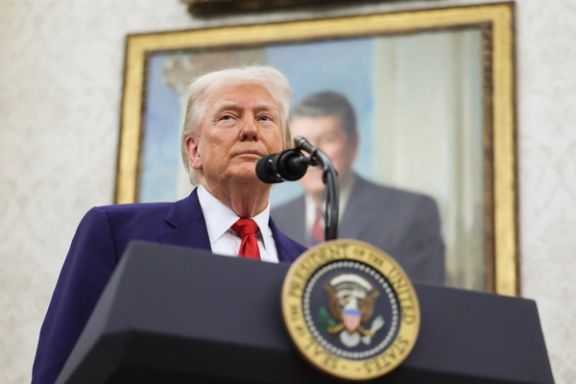
US President Donald Trump looks on as he takes questions from the press at the White House in Washington, May 28, 2025.
US President Donald Trump said on Thursday that a new nuclear agreement with Iran was close despite persistent public disagreement over enrichment, though media reports citing sources close to the talks suggested various novel ways out of the impasse.
“We are very close to a solution,” Trump said on Wednesday. “If we can make a deal, I’d save a lot of lives," adding that Iran appears willing to engage seriously and that they had constructive discussions.
The talks mediated by Oman have entered crunch time with no date and location yet announced for a sixth round.
The United States and Iran are nearing a broad agreement on the future of Tehran’s nuclear program, CNN reported on Wednesday, with talks progressing in recent weeks toward a framework that could be finalized at a future meeting.
Washington and Tehran are considering a potential multinational consortium—possibly including regional partners and the International Atomic Energy Agency—to produce nuclear fuel for Iran’s civilian reactors and may include US investment, CNN reported citing source familiar with the talks.
A White House official, speaking to Fox News, said nothing had yet been agreed on Iran’s nuclear energy program.
Iran denies enrichment freeze proposal
Tehran says its nuclear program is purely peaceful but Western countries and its Mideast adversary Israel doubt its intentions.
Iran says it is keen to reach a nuclear deal but has maintained a right to domestic enrichment despite US demands to shutter it.
Iran on Thursday denied a Reuters report citing two Iranian officials saying they were mulling a proposal to halt uranium enrichment for a year and ship part of its highly enriched stockpile abroad or convert it into fuel plates for civilian nuclear purposes.
“The continuation of enrichment in Iran is a non-negotiable principle,” Foreign Ministry spokesman Esmaeil Baghaei said Wednesday.
The suggestion mulled by Iranian officials, according to the sources cited by Reuters, envisions the disbursement of funds frozen by Washington and the recognition of Tehran's right to enrich uranium for civilian use in return for the pause.
Meant as a political deal that could pave the way for a broader accord, the proposal not yet been floated in the talks, Reuters cited the Iranian sources as saying.
Austria on alleged Iranian nuclear arms ambitions
Austria’s domestic intelligence agency released a report this week saying Iran's program to develop nuclear arms is far advanced, in wording which appeared to outstrip that of its Western counterparts.
"Nuclear weapons are intended to make the regime untouchable and to expand and consolidate its dominance in the Near and Middle East and beyond," the Austrian Federal Office for the Protection of the Constitution said in its annual report.
"The Iranian program for the development of nuclear weapons is far advanced."
The United States has publicly assessed that Iran has not yet decided to build a nuclear weapon but maintains that its nuclear program is aimed at becoming a nuclear threshold state to deter foreign attack.
The Austrian report further alleged that Tehran aims to develop long-range ballistic missiles capable of delivering nuclear warheads, without citing any evidence.
"An arsenal of ballistic missiles is ready to carry nuclear warheads over long distances."
Iran open to US inspectors
In an apparent policy shift, the head of Iran’s Atomic Energy Organization said Tehran may reconsider its longstanding ban on US nuclear inspectors if current talks with Washington lead to a successful agreement.
Mohammad Eslami said American inspectors affiliated with the International Atomic Energy Agency (IAEA) could be allowed into Iranian sites under a future deal, despite current restrictions on personnel from adversary states.
“It is normal that inspectors from hostile countries are not allowed, but if a nuclear deal is reached, we might allow American inspectors,” Eslami said.
Later on Wednesday, IAEA chief Rafael Grossi said any deal between Tehran and Washington that would impose fresh nuclear curbs on Iran should include very robust inspections by the UN nuclear watchdog.
"My impression is that if you have that type of agreement, a solid, very robust inspection by the IAEA ... should be a prerequisite," he said.
"I'm sure it will be, because it would imply a very, very serious commitment on the part of Iran, which must be verified."
US officials have repeatedly said that any new nuclear deal with Iran to replace a lapsed 2015 accord between Tehran and six world powers must include a commitment to halt enrichment, viewed as a potential pathway to developing nuclear bombs.
Iran's stockpile of 60% enriched uranium had increased to 275 kg, enough to theoretically make about half a dozen weapons if Iran further enriches the uranium.
Trump has previously warned that if no agreement is reached, military options remain on the table. “We can blow up a lab,” he said, referring to a hypothetical enforcement scenario under a possible inspection regime, “but nobody’s going to be in the lab.”
Trump, speaking to reporters, also confirmed that he warned Israeli Prime Minister Benjamin Netanyahu not to interfere with ongoing US-Iran negotiations.
The comments followed a New York Times report citing Israeli officials saying the Jewish State was preparing for a potential strike on Iranian nuclear sites even if Tehran and Washington clinch a deal.
Three Indian nationals who traveled to Iran earlier this month are missing, India’s embassy in Tehran said on Wednesday, adding that urgent rescue efforts are underway.
“Family members of 3 Indian citizens have informed the Embassy of India that their relatives are missing after having travelled to Iran,” the embassy said in a statement.
“The Embassy has strongly taken up this matter with the Iranian authorities, and requested that the missing Indians should be urgently traced and their safety should be ensured.”
The missing men — Hushanpreet Singh, Jaspal Singh, and Amritpal Singh — are all from the northern Indian state of Punjab and reportedly lost contact with their families shortly after landing in Tehran on May 1.
According to Indian media, they had planned to travel to Australia via Dubai and Iran, reportedly with the help of an agent based in Hoshiarpur who is now also missing.
Relatives said the men were kidnapped and that a ransom was demanded.
The embassy said it is in regular contact with the families. There was no immediate comment from Iranian authorities.
Iran may reconsider its longstanding ban on US nuclear inspectors if ongoing negotiations with Washington result in a successful agreement, the head of Iran’s Atomic Energy Organization said on Wednesday.
Nuclear chief Mohammad Eslami told reporters in Tehran that inspectors from the United States — currently excluded due to what Tehran views as hostile policies — could be allowed access to Iranian nuclear sites under the auspices of the UN nuclear watchdog, the International Atomic Energy Agency (IAEA), if a deal is finalized.
“It is normal that inspectors from hostile countries are not allowed, but if a nuclear deal is reached, we might allow American inspectors working for the International Atomic Energy Agency to visit our nuclear sites,” Eslami said.
The remarks come as Iran and the United States are expected to enter a sixth round of talks aimed at reviving diplomacy over Tehran’s nuclear program. US President Donald Trump, who withdrew from the 2015 nuclear agreement during his first term, said earlier this month that he expects “good news” from the negotiations.
Enrichment still a red line
Eslami said that uranium enrichment remains a red line for Tehran, speaking of its significance to the country’s nuclear infrastructure.
“Enrichment is the foundation and pillar of the country's nuclear industry,” he said, comparing Western proposals to allowing a country access to a power grid while denying it the ability to generate electricity.
Daily electricity consumption in Iran can vary, with peaks reaching over 72,000 megawatt (MW), exceeding the actual power generation capacity of 60,000 MW during the summer. The capacity of Bushehr nuclear power plant, Iran’s biggest, is currently 1,000MW.
Western powers, led by Washington, have demanded Iran halt uranium enrichment over fears it could lead to nuclear weapons development. Tehran says its program is purely civilian and that it has no plans to build a nuclear bomb.
Iran’s nuclear chief also expressed hopes for what he called greater professionalism from the IAEA and urged the agency to resist outside political pressures, particularly from what he described as “Zionist influence.”
IAEA deputy director allowed to visit sites
He said IAEA Deputy Director General Massimo Aparo is currently in Tehran to inspect two remaining sites as part of an earlier agreement signed in March 2023.
“We hope the agency will act professionally and reduce the influence of the Zionist current,” Eslami said, adding that Iran is fully transparent and operates under full IAEA oversight.
No official proposal on consortium
Addressing reports of a potential nuclear fuel enrichment consortium involving Persian Gulf states, Eslami said Iran has not yet received an official proposal on the matter.
“Our position is legal and based on our rights. Enrichment is the essence of our nuclear industry. We are committed not to pursue nuclear weapons,” he said.
Eslami also dismissed recent allegations from opposition groups and Israeli intelligence about secret nuclear activities, calling them recycled accusations aimed at undermining Iran’s nuclear program.
“Such claims have always been made, but they are baseless. Whenever inspections occur, the truth emerges,” he said.
Oversight of Iran's nuclear facilities has been increasingly challenging for the IAEA. In 2022, Iran removed IAEA cameras and in September 2023, Iran banned a third of the IAEA's inspectors.
Washington is more open to agreeing an interim set of principles for a final nuclear deal with Tehran to break a diplomatic impasse in talks and forestall a potential Israeli attack on Iran, the New York Times reported on Wednesday.
The newspaper, which reported last month that US President Donald counseled Israeli Prime Minister Benjamin Netanyahu against an attack on Iranian nuclear facilities, cited sources familiar with the talks and Israeli thinking.
The United States has become more open to an interim declaration of common principles on a final deal to preempt such an attack, according to the paper.
Mediator Oman and the United States are also discussing creative ways to keep the talks from running aground over the main sticking point of Iranian enrichment.
These include a regional venture to produce fuel for nuclear powers that would involve Iran, Saudi Arabia, and other Arab states, with participation from the United States—though the details of such a plan remain unclear.
A fifth round of negotiations between the US special envoy Steve Witkoff and Iranian foreign minister Abbas Araghchi wrapped up on Friday in Rome with little public sign of progress.
Washington has repeatedly insisted Iran commit to ending domestic enrichment of uranium in a move Tehran has called a non-starter.
Witkoff, the New York Times cited participants in the talks, has dropped an initial rejection of any interim set of understandings on an ultimate deal, in a formula which might fall afoul of Israel and Iran hawks within the US congress.
Israeli officials, according to the sources cited by New York Times, have informed US counterparts that Israel could launch an attack on Iranian nuclear sites even after a deal should it deem the agreement unsatisfactory.
Netanyahu has publicly insisted that Iran suspend all its nuclear activity, in demands which far outpace US insistence on ending enrichment.
The Israeli premier's office issued a statement on Wednesday in response to the article which said simply: "Fake news".
Iran sees domestic uranium enrichment as a national achievement enshrined by international covenants and has accused Washington of being beholden to maximalist Israeli goals.
Some military experts have doubted whether Israel alone can knock out Iranian nuclear capabilities by itself and see its chances of success as much improved with American participation.
An Iranian national has pleaded guilty to charges linked to a ransomware campaign that targeted multiple US cities, including a 2019 cyberattack that crippled services in Baltimore, Maryland, the Department of Justice (DOJ) said on Tuesday.
Sina Gholinejad, 37, admitted to one count of computer fraud and abuse and one count of conspiracy to commit wire fraud. He faces a maximum sentence of 30 years in prison. His sentencing is scheduled for August.
According to court documents, Gholinejad and co-conspirators used the Robbinhood ransomware to breach and encrypt files on the networks of municipalities, health care providers, and nonprofit organizations across the United States between January 2019 and March 2024.
Victims included the cities of Greenville, Gresham, Yonkers, and Baltimore, which alone incurred more than $19 million in damages and lost services.
The attacks rendered city systems offline for months, disrupting essential functions such as water billing, property tax collection, and parking enforcement. Prosecutors said the group demanded Bitcoin payments in exchange for decryption keys and sometimes threatened to publish stolen data.
No state affiliation of the case has been made by the DOJ, but US authorities have previously warned of cyber threats from Iranian state-linked groups. Iran has denied targeting US entities with cyberattacks.
Gholinejad was arrested on January 10, 2025, at Raleigh-Durham International Airport.
The FBI led the investigation, with assistance from Bulgarian authorities.
Iran executed a man convicted of espionage for Israel, judiciary-affiliated news agency Mizan reported on Wednesday, prompting fresh condemnation from several human rights advocates.
Pedram Madani was sentenced to death by a Revolutionary Court on charges of “corruption on earth” over allegations he provided intelligence to Israel as well as "Moharebeh" (waging war against God).
Madani, a political prisoner in his 40s, was arrested in 2019 and had been held in Tehran’s Evin Prison before being transferred to Ghezelhesar Prison days before the execution.
Iran Human Rights (IHR), a Norway-based NGO, said Madani’s death sentence had been overturned by the Supreme Court on three occasions, but the case was reassigned to other branches that reinstated the verdict.
“These are death sentences without due process,” said IHR director Mahmood Amiry-Moghaddam. “They amount to extrajudicial killings.”
Nobel Peace Prize laureate Nargess Mohammadi had called the case “a blatant act of injustice,” saying Madani was denied access to an independent lawyer and coerced into confessing under pressure and prolonged solitary confinement.
Iran's judiciary has not responded to the allegations of procedural irregularities. Authorities have previously defended such cases as necessary for national security, especially amid rising tensions with Israel and reports of sabotage and assassinations inside Iran.
Activists and former detainees described a growing trend of accelerated capital punishment. Mehdi Mahmoudian, a civil activist detained in Evin, said Madani was misled with promises of clemency. “He is the third prisoner in a month to be removed from Ward 4 for execution,” he wrote on social media.
Last month, Iran executed Mohsen Langarneshin, a cyber expert also convicted of aiding Israel. His case, too, drew international criticism after a leaked recording raised questions about the legitimacy of his confession.
At least 113 executions have been recorded in the first 25 days of 2025, IHR reported.
Iran accounted for 64% of all known global executions in 2024, with at least 972 people executed, according to Amnesty International.
Iran has consistently rejected criticism of its judicial system, saying that its courts operate independently and in accordance with Islamic law. However, rights groups and the United Nations have repeatedly called on Tehran to halt executions and ensure fair trials.
Iran Human Rights' 2024 annual report on the death penalty in Iran said that forced confessions, especially those aired live on television, have become "a propaganda tool aimed at creating fear and justifying the heavy sentences handed down to its political opponents and activists".