Blackouts return to Iran as post-war strain exposes grid failures
Widespread blackouts have returned to Iranian homes and public facilities, days after the war with Israel ended, exposing the fragility of the country’s power infrastructure, which had briefly held up while much of the country was shut down.
Officials now cite rising demand and long-standing shortfalls in generation capacity as the cause.
The grid is unable to meet current consumption levels, prompting scheduled two-hour power outages daily, Iran's state electricity company chief, Mostafa Rajabi Mashhadi said. “The demand exceeds production,” he said, adding that outages would decrease only if energy use fell.
“The shortages will ease whenever the energy crisis is reduced to a minimum,” he said, a vague promise that has done little to calm public anger.
Iranian citizens have begun circulating videos of renewed blackouts in cities like Ahvaz, where summer temperatures regularly exceed 50°C.
“After the war ended, the Islamic Republic went back to factory settings,” one resident said in a video sent to Iran International.
Electricity generators, once confined to bakeries, were now being used by most businesses, driving up noise and pollution, he added.
Subsidy system overhaul planned
In parallel, Mohammad Bahrami Seifabadi, a lawmaker on the parliamentary energy committee, unveiled a new two-tier pricing scheme for power and gas.
“Each person will have a fixed energy quota and pay full cost beyond that,” he said, framing it as a replacement for Iran’s current subsidies system.
“Instead of subsidizing consumption, energy support will go to each national ID and individual,” Bahrami added.
Temporary stability during war
Power outages had temporarily eased during the recent 12-day confrontation with Israel, with many workplaces shut. Officials implied the grid had improved, but analysts say the drop in usage, not any reform, was responsible.
“Power cuts during the war were because everything was closed, but the government claimed the credit,” said Reza Gheibi, an Iran International journalist. “Now the deficiencies are back in the open.”
Energy Minister Abbas Aliabadi promised earlier this week that nighttime blackouts would be minimized. “If necessary, disruptions will occur more during the day,” he said in early June.
Successive Iranian summers have seen repeated electricity shortages, often described by officials as “imbalances” between supply and demand.
Energy experts attribute the crisis to underinvestment, dilapidated infrastructure, and a chronic failure to expand power generation, which is estimated to lag by roughly 14,000 megawatts.
A resident of Ahvaz said the latest outages have been especially punishing: “It feels like they are making us pay for the war with Israel.”
United Nations experts on Friday urged Iranian authorities to end a post-ceasefire crackdown marked by executions, mass arrests, and hate speech, warning that the country risks repeating past cycles of repression.
“Post-conflict situations must not be used as an opportunity to suppress dissent and increase repression,” the experts said in a statement, referring to the aftermath of Iran-Israel conflict which began on June 13 and ended with a ceasefire.
The experts which included UN Special Rapporteur on the situation of human rights in the Islamic Republic of Iran, Mai Sato, said they were alarmed by reports that at least six individuals, including three Kurdish men, had been executed on charges of “espionage for Israel.”
They also cited the arrests of hundreds of people, including journalists, human rights defenders, social media users, foreign nationals — particularly Afghans — and members of ethnic and religious minorities such as Baha’is, Kurds, Balouchis and Ahwazi Arabs.
The experts expressed concern over the detention of human rights defender Hossein Ronaghi and his brother and Swedish-Iranian academic Ahmadreza Djalali who they said faced imminent execution with his whereabouts unknown.
The experts warned that Iran’s parliament was advancing legislation that would categorize intelligence activities on behalf of “hostile governments” as “corruption on earth” — a charge punishable by death under Iranian law.
“Criminalizing the sharing of information in broad language violates the rights to freedom of expression and information,” the statement said. “This legislation also represents a worrying expansion of the death penalty that violates international human rights law.”
They also condemned the deteriorating conditions of prisoners transferred from Evin Prison following Israeli strikes on its facilities.
Many detainees were moved to the Great Tehran Penitentiary and Qarchak Prison and held in inhumane conditions. The whereabouts of some prisoners remain unknown, the experts said, describing the situation as amounting to enforced disappearances.
Iran has transferred French nationals Cécile Kohler and Jacques Paris to undisclosed locations after they survived explosions during Israeli strikes on Tehran’s Evin prison on June 23, their family told Iran International.
“Iranian authorities don't tell [us] where they are being held,” Cécile’s sister Noémie told Iran International on Friday.
The couple were arrested in May 2022 while on a tourist trip to Iran.
Noémie said that since the Israeli strike, they have had only one consular visit, on July 1, when the family was relieved to learn that they were "at least still alive.”
She said that the couple had been held in Ward 209 — which operates under the oversight of Iran's Intelligence Ministry — at the time of the strike, and that they had remained there for more than three years.
“They were held in 209 for more than three years,” she said. “They were in solitary confinement several months.”
Ward 209 lies outside the prison's regular judicial oversight and has been described by Human Rights Watch as a “prison within a prison,” where detainees are frequently subjected to prolonged solitary confinement, denied legal access, and subjected to harsh interrogation that may amount to torture.
The couple were moved shortly after the blasts. “We understood [Cécile] was transferred to Qarchak prison,” Noémie said. “She was transferred to Qarchak prison for 24 hours. Then she was transferred to an undisclosed place — she was blindfolded so she doesn’t know where she is being held right now.”
“Jacques was transferred to an undisclosed location right after the bombings,” she added.
The family has not had direct contact with either of them since May 28.
Noémie said Iranian authorities recently charged the couple with “spying for Israel,” “conspiracy to overthrow the regime,” and “corruption on Earth” — charges that carry the death penalty under Iranian law.
“We don’t have more specific information. We only know a judge told them the charges,” she said.
She said the couple is not allowed independent legal representation and that “nobody has access to their case file.”
Psychological torture
During their last direct contact on May 28, Cécile told her family that a judge had warned them a verdict would be issued soon — and that it would be “very severe.”
“The judge had been telling them that for six months,” Noémie said. “Another example of psychological torture.”
Asked why Iranian authorities may be targeting the couple so harshly, Noémie said, “To put pressure on France, I assume. We don’t know what they want and why they persecute Cécile and Jacques this badly.”
She accused Iranian authorities of ongoing abuse. “The Iranian authorities are continuing to torture Cécile and Jacques psychologically after more than three years of detention in inhuman conditions, after they narrowly survived the bombings, with charges that carry the death penalty,” she said.
“They must stop trampling on Cécile and Jacques's rights, disclose their place of detention, allow them to contact their families, and above all hand them over to the French authorities as a matter of urgency.”
France has condemned the charges as politically motivated and continues to demand the couple’s immediate release. Foreign Minister Jean-Noël Barrot has called the accusations “unjustified and unfounded.”
Noémie said she believes the French government is making efforts to help, but called the lack of transparency “complicated and frustrating.”
“My message to Western leaders, especially European, is that they have to work together to put an end to hostage diplomacy,” she added.
Kohler, a teacher, and Paris, her partner, are the last known French citizens held in Iran. French President Emmanuel Macron has described them as “state hostages.”
France and other European Union members accuse Iran of practicing “hostage diplomacy” — detaining foreigners to pressure Western governments.
Iran denies the accusation. Its officials say the arrests followed legal procedures and reject claims of mistreatment.
Former US national security advisor and veteran Iran hawk John Bolton hopes a White House meeting between Donald Trump and Benjamin Netanyahu will pave the way for Tehran's downfall.
“I think here's where they should discuss the terms of, in effect, the surrender of the Ayatollahs,” Bolton said, calling for sustained pressure to build on military successes in a 12-day Israel-Iran war to pave the way for the collapse of Iran's theocracy.
Trump is due to receive Netanyahu on Monday in their first meeting since US and Israeli strikes targeted Iran’s nuclear facilities, missile infrastructure and command centers, killing as many up to 1,200 Iranians. 24 Israelis were killed in Iranian attacks.
Netanyahu has said he will also meet Secretary of State Marco Rubio, Defense Secretary Pete Hegseth, Commerce Secretary Howard Lutnick, and Trump’s Middle East envoy Steve Witkoff.
A weakened Islamic Republic
Bolton argued that the strikes which crippled key military sites and killed senior commanders of Iran’s Islamic Revolutionary Guard Corps (IRGC), have pushed the Islamic Republic's leadership to the brink.
“The aerial strikes are really a substantial destabilizing factor,” he said. “They demonstrate beyond a doubt the Ayatollahs are no longer able to defend their own country. They can be pushed about at will.”
The Islamic Republic, Bolton argued, is at its most vulnerable point since the 1979 revolution, weakened not just militarily but also internally, citing longstanding discontent, particularly among youth, women, and ethnic minorities.
“We're within sight of it, which is why it would be such a tragedy to let up now and let it slip between our fingers,” said Bolton.
There have been few significant protests during or after the conflict.
Ceasefire 'mistake'
Although Bolton praised the initial decision to strike Iran’s nuclear program, he criticized the subsequent US-brokered ceasefire as “a mistake.”
“Our military knows that you don't know exactly how much damage has been done in the first hours after an attack,” he said. “We were in complete control of the skies ... (and) that gave us time ... to decide where additional attacks might be necessary.”
Instead, Bolton said the ceasefire gave Iran breathing room at a critical moment. He attributes that decision, in part, to Trump’s desire to appear as a global dealmaker.
“Trump wants a Nobel Peace Prize and I think he believes that after a very successful US military strike that he could broker it,” said Bolton. “It's always in personal terms for Trump. It's not about American national security interests or Israel or Iran, it's about what makes him look best.”
The president and Bolton spectacularly fell out in public and Trump has repeatedly insulted his ex-subordinate and pulled his government security detail.
Bolton accused the administration of prioritizing loyalty and optics over expertise, pointing to Trump’s appointment of real estate developer Steve Witkoff as Iran envoy.
“Trump's negotiator, Steve Witkoff… has no concept what he's dealing with when he negotiates with the Ayatollahs, no knowledge of nuclear weapons or the risk of nuclear proliferation,” said Bolton.
Critics have raised concerns about 900 pounds of uranium enriched to 60 percent that remains unaccounted for. Bolton said strikes on Esfahan and other sites likely destroyed key elements required to turn that material into a weapon.
“They may have a lot of partially enriched uranium hexafluoride gas,” he said, “but it's a long way to go from that to actually making a nuclear weapon.”
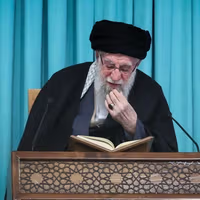
Supreme Leader Ali Khamenei’s declaration of victory in the recent war with Israel and the United States continues to be met with disbelief and ridicule by many ordinary Iranians who mock his televised remarks from a hidden location.
In dozens of messages sent to Iran International's submissions line, Iranians lambasted Khamenei for what they called a false triumph narrative delivered from underground.
“This shameless coward sends messages from a rat hole while the Israeli prime minister walks among his people,” one person said. “Even a kid can tell what really happened.”
In a June 26 speech broadcast from an unknown location, the 86-year-old theocrat said Israel “was nearly brought to its knees" and that Iran had dealt the United States “a harsh slap”.
“If he’s telling the truth, let him come out and speak," another person told Iran International. "He’s still hiding in the sewers."
Mockery was sharp and specific in almost all messages. Another described the leader as “a baby-faced coward high on his own smoke, completely out of touch.”
A leader underground, a public exhausted
A Tehran resident added: “We’ve lived under this regime for nearly fifty years. We’ve learned to reverse everything they say. If he says we crushed them, it means we were crushed.”
Khamenei’s continued isolation was a recurring theme for contributors.
“He hasn’t seen sunlight for weeks. He’s delusional from being underground too long,” one message read. “Come up and see if even a dozen people still believe your story.”
Several messages questioned why, if victory had truly been achieved, key Iranian figures like Foreign Minister Abbas Araghchi reportedly had to request safe passage from Israel just to leave Iranian airspace. Others said even funeral processions of senior commanders were clearer signs of defeat than any speech.
“You weren’t leading anything,” said another viewer. “You hid while others died. Then you reappeared to lecture us from a camera.”
“We’re tired. We’ve survived forty-six years of war, lies and plunder. Enough,” said another.
One contributor predicted there would be no refuge from an inevitable popular backlash: “One day, the people will raise a new flag with bare hands. That day, there will be no bunker and no lie left for you to hide behind.”
Ali Khamenei has not appeared at any public gathering or event since the start of the 12-day war with Israel. He skipped the funerals of slain military commanders and nuclear scientists, and did not even attend the annual mourning ceremonies held at the Hussainiyah in his Tehran compound.
Iran executed at least 21 people during its 12-day conflict with Israel last month including six men accused of spying for the Jewish state, according to a report by Oslo-based rights group Iran Human Rights (IHR).
IHR said many of the espionage trials were rushed and relied on confessions obtained under torture.
Among those hanged on espionage charges were political prisoners Esmail Fekri who was executed after a 10-minute trial without access to a lawyer, Mohammad Amin Mahdavi Shayesteh who allegedly confessed under torture and three Kurdish men including an Iraqi national accused of assisting in the 2020 assassination of nuclear scientist Mohsen Fakhrizadeh, according to IHR.
“The Islamic Republic is at its weakest point in its history, and in order to survive, it needs to carry out more executions to intimidate what it sees as its greatest threat: the Iranian people,” said IHR Director Mahmood Amiry-Moghaddam.
The group said 98 people were executed in total across Iran in June alone. Nearly half were executed for drug-related offenses, while 32 were carried out under the Islamic law of retribution for murder, IHR's report said.
Among those put to death were Afghan nationals, members of Iran’s Kurdish, Arab, and Baluch minorities and one woman.
IHR's report comes amid an escalating crackdown on dissent following the conflict in which Iran's military and nuclear program were dealt big setbacks.
Rezgar Beigzadeh Babamiri, a Kurdish political prisoner arrested during the 2022 nationwide protests, was sentenced to death on charges including plotting to assassinate Supreme Leader Ali Khamenei, his daughter told Iran International on Thursday.
At least 612 people were executed in the first half of 2025 — a 119% increase compared to the same period last year, the report added.
Iran accounted for 64% of all known global executions in 2024, with at least 972 people executed, according to Amnesty International, in what the rights group deems an ongoing official campaign to suppress dissent.