Iran detains 2,000 in war sweep, some may face death for Israel espionage
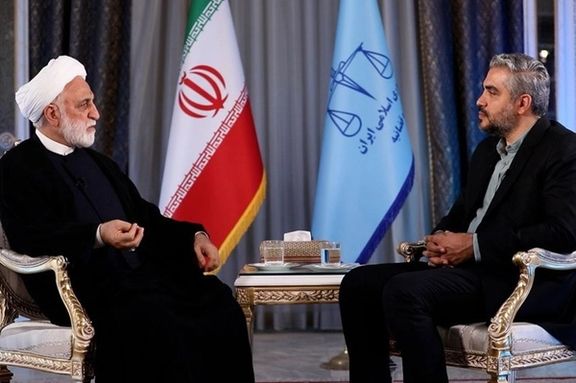
Iran’s judiciary chief Gholamhossein Mohseni Ejei during an interview with state TV (July 2025)
Iran’s judiciary chief said around 2,000 people were arrested during and after the 12-day war with Israel, with some detainees accused of collaborating with the Jewish state potentially facing the death penalty.
“In our law, anyone who cooperates with a hostile state during wartime must be arrested and prosecuted,” Gholamhossein Mohseni Ejei said in an interview with state TV.
“Some of these individuals face severe punishments, including the death penalty, while others may receive lighter sentences,” he added.
The country's chief justice added that many of those detained were released shortly after investigations found no evidence of espionage or cooperation with Israel. Others were released on bail despite lingering suspicions.
Some detainees have been accused of direct ties to Israel and are being interrogated to identify potential co-conspirators, Ejei said.
Ejei said the judiciary has ordered expedited handling of these cases under wartime legal procedures. Indictments have been issued for some cases and trial dates set, while others are still under investigation.
Iran’s parliament has passed an emergency bill to increase penalties for espionage and collaboration with “hostile states.”
Last month, UN experts which included UN special rapporteur on the situation of human rights in the Islamic Republic of Iran, Mai Sato, urged Iran to stop what they described as "post-ceasefire crackdown."
The experts cited the arrests of hundreds of people, including journalists, human rights defenders, social media users, foreign nationals — particularly Afghans — and members of ethnic and religious minorities such as Baha’is, Kurds, Baluchis and Ahwazi Arabs.
Iran's president said that the country is ready for further conflict with Israel as tensions continue to simmer in the wake of the 12-day war, saying that he does not believe that the fragile ceasefire is final.
“We are fully prepared for any Israeli military action, and our forces stand ready to strike deep into the occupied territories once again,” Masoud Pezeshkian told Al Jazeera Arabic, stressing however that the country does not want war.
The conflict between Iran and Israel was triggered by Israeli airstrikes on June 13 that hit military, nuclear, and civilian sites across Iran. Among those killed were senior Iranian military commanders and nuclear scientists.
Iran retaliated with ballistic missile and drone attacks on Israel.
Iran says 1,062 people were killed during the 12-day conflict with Israel, including 786 military personnel and 276 civilians.
Israeli medical officials say a total of 28 people were killed and over 3,000 were wounded by Iranian attacks.
Pezeshkian said Tehran holds Washington partly responsible for the attacks after the US conducted follow-up strikes to Israel's opening attacks on three major Iranian nuclear facilities, later saying to have "obliterated" them. A ceasefire between Iran and Israel took effect on June 23.
Iran says its nuclear program is peaceful. Pezeshkian repeated the same position in the interview, adding that the Islamic Republic has no intention of acquiring nuclear weapons.
“We categorically reject possessing nuclear weapons,” he said. “This is our political, religious, human, and strategic position.”
The president also disputed US President Donald Trump's statement that Iran’s nuclear capabilities had been destroyed, calling the claims an "illusion".
“Nuclear capability resides in the minds of our scientists, not in our facilities," he said.
Diplomatic negotiations on Iran’s nuclear program are expected to resume Friday in Istanbul, where Iranian officials will meet representatives of the E3—France, Germany, and the UK. Talks between Iran and the US, previously channeled through Oman, remain suspended following last month’s escalation.
The three European states, known as E3, have said they would restore international sanctions on Iran by the end of August if the country did not enter productive talks on its nuclear program with Western powers.
Pezeshkian said Tehran remains open to diplomacy but added that “Any future negotiations must be based on a win-win logic.”
Iranian officials increasingly suspect a coordinated campaign of sabotage may be behind the recent wave of unexplained fires and explosions across the country, The New York Times reported.
Over the past two weeks, Iran has seen near-daily reports of fires, blasts, and industrial accidents, striking residential towers, oil facilities, airports, and commercial buildings in cities including Tehran, Karaj, Qom, Mashhad and Tabriz.
While state media and officials have attributed most of the incidents to aging infrastructure or gas leaks, three Iranian officials, including a member of the Islamic Revolutionary Guards Corps (IRGC), told New York Times that they believe many of the events are deliberate acts of sabotage.
Though no evidence was provided, the officials pointed to Israel’s long history of covert operations in Iran, especially its use of targeted assassinations and cyberattacks.
The Iranian government has not publicly acknowledged the sabotage theory. Officials who have spoken publicly say the explosions are the result of technical faults, maintenance issues, or "owner negligence." But the absence of convincing explanations has fueled public skepticism.
On July 10, an explosion at a residential tower in western Tehran caused heavy structural damage and injured several people. Authorities blamed a gas leak, but local eyewitnesses told media outlets the building had not yet been connected to the gas grid.
In one 24-hour span last week, explosions and fires were reported at Mashhad Airport, a desert area near Semnan, and a commercial building in central Tehran. Officials attributed the Mashhad incident to the "controlled burning of weeds," further feeding public disbelief.
Iran should return to nuclear talks, US Ambassador to NATO Matthew Whitaker said in an interview, despite citing President Donald Trump's position that US attacks on Iran last month had devastated its nuclear program.
"Since we obliterated their nuclear program, I think it is time for Iran to come to the table and negotiate with the United States of America on a path towards peace and prosperity for the Iranian people," US Ambassador to NATO Matthew Whitaker told Fox News.
Still, Whitaker said he did not trust Iran's Foreign Minister Abbas Araghchi to deliver an accord after he told the same network the previous day that US strikes had serious damage Iranian nuclear sites but that Tehran would not give up enrichment.
“I don’t believe a single word that the Iranian foreign minister says,” Whitaker said.
“He’s not a credible voice for peace. President Trump’s been very clear—Iran cannot have a nuclear weapon. And since we obliterated their nuclear program, I think it is time for Iran to come to the table and negotiate with the United States of America.”
Iran is expected to meet this week with France, Germany and the UK. Tehran has said it will not end uranium enrichment, even as European powers have mooted triggering renewed international sanctions if no agreement is reached by the end of August.
White House Press Secretary Karoline Leavitt said on Monday that the administration continues to be open to talks with Iran if it deems to be necessary.
Asked whether NATO allies share the administration’s stance, Whitaker said what he called the free world sees Iran and Russia as destabilizing forces.
“You’re either with the side of peace—peace through strength with Donald Trump and the United States—or you’re with the outcast crew of China, Iran, and others who don’t want peace and prosperity for their people,” he said.
“At the end of the day, our allies want to be with us.”
NATO has been critical of the role of Iran in supplying drones to Russia to use in war against Ukraine.
Secretary General Mark Rutte in May warned of increased coordination among the bloc's adversaries Russia, China, North Korea and Iran.
The United States is open to direct talks with Iran but the next move must come from Tehran, the State Department said on Tuesday, as the Islamic Republic and European powers gird for high-stakes nuclear talks in Istanbul later this week.
“As the president has said, the Iranian people stand to benefit from negotiating in good faith. The ball is in their court,” said Tammy Bruce, spokesperson for the US State Department. “The Iranian leadership has a window of opportunity to choose a path of peace and prosperity for their people.”
Bruce told reporters Tuesday that Washington is “also ready to talk directly to the Iranians,” while coordinating closely with its E3 partners—Britain, France and Germany.
Bruce's remarks come ahead of Friday’s meeting in Istanbul, where the E3 will meet directly with Iranian diplomats at the deputy foreign minister level to discuss Iran’s nuclear program and potential sanctions measures.
“The topic of the talks is clear, lifting sanctions and issues related to the peaceful nuclear program of Iran,” Iranian Foreign Ministry spokesman Esmaeil Baqaei said in his weekly briefing.
Speaking on Fox News ahead of the talks, Iranian Foreign Minister Abbas Araghchi said Tehran will not abandon its nuclear program—including uranium enrichment—despite “severe” damage from recent US strikes.
“Our enrichment is so dear to us,” he said. “Obviously we cannot give up our enrichment, because it is an achievement of our own scientists and now more than that, it is a question of national pride," Araghchi told Fox News.
Israel caused over 100 Iranian missile launchers to explode upon activation during the war last month, an Iranian analyst alleged in a newspaper interview, adding that the country’s entire air defense system was hacked by Israel.
“We saw that 120 to 150 rocket launchers exploded the moment they were activated, and Iran’s entire air defense system was hacked,” Saeed Leilaz told Eqtesad Online in an interview published Tuesday.
The assertion was a rare detailed account of specific military and intelligence failures in Iran's heavily controlled media.
A former US intelligence officer told Iran International that figures disclosed publicly are often understated, suggesting the level of Israeli penetration and infiltration could be even deeper.
“When someone says it's between 120 and 150, that's huge — but the real number could be significantly higher,” said Michael Pregent, an independent analyst.
Leilaz criticized Iran’s unpreparedness for what he described as a multi-layered surprise attack by Israel, saying the breach exposed deep and widespread security failures.
"I no longer trust any military or security personnel — whether from the Revolutionary Guards, the Ministry of Intelligence, or the army — unless proven otherwise,” he said.
“From a security standpoint, it can easily be said that the Islamic Republic of Iran was brought to its knees,” Leilaz added.
During the war, Israel killed several senior commanders of Iran’s Islamic Revolutionary Guard Corps (IRGC), including Armed Forces Chief of Staff Mohammad Bagheri, IRGC Commander Hossein Salami, IRGC Aerospace Force Commander Amir Ali Hajizadeh, and IRGC Deputy for Operations Mehdi Rabbani.
Asked whether Iran could recover its air defense system following the widespread hacking Leilaz described, Pregent was doubtful.
“The systems they’re using are Russian. Israel already knows how to hack them and conduct cyberattacks to infiltrate, manipulate data and disable defense assets,” he said.
“If Iran is trying to replenish its air defense systems and return to its previous capacity, it’s basically reinstalling the same system — one that Israel can take down again.”
Israeli airstrikes and drone attacks during the 12-day war killed hundreds of Iranians including civilians, military personnel and nuclear scientists. Iran's retaliatory missile strikes killed 27 Israeli civilians.
According to an Iranian government spokesperson, 1,062 Iranians were killed during the conflict, including 786 military personnel and 276 civilians.
Leilaz also criticized the Islamic Republic’s approach to possible negotiations with the United States, urging the government to first negotiate with its own people.
“During the 12-day war, despite being disillusioned with the ruling system, the Iranian people quietly rose up to defend the country’s territorial integrity. That means there is still room for reconciliation between the Iranian people and the Islamic Republic,” Leilaz said.
The White House said on Monday that the Trump administration remains open to talks with Tehran, as Iran prepares to meet with European allies for a new round of nuclear negotiations on Friday.