Veteran activist urges Khamenei to allow fundamental change or resign
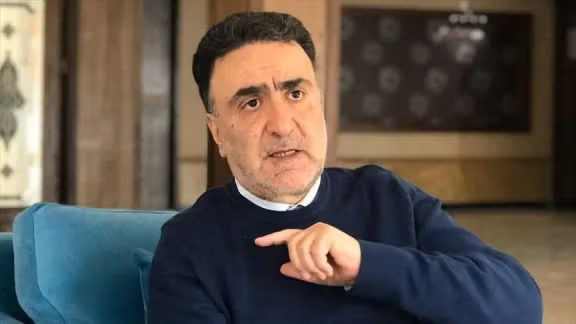
Mostafa Tajzadeh
An imprisoned Iranian political activist issued a statement on Wednesday demanding Supreme Leader Ali Khamenei admit profound failures following a war with Israel and usher in fundamental change or else quit.
"The Supreme Leader’s misguided strategies and miscalculations have placed the Islamic Republic in its weakest and most fragile state ever,” Mostafa Tajzadeh said in the statement released on his official Telegram channel.
"In this critical situation, Mr. Khamenei has no option but to apologize to the Iranian people and accept fundamental reforms in line with national demands, including by forming a constituent assembly based on completely free and fair elections," he added, "or to resign and step down."
Mostafa Tajzadeh is a reformist politician who served as deputy interior minister during the presidency of Mohammad Khatami from 1997 to 2005.
He is closely aligned with Iran’s reformist political faction and has been imprisoned for 10 of the last 16 years, currently on charges including acting against the state, spreading falsehoods and propaganda.
Critical of Khamenei’s handling of tensions with the United States and Israel, Tajzadeh outlined a series of steps the Supreme Leader should take.
Tajzadeh said the change ought to resemble the 1905-1911 Constitutional Revolution which transformed the Qajar monarchy into a modern government through the establishment of a parliament.
Israeli airstrikes and drone attacks during a 12-day war last month killed hundreds of Iranians including civilians, military personnel and nuclear scientists. Iran's retaliatory missile strikes killed 27 Israeli civilians.
"It must be admitted with great sadness that the result of unnecessary and costly anti-Americanism, as well as the conflict with the will of the majority of the people, has been nothing but a bankrupt economy (and) a bleak outlook," Tajzadeh added.
A newspaper affiliated with Supreme Leader Ali Khamenei condemned Iran’s foreign minister for denying threats to assassinate US President Donald Trump, calling it state policy and a matter of justice.
“The issue with Trump and Netanyahu is not assassination, but the implementation of justice,” Kayhan wrote Wednesday, also referring to Israeli Prime Minister Benjamin Netanyahu.
Foreign Minister Abbas Araghchi said in an interview with Fox News on Tuesday that the Islamic Republic does not seek to kill anybody abroad.
"This is not our policy to kill anybody outside Iran, let alone the president of another country," he said, though clerics have issued fatwas calling for his death.
The call came days after Ayatollah Naser Makarem Shirazi and Ayatollah Hossein Nouri Hamedani issued separate fatwas against Trump and Netanyahu.
Shirazi said in his statement: “Any regime or individual threatening the leaders of the Islamic Ummah (nation) and acting on those threats qualifies as a mohareb.”
Kayhan described both Trump and Israeli Prime Minister Benjamin Netanyahu as corruptors on earth and mohareb (enemy of God), terms which if invoked in fatwas or decrees under Shi'ite jurisprudence make it religiously obligatory for devout Shi'ite Muslims to act.
The penalty for the crimes in the Islamic Republic's theocratic system is death.
Kayhan also denounced Araghchi’s comment that “this has never been Iran’s policy to wipe out Israel from the map,” calling the comment “against the country’s official and strategic positions.”
The paper cited statements by the Islamic Republic’s founder, Ruhollah Khomeini, who said Israel “must vanish from the page of time,” as well as Khamenei’s 2015 vow that “Israel will not see the next 25 years.”
The front page of the Kayhan newspaper in September 1982, featuring a headline quoting Islamic Republic founder Ruhollah Khomeini saying, “Israel must vanish from the page of time.”
The backlash follows criticism from the Revolutionary Guards-affiliated Fars News Agency, which said Araghchi’s recent remarks admitting damage to the country's nuclear facilities and enrichment risked projecting weakness in the wake of the war with Israel.
“Our facilities have been damaged – seriously damaged,” Araghchi said in his interview after US strikes on the country's three main facilities were said to have "obliterated" Iran's nuclear program, according to Trump. “The extent of which is now under evaluation … enrichment has currently ceased."
Fars also faulted him for dismissing clerical fatwas targeting Trump, saying that to deny it undermines national resolve.
In January, Iran's President, Masoud Pezeshkian, said that Iran “never attempted” to kill Trump, “and we never will.”
An Iranian satellite is set to launch into orbit aboard a Russian Soyuz rocket on Friday, IRGC-linked Tasnim News Agency reported, marking Tehran’s second space-related operation this week.
The launch is scheduled for 9:54 a.m. Tehran time from Russia’s Vostochny Cosmodrome and will carry two primary satellites, Ionosfera-M 3 and 4, alongside 18 smaller payloads, including the unnamed Iranian satellite. Russian media did not mention Iran but said 17 of the small satellites are Russian-made CubeSats, and one is being launched “for the benefit of a foreign customer.”
On Monday, Iran also carried out a suborbital test of its Qased satellite launcher, which Tasnim described as part of ongoing efforts to develop space technologies. Experts say the test, led by the IRGC, also signaled defiance after the 12-day war with Israel and served as a platform for refining ballistic missile capabilities.
“The same rocket that launches satellites can launch missiles; it's the identical technology,” said Fatima Al-Asrar, a Yemeni-American policy analyst. Iran insists its space program is peaceful, but analysts warn that each test advances dual-use military know-how.
“The timing shows Iran wants to project strength despite its recent setbacks,” said Middle East analyst Sina Azodi. Other observers say the launches may be calibrated to stop short of triggering military retaliation while keeping pressure on Western powers.
Such tests have drawn Western concern due to their dual-use potential — the same technology used to launch satellites can also deliver ballistic missiles. In January 2024, the European Troika, Britain, France, and Germany, condemned Iran’s launch of the Soraya satellite aboard the Qaem 100 rocket, warning it used the same base as long-range missile systems.
Iran’s judiciary chief said around 2,000 people were arrested during and after the 12-day war with Israel, with some detainees accused of collaborating with the Jewish state potentially facing the death penalty.
“In our law, anyone who cooperates with a hostile state during wartime must be arrested and prosecuted,” Gholamhossein Mohseni Ejei said in an interview with state TV.
“Some of these individuals face severe punishments, including the death penalty, while others may receive lighter sentences,” he added.
The country's chief justice added that many of those detained were released shortly after investigations found no evidence of espionage or cooperation with Israel. Others were released on bail despite lingering suspicions.
Some detainees have been accused of direct ties to Israel and are being interrogated to identify potential co-conspirators, Ejei said.
Ejei said the judiciary has ordered expedited handling of these cases under wartime legal procedures. Indictments have been issued for some cases and trial dates set, while others are still under investigation.
Iran’s parliament has passed an emergency bill to increase penalties for espionage and collaboration with “hostile states.”
Last month, UN experts which included UN special rapporteur on the situation of human rights in the Islamic Republic of Iran, Mai Sato, urged Iran to stop what they described as "post-ceasefire crackdown."
The experts cited the arrests of hundreds of people, including journalists, human rights defenders, social media users, foreign nationals — particularly Afghans — and members of ethnic and religious minorities such as Baha’is, Kurds, Baluchis and Ahwazi Arabs.
Iran's president said that the country is ready for further conflict with Israel as tensions continue to simmer in the wake of the 12-day war, saying that he does not believe that the fragile ceasefire is final.
“We are fully prepared for any Israeli military action, and our forces stand ready to strike deep into the occupied territories once again,” Masoud Pezeshkian told Al Jazeera Arabic, stressing however that the country does not want war.
The conflict between Iran and Israel was triggered by Israeli airstrikes on June 13 that hit military, nuclear, and civilian sites across Iran. Among those killed were senior Iranian military commanders and nuclear scientists.
Iran retaliated with ballistic missile and drone attacks on Israel.
Iran says 1,062 people were killed during the 12-day conflict with Israel, including 786 military personnel and 276 civilians.
Israeli medical officials say a total of 28 people were killed and over 3,000 were wounded by Iranian attacks.
Pezeshkian said Tehran holds Washington partly responsible for the attacks after the US conducted follow-up strikes to Israel's opening attacks on three major Iranian nuclear facilities, later saying to have "obliterated" them. A ceasefire between Iran and Israel took effect on June 23.
Iran says its nuclear program is peaceful. Pezeshkian repeated the same position in the interview, adding that the Islamic Republic has no intention of acquiring nuclear weapons.
“We categorically reject possessing nuclear weapons,” he said. “This is our political, religious, human, and strategic position.”
The president also disputed US President Donald Trump's statement that Iran’s nuclear capabilities had been destroyed, calling the claims an "illusion".
“Nuclear capability resides in the minds of our scientists, not in our facilities," he said.
Diplomatic negotiations on Iran’s nuclear program are expected to resume Friday in Istanbul, where Iranian officials will meet representatives of the E3—France, Germany, and the UK. Talks between Iran and the US, previously channeled through Oman, remain suspended following last month’s escalation.
The three European states, known as E3, have said they would restore international sanctions on Iran by the end of August if the country did not enter productive talks on its nuclear program with Western powers.
Pezeshkian said Tehran remains open to diplomacy but added that “Any future negotiations must be based on a win-win logic.”
Iranian officials increasingly suspect a coordinated campaign of sabotage may be behind the recent wave of unexplained fires and explosions across the country, The New York Times reported.
Over the past two weeks, Iran has seen near-daily reports of fires, blasts, and industrial accidents, striking residential towers, oil facilities, airports, and commercial buildings in cities including Tehran, Karaj, Qom, Mashhad and Tabriz.
While state media and officials have attributed most of the incidents to aging infrastructure or gas leaks, three Iranian officials, including a member of the Islamic Revolutionary Guards Corps (IRGC), told New York Times that they believe many of the events are deliberate acts of sabotage.
Though no evidence was provided, the officials pointed to Israel’s long history of covert operations in Iran, especially its use of targeted assassinations and cyberattacks.
The Iranian government has not publicly acknowledged the sabotage theory. Officials who have spoken publicly say the explosions are the result of technical faults, maintenance issues, or "owner negligence." But the absence of convincing explanations has fueled public skepticism.
On July 10, an explosion at a residential tower in western Tehran caused heavy structural damage and injured several people. Authorities blamed a gas leak, but local eyewitnesses told media outlets the building had not yet been connected to the gas grid.
In one 24-hour span last week, explosions and fires were reported at Mashhad Airport, a desert area near Semnan, and a commercial building in central Tehran. Officials attributed the Mashhad incident to the "controlled burning of weeds," further feeding public disbelief.