UN rights chief urges Iran to halt executions as death penalty surges in 2025
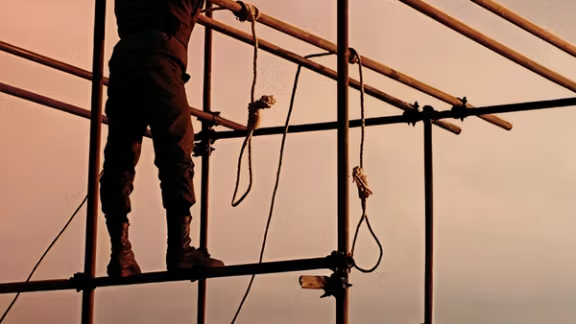
The United Nations' top human rights official on Monday urged Iran to impose an immediate moratorium on the use of the death penalty, citing a surge in executions across the country.
“Reports that there have been several hundred executions in Iran so far this year underscore how deeply disturbing the situation has become and the urgent need for an immediate moratorium in the country on the use of the death penalty,” UN High Commissioner for Human Rights Volker Türk said in a statement.
According to data gathered by the UN Human Rights Office, at least 612 people were executed in the first half of 2025. That figure is more than double the number recorded in the same period last year.
“It is alarming to see the reports that indicate there are at least 48 people currently on death row – 12 of whom are believed to be at imminent risk of execution,” Türk said.
The UN said more than 40 percent of the executions so far this year were for drug-related offences, while others were convicted under broad and vaguely worded charges, including “enmity against God” and “corruption on Earth.”
Human rights experts have repeatedly warned that such charges are often used to criminalize political dissent and suppress freedom of expression.
“Information received by my office also indicates that judicial proceedings in a number of cases, often held behind closed doors, have consistently failed to meet due process and fair trial guarantees,” the High Commissioner said.
Minority groups remain disproportionately affected by executions, the UN added, although it did not specify which groups were most at risk. Rights organizations have previously documented disproportionate targeting of Iran's Baluch, Kurdish, and Baháʼí communities in politically sensitive cases.
The rise in executions follows a wave of repression in the aftermath of the 12-day war between Iran and Israel in June.
Meanwhile, Iran’s Guardian Council is in the final stages of reviewing a controversial espionage bill that would expand the definition of “collaboration with hostile states”—an offence punishable by death.
The proposed legislation includes acts such as online communication, cooperation with foreign media, and what it terms “ideological alignment” with foreign governments.
“This bill dangerously broadens the scope of capital punishment for espionage, and I call for it to be rescinded,” Türk said.
“The death penalty is incompatible with the right to life and irreconcilable with human dignity,” he added. “Instead of accelerating executions, I urge Iran to join the worldwide movement abolishing capital punishment, starting with a moratorium on all executions.”
Iran is one of the world’s top executioners, second only to China, according to human rights groups.
An American citizen who came to Iran to visit relatives before the outbreak of the 12-day war is among five Jews still detained on suspicion of collaborating with Israel.
The man from New York is said to have left Iran 30 years ago and was among 35 Jews in the country detained on spy charges in the wake of the war with Israel.
He had traveled to Iran along with another Jew of Iranian origin who was also arrested but was since released on bail.
Israel’s Ynet quoted a legal representative involved in the case who remained anonymous, who said: ”They came to the wrong place at the wrong time.”
Homayoun Sameyah Najafabadi, the only Jewish representative in Iran’s parliament, said Sunday that the charge of espionage has been formally dismissed against all Jewish detainees held in Tehran, and that the majority of those arrested are expected to be released soon.
“I am proud to announce that following a two-hour meeting with Mohammad Taghavi, the head of the Revolutionary Court in Tehran, it was agreed that three of the five detained members of our community will be released on light bail,” Najafabadi wrote in a statement. “We hope the remaining two individuals in Tehran will also be freed soon.”
MP Homayoun Sameyah Najafabadi
In addition to developments in the capital, Najafabadi also addressed the situation in Alborz province, where a larger group of Jewish Iranians had been detained in recent weeks.
“With regard to the eleven individuals arrested in Alborz province, I am pleased to report that... five women were released on bail last week,” he said. “Additionally, three men were freed from detention just a few days ago.”
He added that he would continue to pursue the release of the remaining detainees in the province. “Tomorrow, a meeting will be held with Ahmad Nowrouzi, the head of the judiciary in Alborz province, regarding the status of the remaining detainees.”
Najafabadi also said that efforts were underway in Shiraz concerning another community member who remains in custody. “With regard to a fellow citizen detained in Shiraz, I, along with the respected head of the Shiraz Jewish Association, am actively pursuing the matter and we hope to witness positive results soon.”
In the wake of the war, 35 Jews were arrested in Tehran and Shiraz, as well as the Alborz province, on suspicion of ties to Israel. The 10,000 strong community has long been pressured to publicly express loyalty to the Islamic Republic and is banned from communicating with relatives in Israel.
Their arrests were part of a mass crackdown, in which 2,000 Iranians were arrested, including members of other minorities including Azeris, Kurds, and members of the Baha'i faith, on suspicion of collaboration with Israel.
The US State Department’s spokeswoman, Tammy Bruce, issued a warning last month, telling dual nationals or American citizens not to travel to Iran.
The State Department website still warns: “Americans, including Iranian-Americans and other dual nationals, have been wrongfully detained, taken hostage by the Iranian government for months, and years. The threat of detention is even greater today. Do not travel to Iran under any circumstances.”
The United States expended roughly 25% of its high-end THAAD missile interceptors during June’s 12-day conflict between Israel and Iran, raising concerns about its ability to sustain future missile defense operations, CNN reported Monday.
US forces deployed two of the military’s seven Terminal High Altitude Area Defense (THAAD) systems in support of Israel, firing more than 100 -- and potentially as many as 150 -- interceptors to defend against a barrage of Iranian ballistic missiles.
The deployment marked the most significant operational use of the system to date, according to the report, which cited sources familiar with the matter.
While the interceptors successfully countered many of Iran’s long-range missiles, experts warn that the rate of usage far outpaces current production capabilities.
The US Department of Defense produced only 11 new THAAD interceptors in 2024 and expects to procure 12 more this fiscal year. The Pentagon plans to acquire 37 in 2026, according to budget documents cited by CNN.
“The reports about THAAD expenditure are concerning,” a US missile defense expert told CNN. “This is not the sort of thing the US can afford to do repeatedly. THAAD is a very scarce resource.”
A senior retired US Army officer told CNN the Department of Defense is now reassessing “wartime stockage levels of critical munitions” and working to increase annual production capacity.
A Pentagon official said the 2026 budget prioritizes “funding in the defense industrial base,” including $1.3 billion for supply chain improvements and $2.5 billion for missile and munitions production.
The Pentagon declined to specify the number of interceptors used, but Press Secretary Kingsley Wilson said, “The US military is the strongest it has ever been… look no further than Operation Midnight Hammer and the total obliteration of Iran’s nuclear capabilities.”
However, experts cited by CNN warned that stockpile shortfalls were already a concern before the Israel-Iran war and could undermine deterrence, particularly in the event of simultaneous conflicts.
Lockheed Martin, THAAD’s manufacturer, currently operates nine active batteries worldwide, seven of them under US control. Two were moved to the Middle East in recent years, with others stationed in Texas, Guam, and South Korea. THAAD systems have also been delivered to the UAE, where they’ve been used against Houthi-launched missiles.
Iran launched over 500 ballistic missiles during the war, with 86% intercepted. However, 36 missiles struck populated areas, resulting in widespread damage across Israeli cities, including Tel Aviv, according to DC-based think tank Jewish Institute for National Security of America (JINSA).
Analysis conducted by DC-based think tank Jewish Institute for National Security of America (JINSA) estimated that THAADs -- alongside Israel’s Arrow-2 and Arrow-3 interceptors -- downed 201 of Iran’s 574 missiles, with 57 hitting populated areas across Israeli cities. The report estimated that the US’ THAAD system accounted for almost half of all interceptions.
JINSA analysis said Iran increasingly deployed more advanced missiles with multiple warheads and decoys in later stages of the war, challenging interception systems. “Only 8% of Iranian missiles penetrated defenses in the first week of the war. That doubled to 16% in the second half of the conflict and eventually culminated at 25% on the final day of the war before the ceasefire.”
Siamak Namazi, a former Iranian-American prisoner who was held in Iran for eight years, has criticized Iranian President Masoud Pezeshkian’s recent call for expatriates to return to the country, accusing the Islamic Republic of continuing a “heinous diplomacy of hostage-taking.”
In a post published on the social media platform X, Namazi said the Pezeshkian administration, like its predecessors, was turning to the Iranian diaspora in times of political and economic crisis.
“Mr. Pezeshkian, you and your ministers, like previous governments during times of hardship, have turned to Iranians abroad and called on them to travel to Iran,” Namazi wrote. “But it is unlikely that even you truly believe the country is safe for them—especially at a time when the arrest of dual nationals and foreign citizens on baseless charges, for the purposes of hostage-taking and political bargaining, has intensified under your own intelligence ministry.”
Namazi directly addressed the president, warning that without concrete steps to end the targeting of foreign nationals, his remarks would be seen as disingenuous. “The only way to prove your government’s goodwill and to declare an end to the Islamic Republic’s heinous diplomacy of hostage-taking is the unconditional release of people like Dr. Ahmadreza Djalali, Reza Valizadeh, and all the other hostages of the Islamic Republic—including those whose names have not yet reached the press,” he wrote.
“Otherwise,” Namazi continued, “your recent remarks will rightly be seen as nothing more than baiting—an attempt to use the Iranian diaspora’s potential to fill solitary confinement cells and keep your case-building interrogators and people-selling diplomats busy.”
Earlier in the month, President Pezeshkian publicly invited Iranians living abroad to return, promising a more open and secure environment.
Namazi was arrested in 2015 and sentenced to 10 years in prison on charges of “collaborating with a hostile government.” He was released in September 2023 as part of a US-Iran prisoner swap, brokered by the Biden administration, that included the unfreezing of $6 billion in Iranian assets and the release of five Iranian nationals held in the United States.
Rights groups and Western officials have long accused the Islamic Republic of using dual nationals as political leverage in negotiations.
According to human rights monitors, dozens of foreign and dual-national detainees remain imprisoned in Iran under opaque legal processes, with access to consular services and fair trials often denied.
Iranian officials are considering formal Wednesday shutdowns to create three-day weekends and a full summer week off amid worsening water and power outages caused by extreme heat and falling reservoir levels across the country.
On Wednesday, July 23, the Islamic Republic tried shutting down government offices, and it cut national power demand by 19,000 megawatt-hours and reduced Tehran’s water usage by 3,800 liters per second, Energy Minister Abbas Aliabadi said on Sunday.
Repeating the closure for four weeks could lower the capital’s consumption by six million cubic meters, he added.
IRGC-aligned Tasnim News Agency described the trial closure as effective, citing a 10 percent decline in Tehran’s daily water use, from up to four million cubic meters down to about 3.4 million.
Iran's government spokeswoman Fatemeh Mohajerani said Sunday that authorities are considering a full summer week off, with a final decision expected on Wednesday.
Iran has recently faced an unprecedented heatwave, and many natural and engineered water reservoirs across the country particularly in Tehran, Alborz and Fars provinces are nearly depleted.
In the capital Tehran, officials have attempted to curb consumption through emergency measures, including repeated water and electricity outages.
Reservoirs drop, outages rise
Authorities warned on Sunday that electricity generation from the Karaj dam in western Tehran may cease within days due to plummeting reservoir levels.
The Karaj dam’s hydroelectric plant, which still produces electricity, may be forced to shut down in two weeks as the water level drops below the intake threshold, its manager Mohammad Ali Moallem said.
Once the reservoir falls beneath a critical line, power generation will no longer be possible, he warned.
Some of Iran’s deepest reservoirs have shrunk to shallow ponds, and water pressure in parts of Tehran is now so low that taps fail to reach above the second floor in many buildings, according to state-run media.
“The water crisis is more serious than what is being talked about today,” President Masoud Pezeshkian said during a cabinet meeting on Monday.
“If we do not make urgent decisions today, we will face a situation in the future that cannot be cured.”
In a video sent to Iran International, a Tehran resident shows new machines dispensing drinking water for a fee, activated with bank cards and filling personal containers like an ATM.
Outages now extend to seven hours in rural areas, said Ali-Gholi Imani, a member of the agricultural pricing council Sunday.
“With the current power cuts, one-third of the country’s agricultural output is being lost,” he warned.
The crisis reflects not only institutional mismanagement but resource collapse, environmental researcher Rouzbeh Eskandari told Iran International.
He recommended urgent investment in wastewater recycling, leak reduction in pipelines, and smart monitoring for farms.
Resolving the country’s water crisis requires a total of 13.26 quadrillion rials, or around $15.7 billion, Mohsen Zangeneh, a member of the Iranian Parliament’s Program and Budget Committee, said Sunday.
According to officials, he added, the national budget for the current year has allocated 500 trillion rials, or about $568.2 million, toward the critical issue.
An Israeli citizen of Iranian origin has been charged with espionage, accused of passing sensitive details about Israeli war plans to an Iranian intelligence operative.
He is accused of revealing the identity of an Iranian sailor on an oil tanker who allegedly aided Israel, disclosing Israeli military strike plans and commando missions, providing drone flight paths from Azerbaijan into Iran, and confirming that Israel’s Nevatim Air Base was hit during Iran’s April missile barrage last year.
The unnamed suspect was arrested earlier in July, and the Attorney General's Office requested that his detention be extended until the end of the proceedings.
He moved to Israel in 1999 and according to court documents, rekindled ties to his birthplace over a decade later on a trip to Turkey, when he visited the Iranian embassy.
According to the prosecutors’ report, he later began a relationship with an Iranian woman who introduced him to Iranian operatives, whom he met in September during a visit to see her in Turkey.
As with previous cases brought before the courts in Israel, the accused maintained contact with the agents through Telegram.
In May, just one month before Israel’s surprise attacks on Iran, the defendant told his Iranian contact that Israel planned to carry out an attack in Iran. He later updated the agent that Israel was planning a commando operation targeting the Islamic Republic’s nuclear facilities.
The attorney's office said that "his dangerousness is heightened in light of the period in which he committed the offenses, during which war is being waged in the State of Israel on several fronts in general and with Iran in particular, and while missiles were being fired at Israel from Iran."
This month, two additional espionage cases were revealed. Indictments were filed against an Israeli soldier who passed information to the Iranians in exchange for money—including imagery of Iranian missile landings and impacts in Israel—and a teacher from the Bedouin community in the Negev who filmed fighter jet takeoffs.
More than 25 cases of Iranian recruitment attempts have been reported by Israeli security authorities over the last year, with over 35 indictments against Israeli citizens filed.
It has led Israeli authorities to launch a campaign earlier in july urging citizens to resist the lure of spying for Iran amid the surge in efforts by Tehran to recruit Israelis for espionage.
Iran’s judiciary chief said last week that around 2,000 people were arrested during and after the 12-day war with Israel, with some detainees accused of collaborating with the Jewish state potentially facing the death penalty.