US keeps mum on American Jew jailed in Iran on Israel spying charges
The US State Department on Tuesday declined to comment on reports that Iran had arrested two American Jewish citizens on suspicion of spying for Israel in the aftermath of the recent 12-day war.
One of the two detainees, identified by HRANA as 70-year-old Yehuda Hekmati, remains in detention.
Hekmati, a jeweler with ties to New York, allegedly drew the attention of the Islamic Republic due to a trip he made to Israel seven years ago.
The second detainee, an Iranian-American resident of Los Angeles, has been released on bail.
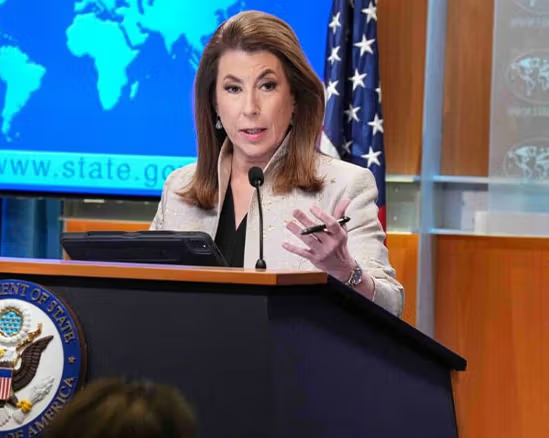
US State Department spokesperson Tammy Bruce declined to comment on the case Tuesday, saying only that she hopes she would be able to speak about it soon.
The State Department has repeatedly warned that Americans, including dual nationals, risk wrongful detention in Iran.
The department's website says: "Americans, including Iranian-Americans and other dual nationals, have been wrongfully detained, taken hostage by the Iranian government for months, and years."
Israel’s Channel 11 quoted a source involved in the American detainees’ case as saying, “These two Americans were in the wrong place at the wrong time.”
Iran’s Jewish community has faced unprecedented scrutiny. Dozens have been interrogated over contacts with family in Israel, and Jewish conscripts have reportedly been forced to participate in loyalty demonstrations to the Islamic Republic.
Foreign nationals have not been spared. Several Europeans have been detained on charges of cooperating with Israel. French citizens Cécile Kohler and Jacques Paris, held in Iran since 2022, now face new espionage charges that could carry the death penalty.
Iran’s judiciary chief recently announced that over 2,000 people have been detained since the war with Israel, some facing charges of “organized collaboration with the enemy”—a charge that can carry the death penalty.
Iran's intelligence ministry issued a lengthy statement asserting alleged successes amid a punishing 12-day war with Israel last month which it said scotched elaborate regime change plans by an array of foreign and domestic enemies.
The ministry said it had thwarted assassinations plots against 35 officials, conducted raids and made arrests targeting the Baha'i religious minority, evangelical Christians, foreign-baed dissidents, Sunni Muslim jihadists, separatists, monarchists and media organizations acting in league with Israel.
Hundreds of military personnel, nuclear scientists and civilians were killed in Israel's surprise campaign last month including top commanders, in major intelligence lapses the statement appeared aimed at addressing.
"What happened during the 12-day imposed was a war plan with planning and full-scale utilization of combined military, security, intelligence, cognitive warfare, disruptive actions, assassination, sabotage, destabilization and incitement of internal unrest," the statement issued on Monday said.
The multifarious plots, it added, were "aiming for the delusion of subjugating and forcing Iran to surrender and overthrowing the sacred Islamic Republic,” it added.
Israel was able to launch deadly attack drones at senior military Islamic Revolutionary Guards Corps (IRGC) leaders from inside the country, killing the armed forces chief of staff, IRGC leader and the elite unit's commanders of aerospace and military operations.
An Iranian analyst alleged in a newspaper interview last week that Israel caused over 100 Iranian missile launchers to explode upon activation during the war last month and that it had hacked the country’s entire air defense system.
The daughter of a top Iranian military commander assassinated by Israel last month said her father was chased down and killed by Israeli agents in a hot pursuit in Tehran and not an airstrike as originally reported.
Not offering explanations for any lapses, the ministry said it "detected and neutralized" Israeli plots to assassinate 23 senior civilian and military officials during the conflict and 13 similar attempts in the months leading up to it.
'Thugs, rebels'
The ministry alleged that it had carried out successful intelligence operations inside Israel, saying its activities were ongoing.
"Numerous and varied offensive and intelligence measures (aggressive espionage) were carried out in various cities of the occupied territories against the interests of the Zionist regime and the criminal gang that rules it."
Israeli authorities say they have uncovered more than 25 cases of Iranian recruitment over the past year, with more than 35 people indicted on serious security charges.
"One of the approaches implemented was to recruit intelligence and operational agents from the regime’s innermost military and security layers," the ministry added. "The larger and more sensitive part of the missions is still ongoing."
The ministry said it had faced down threats from street thugs to the NATO alliance.
"The enemy sought to activate criminals, diverse terrorists in various guises, deploy awaiting spies, conduct assassinations and sabotage, and to mobilize mercenaries, monarchist remnants, thugs, rebel groups, and dormant hypocrite cells to inflame tensions, provoke dissatisfaction and professional protests, and turn conditions into uncontrolled street riots and chaos”, the statement said.
"We faced not only the petty Zionist regime but also the Western intelligence-security NATO,” it added.
A June 23 Israeli air attack on Evin Prison - known for housing dissidents and foreign detainees - was aimed at catalyzing a nationwide revolt, the ministry alleged. Iranian authorities said 80 people were killed in the attack and Amnesty International called for it to be investigated as a war crime.
“We detected and fully neutralized a Mossad-directed monarchist plot to launch and dispatch armed operational teams from across the country to Tehran on June 22 for terrorist actions the next day (during the Evin prison bombing) targeting nearby military and law enforcement centers," the ministry said.
“This monarchist-Zionist scenario was thwarted by identifying involved agents, striking enemy operational teams, and arresting 122 mercenaries across 23 provinces before any terrorist action in Tehran."
The United States on Tuesday criticized Iran’s leadership over the ongoing nationwide water crisis, which have affected millions across the country, blaming it on mismanagement, corruption and neglect.
"Days without water in the scorching heat of July. There's no access to water for drinking, bathing, washing or cooling homes," the US State Department said in a post on its Persian X account, referring to the ongoing water crisis in Iran.
"The people of Iran continue to suffer the real consequences of the regime's greed, corruption, and mismanagement of water resources," the State Department said in the post accompanied by an image captioned, "Iranian people deserve better than this."
Officials in Tehran blame drought and public overuse for Iran’s worst water shortage in living memory.
Despite a UN “red warning” 25 years ago, Iran expanded hydropower rather than wastewater treatment. 80% of untreated wastewater is dumped into rivers, deserts and underground wells, contaminating key water sources.
Amid an unprecedented heatwave in Iran, many natural and engineered water reservoirs across the country particularly in Tehran, Alborz and Fars provinces are nearly depleted.
The Islamic Revolutionary Guard Corps (IRGC) has built over 60 dams in recent decades. More than half are now empty, with hydropower generation operating at just one-third of its nominal capacity.
The daughter of a top Iranian military commander assassinated by Israel last month said her father was killed by Israeli agents in a hot pursuit in Tehran and not an airstrike as originally reported.
“Some might think my father was killed in an airstrike, but it was a direct chase with the Israelis,” Mahdieh Shadmani said in a video posted on Instagram on Monday.
The assertion, if confirmed, would further underscore Iranian security failures which allowed Israel to track and kill hundreds of security personnel in a 12-day war last month.
Ali Shadmani was declared dead on June 17, reportedly from wounds sustained from an Israeli air attack in Tehran.
As commander of the Islamic Republic's war room, the Khatam al-Anbiya Central Headquarters, Shadmani was effectively in charge if Iran's war effort.
Shadmani was killed only four days after assuming the post after his predecessor Gholam Ali Rashid was assassinated in an Israeli strike.
“My father’s location changed every few hours. He carried no smart devices or phones. Security protocols were followed, yet during his time commanding the war headquarters, he was repeatedly targeted for assassination by Israel,” she said on July 4.
Her comments have sparked backlash among supporters of the Islamic Republic. One anonymous user on X said the families of those killed during the 12-day war with Israel “should watch their mouth” and that “some control is needed over their speech.”
Several official narratives regarding the scope and consequences of Israel’s strikes on Iran have come under growing scrutiny.
On July 22, an Iranian political analyst said there had been widespread sabotage of Iran's missile launchers and air defense systems by Israel.
Israeli airstrikes and drone attacks during the 12-day war killed hundreds of Iranians including civilians, military personnel and nuclear scientists. Iran's retaliatory missile strikes killed 29 Israeli civilians.
Nearly all steel production units in Iran have shut down due to severe electricity shortages, according to a senior industry official.
Vahid Yaghoubi, a member of Iran’s Steel Producers Association, said steelmakers have faced a 90% power cut since late April, leaving many factories with just 2–3% of their required electricity -- “not even enough to light facility walkways,” he told state media.
While some industrial zones have retained limited access to electricity, steel producers have borne the brunt of the nationwide power crisis, he said.
The energy restrictions, originally presented as a temporary two-week measure by the Energy Ministry, have stretched over two months now, Yaghoubi added.
“Almost all steel plants are now shut,” he added, saying that even companies that invested in their own power plants -- known as Article 4 facilities -- have been unable to use their electricity due to government intervention.
The Energy Ministry has requested control of these privately funded power stations to manage the national grid. Industry officials argue that the move contradicts existing contracts that prioritize use of this energy for the companies that invested in such power stations.
Iran’s steel industry, which produces over 30 million tons annually and is among the world’s top ten producers, plays a key role in the country’s non-oil exports.
Some firms have turned to Iran’s energy exchange to buy “green electricity” at premium prices in an attempt to keep minimal operations running. However, Yaghoubi said even these paid deliveries were disrupted, with some companies experiencing arbitrary outages.
18,000 workers unpaid at Esfahan Steel Company
The crisis has rippled beyond production, with some companies now unable to pay workers due to frozen accounts and mounting financial strain.
The head of Esfahan Steel Company, Iran's largest, said on Tuesday that the wages of 18,000 workers have been delayed after Iran’s tax authority froze the firm’s bank accounts over unpaid taxes, according to local media.
Ardeshir Afzali told ILNA news agency that the Tax Organization has withdrawn substantial funds from the company’s accounts but has yet to lift the freeze.
He criticized the move, saying authorities “do not understand the fragile post-war economic conditions or the difficulties facing producers.”
Iraqi Prime Minister Mohammed Shia al-Sudani said that his government thwarted 29 attempted missile and drone attacks by Iran-aligned armed groups during the height of the war between Israel and Iran.
In an interview with the Associated Press published Tuesday, al-Sudani said the attacks were aimed at Israel and US military bases inside Iraq.
“These operations were neutralized by Iraqi government security measures,” he said, though declined to elaborate on details.
“We know that the Israeli government had a policy — and still does — of expanding the war in the region. Therefore, we made sure not to give any justification to any party to target Iraq.”
The prime minister said his government engaged in direct communication with Iranian leaders during the crisis, encouraging de-escalation. “We reached out to leaders in Iran to urge them toward calm and to make room for dialogue and a return to negotiations,” al-Sudani said.
Iraqi Prime Minister Mohammed Shia al-Sudani speaking at the parliament in Baghdad, Iraq, October 27, 2022
Since the 2003 US invasion that ousted Saddam Hussein, numerous militias have emerged in Iraq, many with ties to Iran. Following the outbreak of the Israel-Hamas war in October 2023 and the recent Israel-Iran escalation, including US strikes on Iranian nuclear sites, the pro-Iran factions have periodically targeted US bases in Iraq.
Groups within the Popular Mobilization Forces (PMF), an umbrella group of mostly Shia armed groups originally formed to fight the Islamic State and then integrated into Iraq's security forces, have been among those involved.
Al-Sudani acknowledged that the continued presence of the US-led anti-ISIS coalition has provided a “justification” for such groups to remain armed. The withdrawal process began in 2023, but is not yet complete.
“When the coalition withdrawal is complete, there will be no need or justification for any group to carry weapons outside the scope of the state,” he said.
Future of Popular Mobilization Forces
A focal point of US-Iraqi tensions lies in the future of the PMF. Though nominally under Iraqi military command since 2016, many PMF units maintain strong ties to Iran and operate with broad autonomy.
A new bill in Iraq’s parliament is aimed at formalizing the PMF’s status within the security apparatus, a move that has drawn criticism from Washington. The US State Department recently warned the legislation “would institutionalize Iranian influence and armed terrorist groups undermining Iraq’s sovereignty.”
Al-Sudani, however, defended the initiative, saying that it is part of an effort to ensure that arms are controlled by Baghdad. “Security agencies must operate under laws and be subject to them and be held accountable,” he said.
Kurdish region attacks
In recent weeks, a series of drone attacks targeted oil facilities in northern Iraq’s Kurdish region, with Kurdish regional authorities blaming groups in the PMF. Baghdad has denied it, but has not publicly named any perpetrators.
Al-Sudani called the attacks a “terrorist act” and said his government is working with Kurdish authorities and coalition forces to identify those responsible and hold them accountable.