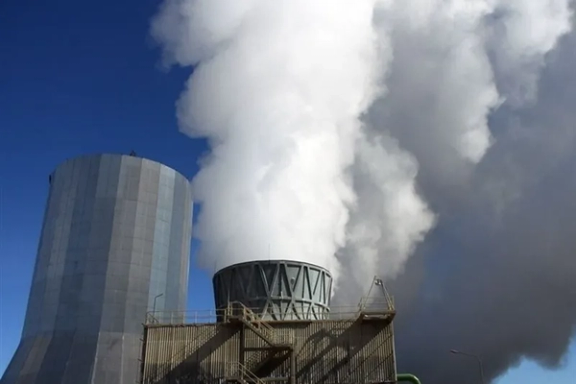
Iran steps up burning of hazardous fuels as energy crisis persists
Iran has stepped up the toxic burning of fuel oil for power generation amid electricity shortages, local media reported Thursday, in a move which is set to further pollute air quality but may do little to ease blackouts.
Tejarat News wrote officials last summer “imposed power outages on citizens under the pretext of ending fuel oil use,” though the practice continued behind the scenes.
“Now it’s clear that mazut never left the government’s agenda—not even last year,” it added.
All major power plants ran on mazut in 2024, Saeed Tavakoli, managing director of the National Iranian Gas Company confirmed Tuesday.
“All power plants across the country used fuel oil at full capacity last year,” he told reporters.
“Despite the president’s emphasis on environmental concerns, this was one of his administration’s adopted strategies.”
“Though the president and his deputy stress environmental protection, when there is an energy imbalance in the country, fuel oil is one of the available sources. In last year’s exceptional conditions, all mazut-fired plants were operational,” Tavakoli added.
“People must now endure pollution, blackouts, and disease at the same time,” Tejarat News warned.
Sanctions, age and mismanagement have taxed Iran's energy infrastructure, and the country has long faced blackouts especially in summer months when water and electricity demand surge.
The economic daily criticized the Pezeshkian administration for what it called a retreat from earlier pledges, adding: “Officials speak of environmental protection and renewable energy, but these same officials chose one of the most harmful fuels for humans and nature last winter.”
In November 2024, the government had ordered a halt to fuel oil use in cities including Arak, Isfahan, and Karaj due to worsening air pollution. That ban has since been quietly revoked.
“The state has now paved the way again for fuel oil use,” Tejarat News said. “But even this return failed to stop the blackouts.”
“Fuel oil burning is no longer an emergency fix—it is now a systematic, institutionalized policy that symbolizes the collapse of energy planning and the state’s neglect of public health and the environment,” it added.
Iran has told European powers it may withdraw from the nuclear Non-Proliferation Treaty (NPT) if UN sanctions are reimposed, Western diplomats told Iran International after last week’s talks in Istanbul.
The message was conveyed during a closed-door meeting last week between Iranian officials and representatives from France, Germany and Britain, known collectively as the E3. The session marked the first formal nuclear discussions since last month’s Israeli and US strikes on Iranian territory.
According to one diplomat present at the meeting, Deputy Foreign Minister Majid Takht Ravanchi said any withdrawal from the treaty should not be interpreted as a step toward building nuclear weapons.
Officials expect sanctions to return
A separate source inside President Masoud Pezeshkian’s government told Iran International that senior Iranian officials have concluded that snapback sanctions under UN Security Council Resolution 2231 are likely and that Tehran must be ready to respond.
Under the 2015 nuclear deal, the snapback mechanism allows a participant to reimpose UN sanctions if Iran is found to be in serious non-compliance. France has recently warned that it will push for global embargoes unless a broader agreement is reached by late August.
Tehran rejects European authority on sanctions
Iran has rejected the legitimacy of any attempt by the E3 to invoke the snapback clause. Foreign ministry spokesman Esmail Baghaei said earlier this week that Britain, France and Germany have no legal standing to trigger the measure and had “marginalized themselves” through their support for Israel and the United States during recent military action.
Baghaei also said Tehran remains opposed to extending Resolution 2231 beyond its scheduled expiration in October.
Talks confined to nuclear file, Iran says
Iranian officials insist that the Istanbul talks were limited to nuclear and sanctions-related issues. Baghaei said no other topics were raised and warned that any attempt to expand the agenda would not be accepted.
“These talks have a clear and limited focus: the lifting of sanctions and matters related to the nuclear program,” he said during his weekly press briefing.
A website tied to Iran’s Revolutionary Guards on Thursday urged parliament to ban the import of dogs, cats and pet supplies, amid growing pressure to restrict pet ownership on religious and cultural grounds.
“If you truly represent the people, protect public rights, especially those of innocent children, and submit a bill to ban all imports of dogs, cats and pet supplies,” Fars News wrote.
The appeal came after the government lifted restrictions on registering import orders for previously banned goods from Eurasian Economic Union countries. The directive, issued by the Trade Promotion Organization, included pet-related items not covered by religious or legal bans.
Fars News criticized the move, saying it contradicted existing dog walking bans and burdened municipalities that already struggle to manage stray animals.
Local crackdowns intensify
Iranian prosecutors have expanded dog walking bans to at least 25 cities, including Kermanshah, Ilam, Hamadan, Kerman and Isfahan. The measures are being enforced under local orders citing Iran’s Penal Code and Constitution as no national legislation has been passed.
Officials have cited Article 638 of the Penal Code, which addresses acts against public morality, and Article 688, which concerns threats to public health. They have also invoked Article 40 of the Constitution, which bars activities that harm others.
Prosecutors in several provinces announced new bans in recent days, reinforcing earlier restrictions first imposed in Tehran in 2019.
“Offenders will face legal action to preserve public decency,” he said, adding that pet ownership reflected “foreign cultural influence.”
Authorities in Ilam, Khalkhal, and other cities have issued similar orders, citing constitutional and penal code provisions relating to public health and morality.
“This practice reflects the promotion of a Western lifestyle,” Khalkhal prosecutor Mozaffar Rezaei said, warning of penalties for transporting or walking dogs in public spaces.
Iran will not return to nuclear negotiations unless the United States agrees to provide compensation for damages sustained during last month’s war, Foreign Minister Abbas Araghchi told the Financial Times.
"They should explain why they attacked us in the middle of... negotiations, and they have to ensure that they are not going to repeat that," Araghchi said in an interview published on Thursday.
The official added that the US must take responsibility for striking Iran during ongoing diplomatic exchanges and that talks cannot resume without financial redress.
Iran confirms new enrichment plant near Isfahan was hit
A third enrichment facility near Isfahan was struck during last month’s conflict, Araghchi told FT, marking the first time Tehran has publicly acknowledged the site was targeted.
Araghchi said the plant had been prepared for activation in response to a formal censure by the International Atomic Energy Agency’s board of governors, which criticized Iran’s lack of cooperation.
“As far as I know, the preparations were made, but it was not active when it was attacked,” he said.
The site was hit as part of a broader US operation that, two days before a ceasefire, targeted Iran’s main enrichment centers at Fordow and Natanz and struck multiple facilities in Isfahan.
‘Road to negotiation is narrow’
Araghchi said he has been in contact with US envoy Steve Witkoff and that the two sides have exchanged messages before, during and after the war. He described the path to talks as narrow but not closed.
“I need to convince my hierarchy that if we go for negotiation, the other side is coming with real determination for a win-win deal,” he said. But he added that Tehran requires confidence-building measures before proceeding, including financial compensation and security assurances.
Araghchi repeated Iran’s rejection of US demands for “zero enrichment” and said Tehran would not abandon its rights under the Nuclear Non-Proliferation Treaty. He said Iran still retains the knowledge and technical capability to resume high-level enrichment if needed.
Talks with IAEA expected next month
Though Iran suspended cooperation with the International Atomic Energy Agency after the war, Araghchi said Tehran expects to hold technical talks with the agency in the coming weeks to discuss a “new modality of cooperation.” He said the talks would not involve inspections.
Western officials say Iran’s nuclear infrastructure was heavily damaged but not eliminated, and that a significant stockpile of highly enriched uranium may remain.
Warning to Europe over snapback
Araghchi also warned the UK, France and Germany that any move to trigger the UN snapback mechanism, which would restore sanctions lifted under the 2015 nuclear deal, would end Iran’s talks with them.
“If they do snapback, that means that this is the end of the road for them,” he said. “With the Europeans, there is no reason right now to negotiate because they cannot lift sanctions, they cannot do anything.”
The US said it remains open to direct talks with Iran but reaffirmed its maximum pressure strategy this week by announcing new sanctions on an Iranian oil shipping network.
Iran's Islamic Revolutionary Guards Corps (IRGC) on Wednesday issued a cryptic warning to Israel that the geography of Tehran's response to any future attack would shift and its arch-foe would face a punishing response.
"The geography of the response and the battlefield may change, and Iran's reactions will be more crushing than previously observed," state media outlet Mehr news cited the spokesman of the sprawling military organization as saying.
“If the Zionist regime launches a new attack on the powerful and resilient Iran, the initiative to end the conflict will be in our hands,’ Ali Mohammad Naeini said.
Israel's surprise 12-day military campaign against Iran last month killed hundreds of military personnel and civilians in air strikes and drone attacks. Missile salvos by Iran killed 28 Israeli civilians.
Iranian military leaders had made similar threats against Israel before the conflict, and official declarations of victory following the war have yet to substantively grapple with the lopsided toll and Tehran's intelligence lapses.
“We will not allow the sirens in the occupied territories to fall silent, and the enemy must not have the opportunity to leave its shelters,” Naeini said. “They will experience more fleeing and displacement than they did during the 12-day war.”
Iran's armed allies in the region have been degraded by nearly two years of Israeli attacks, but an Emirati news outlet reported on Wednesday that a top IRGC general traveled to Iraq to shore up support for Tehran-backed militias there.
Citing Iraqi political sources close to the Shi'ite-run political establishment, al-Ain al-Ekhbariya reported that the commander of the IRGC's elite Quds Force Esmail Qaani made an unannounced visit to Iran's neighbor.
The visit, the outlet said, involved meetings with senior Shi'ite political and militia leaders and aimed at shoring up unity and coordination as parliamentary elections loom.
Mysterious attacks hit Western-run oil facilities in Iraq's Kurdish region this month, in strikes blamed by local officials on Iran-backed militias. The sources cited by al-Ain al-Ekhbariya alleged Qaani described the events as not authorized by Tehran.
Following a US-brokered ceasefire on June 25, Israel and Iran have repeatedly exchanged threats.
Israel 'wiped off the face of the earth'
Iran’s interim chief of staff, Habibollah Sayyari, praised the Islamic Republic’s wartime performance on Wednesday, saying the conflict extended beyond just Israel.
“People must understand that we did not fight just one regime, we fought the world. That means we fought NATO, Europe and the United States. This is very important, yet we emerged from it with our heads held high,” Sayyari said.
Former IRGC chief Mohsen Rezaei added to the uptick of official military rhetoric on Wednesday, threatening to eradicate Israel.
“A day will come when great revenge and severe punishment will be carried out, and Israel will be wiped off the face of the earth forever,” Rezaei said on Wednesday.
The United States on Wednesday sanctioned an alleged global shipping and smuggling network controlled by the son of Ali Shamkhani, Iran's former national security chief and an adviser to supreme leader Ali Khamenei.
More than 50 individuals and entities were designated, and over 50 vessels identified, in what the US Treasury called its largest Iran-related action since 2018.
“The Shamkhani family’s shipping empire highlights how the Iranian regime elites leverage their positions to accrue massive wealth and fund the regime’s dangerous behavior,” Treasury Secretary Scott Bessent said in a statement.
According to the Treasury, Hossein Shamkhani—who uses false identities including “H,” “Hector,” and “Hugo Hayek,” the name on his Dominican passport—built the network by exploiting his father’s political reach.
US Treasury map alleging geographic scope of Shamkhani-linked shipping activities
“This network transports oil and petroleum products from Iran and Russia, as well as other cargo, to buyers around the world, generating tens of billions of dollars in profit,” the Treasury press release said.
'Targeting elite not people'
The agency added that the network’s containership fleet also carries cargo in and out of Iran, employing tactics similar to those used by sanctioned oil tankers—frequent changes in operators and management firms to obscure ties to the Shamkhani family and avoid blacklisting.
The sweeping sanctions freeze any US-based assets and prohibit Americans from doing business with the named entities.
US Treasury graphic alleging processes underlying Shamkhani-linked shipping activities
The Shamkhani family has also been accused of using its illicit wealth to obtain foreign passports and luxury properties abroad—privileges far removed from the daily struggles of ordinary Iranians.
“These sanctions target the regime’s elite inner circle,” Bessent said, “not the people of Iran.”
Ali Shamkhani, a former defense minister and former secretary of Iran’s Supreme National Security Council, was sanctioned by the US in 2020. Thursday’s action suggests Washington sees his family as central to Tehran’s efforts to evade international economic pressure.
Though enforcement depends on cooperation from third parties, the move signals Washington’s intent to escalate pressure on Iran’s ruling elite amid stalled nuclear diplomacy and deepening ties between Tehran and Moscow.