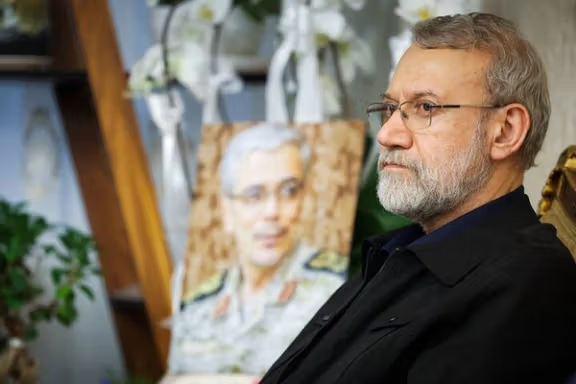
Lebanese FM to snub visiting Iranian security chief as tensions soar - media
Iran’s National Security Council Secretary Ali Larijani
Lebanese Foreign Minister Yusuf Raji will not meet Iran's newly reappointed security boss Ali Larijani when he visits the country this week, Lebanese media reported, as Beirut seethes over Iran's criticism of its efforts to disarm Hezbollah.
“Lebanese Prime Minister Nawaf Salam will convey the Lebanese government’s displeasure with Iranian officials’ statements rejecting Hezbollah’s disarmament, seen as blatant interference in Lebanon’s internal affairs,” Hona Lebanon reported, citing sources.
Founded in 1982 by Iran's Islamic Revolutionary Guard Corps, Hezbollah has long been a formidable opponent of Israel but was mauled by its arch-foe in fighting late last year.
The Lebanese government last week tasked the military with disarming the Iran-backed group, leading to sharp criticism by the Islamic Republic.
Another Lebanese media outlet, Al-Liwaa, reported that the Lebanese Foreign Minister will not meet Larijani and prefers he not visit Beirut.
Larijani is due to arrive in Lebanon on Wednesday after visiting Iraq where he signed a security agreement on Monday.
Ali-Akbar Velayati, a senior foreign policy advisor to Supreme Leader Ali Khamenei, called Hezbollah’s disarmament "a dream that won’t come true" on Saturday describing it as a policy dictated by Israel and the United States.
The Lebanese Foreign Ministry, in a statement on X, condemned the remarks as "a flagrant and unacceptable interference in Lebanon’s internal affairs," saying it would not tolerate such “unacceptable conduct."
The Lebanese government has long been under international pressure to assert a monopoly on arms, particularly from Western states that view Iran-backed Hezbollah’s military structure as a parallel force within the state.
“Hezbollah has no choice but to negotiate with the Lebanese government, as failure to do so would mean preparing for war,” Qassem Mohabaali, former Middle East Director at the Iranian Foreign Ministry, told the news outlet Khabarfori.
Iran on Monday criticized the International Atomic Energy Agency (IAEA) for what it called a failure to act over Israeli and US attacks in June after talks in Tehran with the UN nuclear watchdog’s deputy director general earlier in the day.
“The Islamic Republic expressed its objection to the failure of the agency to fulfill its responsibilities regarding the Israeli and US attack and raised its demands for correcting the agency’s improper processes,” deputy foreign minister Kazem Gharibabadi said.
Gharibabadi's remarks came following a meeting with IAEA deputy director general Massimo Aparo, who was in Tehran for a brief trip on Monday. The visit marked the highest-level meeting between the IAEA and Iran since the attacks on Iranian nuclear sites badly frayed ties.
Iran's foreign minister Abbas Araghchi had stressed earlier that the visit would not involve nuclear inspections but rather dialogue with the agency.
In June, Iran’s parliament approved a bill to suspend the country’s cooperation with the IAEA, a day after a ceasefire with Israel.
The bill, passed with 221 votes in favor, none against, and one abstention out of 223 members present, and bars the UN nuclear watchdog’s inspectors from accessing Iran’s nuclear facilities.
At the time, Iran also accused IAEA chief Rafael Grossi of bias and failing to condemn the attacks.
On July 4, Grossi said that the agency's team of inspectors had departed Iran to return to its headquarters in Vienna after the new law barred cooperation with the IAEA.
Israel launched a surprise military campaign on June 13 targeting military and nuclear sites, killing hundreds of military personnel, nuclear scientists and civilians.
Iran responded with missile strikes that killed 31 civilians and one off-duty soldier, according to official figures published by the Israeli government.
The Islamic Republic says 1,062 people were also killed by Israel during the 12-day conflict, including 786 military personnel and 276 civilians.
On June 22, the US carried out airstrikes on Iran’s key nuclear sites at Fordow, Natanz, and Isfahan.
The full extent of the damage remains unclear but President Donald Trump has repeatedly said that the strikes "obliterated" the country's nuclear program.
A right-wing political party in the UK is demanding an upcoming Shi'ite Islamic camp for children be cancelled over alleged ties to Iran’s government which organizers deny.
Reform UK, formerly known as the Brexit Party led by Nigel Farage, says Camp Wilayah has “clear and troubling ties to the Iranian Revolutionary Regime.”
The camp, set to be held for boys and girls aged nine to 14 is run by the Ahlulbayt Islamic Mission (AIM).
In a section on the camp's official website called "hijab and segregation," organizers said the genders would be separated and hijabs will be mandated for the girls.
Several local branches of Reform UK sent a letter to the managers of Phasels Wood Activity Centre in Hertfordshire outside London, urging them to cancel the event.
The center is run by The Scout Association, the largest mixed-gender youth organization in Britain which is a branch of the worldwide Scout Movement.
“The decision to host Camp Wilayah at this site is not just inappropriate – it is a grave betrayal of everything the Scout movement stands for," Reform UK Hertfordshire branch chair Keith Steers wrote in a letter.
"Camp Wilayah is not an innocent cultural gathering. It is the ideological outreach arm of AIM. By offering sanctuary to Camp Wilayah, you align yourselves ... with tyranny.”
Reform UK has been gaining in popularity in recent months with its sharp criticism of established political parties and illegal immigration which critics have branded xenophobia.
AIM fired back in a post on their website.
“Camp Wilayah is not a space for indoctrination or radicalization. It has never promoted hatred of any kind, and no incident has ever been cited nor any evidence presented to suggest a problem at the camp."
"We have no relationship with the government of Iran or any other foreign country."
A search of the AIM website shows it promotes books written by Iran’s Supreme Leader Ali Khamenei and the founder of the Islamic Republic, Ayatollah Ruhollah Khomeini. In social media posts, the AIM has repeatedly praised Khamenei, calling his books “an excellent source of knowledge and a great read.”
AIM has also praised Qasem Soleimani — the former Quds Force commander killed in a 2020 US drone strike — as a “great hero.” One of its social media posts features a photograph alongside a Khomeini quote about exporting the Islamic Revolution.
"It is deeply alarming that schoolchildren are being taken to these camps. This raises further questions about the influence of Iran here in the UK,” he added.
UK-based human rights lawyer Omid Shams told Iran International that AIM operates under the umbrella of the Ahlul Bayt World Assembly, an Iran-based organisation whose leaders are appointed in Tehran and have historically been close to Supreme Leader Ali Khamenei. He says former head Mohammad Hassan Akhtari — a onetime Iranian ambassador to Syria and representative of the Quds Force — and other senior figures “are the closest people to Khamenei,” making AIM part of a wider network advancing Iran’s “soft power” abroad.
"There is no way, under any circumstances, that you would say that these organizations are not affiliated with the Islamic Republic of Iran," Shams said.
AIM did not immediately respond to request for comment but posted on their website "to be absolutely clear: AIM has never been affiliated with any organisation called the “Ahlul Bayt World Assembly.” We are not a branch, partner, or member of that body. These claims are entirely false."
The latest dispute comes a month after the British Parliament’s Intelligence and Security Committee warned of a growing threat of physical attacks by Iran in the UK, including targeting British Jews and Iranian dissidents.
Iran’s Ministry of Intelligence issued secret guidance warning ministries and major companies to prepare for the likely return of punishing United Nations sanctions, documents reviewed by Iran International show.
The Intelligence Ministry said that the return of so-called snapback sanctions will include a ban on arms sales, freezing of assets and foreign currency accounts of companies abroad.
“Re-sanctioning of legal and natural persons active in industries such as oil, petrochemicals, banking, shipping, insurance and sensitive technologies will be activated,” the document said.
Potential fallout could roil markets and exacerbate unemployment and deepen popular discontent, the ministry added.
“Severe currency fluctuations, reduced purchasing power, increased unemployment, layoffs and heightened social discontent are to be expected,” the Intelligence Ministry said.
The snapback mechanism is part of UN Security Council Resolution 2231, which endorsed a 2015 deal over Iran's disputed nuclear program called the Joint Comprehensive Plan of Action (JCPOA).
Under Resolution 2231, any party to the accord can file a complaint accusing Iran of non-compliance. If no agreement is reached within 30 days to maintain sanctions relief, all previous UN sanctions would automatically “snap back,” including arms embargoes, cargo inspections and missile restrictions.
Iran’s Intelligence Ministry also pointed to potential alternative partners for the Islamic Republic to evade the sanctions.
“Identify alternative suppliers in countries like China, Russia, Iraq, etc., which will be less affected by sanctions,” the statement said.
The guidance also warned of renewed threats to national security including cyberattacks on critical infrastructure.
“Increased targeted cyberattacks on economic infrastructure, focusing on supply chains, automation, and financial management, as well as efforts by foreign intelligence services to infiltrate through third parties, contractors, or organizational applications, will be some of the threats,” the statement said.
France, the United Kingdom and Germany told Iran they would restore UN sanctions unless it reopened talks on its nuclear program immediately and produced concrete results by the end of August.
Iranian diplomates last met representatives of the three European countries in Istanbul on July 25.
Iran’s Foreign Ministry spokesman Esmail Baghaei described the meeting with Britain, France and Germany as a “test of realism” for the E3 powers, calling it a chance for them to correct past positions.
Israel's defense minister on Monday hit back at a list published by media linked to Iran's military which named Israeli officials in an assassination list, appearing to threaten Supreme Leader Ali Khamenei's life in response.
"I suggest to the Iranian dictator Khamenei that when he leaves the bunker, he occasionally look up at the sky and listen carefully to every buzz," Katz wrote on X Monday.
"The participants of the 'red wedding' are waiting for him there," he added referring to the codename of an Israeli campaign starting on June 13, 2025, in which a series of coordinated strikes killed several of Iran’s most senior military leaders.
The operation, named after a massacre scene in the Game of Thrones TV series, targeted top figures including Revolutionary Guards commander Hossein Salami, chief of staff of armed forces Mohammad Bagheri, and senior general Gholam Ali Rashid.
Katz's warning followed the release of an assassination list by the Islamic Revolutionary Guard Corps-affiliated Telegram channel Saberin News amid continued tensions between Israel and Iran despite a US brokered ceasefire on June 24 which ended the 12-day conflict.
Last week, the new intelligence chief of Iran’s Revolutionary Guards said Tehran views the ceasefire with Israel as merely a pause to an ongoing war, as Iran's security establishment doubled down on confrontational rhetoric toward its arch-nemesis
Iranian border guards, in coordination with the navy, have seized a tanker carrying more than 2 million liters of what authorities described as smuggled diesel fuel in the Gulf of Oman, state media reported on Monday.
The vessel, identified as Phoenix and sailing under the flag of a third country --Cook Islands -- was intercepted in Iran’s exclusive waters near Jask, said Ahmadali Goudarzi, commander of the border guards.
He said the operation was carried out following aerial surveillance and electronic monitoring that indicated an alleged large-scale smuggling attempt.
Authorities said 17 foreign nationals on board were detained and transferred to Jask for legal proceedings.
The cargo’s value was estimated at 759 billion rials (about $840,000), according to state media.
Iran has stepped up maritime enforcement in recent months, especially in waters near the Strait of Hormuz and the Persian Gulf, where fuel smuggling remains a persistent issue due to price differences with neighboring countries.
In April, Iran’s Revolutionary Guard Corps (IRGC) Navy said it had seized a tanker carrying 100,000 liters of smuggled fuel and detained six people, according to Fars News Agency. That followed a separate operation in which two tankers allegedly transporting more than 3 million liters of diesel were intercepted and taken to the port of Bushehr.
The IRGC regularly announces such seizures as part of what it calls efforts to curb fuel trafficking in the region, a key route for global oil shipments. Iran has also seized tankers over maritime disputes or in response to international sanctions enforcement.