Iran nuclear dispute entirely based on fabricated Israeli data, official says
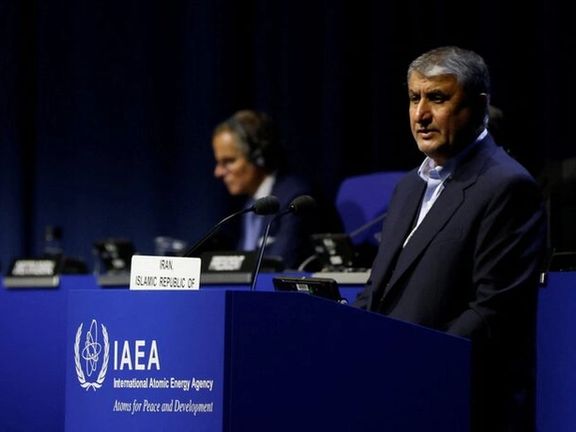
Head of Atomic Energy Organization of Iran Mohammad Eslami and International Atomic Energy Agency Director General Rafael Grossi attend the opening of the IAEA General Conference at their headquarters in Vienna, Austria, September 26, 2022
The head of Iran's Atomic Energy Organization has criticized Israeli claims about Tehran’s nuclear activities, saying the program is peaceful and the allegations are based on a distorted and inaccurate dossier.
“A fabricated and fake dossier created by Israel fuels accusations and pretexts — nothing but an attempt to stop our peaceful nuclear program,” Mohammad Eslami said on Tuesday.
Eslami also included the International Atomic Energy Agency (IAEA) in his criticism, saying the agency must condemn the killing of individuals involved in Iran's nuclear program in Israeli attacks, Revolutionary Guards-affiliated Tasnim News reported.
"The assassination of Iran's nuclear scientists, who had no military affiliations, is among their crimes, and such actions by the regime must be strongly condemned by the IAEA,” Eslami said.
Israel launched a surprise military campaign on June 13 targeting military and nuclear sites, assassinating senior Iranian commanders and killing hundreds of civilians.
The war, which lasted for 12 days, saw Israel kill more than 30 senior security officials and 11 senior nuclear scientists.
According to an Iranian government spokesperson, 1,062 Iranians were killed during the conflict, including 786 military personnel and 276 civilians. Iran retaliated with missile strikes that killed 32 people, including 31 civilians and one off-duty soldier.
On June 22, the United States carried out airstrikes on Iran’s key nuclear sites at Fordow, Natanz, and Isfahan.
"During the 12-day war, several registered facilities under continuous IAEA monitoring, with 130 inspectors, were repeatedly attacked with missiles and other projectiles,” Eslami added.
Iran also criticized the IAEA on Monday for what it called a failure to act over Israeli and US attacks in June, after talks in Tehran with the UN nuclear watchdog’s deputy director general earlier in the day.
“The Islamic Republic expressed its objection to the failure of the agency to fulfill its responsibilities regarding the Israeli and US attack, and raised its demands for correcting the agency’s improper processes,” Deputy Foreign Minister Kazem Gharibabadi said.
Ontario’s top court has upheld a ruling that Ukraine International Airlines must pay full compensation to the families of passengers killed when Iran shot down Flight PS752 in 2020. But families say the ruling doesn’t diminish Iran’s responsibility.
The unanimous Ontario Court of Appeal decision leaves intact a 2024 ruling that found the airline negligent for allowing the flight to depart despite escalating military tensions in the region.
Just minutes after takeoff, two Iranian surface-to-air missiles struck the Boeing 737, killing all 176 people on board, including 55 Canadian citizens and 30 permanent residents. Many others had deep ties to Canada.
Remembering victims of PS752 at annual memorial.
The case hinged on the Montreal Convention, an international treaty governing air travel. The convention caps airline liability at US$180,000 per passenger unless the carrier is found negligent, in which case full damages may be awarded.
Last year, an Ontario judge concluded that UIA failed to conduct a proper risk assessment before the flight left Tehran, falling short of the “standard of care” required under international law. That finding meant the airline could not rely on the treaty’s liability limit.
The Association of Families of Flight PS752 Victims welcomed the decision but stressed that it does not absolve Iran or the Islamic Revolutionary Guard Corps (IRGC), which fired the missiles.
The group noted the ruling addresses only the airline’s responsibility for assessing conflict-zone risks, not Iran’s culpability in the attack.
They also highlighted that the lower court dismissed Iran’s official explanation — blaming “human error” — as implausible, calling its report flawed and contradictory.
Lawyers Paul Miller and Jamie Thornback, who represent some of the families, called the decision “a landmark.” In a joint statement, they said, “At a time of heightened conflicts around the world, the judgment sends a clear message to international airlines that open airspace cannot be assumed to be safe airspace. Airlines must exercise extreme caution and diligence when operating in or near a conflict zone.”
Accountability efforts continue in international courts Separate legal proceedings against Iran remain underway at the International Civil Aviation Organization, the International Court of Justice, and the International Criminal Court.
Canada, along with the UK, Sweden and Ukraine, has pledged to continue pressing for accountability under international law, though those cases are expected to take years.
The ruling follows the Supreme Court of Canada’s 2024 decision not to hear an appeal from families seeking to enforce a $107 million default judgment against Iran. That effort was blocked after an Ontario court ruled Iranian assets in Canada were protected by diplomatic immunity.
The families said in a statement that they hope the ruling will help prevent similar tragedies in the future.
Israeli Prime Minister Benjamin Netanyahu used a message addressing the Iranian people and their deepening water crisis on Tuesday to call for regime change and in a TV interview hinted that a war with Tehran is not over.
Netanyahu promised that if Iran “breaks free” from its leadership, Israel would send top water experts to help recycle and desalinate water, restoring rivers, lakes, and reservoirs.
“The thirst for water in Iran is only matched by the thirst for freedom,” he said, speaking with a full jug of water on the table as a prop to underscore his point.
“I urge you to be bold and brave … take risks for freedom, for your future, for your families … Take to the streets. Demand justice. Demand accountability. Protest tyranny. Build a better future for your families and for all Iranians,” he added.
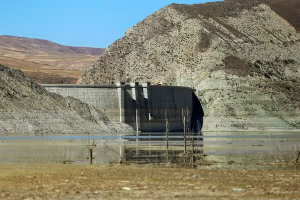
In recent weeks, several cities have faced water shutoffs lasting up to 48 hours, while rolling blackouts have compounded the strain in peak summer heat. Key reservoirs are at critically low levels, with some including the Karaj, Lar, and Taleghan dams dramatically depleted compared to last year.
President Masoud Pezeshkian has warned that without immediate cuts to consumption, some dams could run dry by early autumn, deepening what is already a nationwide environmental emergency.
The address comes as Israel faces its own accusations of restricting access to clean water in Gaza — charges Netanyahu denies — and as he remains wanted by the International Criminal Court for alleged war crimes.
Hint of unfinished business
In a separate sit-down with Israel’s i24 News, Netanyahu described the June strikes that destroyed key elements of Iran’s nuclear and ballistic missile programs as historic and vowed to stop Tehran from rebuilding.
When an i24 reporter asked, “Don’t you sometimes feel like wishing to finish work there?” Netanyahu replied, “Yes, but I won’t go into the details of this. We are following this … with seven eyes … together with our American friends.”
Netanyahu also acknowledged that Iran still retains 400 kilograms of uranium enriched to 60% purity but said Tehran is not currently in a position to advance its nuclear program.
"They have 400 kilograms left. We knew in advance that it wouldn't be damaged. But it's a necessary condition but not sufficient to produce nuclear bombs."
That assessment stands in contrast to the view of former IAEA deputy chief Olli Heinonen, who told Eye for Iran in a recent interview that this amount of material—if further enriched to weapons-grade—could be enough for about ten nuclear bombs
It could be converted within days in a small, concealed facility if the expertise and equipment remain available, he added.
Netanyahu's predecessor, Naftali Bennett also shared a video message to Iranian people on Tuesday, saying, "Iran has a choice: it can choose to continue war or it can choose peace, the way of working together.
Iran’s president will travel to Yerevan next week, Armenian media reported on Tuesday citing the country’s economy ministry, as Tehran continues to push back on a US deal with Armenia to develop a controersial corridor along its southern border with Iran.
Masoud Pezeshkian will start his four-day visit to Yerevan on August 18, according to Armenian media outlets.
Iran's government or state-run media have not yet confirmed the visit which is expected to focus on the US-Armenia deal on a Caucasus corridor.
On Friday, Trump brokered a peace deal between Armenia and Azerbaijan, which gives Washington leasing rights to develop the Zangezur transit route connecting Azerbaijan with its exclave, Nakhchivan. It will be renamed the Trump Route for International Peace and Prosperity (TRIPP).
On Monday, Pezeshkian had a phone conversation with Armenian Prime Minister Nikol Pashinyan, during which he urged regional countries to "remain vigilant and cautious in the face of possible schemes by the United States to pursue its hegemonic goals in Caucasus."
He warned that the United States may use the Zangezur project to achieve its objectives under the guise of economic investment or promotion of peace.
On Tuesday, Iranian Foreign Minister Abbas Araghchi said the planned transport route must not change the region’s geopolitics or cut Iran's access to other corridors.
Speaking in a phone call with his Armenian counterpart Ararat Mirzoyan, Araghchi said, “In any decision or action, respect for national sovereignty and the territorial integrity of countries must be fully observed."
Earlier in the day, government spokeswoman Fatemeh Mohajerani dismissed what she called exaggerated claims about the Zangezur corridor, saying it covers only a small area near Iran’s border.
"It is not as if our entire northern border has been lost,” Mohajerani said, but added that that Iran demands stability, territorial integrity, and existing sovereignty to be preserved.
A senior adviser to Iran’s supreme leader, however, vowed to block the establishment of the transit corridor saying it would endanger regional security and alter the region's geopolitics.
“This passage will not become a gateway for Trump’s mercenaries — it will become their graveyard,” Ali Akbar Velayati said.
Velayati stressed that Iran has always opposed the Zangezur corridor, saying it would alter borders, fragment Armenia, and restrict Iran’s regional access.
The Iranian Baha’i community has faced systematic repression, arrests, and nearly 1,500 years in prison sentences over the past five years, according to the Human Rights Activists News Agency (HRANA).
At least 284 Baha’is were arrested and 270 were summoned to security or judicial institutions in Iran between August 2020 and 2025, the US-based rights group said on Monday.
Other violations of Baha’i rights in Iran over the same period included 419 cases of home searches, 147 trials, 127 travel bans, 108 prison sentence enforcements, 106 denials of education and 57 restrictions on economic activities, it added.
The Bahaʼi faith emerged in nineteenth century Persia, challenging Islamic orthodoxy with its teachings on universal religion and progressive revelation.
Iranian authorities perceive it as a threat to religious and political control, calling it a false religion and a cult.
Over the past five years, 388 Baha’is in Iran have been sentenced by judicial or security institutions to a total of 17,948 months of imprisonment, HRANA reported, equivalent to 1,495 years and 8 months.
Additionally, 91 individuals were fined about 503 billion tomans ($12 million), and 103 were deprived of social rights. Twenty-five individuals were sentenced to 600 months of exile, HRANA said.
Imprisoned for being Baha’i
Many Baha’i prisoners received long-term sentences during this period, often without fair trial procedures and based on charges such as “propaganda against the regime” or “forming illegal groups.”
The figures include 17,324 months of mandatory imprisonment and 624 months of suspended sentences.
The HRANA report identified 2023 as the most repressive year, with 162 documented violations, and 2024 as having the highest number of arrests 76, and a total of 5,220 months of imprisonment.
Other forms of pressure
Beyond judicial prosecution, Baha’is in Iran face other forms of repression, including economic and educational exclusion, interference with burials, cemetery destruction, and property confiscation, HRANA reported.
The pressure and harassment have intensified in recent years, with Baha’is facing more security and judicial actions than any other religious minority in Iran.
Over the past three years, an average of 72% of all reported religious minority rights violations in Iran have targeted Baha’is, HRANA reported.
Iran’s Supreme Leader Ali Khamenei has on several occasions called the Baha’i faith a cult, and in a 2018 religious fatwa, he forbade contact including business dealings with its followers.
Iran's ministry of Intelligence said last month it had made arrests targeting the Baha'i religious minority, evangelical Christians, foreign-based dissidents, Sunni Muslim jihadists, separatists, monarchists and media organizations acting in league with Israel as part of its post-war crackdown.
Tehran moderates are openly signaling readiness for a return to nuclear talks, hinting at accepting some restrictions on its activities but Washington appears unmoved.
“We stated to the (US) negotiating party that we are willing to build trust, but it seems as though they have pretended to be asleep,” Vice President Mohammad Reza Aref said on Tuesday—the clearest suggestion yet that reluctance may be coming from the United States.
“Even direct negotiations can happen,” he added, under balanced conditions. “The Islamic Republic’s approach to negotiations is in line with what the people want.”
The remarks followed Deputy Foreign Minister Majid Takhtravanchi’s statement a day earlier that Iran was prepared to limit its nuclear program if US sanctions were lifted.
There was no public response by Washington.
US Secretary of State Marco Rubio along with foreign ministers of France, Germany and Britain set an informal end-August deadline for a new nuclear deal, warning failure would mean triggering the so-called "snapback" of UN sanctions.
‘No rush’
But no response came from Washington. President Donald Trump told reporters in mid-July that the urgency to engage with Iran had vanished after US strikes in late June.
“They would like to talk. I’m in no rush to talk because we obliterated their site,” Trump told reporters mid July, implying he was content to let pressure build.
European officials have warned Tehran that unless it fully cooperates with the International Atomic Energy Agency (IAEA), the “trigger mechanism” for snapback could be activated, restoring UN sanctions this fall.
Red lines
Despite the conciliatory gestures, Iran’s red lines remain intact.
Takhtravanchi told Japan’s Kyodo News this week that Tehran would not relinquish what it called its right to uranium enrichment.
Officials also stressed that Monday’s visit by IAEA Deputy Director General Massimo Aparo was unrelated to inspections, and Tehran continues to bar IAEA chief Rafael Grossi, accusing him of complicity in the recent attacks.
Reformist daily Arman Melli called Takhtravanchi’s offer “a new prudent decision regarding the nuclear dossier,” noting Iran’s aim to avoid the trigger mechanism while securing sanctions relief to ease its deep financial crisis.
Hardline outlets, meanwhile, have expressed anger at the IAEA and the UN Security Council’s failure to condemn the strikes, and domestic critics warn that opening talks with Washington could be politically costly.
Divisions and outlook
While the Foreign Ministry and its diplomats remain cautious about re-engaging the West, the Presidential Office appears more eager to pursue direct negotiations.
Vahideh Karimi, political editor of Shargh, warned that the combination of Iran’s tentative flexibility and Washington’s hesitation could prolong the stalemate, calling Takhtravanchi’s proposal “realistic” but fragile.
She also pointed to Tehran’s missile program — repeatedly declared off-limits after the war with Israel — as a potential deal-breaker.
Others, like Ham Mihan columnist Majid Younesian, argue the balance of forces is shifting in Iran’s favor and that confrontation with the US and Europe must evolve.
“Change does not mean surrender, as hardliners claim. Not all problems need to be solved with guns, slogans, and provocations,” he wrote.