France, Germany, UK ready to trigger snapback sanctions on Iran | Iran International
France, Germany, UK ready to trigger snapback sanctions on Iran
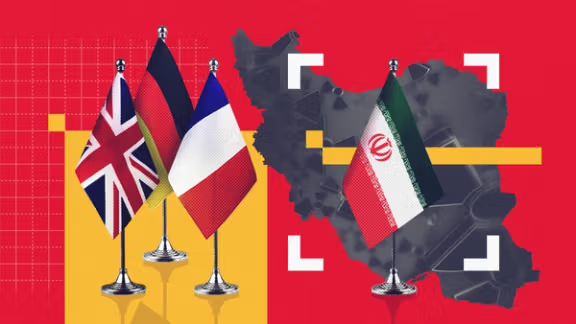
France, Germany and the United Kingdom have told the United Nations they are prepared to reimpose international sanctions on Iran unless it resumes nuclear negotiations with the United States and other powers, according to a letter shared by the French foreign ministry.
In a letter to UN Secretary-General António Guterres and the Security Council, the foreign ministers of the three European nations — known as the E3 — said they were ready to trigger the “snapback” mechanism under the 2015 nuclear deal if Tehran did not agree to talks before the end of August, or accept an extension to the deadline.
“We have made it clear that if Iran is not willing to reach a diplomatic solution before the end of August 2025, or does not seize the opportunity of an extension, E3 are prepared to trigger the snapback mechanism,” the ministers wrote.
The letter was first reported by the Financial Times and France's Le Monde newspaper.
The letter was signed by French Foreign Minister Jean-Noël Barrot, Germany’s Johann Wadephul, and Britain’s David Lammy, and comes two months after US and Israeli strikes on nuclear sites in Iran. The Iranian mission to the UN did not immediately respond to a request for comment.
Under UN Security Council Resolution 2231, which endorsed the nuclear accord, any signatory can trigger the reimposition of sanctions if Iran is deemed in breach. The sanctions — including arms embargoes, cargo inspections and restrictions on missile development — are set to expire on Oct. 18 unless renewed.
Extension for discussion
The Financial Times said the E3 told Iranian negotiators at talks in Turkey last month they would extend the August deadline if Tehran resumed discussions with Washington and restored cooperation with the International Atomic Energy Agency before September. One Western diplomat described those talks as “difficult.”
Iranian Foreign Minister Abbas Araghchi told the newspaper in July that the European powers had no “legal or moral grounds” for a snapback and warned they would be excluded from future nuclear talks if they went ahead.
Iran bracing for snapback
Separately, Iran International reported earlier this week that Iran’s Ministry of Intelligence has issued confidential guidance to ministries and major companies to prepare for the possible return of punitive UN measures.
The leaked document said renewed sanctions would target arms sales, freeze overseas assets, and reimpose restrictions on industries such as oil, petrochemicals, banking, shipping, insurance and sensitive technologies.
The ministry warned of “severe currency fluctuations, reduced purchasing power, increased unemployment, layoffs and heightened social discontent” if sanctions return, and urged companies to seek alternative suppliers in countries including China, Russia and Iraq. It also cautioned about heightened cyber threats to economic infrastructure.
Iran suspended cooperation with the IAEA in June following a brief war with Israel. A senior from the nuclear watchdog met with Iranian counterparts in Tehran on Monday.
'Iran has hand on trigger for NPT exit'
A senior Iranian lawmaker warned on Wednesday that parliament could move to withdraw Iran from the Nuclear Non-Proliferation Treaty (NPT) if Western powers reimpose the UN sanctions.
“If the other side takes steps toward operationalizing the snapback mechanism and using it, the Iranian parliament will definitely respond,” Manouchehr Mottaki, a member of parliament’s economic committee, was quoted as saying by Iranian media.
He said lawmakers were “ready to pull the trigger” on an NPT exit, adding that the West had no legal grounds to restore sanctions under the 2015 nuclear deal and was using the threat only as leverage.
“If they make their threat a reality, in line with the guidance of the Supreme Leader, we will also make our threat a reality,” Mottaki said.
The head of Iran's Atomic Energy Organization has criticized Israeli claims about Tehran’s nuclear activities, saying the program is peaceful and the allegations are based on a distorted and inaccurate dossier.
“A fabricated and fake dossier created by Israel fuels accusations and pretexts — nothing but an attempt to stop our peaceful nuclear program,” Mohammad Eslami said on Tuesday.
Eslami also included the International Atomic Energy Agency (IAEA) in his criticism, saying the agency must condemn the killing of individuals involved in Iran's nuclear program in Israeli attacks, Revolutionary Guards-affiliated Tasnim News reported.
"The assassination of Iran's nuclear scientists, who had no military affiliations, is among their crimes, and such actions by the regime must be strongly condemned by the IAEA,” Eslami said.
Israel launched a surprise military campaign on June 13 targeting military and nuclear sites, assassinating senior Iranian commanders and killing hundreds of civilians.
The war, which lasted for 12 days, saw Israel kill more than 30 senior security officials and 11 senior nuclear scientists.
According to an Iranian government spokesperson, 1,062 Iranians were killed during the conflict, including 786 military personnel and 276 civilians. Iran retaliated with missile strikes that killed 32 people, including 31 civilians and one off-duty soldier.
On June 22, the United States carried out airstrikes on Iran’s key nuclear sites at Fordow, Natanz, and Isfahan.
"During the 12-day war, several registered facilities under continuous IAEA monitoring, with 130 inspectors, were repeatedly attacked with missiles and other projectiles,” Eslami added.
Iran also criticized the IAEA on Monday for what it called a failure to act over Israeli and US attacks in June, after talks in Tehran with the UN nuclear watchdog’s deputy director general earlier in the day.
“The Islamic Republic expressed its objection to the failure of the agency to fulfill its responsibilities regarding the Israeli and US attack, and raised its demands for correcting the agency’s improper processes,” Deputy Foreign Minister Kazem Gharibabadi said.
Tehran moderates are openly signaling readiness for a return to nuclear talks, hinting at accepting some restrictions on its activities but Washington appears unmoved.
“We stated to the (US) negotiating party that we are willing to build trust, but it seems as though they have pretended to be asleep,” Vice President Mohammad Reza Aref said on Tuesday—the clearest suggestion yet that reluctance may be coming from the United States.
“Even direct negotiations can happen,” he added, under balanced conditions. “The Islamic Republic’s approach to negotiations is in line with what the people want.”
The remarks followed Deputy Foreign Minister Majid Takhtravanchi’s statement a day earlier that Iran was prepared to limit its nuclear program if US sanctions were lifted.
There was no public response by Washington.
US Secretary of State Marco Rubio along with foreign ministers of France, Germany and Britain set an informal end-August deadline for a new nuclear deal, warning failure would mean triggering the so-called "snapback" of UN sanctions.
‘No rush’
But no response came from Washington. President Donald Trump told reporters in mid-July that the urgency to engage with Iran had vanished after US strikes in late June.
“They would like to talk. I’m in no rush to talk because we obliterated their site,” Trump told reporters mid July, implying he was content to let pressure build.
European officials have warned Tehran that unless it fully cooperates with the International Atomic Energy Agency (IAEA), the “trigger mechanism” for snapback could be activated, restoring UN sanctions this fall.
Red lines
Despite the conciliatory gestures, Iran’s red lines remain intact.
Takhtravanchi told Japan’s Kyodo News this week that Tehran would not relinquish what it called its right to uranium enrichment.
Officials also stressed that Monday’s visit by IAEA Deputy Director General Massimo Aparo was unrelated to inspections, and Tehran continues to bar IAEA chief Rafael Grossi, accusing him of complicity in the recent attacks.
Reformist daily Arman Melli called Takhtravanchi’s offer “a new prudent decision regarding the nuclear dossier,” noting Iran’s aim to avoid the trigger mechanism while securing sanctions relief to ease its deep financial crisis.
Hardline outlets, meanwhile, have expressed anger at the IAEA and the UN Security Council’s failure to condemn the strikes, and domestic critics warn that opening talks with Washington could be politically costly.
Divisions and outlook
While the Foreign Ministry and its diplomats remain cautious about re-engaging the West, the Presidential Office appears more eager to pursue direct negotiations.
Vahideh Karimi, political editor of Shargh, warned that the combination of Iran’s tentative flexibility and Washington’s hesitation could prolong the stalemate, calling Takhtravanchi’s proposal “realistic” but fragile.
She also pointed to Tehran’s missile program — repeatedly declared off-limits after the war with Israel — as a potential deal-breaker.
Others, like Ham Mihan columnist Majid Younesian, argue the balance of forces is shifting in Iran’s favor and that confrontation with the US and Europe must evolve.
“Change does not mean surrender, as hardliners claim. Not all problems need to be solved with guns, slogans, and provocations,” he wrote.
While China keeps buying discounted oil from Iran and Russia, it is steering new investments and trade routes toward their competitors, official Chinese data reveals.
Billions are flowing into Central Asia, the Caucasus and the Arab world while Beijing’s allies in Tehran and Moscow are left out of major infrastructure projects.
The latest figures on China’s Belt and Road Initiative (BRI) show the scale of the shift.
In the first half of 2025, Beijing invested more than $57 billion and signed $66 billion in contracts under the scheme. Neither Iran nor Russia appears on the list.
For Iran, this marks almost a decade without significant Chinese investment—the last major deal was in 2016, when CNPC signed on to develop South Pars Phase 11, only to pull out after U.S. sanctions returned.
Although Tehran, Moscow and Beijing often signal unity—through joint summits, military drills, and declarations that present them as a bloc challenging the West—China’s approach has been far more pragmatic.
In Washington and European capitals they are frequently cast as strategic allies, but Beijing has shown little appetite for sharing in Iran’s or Russia’s conflicts, and is not putting its money where its mouth is.
New routes
China is backing transport corridors that cut both countries out of Eurasian trade.
Cargo along the Central Asia–Caucasus–Turkey–Europe route rose 68% last year to 4.5 million tons, while traffic through Russia fell more than 45% in both directions.
Beijing now holds a 51% stake in the $4.7 billion Kyrgyzstan–Uzbekistan railway—which also links Kazakhstan and the Caucasus.
All these routes pass through Azerbaijan, which is set to launch the Zangezur Corridor along Iran’s border following an agreement with Armenia brokered by the United States.
Once complete, it could double Azerbaijan’s cargo transit by 2027, twice Iran’s total foreign cargo transit in 2024.
Energy leverage erodes
Azerbaijan is also moving to bypass Iran in gas supply.
Turkey’s new pipeline to Nakhchivan, completed in March, ends the exclave’s reliance on Iranian transfers.
Planned Azerbaijani gas exports to Armenia, Nakhchivan, and Turkey will further shrink Iran’s role, including its modest gas-for-electricity swap with Yerevan.
China invested $39 billion in the Middle East last year, and more than $19 billion in the first half of 2025—none in Iran.
Iran’s Arab neighbors are pushing ahead with mega-projects: Iraq’s $17 billion Grand Faw Port expansion to the Turkish border, Saudi-led Red Sea links, and renewable energy and oil investments across Turkmenistan, Azerbaijan, Kazakhstan, and Uzbekistan.
Isolation deepens
Sanctions, political unpredictability, and strained ties with the West have made Iran and Russia high-risk bets for long-term infrastructure projects.
A decade of continued Chinese uninvestment has compounded Iran’s marginalization.
As China, Arab states, and Central Asian neighbors weave tighter networks of trade, energy, and diplomacy, Iran risks falling further behind—economically and geopolitically—unless it repositions itself to join the region’s emerging connectivity map.
Iran on Monday criticized the International Atomic Energy Agency (IAEA) for what it called a failure to act over Israeli and US attacks in June after talks in Tehran with the UN nuclear watchdog’s deputy director general earlier in the day.
“The Islamic Republic expressed its objection to the failure of the agency to fulfill its responsibilities regarding the Israeli and US attack and raised its demands for correcting the agency’s improper processes,” deputy foreign minister Kazem Gharibabadi said.
Gharibabadi's remarks came following a meeting with IAEA deputy director general Massimo Aparo, who was in Tehran for a brief trip on Monday. The visit marked the highest-level meeting between the IAEA and Iran since the attacks on Iranian nuclear sites badly frayed ties.
Iran's foreign minister Abbas Araghchi had stressed earlier that the visit would not involve nuclear inspections but rather dialogue with the agency.
In June, Iran’s parliament approved a bill to suspend the country’s cooperation with the IAEA, a day after a ceasefire with Israel.
The bill, passed with 221 votes in favor, none against, and one abstention out of 223 members present, and bars the UN nuclear watchdog’s inspectors from accessing Iran’s nuclear facilities.
At the time, Iran also accused IAEA chief Rafael Grossi of bias and failing to condemn the attacks.
On July 4, Grossi said that the agency's team of inspectors had departed Iran to return to its headquarters in Vienna after the new law barred cooperation with the IAEA.
Israel launched a surprise military campaign on June 13 targeting military and nuclear sites, killing hundreds of military personnel, nuclear scientists and civilians.
Iran responded with missile strikes that killed 31 civilians and one off-duty soldier, according to official figures published by the Israeli government.
The Islamic Republic says 1,062 people were also killed by Israel during the 12-day conflict, including 786 military personnel and 276 civilians.
On June 22, the US carried out airstrikes on Iran’s key nuclear sites at Fordow, Natanz, and Isfahan.
The full extent of the damage remains unclear but President Donald Trump has repeatedly said that the strikes "obliterated" the country's nuclear program.
Iran’s Ministry of Intelligence issued secret guidance warning ministries and major companies to prepare for the likely return of punishing United Nations sanctions, documents reviewed by Iran International show.
The Intelligence Ministry said that the return of so-called snapback sanctions will include a ban on arms sales, freezing of assets and foreign currency accounts of companies abroad.
“Re-sanctioning of legal and natural persons active in industries such as oil, petrochemicals, banking, shipping, insurance and sensitive technologies will be activated,” the document said.
Potential fallout could roil markets and exacerbate unemployment and deepen popular discontent, the ministry added.
“Severe currency fluctuations, reduced purchasing power, increased unemployment, layoffs and heightened social discontent are to be expected,” the Intelligence Ministry said.
The snapback mechanism is part of UN Security Council Resolution 2231, which endorsed a 2015 deal over Iran's disputed nuclear program called the Joint Comprehensive Plan of Action (JCPOA).
Under Resolution 2231, any party to the accord can file a complaint accusing Iran of non-compliance. If no agreement is reached within 30 days to maintain sanctions relief, all previous UN sanctions would automatically “snap back,” including arms embargoes, cargo inspections and missile restrictions.
Iran’s Intelligence Ministry also pointed to potential alternative partners for the Islamic Republic to evade the sanctions.
“Identify alternative suppliers in countries like China, Russia, Iraq, etc., which will be less affected by sanctions,” the statement said.
The guidance also warned of renewed threats to national security including cyberattacks on critical infrastructure.
“Increased targeted cyberattacks on economic infrastructure, focusing on supply chains, automation, and financial management, as well as efforts by foreign intelligence services to infiltrate through third parties, contractors, or organizational applications, will be some of the threats,” the statement said.
France, the United Kingdom and Germany told Iran they would restore UN sanctions unless it reopened talks on its nuclear program immediately and produced concrete results by the end of August.
Iranian diplomates last met representatives of the three European countries in Istanbul on July 25.
Iran’s Foreign Ministry spokesman Esmail Baghaei described the meeting with Britain, France and Germany as a “test of realism” for the E3 powers, calling it a chance for them to correct past positions.