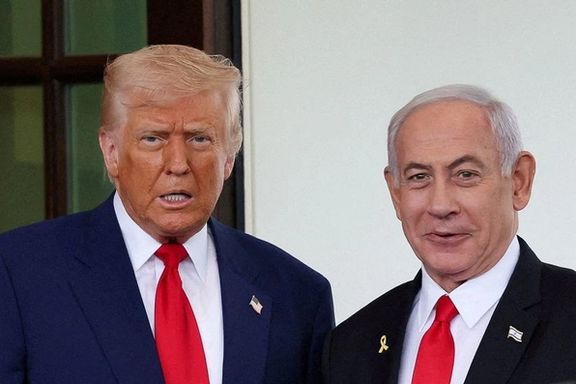
Washington has outsourced its Iran policy to Israel following the 12-day war, former Obama-era negotiator Alan Eyre told Iran International, warning that the Trump administration now sees Iran's nuclear issue as resolved despite the remaining risks.
On June 22, the United States joined Israel’s campaign against Iran and carried out airstrikes on its key nuclear facilities at Fordow, Natanz, and Isfahan.
"President Trump said the [Iranian] nuclear program is obliterated. They seem to have put it in the ‘mission accomplished’ category,” Eyre told Iran International's podcast, Eye for Iran.
Under Obama, Under Secretary of State Wendy Sherman worked closely with world powers to keep the 2015 nuclear deal alive, balancing many interests through complex diplomacy — a sharp contrast to today’s one-track coordination with Israel, Eyre said.
"There’s pretty much one person in the foreign affairs who he is coordinating with, and that’s Prime Minister Netanyahu," Eyre said, "The gentleman in charge, Mr. Witkoff, has a lot of other stuff on his plate to include Gaza and Ukraine. We’re really not paying any attention to the Iran portfolio. We have sort of outsourced it to Israel.”
Signals of a renewed fight
Tehran’s decision to revive its Supreme Defense Council — a wartime command body not convened since the Iran–Iraq War — is widely seen as a signal it expects the ceasefire with Israel to be temporary.
The move suggests Iranian leaders are bracing for renewed conflict and working to reestablish what Eyre described as “some type of strategic deterrence,” from rebuilding air defenses to restoring missile and nuclear capabilities.
Tehran at a crossroads
Weakened by war and diplomatic deadlock, Iran’s clerical elite faces a stark choice: defy pressure to halt its nuclear activity and risk further Israeli and US attack or concede and risk a leadership fracture.
A fragile ceasefire ended the 12-day war in June. Both sides claimed victory, but the war exposed vulnerabilities and punctured Iran’s image of deterrence.
Three Iranian insiders told Reuters the political establishment now views nuclear negotiations with Washington as the only way to avoid further escalation and existential peril. The Israeli strikes began just a day before a planned sixth round of talks with the US.
Supreme Leader Ali Khamenei and Iran’s political leadership have agreed in principle to resume nuclear talks with Washington, seeing diplomacy as essential to preventing further US–Israeli strikes.
E3 Snapback Threat Adds Pressure
Britain, France, and Germany have warned they are prepared to trigger the UN’s “snapback” sanctions mechanism if Iran does not return to talks by the end of August.
Eyre said that even after the attacks, Iran retains the industrial capacity, enriched uranium, and technical knowledge to produce a nuclear weapon if it chooses.
“The fork in the road now is — does it try to reconstitute what it had before, or does it try something else… like moving toward a nuclear weapon?” he said.
Israel and the US could launch a new war if Iran attempts to resume uranium enrichment, a former Iranian official warned Friday, less than two months after a US-brokered truce ended a 12-day war between Iran and Israel.
“Enrichment without an agreement means war—and even with an agreement, it is currently impractical,” Qassem Mohebali, former director general for the Middle East and North Africa at Iran's Ministry of Foreign Affairs, told Rouydad 24 website.
"The only solution is to temporarily suspend this right until a deal is reached.”
Last month, Iran's foreign minister insisted Tehran would not give up enrichment and the United States has no way to end it militarily, after US President Donald Trump vowed to wipe out Iran's nuclear sites again if it revived its activities.
"All should know that we Iranians have NOT BOUGHT our PEACEFUL nuclear program; we have BUILT IT WITH BLOOD, SWEAT, AND TEARS," Araghchi posted on X in late July.
"They still talk about enrichment. I mean, who would do that? You just come out of something that's so bad, and they talk about, we want to continue enrichment. Who would say that? How stupid can you be to say that?" Trump said.
Is enrichment Iran's right?
While Iran insists that enrichment is its right under the Non-Proliferation Treaty (NPT), Mohebali says the right to enrichment and its actual implementation are different.
"The NPT doesn’t explicitly grant a ‘right to enrichment’, it only permits peaceful nuclear technology use, which doesn’t necessarily include enrichment."
“Iran could be granted this right but choose not to exercise it until an agreement is reached. At present, enrichment seems neither feasible nor open for discussion,” Mohebali added.
On June 22, Trump ordered airstrikes on Iran’s nuclear sites at Fordow, Esfahan, and Natanz, capping off a surprise Israeli military campaign that killed hundreds of people, including military personnel, nuclear scientists, and civilians.
Mohebali also warned that Iran's failure to reach a deal with world powers over its disputed nuclear program may lead to the return of UN sanctions which could itself escalate tensions.
“The return of UN Security Council sanctions—particularly Resolution 1929—would allow the United States, Israel, and Europe to impose official sanctions and carry out actions such as inspecting planes, ships, trains, or individuals. Such actions could themselves lead to war,” he said.
Iran’s Ministry of Intelligence issued secret guidance warning this week to ministries and major companies to prepare for the likely return of punishing United Nations sanctions.
France, Germany, and the United Kingdom have warned that they are prepared to trigger the so-called “snapback” mechanism by the end of August if Tehran fails to reach a diplomatic solution.
The snapback mechanism, part of UN Security Council Resolution 2231, which endorsed the 2015 Joint Comprehensive Plan of Action (JCPOA), allows any party to the accord to file a complaint accusing Iran of non-compliance.
If no resolution is reached within 30 days, all previous UN sanctions would automatically “snap back,” including arms embargoes, cargo inspections, and missile restrictions.
Israeli defense forces are accelerating plans to strengthen the country’s advanced defense capabilities in anticipation of a new wave of missile attacks from Iran or its Yemeni proxy forces, Walla News reported on Friday.
Director General of the Defense Ministry, Major General Amir Baram, has ordered the expedited development and production of air defense systems, including the Arrow 3, Arrow 4, Iron Dome, David’s Sling, and a ground-based laser system, according to the report.
The directive also covers additional ground-based laser systems, various radar systems, and other classified technologies.
Each of these defense systems covers different capabilities. The Iron Dome is a short-range system that intercepts rockets and artillery shells with a range of 4-70 km (2-43 miles). It uses radar to detect and track threats, and its interceptors destroy them mid-air.
Arrow 3 and Arrow 4 are long-range ballistic missile defense systems. Arrow 2 intercepts missiles in the upper atmosphere, while Arrow 3 targets them in space, making it effective against threats such as Iran’s ballistic missiles.
David’s Sling is a medium-range defense, intercepts tactical ballistic missiles, cruise missiles, and drones (40-300 km, 24-186 miles range).
On Thursday, Israel’s military chief said the army is prepared to launch more strikes on Iran if necessary, after what he described as a successful preemptive war in June that halted an emerging existential threat to Israel.
Baram’s order follows continued missile launches by Iran-backed Houthis from Yemen and also speculations about the resumption of the June war between Iran and Israel.
Investigations into Iranian missile strikes on Israel—particularly those in the final hours before the ceasefire—are a focus of the air defense unit’s current assessments, the Walla News report said.
The last missile salvo against Israel occurred on June 24, when Iran fired six barrages totaling 20 ballistic missiles. Israel said most were intercepted, but some hit targets, including an apartment complex in Beersheba.
Baram’s directive places strong emphasis on cooperation with the United States Central Command (CENTCOM). Israel officially became part of CENTCOM’s area of responsibility in 2021.
Israel launched a surprise military campaign on June 13 targeting military and nuclear sites, assassinating senior Iranian commanders, and killing hundreds of civilians.
The chief of staff to Iran's president said Israel’s attack on a Supreme National Security Council (SNSC) meeting on June 16 was a targeted attempt to kill Masoud Pezeshkian, who escaped with a minor injury.
On the fourth day of the Israeli 12-day war on Iran, the SNSC meeting attended by the heads of Iran’s three branches of power was hit by six bombs or missiles. Iranian state media later reported that President Pezeshkian and some other officials sustained minor leg injuries when trying to flee.
“I immediately ran out of the meeting and saw Pezeshkian walking about four meters away. He was on his feet, with a slight injury to his leg,” Mohsen Haji-Mirzaei, chief of staff to the Iranian president, said in an interview aired by the state TV on Friday.
He said that despite his injured leg, President Pezeshkian took a shower that day and met with Supreme Leader Ali Khamenei. The next day, he visited a doctor to drain a swollen hematoma from his leg.
“Israel had a calculated plan to kill Pezeshkian, but God did not will his death,” Haji-Mirzaei said.
Israel targeted the building’s entrances and exits with six missiles or bombs to block escape routes and cut off airflow, Revolutionary Guards affiliated Fars News reported last month.
“Interior Minister Eskandar Momeni had inhaled so much dust that he was struggling to breathe, and medics were helping him," Pezeshkian's chief of staff said.
“I saw General Mousavi (Abdolrahim Mousavi, chief of staff of the Iranian armed forces) with his face and body covered in dust and his clothes torn,” Haji-Mirzaei added.
Israel launched a surprise military campaign on June 13 targeting military and nuclear sites, assassinating senior Iranian commanders and killing hundreds of civilians.
During the 12-day conflict, Israel killed more than 30 senior security officials and at least 11 senior nuclear scientists. According to an Iranian government spokesperson, 1,062 Iranians were killed, including 786 military personnel and 276 civilians.
Iran retaliated with missile strikes that killed 31 civilians and one off-duty soldier. On June 22, the United States joined the campaign by carrying out airstrikes on Iran’s key nuclear facilities at Fordow, Natanz, and Isfahan.
A US-brokered ceasefire put an end to the conflict on June 24.
Iran’s customs data indicates that strategic reserves of animal feed have declined, raising warnings about potential impacts on the country's food security.
“Customs data shows a 60% decrease in soybean meal imports and an 8% decrease in corn imports in the first four months of this year compared to the same period last year,” ILNA news agency reported.
“Animal feed inputs of very low quality have reached end consumers at prices about twice the approved rates due to import monopolies — a trend that seriously threatens the country's food security in the sensitive period following June’s 12-day war with Israel,” ILNA quoted Mojtaba Aali, the CEO of the National Livestock Farmers Union, as saying, referring to June's 12-day war with Israel.
Aali said that livestock farmers in Fars province, a key hub for livestock production, recently held protests over the issue.
According to Iranian media, over the past five months, reserves of supplies such as corn and soybean meal, which are mostly imported from countries such as Brazil, have been significantly lower than the country’s monthly consumption.
In the same period, a rise in prices has been recorded, affecting most livestock farmers and their ability to purchase animal feed.
“Corn has been traded at 130,000 rials ($1.30), barley at 220,000 rials ($2.30), and soybean meal at 230,000 rials ($2.40),” ILNA reported.
According to S&P Global, the June war has left behind many issues facing the country's food security, not least regarding essential imports.
"Exporters of corn and soybeans in Brazil and Basmati rice from India have already raised alarms about trade with Iran due to rising insurance premiums, delayed payments, and wartime dangers such as jamming of navigation or communication systems," its analysts wrote.
As of 2025, data from Iran’s Statistics Center shows that the country’s agricultural land has shrunk to 15.43 million hectares, a decrease from 18 million hectares in previous years.
Farming continues to be a major source of livelihood, supporting over 4.5 million people, 89% of whom live in rural areas and 11% in urban settings, with the agricultural sector contributing roughly 8.3% to Iran’s GDP and employing about 27% of the national workforce.
Compounding this, over the past year, the country has experienced a 1.5°C increase in average temperatures and a 45% decline in rainfall, leading to further desertification across the country.
A senior Iranian intelligence official and a network of operatives have been identified as key figures in a cyber group that targeted London-based broadcaster Iran International and its staff, according to information obtained by the channel.
The hacking group, known as “Handala,” is tied to the Iranian Ministry of Intelligence’s Domestic Security Directorate and operates as part of a broader cyber unit known as “Banished Kitten” — also referred to as Storm-0842 or Dune.
This unit falls under the supervision of Yahya Hosseini Panjaki, the ministry’s deputy for domestic security. Panjaki was sanctioned by the United States in 2024 over alleged plots to assassinate Iranian dissidents abroad, a few months after his identity was exposed by Iran International.
The broadcaster said the latest findings show that the July cyber operation was intended to intimidate journalists and disrupt their work, with the group publishing personal documents, private images, and screenshots from an editorial meeting.
A screengrab from a video showing Ali Bermoudeh
According to information obtained by Iran International, one of the identified operatives is Ali Bermoudeh, a 27-year-old from Tabriz who runs an online store and has previously worked with Iran’s cyber police (FATA).
One source said that "Bermoudeh is an amateur hacker whose passwords for many of his main accounts are simply his date of birth. All his user credentials with that same password are stored with one service provider."
According to the source, he has been gathering user data for security agencies since his teenage years, and he is connected to the network through his father Mousa Bermoudeh, a provincial official with the state-affiliated Foundation of Martyrs and Veterans Affairs and a decorated IRGC Basij member.
The group also includes Morteza Aftabifar, said to be Bermoudeh’s handler within the Ministry of Intelligence.
Both men are from Tabriz, as is Panjaki, who heads the larger project within which the cyber unit operates.
Panjaki is described as part of a newer generation of intelligence managers trusted by Supreme Leader Ali Khamenei, with a background in political science from Azad University of Tabriz. He also founded a “Qassem Soleimani Headquarters” within the ministry, coordinating with the Islamic Revolutionary Guard Corps on overseas operations, the channel has learned.
In July, Iran International confirmed that leaked materials published by Iranian state outlets came from earlier hacks in summer 2024 and January 2025, which it attributed to Banished Kitten.
The channel said the hackers may have installed malware via compromised Telegram accounts. “These cyberattacks are part of a broader campaign of threats targeting Iran International, including physical threats against our staff.”
Iran International, which reports on events in Iran and the wider region, said its staff had faced sustained harassment since the channel was founded in 2017, including threats of assassination and kidnapping, physical assaults, online abuse, and hacking.
British lawmakers have accused Iran of engaging in “transnational repression” on UK soil, citing assassination plots, intimidation of family members, asset freezes, smear campaigns, and cyberattacks.
The channel has also been the focus of physical threats: in 2023 a man was convicted under terrorism laws after filming outside its premises, and in 2024 a presenter was stabbed in London.
Iran International said earlier in August that it had filed an urgent appeal to United Nations experts over “serious risks to the lives and safety” of its journalists worldwide and their relatives inside Iran.
US-based advocacy group United Against Nuclear Iran (UANI) called on Washington and its European allies to confront Iran’s transnational repression, which it says has escalated since the start of a 12-day war between Iran and Israel in June.