New security deal with Iraq to secure regional stabilization, Iran says
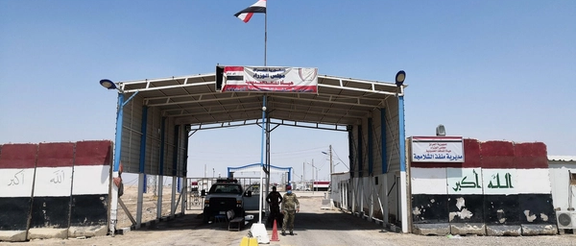
Iraqi Border Guards are seen at the border gate between Iraq and Iran after it partially reopened at the Shalamcheh Border Crossing, Iraq July 7, 2020.
Iran’s top security official said the new security agreement that Tehran and Baghdad signed last week is aimed at preventing foreign powers from destabilizing the region, while Iraq played down the pact as a simple border agreement.
“We must not allow others to destabilize the region. Instead, we should preserve stability along this path. That is why we signed an important security agreement with Iraq,” Ali Larijani, Secretary of Iran’s Supreme National Security Council, said in a televised interview about his recent visit to Baghdad and Lebanon.
The agreement includes “a mutual commitment to prevent any disruption by individuals, groups, or third countries, in such a way that no party can use the other’s territory against the other side or create breaches in security,” Larijani said.
He linked the deal to recent regional tensions, saying that “even in the past 12-day war this issue was taken into consideration; part of the war was supported from the skies of some countries," referring to nations Iran says supported Israel's attacks on Iran.
The advisory said the agreement builds on a 2023 protocol concerning Iranian Kurdish opposition groups. It emphasized that “there is no security agreement between the two countries; rather, it is a security memorandum of understanding.”
Washington voices opposition
Iraq’s National Security Advisor Qassem al-Araji met with US Chargé d’Affaires Steven Fagin on Saturday to discuss the deal, which Washington has opposed.
In their meeting, Araji “reviewed the details of the security memorandum of understanding signed between Iraq and the Islamic Republic of Iran regarding border control, which contributes to supporting regional security and stability, preventing smuggling and infiltration,” his office said.
Washington, however, has argued the deal undermines Iraqi sovereignty. “We oppose any legislation that is inconsistent with the goals of our bilateral security assistance and partnership and runs counter to strengthening Iraq’s existing security institutions,” State Department spokesperson Tammy Bruce said Tuesday.
“We support genuine Iraqi sovereignty, not legislation that would turn Iraq into an Iranian satellite state,” she added.
New security deal with Iraq to secure regional stabilization, Iran says | Iran International
Iran’s Revolutionary Guards and its regular army issued statements on Sunday marking the anniversary of the return of prisoners of war from Iraq in 1990, praising their resilience and pledging readiness to confront threats against the country.
The Islamic Revolutionary Guard Corps (IRGC) said the anniversary of the release of Iranian captives during the 1980s war with Iraq recalled “divine patience, iron will and steadfast faith” that upheld the dignity of the Iranian nation.
“The Iranian nation... is prepared to crush any enemy front and any malicious plan against the security and future of its land,” the Guards said.
The statement described the former POWs as “the true symbols of active resistance and strategic hope,” adding that their example had shown “the power of faith, national unity and revolutionary steadfastness can bring the biggest war machines and imperialist policies to their knees.”
The IRGC pledged to remain committed to the ideals of the Islamic Republic’s late founder Ruhollah Khomeini, Supreme Leader Ali Khamenei, and the Iranian nation.
The Iranian army issued a separate statement commemorating the date, describing the return of the POWs as a moment of national pride. “The 26th of Mordad (August 17) reminds us of the glorious return of the liberated, whose patience and faith demonstrated the greatness and endurance of the Iranian nation to the world,” it said.
The army praised the sacrifices of those held in captivity and said their memory would “shine like a beacon on the path of future generations.”
It vowed to continue the path of resistance and expressed confidence that, “by divine grace, oppressed nations of the region will also expel Zionist and American occupiers from their lands and expand the geography of resistance to the horizon of ultimate victory for the Islamic nation.”
August 17, 1990, marked the return of the first group of Iranian captives after years of imprisonment in Iraq. Nearly 50,000 Iranians, many of them volunteer fighters, were eventually repatriated in exchange for a similar number of Iraqi prisoners of war.
Iran’s Supreme Court has upheld the death sentence of labor activist Sharifeh Mohammadi, convicted of armed rebellion against the Islamic Republic, despite what her lawyer described as unresolved flaws in the case.
Branch 39 of the Supreme Court endorsed the ruling even though none of the flaws it previously cited as the basis for overturning her sentence have been resolved, Mohammadi's attorney Amir Raeisian said on Saturday.
"The Supreme Court was expected to once again overturn the ruling, but contrary to expectations, it did not," the lawyer said.
Mohammadi was convicted on charges of baghi or “armed rebellion against the state”, which carries the death penalty under the Islamic Republic's law.
Human rights groups say her membership in the Committee for Coordinating to Help Form Workers’ Organizations was the grounds for the death sentence.
The Islamic Republic's security forces consider the committee as an affiliate of the Komala, a Kurdish armed opposition group that has been engaged in guerilla warfare against the Islamic Republic. However, both Mohammadi's family and the Komala have dismissed any affiliation.
According to rights groups, during her detention, Mohammadi was deprived of basic prisoner rights, such as in-person visits and phone calls.
For a long time, she was denied visits with her family, especially her child, and was not allowed to contact them by phone.
The decision has drawn sharp criticism by prominent activists including Masih Alinejad.
“This is not just an attack on one woman, it is an attack on every mother who dares to dream of a better life for her children. When injustice threatens the most vulnerable among us, our silence becomes consent. We must raise our voices for Sharifeh, because her fight is the fight of us all,” Alinejad wrote on X.
Last year, 834 Iranians were executed, according to the United Nations, marking a record high and a 50-percent increase from the previous year.
At least 22 of those executed were women, making Iran the world's number one executioner of women. The 2023 figures were the highest since 2014, according to Norway-based organization Iran Human Rights.
In January, the UN called for an end to the "horrific wave of executions" underway, with 67 executions in May alone.
Tehran will deliver a far stronger response to any future attacks by the United States or Israel, the Islamic Republic's Armed Forces said in a statement on Saturday.
“Once again, we firmly warn the criminal America, the malicious and brutal Zionist regime to abandon conspiracies and hostility against a powerful and invincible Iran,” said the General Staff of the Armed Forces in the statement marking the anniversary of the release of Iranian war prisoners from Iraq.
"In the event of any miscalculation or satanic action, what prevented us from wider operations during the 12-day imposed war will no longer apply," the military warned.
"This time they will face new surprises and far more crushing blows."
Israel’s military chief said on Thursday the army is prepared to launch more strikes on Iran if necessary, after what he described as a successful preemptive war in June that halted an emerging existential threat to Israel.
“We struck Iran and its axis, whose declared aim was our destruction,” chief of staff Lt. Gen. Eyal Zamir said at a military college change of command ceremony.
On June 13, Israel launched land and air strikes targeting senior Iranian military leaders, nuclear scientists, and politicians, while damaging or destroying Iranian air defenses and nuclear facilities.
Iran retaliated with missile and drone attacks on Israeli cities and military sites. On the ninth day of fighting, the United States bombed three Iranian nuclear sites. Iran then struck a US base in Qatar before a US-brokered ceasefire ended the conflict.
Zamir said the campaign in June sent a clear message that Israel "would not allow its enemies to become stronger with capabilities that will endanger its existence and will be willing to pay a heavy price to ensure its existence and future."
"If necessary, we will know how to act again with precision, intensity and lethality."
A Danish newspaper has revealed extensive financial and organizational ties between the Islamic Republic and Imam Ali Mosque in Copenhagen, one of the largest Shiite centers in Denmark.
“The Imam Ali Mosque in Copenhagen has received millions of kroner from Iranian donors for the purchase of a detached house. This is shown by secret documents that Berlingske has been given. The money has gone through the Iranian Embassy in Copenhagen,” wrote the paper.
The mosque received millions of kroner from Iranian institutions and donors to advance the Islamic Republic’s ideological agenda, according to documents obtained by Berlingske.
In 2007, about 2.7 million kroner was transferred through Iran’s embassy in Copenhagen to the mosque’s managing association. The funds, provided by two Iranian charities, were used to buy a villa in Denmark.
Although the Danish Justice Ministry licensed the property strictly for embassy staff housing, it became the residence of Mohammad Mahdi Khademi, the mosque’s imam and chairman.
Khademi, from an influential Iranian family, was formally employed by the Iranian embassy between 2001 and 2015 and listed internally as embassy staff, Berlingske reported.
The mosque’s bylaws, previously reported in Danish media, state it is “under the authority of the Supreme Leader of the Islamic Republic.”
The revelations have sparked calls in parliament for closure of the mosque. Some lawmakers described it as a propaganda arm of the Islamic Republic and urged its immediate shutdown. Others argued that if current laws prevent closure, legislation must be amended to stop foreign-backed institutions from operating.
The financial dealings and property case linked to the mosque are now under review by Danish security and judicial authorities.
Germany banned the Islamic Center of Hamburg in July 2024, citing its promotion of the Islamic Republic’s ideology, support for Hezbollah, and actions contradicting the German constitution.
A nationwide police raid in November 2023 across 54 associated offices in seven states precipitated the center’s removal from the umbrella Central Council of Muslims in Germany, laying the groundwork for a formal ban on its operations and affiliates.
An Iranian police officer was killed and another wounded on Friday night when gunmen from a Sunni militant group opened fire on a military vehicle in the southeastern city of Iranshahr, local police said.
The police have identified the victims as Sgt. Ramin Sadeghi.
The gunmen exchanged fire with police before fleeing, according to the IRGC-affiliated Fars News.
The shooting occurred when a passing car opened fire on security forces moving through the city, according to a report by Haalvsh, a human rights organization that focuses on the restive Sistan-Baluchestan province.
A heavy security presence followed, with dozens of military and plainclothes forces dispatched to the scene, according to witnesses. Checkpoints were set up at the entrances and exits of Iranshahr, where drivers were stopped and asked for identification.
The Sunni militant group Jaish ul-Adl claimed responsibility for the attack in a statement on its Telegram channel.
The incident comes less than three weeks after a deadly assault on a courthouse in Zahedan, the provincial capital of Sistan and Baluchestan, in which nine people were killed — including three attackers — and 20 others wounded.
Jaish ul-Adl said it carried out that attack, which involved gunmen storming the judiciary compound and setting off an explosion.
Sistan and Baluchestan, bordering Pakistan and Afghanistan, has long experienced unrest involving Sunni militant groups, drug traffickers, and security forces.
Jaish al-Adl, designated a terrorist organization by both Iran and the United States, says it fights for the rights of Iran’s Baloch minority but is accused by Tehran of ties to cross-border militant networks.