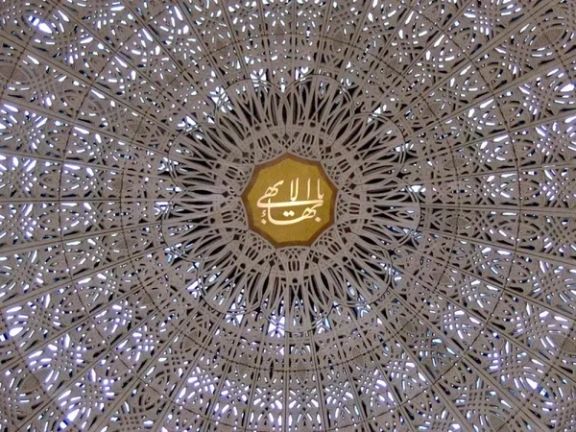
A calligraphy artwork depicting the name of the Baha’i faith’s founder
Authorities in the central Iranian city of Isfahan have begun seizing homes and assets from members of the Bahá’í religious minority by text message—an unprecedented move a community spokesperson called “economic strangulation” that has mostly targeted women.
“This is the first time we know of that the government has used text messages to order confiscations,” Farhad Sabetan, spokesperson for the Baha’i International Community (BIC) told Iran International.
“What we are witnessing is nothing less than economic strangulation of the Baha’i community—families are deprived of their livelihoods overnight, without due process, without even a court order.”
Bahais constitute the largest religious minority in Iran and have faced systematic harassment and persecution since the Islamic Revolution of 1979.
Iran does not recognize the Baha’i faith as an official religion, unlike Christianity, Judaism, or Zoroastrianism. Authorities label it a “cult” with alleged foreign ties—charges its followers reject.
The BIC said the seizures included homes, vehicles, and other assets, carried out under Article 49 of Iran’s constitution, a clause designed to reclaim property gained through illicit activities such as theft or drug trafficking. In practice, Sabetan said, it is being misused “to plunder the possessions of citizens who have committed no crime other than being Baha’i.”
According to the BIC, families were ordered by text to present themselves to court or face arrest. Some later discovered blocked bank accounts, frozen business transactions, and restrictions on selling property. In several cases, court files were not recorded in Iran’s official judicial notification system, preventing defendants and their lawyers from reviewing them.
The confiscations come as Iranian authorities step up pressure on Baha’is, accusing them without evidence of spying for Israel. While thousands of Baha’i-owned properties have been seized since the 1979 revolution, rights groups say the new reliance on digital notices reflects a more brazen, impersonal stage of repression.
Sabetan said that the majority of those targeted in Isfahan are women—many engaged in teaching and community service. “It may not be coincidental,” he said. “After the Women, Life, Freedom movement, the government has been cracking down on women broadly. Now Baha’i women are being targeted in the same way—mothers and educators denied the ability to care for their families or live normal lives.”
According to the US-based Human Rights Activists News Agency (HRANA), Baha’is account for more than 70 percent of all documented violations against religious minorities in Iran over the past three years. At least 284 Baha’is have been arrested in the past five years, receiving a combined 1,495 years in prison sentences.
“What the Iranian government is doing amounts to a gradual death sentence,” Sabetan said. “They may not execute Baha’is as they did in the early years of the revolution, but by stripping them of work, property, and dignity, they are trying to erase our community.”
A reformist-leaning Iranian Telegram channel on Wednesday published the names of 64 women it said are jailed for political reasons, challenging Iran's judiciary chief who said no more than five such detainees exist.
“This list concerns female political prisoners in Gharchak prison and a handful of other known cases. It does not cover other cities or prisons across the country,” Tahkim Mellat said in its statement, adding that the document was presented solely for civic and legal follow-up.
Qarchak Prison is a women’s facility southeast of Tehran, known for holding political prisoners in poor and overcrowded conditions, according to rights groups.
The announcement came after judiciary chief Gholamhossein Mohseni Ejei said he had asked political groups to provide names of detainees.
Ejei argued that reformist figures had admitted identifying “no more than three to five” prisoners, calling on them to announce this publicly.
Yet Tahkim Mellat countered that in Gharchak prison alone more than 60 women are held for political activity.
'No transparency'
The names include Raheleh Rahimi Pour, a 75-year-old suffering from a brain tumor, and Kobra Beigi, 70, who was excluded from a 2023 amnesty.
Several other political prisoners who face death sentences were also named including, Sharifeh Mohammadi, Pakhshan Azizi, and Varisheh Moradi.
“The demand for the release of political prisoners had previously been raised by individuals and groups within civil society as a political necessity; however, until now, the government and political parties have taken no action to recognize or pursue the rights of more than just a few political prisoners,” reads the statement by the outlet.
“This silence and lack of transparency by political officials has resulted in a large number of political prisoners remaining in detention without adequate support or attention.”
Calls for accountability
Responding last week to Ejei’s remarks, veteran reformist commentator Emadeddin Baghi said the judiciary “certainly does not need to request a list from others if it wishes to prepare a more complete and accurate one.”
Independent civic associations, if not restricted, could provide more reliable data, Baghi added.
“What matters,” Baghi said, “is to set clear criteria — such as prioritizing prisoners near the end of their sentences, those whose convictions are disproportionate, or those eligible for parole under the law — rather than debating whether the number is five or sixty.”
Tahkim Mellat said officials have a duty to respond to the list it published.
Iran’s communications minister confirmed on Wednesday that widespread disruptions to GPS and internet services were linked to “security considerations” and said raising tariffs for mobile operators had become unavoidable to sustain services.
“Disruptions in frequency bands and GPS signals are due to security concerns and the possible presence of drones,” Sattar Hashemi told reporters after a cabinet meeting, according to state media. “Naturally, this has created problems in providing services to the people. We are negotiating and working step by step to resolve them.”
Hashemi said Iran would not rely on a single technology, when asked about switching to China’s BeiDou navigation system. “We will naturally use all capacities that exist in the world. Sole reliance on one technology is not in our interest,” he said.
He also addressed mounting pressure from mobile operators to increase prices, noting that years of frozen tariffs and rising costs had left them struggling to maintain services.
“The significant increase in operating costs and wages, the higher price of imported equipment, and rising electricity bills have pushed operators to seek tariff reviews. Revising tariffs is essential for maintaining service quality and carrying out development projects,” he said.
The comments follow warnings from Irancell, Iran’s second-largest operator, that without a 70% rise in tariffs the country could face daily internet blackouts of up to three hours.
“If tariffs are not adjusted, operators will not be able to invest, and improving internet quality will be impossible,” CEO Alireza Rafiei said earlier this week, warning that internet outages could soon resemble Iran’s routine power cuts.
Iran has been grappling with deteriorating connectivity since a 12-day war with Israel in June. Internet speeds have slowed, blackouts have multiplied, and GPS interference has continued across major cities, disrupting everything from ride-hailing services and delivery apps to logistics firms and automated calls to prayer.
Ordinary Iranians say the disruptions have upended daily routines. “Even ordering food has become a pain,” a Tehran resident told Iran International. “Drivers can’t find you or show up at the wrong place. By the time it gets to you, it’s cold or your lunch break is over.”
Officials have defended the disruptions as necessary for national defense, arguing GPS jamming can prevent drones and guided missiles from hitting their targets.
“Some of the disruptions to the GPS system originate from within the country for military and security purposes,” Deputy Minister Ehsan Chitsaz said last month, adding Iran was exploring BeiDou as an alternative.
A report by Tehran’s E-Commerce Association earlier in the month ranked Iran 97th out of 100 countries for connectivity, calling its internet “unreliable, restricted and slow.” The group said more than 10 million online businesses had been damaged by systemic disruption.
Hashemi acknowledged the crisis had hurt businesses but insisted raising tariffs and diversifying technology were the only viable paths forward. “We must preserve the ability of operators to develop networks,” he said. “That requires revising tariffs and using every global capacity available.”
Iranian President Masoud Pezeshkian said on Wednesday that US and European unilateralism was unbearable as he met Belarusian leader Alexander Lukashenko in Minsk, where the two allies signed 12 cooperation documents and a joint statement.
“Today America and some European countries are seeking to expand unilateralism and impose their views on other nations,” Pezeshkian said, according to Iran’s state news agency IRNA. “This approach has not been and will not be tolerable for you or for us.”
Pezeshkian, who arrived in Belarus on Tuesday night, said Tehran and Minsk enjoyed “broad common ground” not only in bilateral relations but also in regional and international forums, citing the Eurasian Economic Union, the Shanghai Cooperation Organization and BRICS as platforms for cooperation.
“Western countries led by America want to force us to move according to their will,” he said. “But Iran and Belarus believe they lack nothing compared with countries that impose sanctions, and that together they can overcome sanctions and difficulties.”
Lukashenko, a close ally of Russia, welcomed Pezeshkian and said: “Belarus is a friendly country and a reliable partner for Iran. You have come to a friend.” He assured his Iranian counterpart that Minsk wanted to expand cooperation and resolve obstacles to existing agreements.
Belarusian President Alexander Lukashenko and Iranian President Masoud Pezeshkian during a meeting in Minsk, Belarus, August 20, 2025
"In conditions of geopolitical turbulence, Minsk and Tehran are undertaking consistent and balanced steps to further develop cooperation, and are working hard to turn each new challenge into a new opportunity," Belarusian state news agency Belta quoted Lukashenko as saying.
"We are ready to discuss any issues, we have no closed topics," Lukashenko said, adding that the two countries could partner across a range of areas including "military-technical cooperation".
Recalling his own visit to Tehran, Lukashenko said: “I have very good memories from this trip, especially the meeting with the Supreme Leader of Iran. I ask you to convey my best wishes to him. I believe that there are no closed paths before us and we can elevate our relations to the highest levels.”
The two leaders witnessed the signing of 12 cooperation documents in areas including politics, international law, tourism, culture, media, health, pharmaceuticals, industry, environment, free zones, special economic zones and investment, as well as a joint statement.
Pezeshkian also laid a wreath at Minsk’s Victory Square memorial before beginning his official meetings. His trip to Belarus followed a state visit to Armenia earlier this week.
A warehouse disguised as an industrial facility in Shahin Shahr, Isfahan, is being used as a secret prison where hundreds of Iranian inmates are held in inhuman conditions under the management of a Revolutionary Guards cooperative, the Iran Human Rights Society said on Tuesday.
“In recent weeks, multiple reports have surfaced about a facility in Shahin Shahr officially designated as a ‘prison employment site,’ which in practice has become a warehouse for holding hundreds of inmates in harsh, inhuman conditions,” the group said.
The facility is described as a large warehouse with a small yard fenced off with barbed wire, lacking the basic standards of an official prison. Photographs published by the group show the area but do not provide verifiable coordinates due to concealment and security measures.
A handout image released by the Iran Human Rights Society shows a map of a secret prison site in Shahin Shahr, Isfahan province, August 2025.
“Despite its name, no job training or rehabilitation takes place there. Instead, around 100 prisoners are bussed out daily from 5 a.m. and put to work in conditions resembling forced labor.”
Iran International can not independently verify the report.
Harsh conditions and deprivation
Prisoners endure overcrowding without cooling or ventilation systems, the rights group added. Water and electricity are cut for three days each week, and detainees are given only minimal food.
“Food and bread are provided in very small and poor-quality amounts… daily rations are just two loaves of bread and low-quality food.”
No medical services are available, and the only drugs regularly distributed are sedatives and methadone, pushing many inmates to forced consumption, wrote the Iran Human Rights Society.
“Reports from Shahin Shahr prison paint a disturbing picture of a hidden and illegal detention site… a place for added deprivation, forced labor, and psychological and physical pressure,” the report said, urging international bodies to press Iran to meet its human rights obligations.
Iran’s state-affiliated Farhikhtegan newspaper warned on Wednesday that Tehran should prepare for “potential threats from its northern borders” following the US-brokered Armenia-Azerbaijan deal to develop the Zangezur corridor.
The daily compared the situation to Iran’s missile strike on a US base in Qatar during the June conflict, saying Tehran must make clear that “if threats arise from the soil of neighboring states, security considerations will prevail over diplomacy.”
The article comes after a US-brokered peace deal between Armenia and Azerbaijan earlier in August granted Washington leasing rights to develop the Zangezur transit corridor, now renamed the Trump Route for International Peace and Prosperity (TRIPP).
The deal allows a US company to build and manage the route connecting Azerbaijan with its exclave Nakhchivan, a project Tehran has repeatedly described as a geopolitical risk.