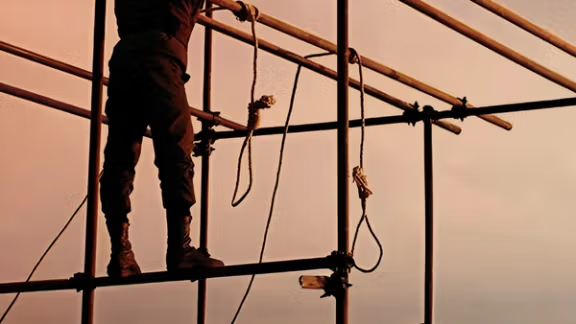
Iran executed at least 160 people in past month, rights group says
At least 160 people were executed in Iran over the past month, according to a report by the Human Rights Activists News Agency (HRANA), which warned that the pace of executions in the country is accelerating.
HRANA said the executions took place during the Iranian month of Mordad (July 23 to Aug. 22), averaging one every five hours.
It also documented 16 new death sentences and four confirmations of capital punishment, including that of jailed labor activist Sharifeh Mohammadi. Three executions were carried out in public.
The group described the surge as a grave violation of the right to life, saying executions “create a sense of insecurity and instability in society and fuel a culture of violence.” It also reported dozens of prisoners facing solitary confinement, denial of medical care, and restrictions on communication during the same period.
According to HRANA, executions over the past month rose by 54 compared with the same period last year, when 106 people were hanged.
So far this year, it said, at least 818 people, including 21 women, have been executed in Iran.
Iran is one of the few countries that continues public hangings. Earlier this month, a man convicted of murdering a mother and her three children was hanged in public in Fars province, according to the judiciary.
Rights groups including Amnesty International have raised alarm over an uptick in executions since June’s 12-day war with Israel, warning that authorities have pushed for expedited trials and punishments.
At least 975 people were executed in Iran in 2024, a 17% increase from the previous year, making it one of the world’s leading users of the death penalty, according to rights monitors.
Amnesty International accused Iranian authorities on Friday of “destroying vital evidence” of crimes against humanity by converting a section of Tehran’s main cemetery containing graves of executed dissidents into a parking lot.
“This is another grim reminder of systemic impunity for the mass executions of the 1980s,” Amnesty Iran said on X, adding that the graves in Lot 41 of Behesht-e Zahra cemetery were being bulldozed with official permission.
“By destroying them, authorities are concealing evidence of their crimes and hampering the rights to truth, justice and reparations.”
Tehran’s deputy mayor Davoud Goudarzi admitted last week that the plot had been cleared to provide parking for visitors to nearby graves, saying permission was granted by provincial authorities.
Lot 41 contains the remains of members of opposition groups, including the Mujahedin-e Khalq Organization (MEK), as well as Baha’is and others executed in the early years after the 1979 revolution.
Rights groups and families of the victims say the site is a crime scene that requires forensic preservation.
“Destruction of these graves is a serious human rights violation as it hinders future investigations into the mass executions carried out by the Islamic Republic,” Shahin Milani of the Iran Human Rights Documentation Center told Iran International this week.
Lot 41, long known as the “section of the executed” or “curse-land,” has been under tight surveillance for decades.
Authorities have previously destroyed or desecrated headstones of victims from the 1980s and of more recent unrest, including the 2022 protests.
Amnesty renewed its call for Iran to “stop the destruction and desecration of graves” and to respect families’ rights to bury their loved ones with dignity.
UN human rights experts on Thursday condemned what they called Iran’s intensifying campaign of repression against journalists working for Iran International and the intimidation of their families, particularly after the 12-day war with Israel.
“We are deeply concerned by credible threats to the lives and safety of 45 Iran International journalists and staff and 315 of their family members,” the experts said in a joint statement.
The statement comes after Iran International filed an urgent appeal earlier this month with the experts urging them to take action against Iran over serious risks to the lives and safety of their journalists worldwide and relatives inside Iran.
UN experts said several UK-based journalists have required police protection, with some forced to move into safe houses or relocate abroad.
"Reports suggest that journalists have been followed, had tracking tags attached to their cars, and their cars repeatedly broken into. Women journalists have faced threats of death and sexual violence on social media and instant messaging services, some receiving hundreds of messages a day."
The experts which included UN Special Rapporteur on the situation of human rights in Iran, Mai Sato, said the latest phase of repression had increasingly targeted family members in Iran, who have been interrogated, placed under surveillance, and threatened with arrest or death.
Interrogators allegedly demanded that relatives pressure journalists to quit Iran International or serve as informants, particularly concerning alleged ties to Israel, the statement said.
“This campaign is an attempt to silence and censor critical reporting and courageous public interest journalism by a fragile Government that appears afraid of legitimate criticism."
“Such intimidation violates both freedom of expression and media freedom and may have a chilling effect on other journalists. It also deprives the public of their right to information. Civic space in Iran is already severely limited, and transnational repression further impedes those seeking to expose human rights violations,” they added.
The UN experts urged Iran to “immediately stop threatening and intimidating journalists and their families” and to investigate all such threats, prosecute those responsible, including state officials, and prevent future violations.
Iran International is an independent Persian-language satellite TV news channel broadcasting live 24/7 from London and Washington DC.
The network started in 2017 and has become the most watched Persian-language TV channel within and outside Iran on both satellite and online platforms.
Authorities in the central Iranian city of Isfahan have begun seizing homes and assets from members of the Bahá’í religious minority by text message—an unprecedented move a community spokesperson called “economic strangulation” that has mostly targeted women.
“This is the first time we know of that the government has used text messages to order confiscations,” Farhad Sabetan, spokesperson for the Baha’i International Community (BIC) told Iran International.
“What we are witnessing is nothing less than economic strangulation of the Baha’i community—families are deprived of their livelihoods overnight, without due process, without even a court order.”
Bahais constitute the largest religious minority in Iran and have faced systematic harassment and persecution since the Islamic Revolution of 1979.
Iran does not recognize the Baha’i faith as an official religion, unlike Christianity, Judaism, or Zoroastrianism. Authorities label it a “cult” with alleged foreign ties—charges its followers reject.
The BIC said the seizures included homes, vehicles, and other assets, carried out under Article 49 of Iran’s constitution, a clause designed to reclaim property gained through illicit activities such as theft or drug trafficking. In practice, Sabetan said, it is being misused “to plunder the possessions of citizens who have committed no crime other than being Baha’i.”
According to the BIC, families were ordered by text to present themselves to court or face arrest. Some later discovered blocked bank accounts, frozen business transactions, and restrictions on selling property. In several cases, court files were not recorded in Iran’s official judicial notification system, preventing defendants and their lawyers from reviewing them.
The confiscations come as Iranian authorities step up pressure on Baha’is, accusing them without evidence of spying for Israel. While thousands of Baha’i-owned properties have been seized since the 1979 revolution, rights groups say the new reliance on digital notices reflects a more brazen, impersonal stage of repression.
Sabetan said that the majority of those targeted in Isfahan are women—many engaged in teaching and community service. “It may not be coincidental,” he said. “After the Women, Life, Freedom movement, the government has been cracking down on women broadly. Now Baha’i women are being targeted in the same way—mothers and educators denied the ability to care for their families or live normal lives.”
According to the US-based Human Rights Activists News Agency (HRANA), Baha’is account for more than 70 percent of all documented violations against religious minorities in Iran over the past three years. At least 284 Baha’is have been arrested in the past five years, receiving a combined 1,495 years in prison sentences.
“What the Iranian government is doing amounts to a gradual death sentence,” Sabetan said. “They may not execute Baha’is as they did in the early years of the revolution, but by stripping them of work, property, and dignity, they are trying to erase our community.”
A reformist-leaning Iranian Telegram channel on Wednesday published the names of 64 women it said are jailed for political reasons, challenging Iran's judiciary chief who said no more than five such detainees exist.
“This list concerns female political prisoners in Gharchak prison and a handful of other known cases. It does not cover other cities or prisons across the country,” Tahkim Mellat said in its statement, adding that the document was presented solely for civic and legal follow-up.
Qarchak Prison is a women’s facility southeast of Tehran, known for holding political prisoners in poor and overcrowded conditions, according to rights groups.
The announcement came after judiciary chief Gholamhossein Mohseni Ejei said he had asked political groups to provide names of detainees.
Ejei argued that reformist figures had admitted identifying “no more than three to five” prisoners, calling on them to announce this publicly.
Yet Tahkim Mellat countered that in Gharchak prison alone more than 60 women are held for political activity.
'No transparency'
The names include Raheleh Rahimi Pour, a 75-year-old suffering from a brain tumor, and Kobra Beigi, 70, who was excluded from a 2023 amnesty.
Several other political prisoners who face death sentences were also named including, Sharifeh Mohammadi, Pakhshan Azizi, and Varisheh Moradi.
“The demand for the release of political prisoners had previously been raised by individuals and groups within civil society as a political necessity; however, until now, the government and political parties have taken no action to recognize or pursue the rights of more than just a few political prisoners,” reads the statement by the outlet.
“This silence and lack of transparency by political officials has resulted in a large number of political prisoners remaining in detention without adequate support or attention.”
Calls for accountability
Responding last week to Ejei’s remarks, veteran reformist commentator Emadeddin Baghi said the judiciary “certainly does not need to request a list from others if it wishes to prepare a more complete and accurate one.”
Independent civic associations, if not restricted, could provide more reliable data, Baghi added.
“What matters,” Baghi said, “is to set clear criteria — such as prioritizing prisoners near the end of their sentences, those whose convictions are disproportionate, or those eligible for parole under the law — rather than debating whether the number is five or sixty.”
Tahkim Mellat said officials have a duty to respond to the list it published.
Iran’s communications minister confirmed on Wednesday that widespread disruptions to GPS and internet services were linked to “security considerations” and said raising tariffs for mobile operators had become unavoidable to sustain services.
“Disruptions in frequency bands and GPS signals are due to security concerns and the possible presence of drones,” Sattar Hashemi told reporters after a cabinet meeting, according to state media. “Naturally, this has created problems in providing services to the people. We are negotiating and working step by step to resolve them.”
Hashemi said Iran would not rely on a single technology, when asked about switching to China’s BeiDou navigation system. “We will naturally use all capacities that exist in the world. Sole reliance on one technology is not in our interest,” he said.
He also addressed mounting pressure from mobile operators to increase prices, noting that years of frozen tariffs and rising costs had left them struggling to maintain services.
“The significant increase in operating costs and wages, the higher price of imported equipment, and rising electricity bills have pushed operators to seek tariff reviews. Revising tariffs is essential for maintaining service quality and carrying out development projects,” he said.
The comments follow warnings from Irancell, Iran’s second-largest operator, that without a 70% rise in tariffs the country could face daily internet blackouts of up to three hours.
“If tariffs are not adjusted, operators will not be able to invest, and improving internet quality will be impossible,” CEO Alireza Rafiei said earlier this week, warning that internet outages could soon resemble Iran’s routine power cuts.
Iran has been grappling with deteriorating connectivity since a 12-day war with Israel in June. Internet speeds have slowed, blackouts have multiplied, and GPS interference has continued across major cities, disrupting everything from ride-hailing services and delivery apps to logistics firms and automated calls to prayer.
Ordinary Iranians say the disruptions have upended daily routines. “Even ordering food has become a pain,” a Tehran resident told Iran International. “Drivers can’t find you or show up at the wrong place. By the time it gets to you, it’s cold or your lunch break is over.”
Officials have defended the disruptions as necessary for national defense, arguing GPS jamming can prevent drones and guided missiles from hitting their targets.
“Some of the disruptions to the GPS system originate from within the country for military and security purposes,” Deputy Minister Ehsan Chitsaz said last month, adding Iran was exploring BeiDou as an alternative.
A report by Tehran’s E-Commerce Association earlier in the month ranked Iran 97th out of 100 countries for connectivity, calling its internet “unreliable, restricted and slow.” The group said more than 10 million online businesses had been damaged by systemic disruption.
Hashemi acknowledged the crisis had hurt businesses but insisted raising tariffs and diversifying technology were the only viable paths forward. “We must preserve the ability of operators to develop networks,” he said. “That requires revising tariffs and using every global capacity available.”